
Imagine a computer that does not simply run software. It contains living biological material capable of responding to electrical signals.
That is not a film plot. On 2 March 2025, an Australian company called Cortical Labs launched the CL1, which it calls the first code deployable biological computer. Inside each unit, living human neurons sit on a silicon chip. By March 2026 the company had opened a prototype “bio data centre” in Melbourne with 120 of these units. In August 2026, a 20 unit rack was switched on in Singapore with NUS Medicine and the data centre operator DayOne.
So here is the question. What if the next layer of computing infrastructure does not depend only on silicon, but also uses living cells? Wetware as a Service is the business idea built on that question. It deserves attention from researchers, business leaders and curious readers, but it also deserves careful reading. Some parts are proven. Many are not.
What Is Wetware as a Service?
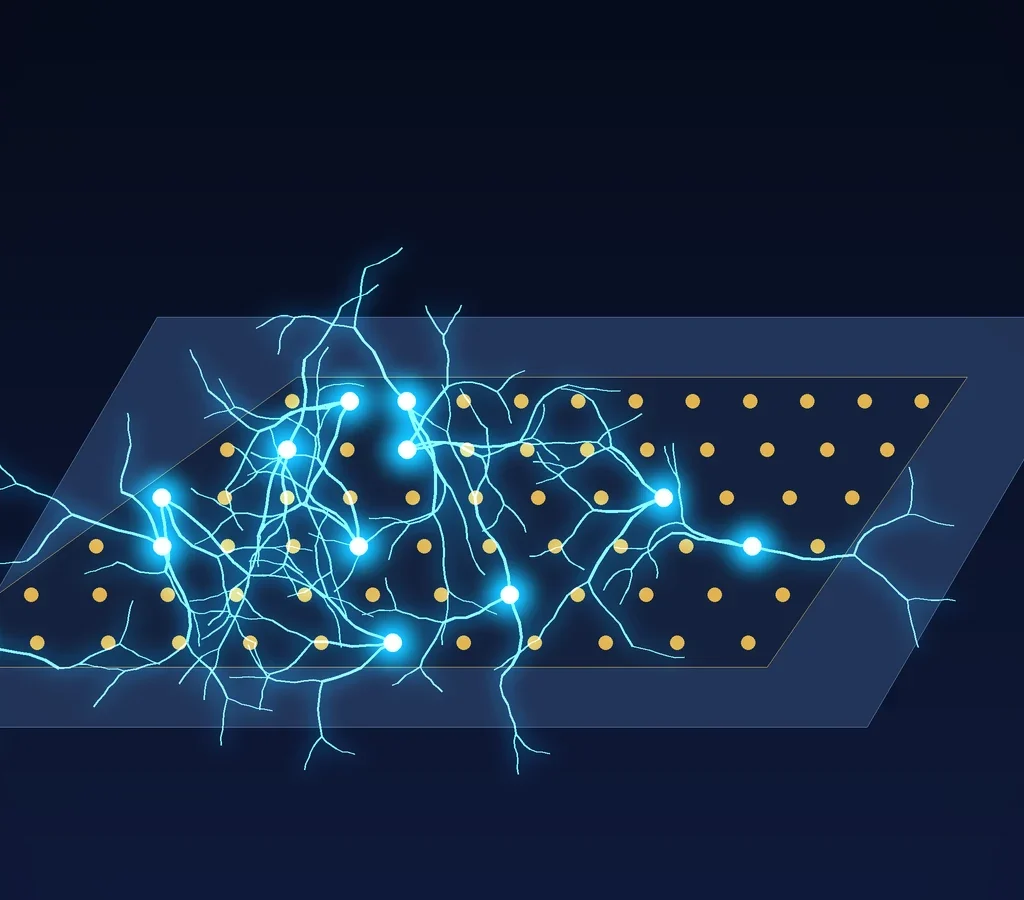
“Wetware” is a nickname for living tissue used as part of a computing system. Hardware is the machine. Software is the code. Wetware is the wet, biological part, such as neurons.
Neurons are the cells of the brain. They send tiny electrical signals, and they change their connections when they receive feedback. Scientists call this plasticity.
Wetware as a Service means renting access to such living systems through the internet, instead of owning and feeding them yourself. You send instructions. A lab or data centre keeps the cells alive, runs your experiment and sends back the results.
Wetware as a Service is an emerging model, not a mature industry. A handful of companies sell it today, mainly to researchers. Nobody can honestly say yet that it is a standard category of cloud computing.
From SaaS to Wetware as a Service
These terms sound alike, but they describe different things.
| Technology | Basic idea | What you access |
|---|---|---|
| SaaS | Use software through the internet | Code |
| HaaS | Rent hardware through a service model | Machines |
| BCI | Link a brain to an external device | A person’s own brain signals |
| Biological computing | Use biological parts to compute | Living cells doing calculation |
| Wetware as a Service | A service model built on biological computing | Living cultures, rented remotely |
The key difference is this. SaaS and HaaS rent things that never get tired or die. Wetware as a Service rents something alive. A brain computer interface reads signals from a person. Wetware computing uses cells grown in a lab, with no person attached. They are not interchangeable.
How Does This Technology Work?
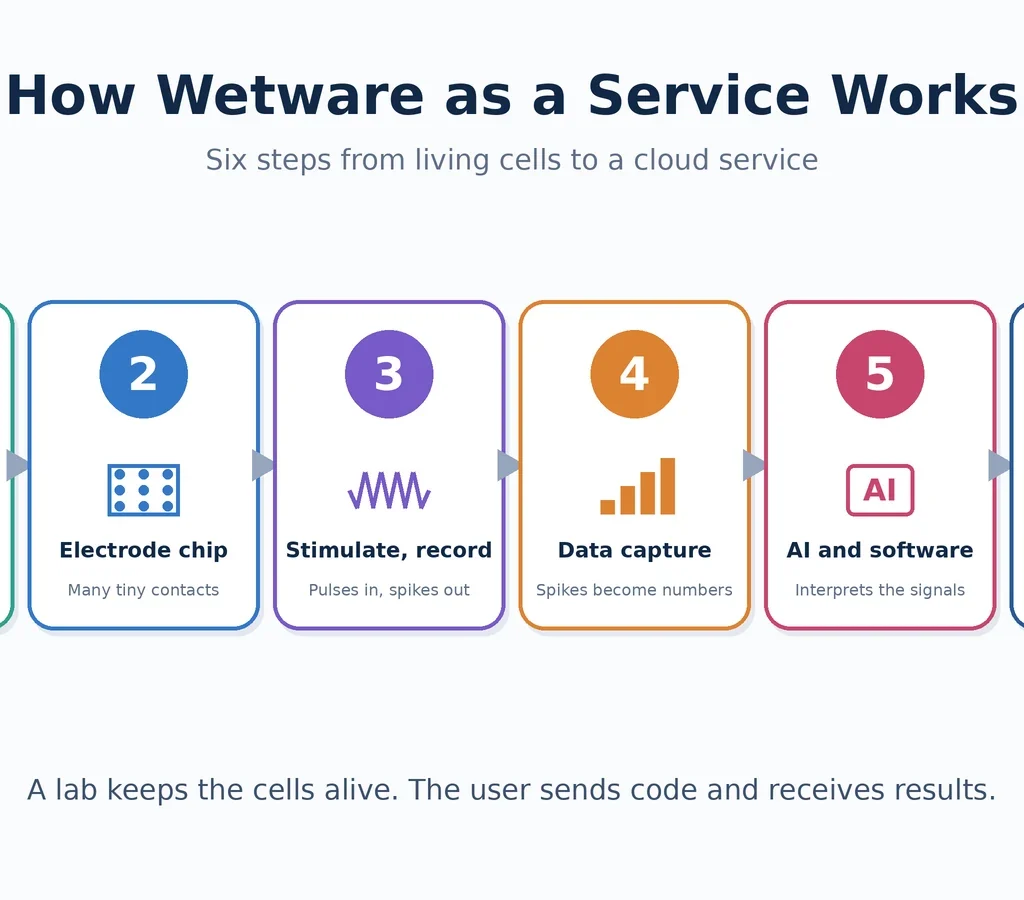
The pipeline has six steps.
- Living material. Neurons are grown from stem cells, often made from donated blood or skin cells that were reprogrammed. They form flat cultures or small 3D clumps called organoids.
- Electrodes. The cells sit on a multi electrode array, a chip with many tiny metal contacts.
- Stimulate and record. The chip sends small pulses into the cells and records the electrical spikes that come back.
- Data capture. Software turns the raw spikes into numbers.
- AI and software. Algorithms interpret the signals and decide the next pulse. This makes a feedback loop.
- Remote delivery. Users connect through a cloud interface or a programming interface, while the lab handles the biology.
An illustrative interaction: a researcher writes a short program that sends pulses to a culture, reads the response, and gives predictable feedback when the pattern matches a goal, all through a web connection.
One warning: an organoid is a small, simple clump of cells, not a human brain.
Table of Contents
The Science Behind the Revolution
Four research milestones matter most.
DishBrain (2022). In a paper in Neuron, Brett Kagan and colleagues placed about 800,000 neurons, from mouse embryos and human stem cells, on a chip and gave them a simple Pong style game. The cultures showed apparent learning within five minutes of gameplay, which control conditions did not. It showed adaptation to feedback, not human level thinking.
The organoid intelligence roadmap (2023). A Johns Hopkins led team published a plan in Frontiers in Science. It proposed organoid intelligence as a field, and it stressed that today’s organoids are tiny. Lead author Thomas Hartung said a system with the brainpower of a mouse could take decades. Ethics was part of the plan from day one, and a companion Baltimore declaration addressed it directly.
Brainoware (2023). Researchers at Indiana University Bloomington mounted a brain organoid on a chip and used it as a “reservoir” in Nature Electronics. In a speech test with 240 audio clips of Japanese vowels, accuracy rose from about 51% to about 78% after training. That is progress, but far below what ordinary software achieves. Other scientists urged caution, noting that organoids do not “hear” speech, they only react to electrical input.
FinalSpark Neuroplatform (2024). A Swiss company described a remotely accessible system in Frontiers in Artificial Intelligence. Over three years it had used more than 1,000 brain organoids and collected over 18 terabytes of data, with some organoids living beyond 100 days. It is research infrastructure, not a finished product.
Together these show that living neurons can be wired to chips, can respond to feedback, and can be accessed remotely. They do not show that biology beats silicon at useful, everyday tasks.
Real World Applications and Business Opportunities
Most value from Wetware as a Service today sits in research, not in replacing computers.
Drug discovery. Neurons can show how a drug changes electrical activity. Cortical Labs has reported an epilepsy model where treated cultures regained learning capacity after antiepileptic drugs. Limit: results from cultures may not transfer to people. Potential: faster early screening.
Disease modelling. Organoids made from patient cells can reflect a person’s biology. Johns Hopkins researchers have discussed comparing organoids from typical donors and from donors with autism. Limit: organoids are immature and varied. Potential: more personal medicine.
Neural signal analysis. AI can find patterns in spike data. Limit: the neural code is not fully understood.
Computing research. Brainoware and DishBrain test new ways to compute. Limit: small scale, low accuracy. Potential: low power learning systems, though this is unproven.
Research infrastructure. Few labs can run living cultures. Renting access removes that barrier. This is the strongest case for the service model.
Experimental systems are not replacing conventional computers.
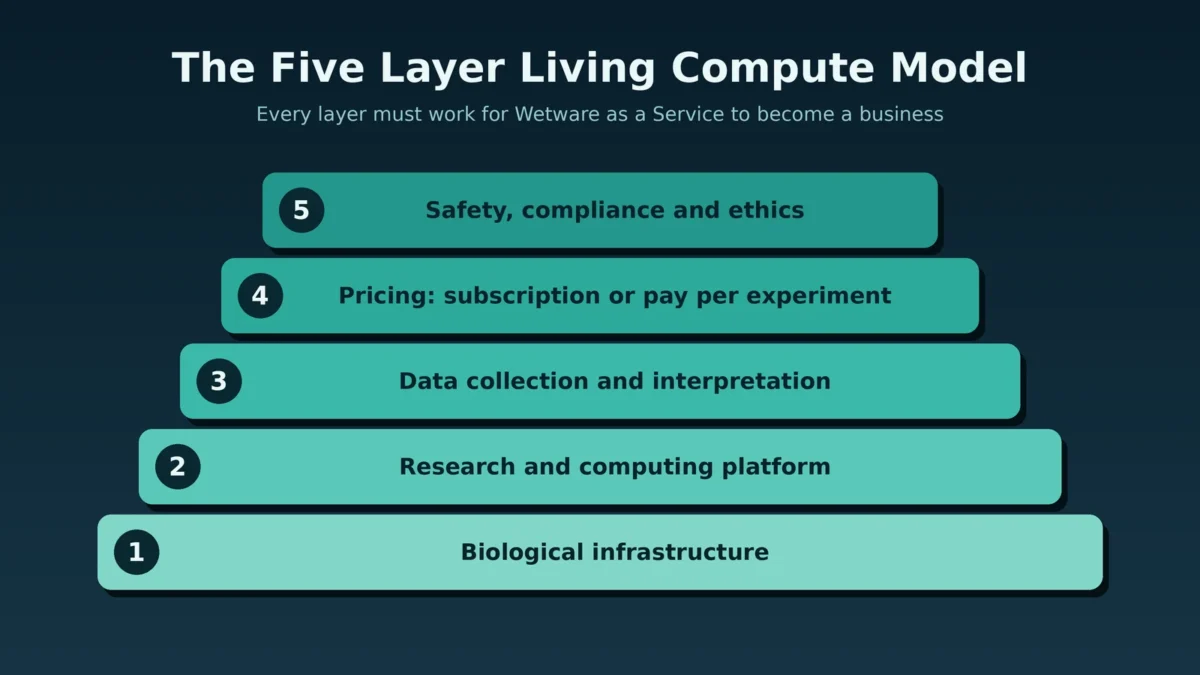
A Practical Business Framework: The Five Layer Living Compute Model
Here is an original way to judge whether Wetware as a Service can become a business. Each layer must work, or the whole stack fails.
- Biological infrastructure. Cell sourcing, culture, life support and replacement. Cortical Labs says its units keep neurons viable for up to six months, so cells must be renewed constantly.
- Research and computing platform. Electrodes, control software and interfaces. Cortical Labs released a public programming interface in February 2026 so developers can talk to the cells.
- Data and interpretation. Raw spikes mean little. The value lies in turning them into clear, repeatable results.
- Pricing. Options include a subscription, pay per experiment, or an enterprise contract. Reports in 2025 put Cortical Cloud at about $300 per week per unit and the CL1 hardware at $35,000. Check current prices before quoting them.
- Safety, compliance and ethics. Rules on human derived cells, donor consent, biosafety and data privacy. Singapore’s pilot is described as a place to test governance, biosafety and compliance before scaling.
Customers: pharmaceutical teams, university labs, neurotechnology startups and AI researchers. Costs: life support, skilled biologists, cell replacement and quality control. Barriers: reliability and repeatable results. Scalability: each culture is grown, not copied, so scaling is slow compared with adding servers.
Hypothetical example (illustrative, not a real company)
Imagine “NeuroLeaf Labs”, a small drug screening startup. It wants to test whether a compound restores normal activity in neurons modelled on epilepsy. Building its own lab would cost far more than it can afford. So it rents four units on a cloud service for 12 weeks. At a reported $300 per unit per week, the rental would be about $14,400 before staff costs. It runs the same protocol on each unit, compares results and decides which compounds deserve animal testing. Illustrative numbers built from a reported list price, not a case study.
Advantages and Limitations
Potential advantages
- A different way to process information, based on learning cells.
- New tools for neuroscience and disease research.
- Novel drug screening methods.
- Hybrid biological and digital computing.
- Research infrastructure that small labs can afford.
Major limitations
- Living systems need constant care and eventually die.
- Results can vary between cultures, which hurts reproducibility.
- Scaling is slow.
- Ethical questions about human derived neural tissue.
- Privacy and security of biological and experimental data.
- Unclear regulation.
- High research and running costs.
A fair note on energy. Cortical Labs says each CL1 uses about 25 watts and a full rack 800 to 1,000 watts. That is small. But as The Next Web pointed out, the announcement gave no benchmark or work done per watt, and the wattage includes pumps and temperature control that keep cells alive. Low power only matters if the machine does useful work. FinalSpark’s claim of a million times less energy than digital chips is also a company claim, not an independently proven result.
The Biggest Misconception About Wetware
Wetware as a Service does not mean an artificial human brain in the cloud, though many readers imagine one.
A cultured network has a few hundred thousand neurons. Reports differ on the exact number per CL1 unit, from about 200,000 to 800,000. A human brain has around 86 billion. Brain computer interfaces read a real person’s brain. Organoid research studies lab grown tissue. Commercial AI services such as chatbots run on silicon. These are four different things.
Today, living neurons are best seen as a research instrument with computing potential.
What Could the Future Look Like?
Established: remote access to living cultures exists, and a few small racks are running. Informed prediction: for the next five to ten years, Wetware as a Service will likely stay research focused.
What could speed things up: longer lived cultures, better stimulation methods, standard protocols and independent benchmarks that show clear advantages on specific tasks.
What could slow things down: cost, variability, regulation and public concern about human derived tissue.
AI’s role: machine learning is probably the best tool for reading biological signals, so the two fields will grow together.
Partnerships: expect tie ups between biotech firms, universities and data centre operators, like the Singapore pilot.
Could Wetware as a Service become a real market? Possibly, starting with drug discovery and neuroscience tools. A broad computing market is far less certain.
What Should Businesses and Readers Do Next?
- Follow peer reviewed research on Wetware as a Service, not press releases alone.
- Watch organoid intelligence and biocomputing journals.
- Track rules on human derived cells and neural data.
- Ask for benchmarks and independent replication before believing any claim.
- Look for real research uses, such as screening or disease modelling.
- Avoid hype. Be sceptical of pitches that promise to replace silicon soon.
FAQ section
What is Wetware as a Service? It is a model where users rent remote access to living biological material, usually neurons on chips, to run experiments or computations. It is an emerging concept, mostly used by researchers today.
How is wetware different from software? Software is code that runs on machines. Wetware is living tissue that responds to electrical signals and changes with experience. It needs food, warmth and constant care.
Can living neurons perform computing tasks? In small, controlled tests, yes. Neurons on chips have adapted to feedback in a game and handled basic speech and math tasks, but they do not match conventional computers on everyday work.
What is the relationship between wetware and brain computer interfaces? A brain computer interface connects a person’s own brain to a device. Wetware computing uses lab grown cells with no person attached. They share electrode technology but have different goals.
Is Wetware as a Service commercially available? Yes, in a limited form. Cortical Labs offers Cortical Cloud, and FinalSpark gives remote access to organoids. Customers are mainly researchers and companies exploring early applications.
Can biological computing replace silicon chips? Not today. It may complement silicon for special tasks, but no independent evidence shows it can replace chips for general computing.
What are the ethical risks of biological computing? Key concerns include donor consent, the use of human derived neural tissue, how to treat more complex cultures as they grow, and data privacy. Researchers have called for ethics to be built in from the start.
What is the future of Wetware as a Service? Most likely, growth in drug discovery and neuroscience research first. Wider computing use depends on proven benchmarks, lower costs and clear regulation.
Conclusion: Intelligence Beyond Silicon?
Could the future of computing combine silicon intelligence with biological intelligence? The evidence says it is possible, but early. Living neurons have learned to play Pong, recognise simple speech patterns and run in small racks across two countries.
Wetware as a Service may become a real way to rent biology the way we rent servers today. The test is simple. Does it produce useful, repeatable work that silicon cannot do as cheaply? Until independent results answer that, the sensible position is curiosity with a firm grip on the evidence.