
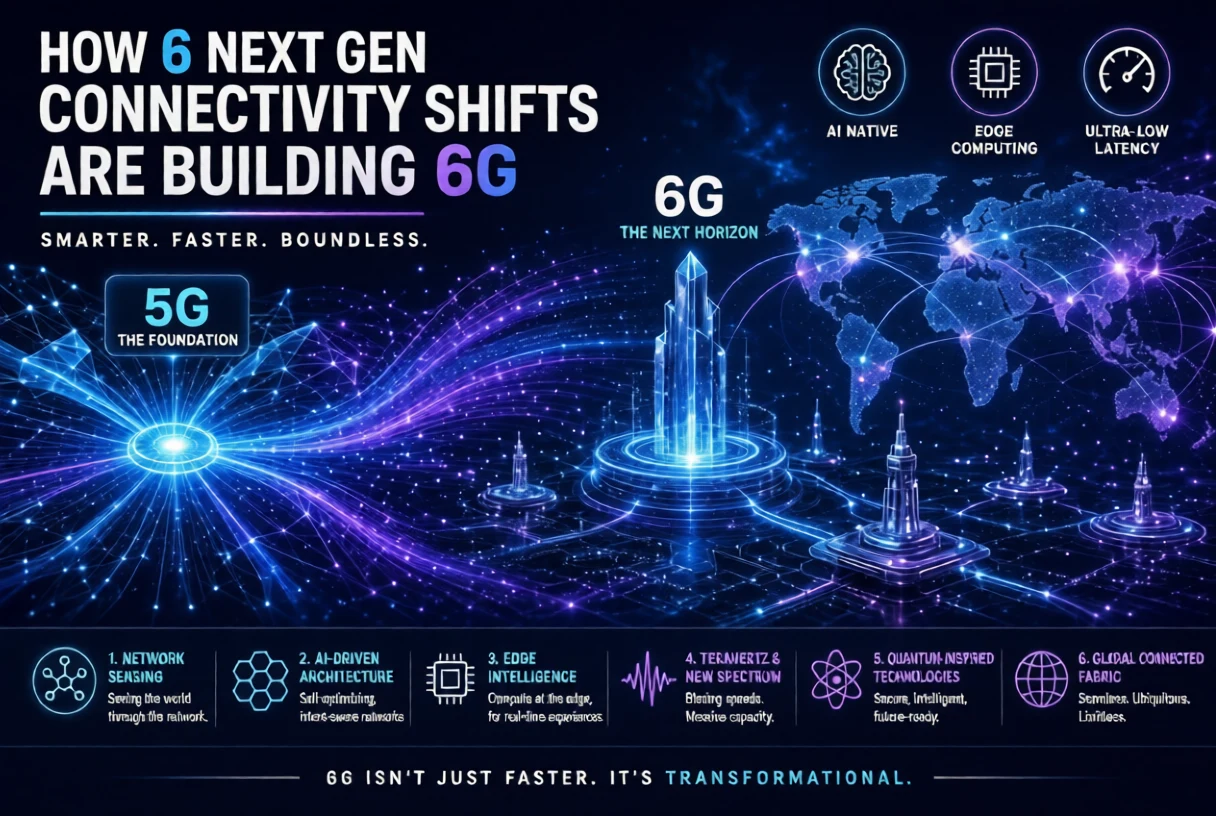
Picture a network engineer on a quiet night shift somewhere in Asia, watching a dashboard behave in a way dashboards are not supposed to behave. Traffic that should be dropping at 2 a.m. is being rerouted before it even spikes. Cells that should be running at full power are dimming themselves in patterns no human scheduled. Nothing is broken. If anything, the network is working better than it ever has.
This is a hypothetical scene, but it is not a fictional one. It reflects something genuinely happening inside networks right now: systems that used to simply move data are starting to predict it, optimize around it and quietly coordinate themselves. That shift is the real story behind Next Gen Connectivity, and most people will not notice it until it is already normal.
Here is the uncomfortable part. While operators are still finishing the rollout of 4G’s successor, engineers, standards bodies and chipmakers are already laying groundwork for whatever comes after 5G. Something enormous is underway in telecommunications, and it has almost nothing to do with faster download speeds.
Table of Contents
5G Advanced Is Not a Rebrand, It Is a Rebuild
It is easy to assume 5G Advanced is just marketing polish on a network you already have. It is not. Defined through 3GPP Release 18, which was functionally frozen in mid 2024, 5G Advanced represents a deliberate mid cycle overhaul that goes well beyond the early 5G deployments most people are still using. According to 3GPP, the standards body behind the specification, Release 18 reached a stable, frozen state in June 2024, giving equipment makers a firm foundation to build on.
The differences are structural, not cosmetic. Release 18 introduces artificial intelligence directly into the radio interface itself, using machine learning models for predictive beam management that can reduce signaling overhead by roughly 75 percent, along with a lighter connectivity class built for sensors and wearables that cuts device complexity down to about a quarter of a full 5G modem, opening the door to billions of internet of things devices. Equipment vendors have already moved from paper to hardware. Ericsson, Nokia and Huawei have shipped base stations capable of these features, and Qualcomm’s newest flagship modem already supports the full Release 18 feature set in phones sold this year.
Then there is the part almost nobody outside the industry talks about: energy. Field trials at major operators, including Deutsche Telekom and China Mobile, have already demonstrated more than 20 percent reductions in radio access network power draw, a number that matters far more to an operator’s bottom line than most consumers realize.
None of this is speculative. It is being deployed, measured and refined right now.
Why 6G Research Already Started, Even Though 5G Isn’t Finished
Here is where the story turns strange. 3GPP is not waiting for 5G Advanced to finish before thinking about what replaces it. Release 20, the final release focused purely on 5G Advanced, is running an eighteen month roadmap through 2026 and 2027 while deliberately reserving enough working capacity for early 6G studies to proceed in parallel.
That is not impatience. It is how telecommunications infrastructure has always worked, because building a global wireless network takes a decade of coordination, spectrum negotiation and hardware manufacturing. The International Telecommunication Union has been formalizing what it calls IMT 2030, the technical foundation for 6G, since 2023, built around four guiding principles: sustainability, security and resilience, connecting the unconnected and what the ITU calls ubiquitous intelligence.
That timeline is not a rumor. The ITU laid out three formal stages for 6G: a vision defined by 2023, requirements and evaluation methodology completed in 2026, and full technical specifications targeted for 2030. In February 2026, the relevant ITU working group reached agreement on the minimum technical performance requirements for IMT 2030, with formal approval expected by the end of the year. Vendors are already framing the relationship plainly. Ericsson, Huawei and Nokia all treat 5G Advanced as the direct foundation for 6G, with the first concrete 6G specifications expected around 2027 to 2028 under Release 21, and commercial availability targeted for roughly 2030.
This is the part most people overlook: 6G is not a leap into the unknown. It is being built, brick by regulatory brick, on top of a network that is still expanding.
The Building Blocks of Next Gen Connectivity
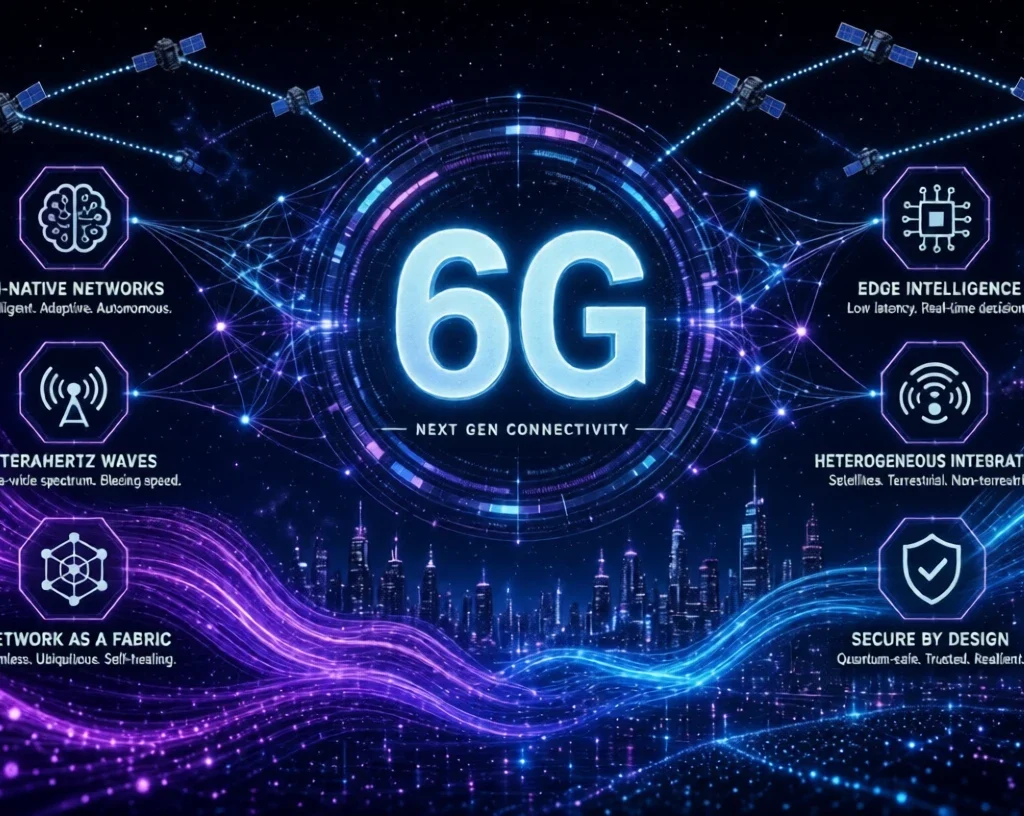
Several technologies are converging to define what Next Gen Connectivity could eventually look like. Some are already live. Others remain firmly experimental.
Networks that manage themselves. Artificial intelligence is moving from a tool operators use to analyze networks into a system embedded inside the network’s own decision making, adjusting power, capacity and routing in near real time.
Edge computing. Processing data closer to where it is generated, rather than shipping everything to a distant data center, is already reducing latency for applications like industrial automation and cloud gaming.
Satellite connectivity. Non terrestrial networks, meaning direct links between phones and orbiting satellites, are moving from novelty to standard feature. The World Radiocommunication Conference in 2023 identified specific frequency ranges, including bands around 4.4 to 4.8 GHz, 7.1 to 8.4 GHz and 14.8 to 15.35 GHz, for further study as candidates for future mobile use, with satellite access improvements explicitly on the Release 20 roadmap.
Massive machine connectivity. Reduced complexity devices are quietly preparing networks to support an enormous population of low power sensors across agriculture, logistics and utilities.
Immersive communication and digital twins. Applications that mirror physical environments in real time, useful for manufacturing and remote operations, remain largely experimental but are guiding early 6G research priorities.
Advanced spectrum and sensing. Researchers are studying whether future networks can sense their physical environment, not just carry data through it. This remains one of the more speculative frontiers of 6G work.
What This Means for Ordinary People and Businesses
For most consumers, the near term impact of 5G Advanced will be felt rather than announced: steadier connections in crowded stadiums, better indoor coverage, longer device battery life thanks to smarter power management. Nobody will wake up to a press release. They will just notice their phone stops struggling in places it used to struggle.
Businesses stand to gain more directly. Lower latency and AI managed networks open real opportunities in manufacturing, logistics and remote operations, where reliability and response time translate straight into cost savings. Early field evidence backs this up. In August 2026, SoftBank and Ericsson tested an AI native network scheduler on a live commercial network and measured roughly 25 percent higher spectral efficiency and close to 50 percent higher download throughput compared with conventional scheduling. The economics are becoming harder to ignore. GSMA research indicates network energy typically accounts for 15 to 20 percent of an operator’s operating expenses, and average energy intensity across the operators it studied fell by roughly 15 percent per year between 2019 and 2025.
Case Study: How KDDI Cut Radio Network Power Use Without Cutting Performance
The problem was straightforward but costly. KDDI, Japan’s second largest mobile operator with more than 60 million subscribers, had committed under its own Green Plan to cut carbon emissions by fifty percent by 2030 compared with 2019 levels, and a large share of that reduction had to come from the power consumed by its base stations around the clock, whether traffic was heavy or nearly silent.
The technology used was Nokia’s AVA for Energy Efficiency, an AI system layered over existing radio equipment. Rather than switching cells off and on using fixed schedules, the way older energy saving tools do, the system continuously analyzes real traffic patterns across neighboring cells and predicts precisely when radio resources can be safely powered down.
KDDI trialed it as Japan’s first AI controlled radio access network, and the results were measurable rather than promotional. On average, KDDI reduced power consumption by up to fifty percent in low traffic environments and by up to twenty percent per cell overall, with no degradation in network performance and no service alarms triggered during the trial. The entire project, including building the data pipeline the AI relied on, took only four weeks to set up.
What it tells us about Next Gen Connectivity is simple and important: the intelligence layer being tested today for energy savings is a direct preview of the kind of self managing network behavior that 6G research assumes will exist by default. This was not a laboratory simulation. It was a live commercial network quietly learning to run itself more efficiently, and the results held up under real world evidence.
The Risks Nobody Likes to Mention
Not everyone in the industry is convinced the AI native vision of future networks is guaranteed to work economically. Some telecom engineers have openly questioned whether operators have a clear financial case for expanding AI heavy radio infrastructure, since doing so could mean spending more on hardware and energy at the same time AI is supposed to be saving both. That skepticism is worth taking seriously rather than dismissing as caution from people who dislike change.
Other challenges are less about economics and more about coordination. Spectrum policy differs by country and requires years of negotiation through bodies like the ITU and regional regulators. Interoperability across vendors depends on standards being finalized on schedule. Cybersecurity risk grows as networks become more autonomous and more deeply integrated with artificial intelligence, since a compromised optimization system could do far more damage than a compromised individual device. And the infrastructure investment required from operators, many of whom are still paying off 5G rollout costs, is substantial.
None of these challenges are fatal. But they are the reason serious industry analysis treats 6G as a long, carefully governed transition rather than a switch someone flips in 2030.
The Road Ahead
The realistic timeline looks something like this. Through 2026 and 2027, expect continued 5G Advanced deployment alongside refinement of 6G use cases and requirements. Around 2027 to 2028, the first concrete 6G technical specifications are expected to emerge. Commercial 6G systems, if the current trajectory holds, are targeted for roughly 2030, with early pilots likely appearing in select markets before then.
Every one of those dates depends on spectrum agreements, chipset readiness and standards work proceeding on schedule, none of which is guaranteed. Evidence based forecasting means acknowledging that plainly rather than promising certainty the industry itself does not claim.
Conclusion
The network engineer in that opening scene was not witnessing science fiction. They were watching an ordinary night shift inside a system that is already learning to think for itself, one prediction and one power adjustment at a time. That is the real shape of Next Gen Connectivity right now: not a dramatic leap, but a steady, well documented, occasionally contested transformation happening inside infrastructure most people never think about until it fails.
It is not arriving in 2030. It is already underway.
Frequently Asked Questions
What is 5G Advanced? 5G Advanced is the industry name for 3GPP Release 18 and Release 19, a major mid cycle upgrade to 5G that adds artificial intelligence into network operations, better support for small connected devices and improved energy efficiency, rather than representing an entirely new generation of wireless technology.
How is 5G Advanced different from early 5G? Early 5G, covered by Releases 15 through 17, focused mainly on faster speeds and broader coverage. 5G Advanced adds intelligence at the network level, including AI assisted radio management, reduced complexity devices for massive IoT, and measurable power savings that earlier releases did not include.
Why has 6G research started so early, while 5G is still expanding? Because building global wireless infrastructure takes roughly a decade from early research to commercial deployment. Standards bodies like the ITU and 3GPP run 6G groundwork in parallel with 5G Advanced specifically so the industry is not starting from zero once 5G reaches its limits.
When could 6G networks become commercially relevant? Based on current 3GPP and ITU planning, the first formal 6G specifications are expected around 2027 to 2028, with commercial availability targeted for roughly 2030. These dates are planning targets, not guarantees, and depend on spectrum and standards decisions still in progress.
How will artificial intelligence influence future networks? AI is already being used to predict traffic, manage energy consumption and optimize radio performance in live 5G Advanced networks. In 6G research, AI is expected to become a built in part of how networks operate, rather than an add on tool.
Will 6G replace 5G immediately once it launches? No. Every previous mobile generation has coexisted with its predecessor for years after launch. 5G Advanced networks are expected to remain the backbone of global connectivity well into the early years of any 6G rollout.
How could Next Gen Connectivity affect businesses? Lower latency, AI managed networks and improved reliability could benefit manufacturing, logistics, healthcare and remote operations directly, though the scale of benefit will vary by industry and depends on continued infrastructure investment.
What challenges could slow down 6G adoption? Spectrum policy negotiation, interoperability between vendors, cybersecurity risk in more autonomous networks, unresolved questions about the economics of AI heavy infrastructure, and the sheer cost of new infrastructure investment are all realistic obstacles that industry analysts continue to debate.