
It is 7:15 AM on a Tuesday, and your phone is already buzzing nonstop. Overnight, a major regulatory shift just invalidated your primary distribution model. Three key clients are demanding answers before noon. Your operations lead is asking whether to freeze vendor payments, and two senior engineers have requested urgent private calls because rumors of layoffs are spreading through the team chat. You open your quarterly strategic plan, and every page feels obsolete. There is no playbook for this exact scenario, the data on the table is incomplete, and waiting until Friday to decide means watching the business bleed.
When everything becomes uncertain, what should guide your next decision?
Most managers are trained to rely on detailed forecasts, established procedures, and proven tactics. Those tools work remarkably well when the business environment is stable. Yet when markets shift overnight or crises strike without warning, conventional plans collapse. In a time of ambiguity, sound principles serve as the inner compass that keeps leaders steady, protects organizational trust, and turns confusion into purposeful action.
Table of Contents
What Management Principles Actually Mean
In everyday workplace conversation, people often treat principles like vague motivational slogans framed on a lobby wall. In reality, a management principle is a fundamental truth or core standard of conduct that guides judgment when exact instructions do not exist.
A practical distinction is how principles operate compared to plans. A plan tells you what steps to take assuming conditions stay predictable. A principle tells you how to think and behave when those conditions disappear.
For example, consider a customer support team facing a sudden software outage. A standard procedure might say, “Offer a 10% discount code for delays over two hours.” What happens if the outage lasts three days and affects enterprise clients differently than individual users? The rule breaks down. However, if the company operates on the principle of radical transparency and fair restitution, the manager immediately knows what to do: communicate honestly before customers ask, acknowledge the real impact, and tailor compensation to actual disruption.
Why Ambiguity Differs From Ordinary Uncertainty
People often use uncertainty and ambiguity as if they mean the same thing, but leaders face two very different challenges:
- Uncertainty means you know the possible outcomes, even if you do not know which one will happen. Launching a new product carries uncertainty; it might sell well or poorly, and you can calculate those odds.
- Ambiguity means the situation itself is unclear, fragmented, and open to multiple interpretations. You do not even have all the variables yet, and old cause and effect patterns no longer apply.
In a time of ambiguity, gathering more data rarely solves the problem immediately because the facts are still shifting. Principles help you separate what is merely urgent from what is truly important. Urgent tasks scream for attention, such as replying to an angry email or rushing out a half baked press release. Important decisions protect long term viability, safety, and credibility. Core values act as a filter so you do not sacrifice long term trust to solve a short term panic.
Principles vs. Rules, Policies, Strategies, and Beliefs
Clear thinking requires separating concepts that often get tangled together in management discussions.
- Principles: Broad, enduring standards of judgment (for example, “Protect customer safety above short term revenue”). They require active human reasoning.
- Rules: Specific, mandatory instructions designed for predictable situations (for example, “All expense reports require receipts”).
- Policies: Formal organizational guidelines that translate principles and legal requirements into standard operational boundaries (for example, data privacy protocols).
- Strategies: Chosen paths or competitive approaches designed to achieve specific goals within a defined timeframe (for example, expanding into regional markets). Strategies change as markets evolve.
- Personal Beliefs: Individual convictions shaped by upbringing or worldview. While personal integrity matters, organizational principles must be shared and agreed upon so an entire team pulls in the same direction.
Managing by Fixed Rules vs. Sound Principles
Relying purely on rigid rules creates a fragile organization, while relying purely on loose ideals without structure creates chaos. Understanding where each approach works best helps leaders balance consistency with flexibility.
| Dimension | Managing Through Fixed Rules | Managing Through Sound Principles |
| Primary Strength | Ensures compliance, speed, and uniformity in routine tasks. | Enables sound judgment and adaptability in unfamiliar crises. |
| Main Limitation | Fails or creates paralysis when an unexpected situation arises. | Requires mature critical thinking and clear shared understanding. |
| Employee Mindset | Focuses on following steps and avoiding blame. | Focuses on ownership, problem solving, and ethical outcomes. |
| Response to Change | Slow, because every rule must be rewritten from the top. | Fast, because teams apply existing values to new realities. |
One important limitation is that principles are never an excuse to ignore laws, safety regulations, financial controls, or professional accountability. High performing organizations use strict rules for compliance and safety, while empowering people with clear principles for complex decision making.
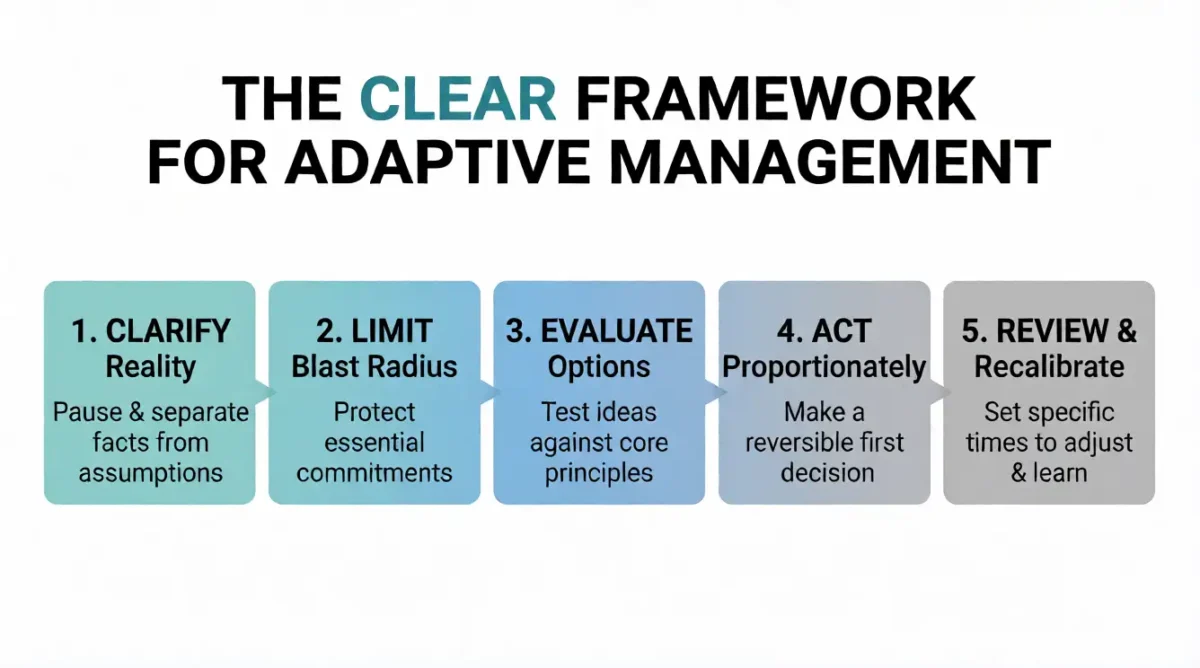
The CLEAR Framework for Adaptive Management
When pressure mounts, human brains naturally rush toward either panic or stubbornness. To make steady decisions in a time of ambiguity, leaders can use the CLEAR Framework:
- Clarify Reality (Pause and Separate): Stop reacting for fifteen minutes. Write down what you know for certain, what is merely an assumption, and what information is missing. Naming the unknown reduces emotional panic.
- Limit the Blast Radius (Protect Essentials): Identify the people, safety standards, and core commitments that must not be compromised. Decide what you will not sacrifice under pressure.
- Evaluate Options Through Principles: Generate two or three realistic next steps. Test each option against your core management principles rather than asking which option feels easiest right now.
- Act Proportionately: Make a reversible decision first whenever possible. Communicate clearly to your team what you are doing, why you are doing it, and when you will share the next update.
- Review and Recalibrate: Set a specific time within 24 to 72 hours to examine incoming evidence. Accountability remains essential; if new facts show your first move missed the mark, adjust quickly without defensiveness.
Real World Illustration: Two Responses to a Supply Crisis
Consider a realistic composite scenario based on common supply chain disruptions faced by mid sized manufacturers. Imagine a regional medical packaging company whose primary raw material supplier suddenly halts shipments due to an unexpected plant shutdown. Inventory will run out in ten days, hospital clients are waiting on orders, and floor staff are anxious about unpaid downtime.
Manager A reacts out of fear of looking weak. To buy time, this manager tells staff that everything is under control, avoids updating hospital clients until shipments are actually late, and rushes to sign a high cost contract with an unvetted broker without checking quality standards. Within two weeks, defective materials arrive, clients discover the hidden delay, and key employees lose faith in leadership honesty.
Manager B applies principle based leadership. Within hours, this manager gathers team leads, shares the exact inventory timeline honestly, and commits to protecting staff pay during the transition. Manager B contacts hospital clients immediately to explain the disruption and prioritizes shipments for urgent surgical supplies first. The team collaborates to qualify a secondary supplier using strict safety checks. While deliveries still face minor delays, clients appreciate the candor, employees rally to solve bottlenecks, and the company emerges with stronger relationships.

Expert Interpretation: Why Principles Drive Performance
Research into organizational behavior consistently shows that employee confidence does not come from leaders pretending to have every answer. Rather, confidence grows when teams trust how their leaders make decisions. According to Harvard Business School professor Sandra J. Sucher and researcher David M. Bersoff, writing in Harvard Business Review (2025), organizations that maintain a trust building orientation during turbulent periods not only achieve better stability during the crisis, they recover faster afterward because stakeholders remain committed.
A principle driven leader stays firm on core values while remaining flexible in methods. This does not necessarily mean every decision will succeed. Markets can still turn against a well run company. However, principled leadership prevents self inflicted damage, reduces internal politics, and encourages psychological safety so frontline workers report problems early instead of hiding them.
What the Evidence Indicates About Ambiguity and AI
The rise of artificial intelligence makes human principles even more critical. In a 2026 research briefing published by MIT Sloan Management Review, researchers Ina M. Sebastian and Peter Weill introduced the AI Decision Matrix, emphasizing that while automated systems handle routine, low ambiguity tasks well, high ambiguity and high risk situations require firm human oversight. Algorithms optimize for past patterns, which is precisely what breaks down during unprecedented change. Human leaders must supply ethical judgment, contextual empathy, and accountability when data cannot dictate the right trade off.
Advantages and Limitations of Principle Based Leadership
Key Advantages:
- Consistent Judgment: Teams can predict how leadership will respond even in brand new scenarios.
- Faster Execution: Employees do not need to wait for micromanagement when they understand the guiding boundaries.
- Stronger Organizational Resilience: Shared values hold teams together when external structures shift.
Important Limitations:
- Interpretation Gaps: Two managers might interpret “customer first” differently unless leaders discuss concrete examples beforehand.
- Principle Overload: Listing twelve corporate values creates confusion; three to five clear principles work far better.
- Rigidity Trap: Clinging to an outdated business tradition under the disguise of “principle” can block necessary innovation.
Four Common Misconceptions
- “Principles mean never changing your mind.” In real workplace situations, principles govern standards, not tactics. Changing a failing strategy based on new evidence shows wisdom, not weakness.
- “Good leaders always know the right answer.” In a complex crisis, nobody has complete foresight. Great leaders know which questions to ask and which lines they will not cross.
- “More rules will eliminate ambiguity.” Adding bureaucracy during a fast moving crisis slows down response times and encourages people to hide behind checklists instead of using common sense.
- “Having good intentions guarantees good outcomes.” Principles must be paired with rigorous evidence, operational discipline, and honest feedback.
Applying Principles Across Modern Workplaces
- Small Businesses and Startups: When cash is tight and roles overlap, principles like speed with transparency prevent founders from making desperate promises to investors or customers.
- Remote and Distributed Teams: Without hallway conversations, clear principles around asynchronous communication and outcome ownership keep teams aligned across time zones.
- Technology and AI Driven Workplaces: When deploying AI tools in hiring or customer service, principles of fairness and human accountability ensure teams audit automated outputs rather than blindly trusting software.
- Personal Career Decisions: When facing layoffs or industry shifts, personal principles such as continuous learning and integrity help professionals choose roles based on long term growth rather than short term panic.
Five Questions to Ask Before Your Next Tough Decision
Before committing to a major move in an uncertain situation, pause and ask yourself:
- What are the verified facts right now, and what am I merely assuming?
- Who will carry the biggest risk if this decision goes wrong, and have I considered their perspective?
- If this decision were explained publicly to my team and customers tomorrow, could I defend its fairness?
- Am I choosing this option because it is genuinely right, or simply because it relieves my immediate anxiety?
- What specific signal will tell me within a week that this decision should be reviewed or reversed?
Frequently Asked Questions
1. What does a time of ambiguity mean in management?
It refers to a period when information is incomplete, past patterns no longer predict future results, and situations can be interpreted in multiple ways, making standard plans unreliable.
2. Why are management principles important during uncertainty?
They provide a consistent moral and strategic compass, helping leaders and employees make coherent decisions without waiting for step by step instructions.
3. How are principles different from rules?
Rules dictate specific actions for predictable situations, while principles offer broad standards of judgment that guide behavior when rules do not cover a new problem.
4. How can managers make decisions with incomplete information?
By separating facts from assumptions, protecting essential commitments, taking smaller reversible steps, and reviewing results frequently as new data emerges.
5. Can strong principles make an organization more adaptable?
Yes. When people understand the core boundaries they must respect, they feel safer experimenting and solving problems quickly on the front lines.
6. How can employees apply principle based thinking in their careers?
Employees can define three or four core professional standards—such as reliability, honest communication, and curiosity—and use them to evaluate job offers, resolve conflicts, and handle workplace change.
Moving Forward With Clarity
No management philosophy can eliminate the discomfort of stepping into the unknown. Markets will continue to shift, technologies will reshape industries, and unexpected disruptions will test every organization. Yet a time of ambiguity does not have to produce paralysis or reckless shortcuts. When leaders anchor their thinking in clear, ethical, and practical principles, they give their teams something far more valuable than a rigid map: they give them the judgment, trust, and steadiness needed to navigate whatever comes next.