
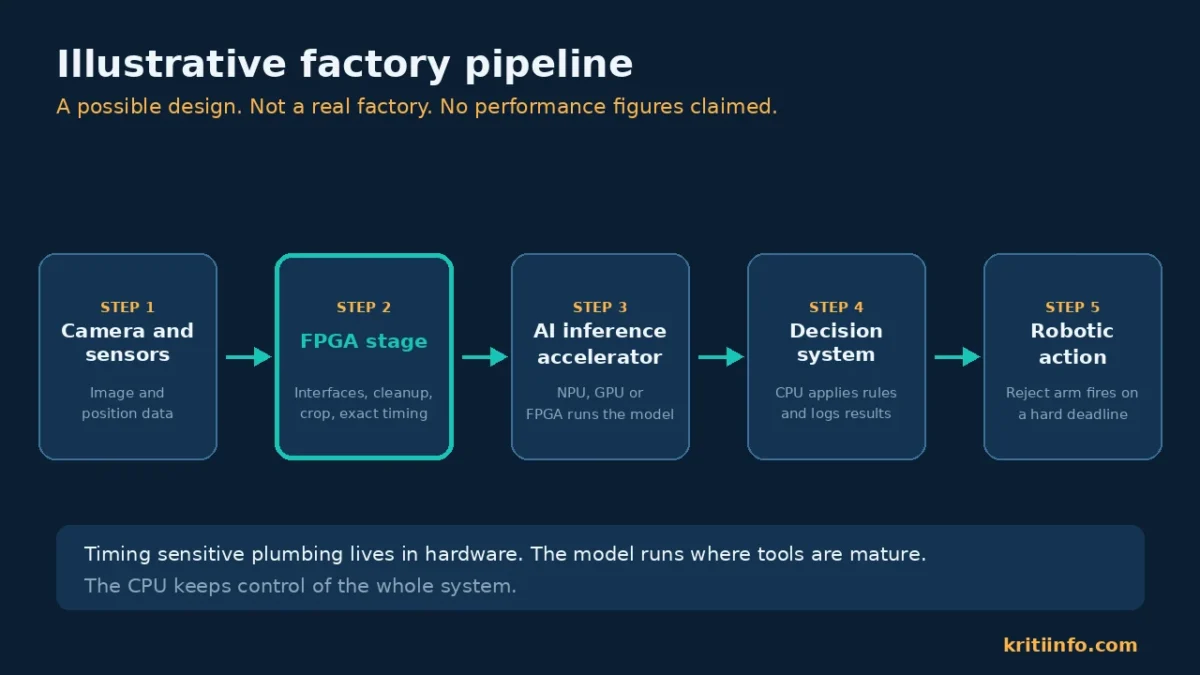
FPGA logic blocks forming a programmable circuit path, with the title: the missing hardware layer for edge AI
Every 25 nanoseconds, the Large Hadron Collider at CERN produces a collision event carrying about 1 MB of raw data. Nobody can store that flood, so a filter decides within microseconds which events to keep and which to erase.
The cloud is too far away for this job. The authors of a widely cited hls4ml paper say neither CPUs nor GPUs can meet the timing limit. FPGAs do it instead: chips whose circuits can be rearranged for one purpose. According to later CERN work, the trigger system cuts the rate from 40 million events per second to 100,000.
This is a real system, not a thought experiment. Few of us run particle detectors, but the same question now follows AI into cars, factories, hospitals and cameras: what happens when sending every piece of information to the cloud is simply too slow? Here is how FPGAs are becoming the missing hardware layer for edge AI, where they help, and where they do not.
Table of Contents
The Hardware Gap
Edge AI means running models on or near the device that collects the data. Cloud round trips add delay, networks fail, medical and video data are private, and streaming everything costs energy.
Devices, though, have tight limits on size, heat and battery. CPUs are flexible but slow at neural network maths. GPUs are fast but can be power hungry. NPUs are efficient but fixed in what they support. Gaps remain around unusual sensors, custom interfaces and strict timing.
FPGAs fit there. The argument is modest: they offer programmable hardware shaped around one workload, bringing efficient processing closer to the sensor. They add a layer rather than replace the others.
What Exactly Is an FPGA?
A Field Programmable Gate Array (FPGA) is a chip of small building blocks that you can wire together after manufacture.
Picture a CPU as a general purpose kitchen. One chef follows recipes line by line and can cook anything, but only a few dishes at once. An FPGA is a kitchen whose equipment you can rearrange: a conveyor of ovens for pizza night, a row of pots for soup. Once built, every station works at the same moment.
Four ingredients make it work:
- Logic blocks with look up tables that imitate small digital circuits.
- DSP slices for the multiply and add at the heart of neural networks.
- Block RAM, small memory beside the logic.
- Configurable interconnects, the wiring you rearrange.
A 2026 University of Turku thesis notes that GPUs hide delay with many threads, while FPGAs map the algorithm’s data flow onto the chip, keeping timing predictable.
Why Edge AI Needs a New Hardware Layer
Take a smart camera on a production line. Sending raw video to a distant server wastes bandwidth, adds delay and exposes private footage. A smarter design filters at the source and sends only decisions. That first stage is repetitive, time critical and often tied to unusual sensor formats. General processors add overhead, and fixed AI chips may not support the sensor.
How FPGAs Are Becoming the Missing Hardware Layer for Edge AI
The word “missing” matters. FPGAs rarely run whole products. They sit between sensors and the main processor and handle what others handle badly:
- Sensor handling: exact timing and unusual interfaces for cameras, radar and custom sensors.
- Low latency inference: a fixed pipeline with no operating system or batching delay.
- Parallel execution: many operations per clock cycle.
- Custom precision: 8 bit numbers or far smaller. CERN’s tools train networks down to 1 or 2 bits.
- Predictable timing in suitable designs, and field updates as algorithms change.
In practice the CPU runs the system, an NPU or GPU runs the heavy model, and the FPGA handles the first and last mile. Vendors are building for this. AMD’s Kria KV260 vision kit lists at $249. Altera’s Agilex 5 family places AI tensor blocks inside the fabric. Lattice targets tiny, low power devices. These are vendor claims, so test them.
What the evidence shows
CERN. A convolutional network on an FPGA reached a latency of 5 microseconds, and compression cut critical resource use by 97 percent with no accuracy loss. The networks were small, so this shows the ceiling, not the average.
Turku. The thesis ran one INT8 traffic detector on four edge boards: a Coral Edge TPU, a Khadas VIM3 NPU, a Jetson Nano GPU (with a substitute model) and an AMD Kria KV260 FPGA. Findings:
- No single paradigm dominated.
- The 5.0 TOPS NPU was slowest, at 0.71 frames per second. The 4.0 TOPS Edge TPU ran 4.2 times faster with 6.8 times more frames per second per watt.
- On the FPGA, accuracy fell from 0.2400 to 0.0233 mAP50. The author traced it to the toolchain’s per tensor, power of two quantization, not the hardware. Speed and power were unaffected.
Caveat: a master’s thesis, one model, one dataset, older boards. It still shows the real FPGA risk: the silicon can be fine while the software flow breaks the result.
CPU vs GPU vs FPGA vs NPU
| CPU | GPU | NPU | FPGA | |
|---|---|---|---|---|
| Purpose | General tasks, control | Parallel maths, AI | Fixed AI inference | Custom hardware per task |
| Approach | Sequential instructions | Thousands of threads | Fixed neural engine | Circuits wired to the algorithm |
| Parallelism | Low | Very high | High, supported operators | High, by design |
| Flexibility | Highest | High, in software | Lowest | High, in hardware |
| Latency | Varies with the OS | Strong throughput, batching adds delay | Low for supported models | Very low, predictable |
| Power | Moderate | Often highest | Often lowest | Depends on design |
| Effort | Easiest | Moderate | Easy if supported | Hardest |
| Best for | Control | Large models | Standard vision models | Sensor interfaces, strict timing |
These are general patterns from my analysis. One CPU, GPU and NPU benchmark found NPUs balanced latency and throughput at lower power, while GPUs did best at large sizes but used more energy. The chips are teammates, not rivals.
Where FPGAs Could Transform Real World Applications
Status labels are my view.
- Autonomous driving (emerging). FPGAs can ingest and preprocess camera and radar streams for millisecond decisions.
- Medical monitoring and imaging (mixed). Altera lists both among Agilex 5 targets, while AI on top of existing signal chains is newer.
- Smart factories (emerging). See the example below.
- Smart cameras (established for vision pipelines). AMD positions the KV260 for machine vision.
- Telecom (established). Fast packet and signal handling is long standing FPGA territory. See telecommunication beyond borders and 6G connectivity shifts.
- Drones and surveillance (emerging). Size, weight and power are tight, and Lattice promotes low power FPGAs for UAVs. See Robots in War.
- Agriculture (emerging). A study summarised in the Turku thesis tested GPUs, a Coral TPU and FPGA DPUs on an agricultural dataset and reported FPGAs fastest, with comparable accuracy.
A Practical Example: The Factory That Cannot Afford a Delay
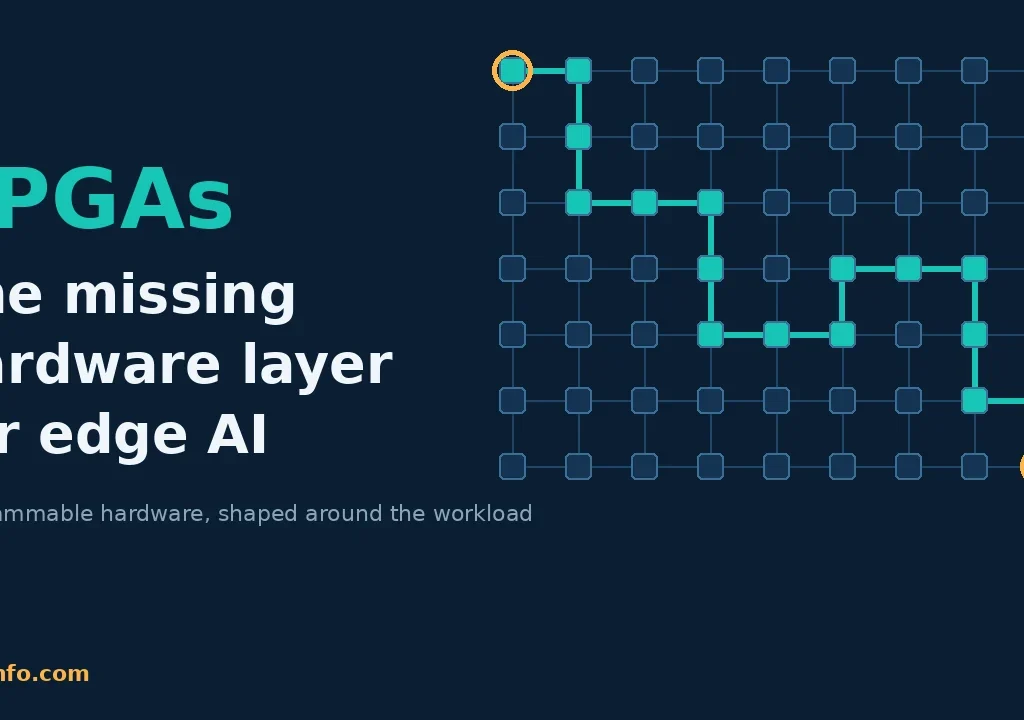
Illustrative scenario. Not a real factory, and no performance figures are claimed.
Illustrative factory pipeline from camera and sensors to FPGA stage, AI accelerator, decision system and robotic action
A camera watches bottles race along a line, and a defect must be caught before the next machine. One possible design: Camera and sensors → FPGA preprocessing → AI inference accelerator → decision system → robotic action.
The FPGA reads the camera interface, corrects the image, crops the bottle and triggers capture the moment a position sensor fires. It streams clean data to the model, which may run on an NPU, GPU or the FPGA itself. A CPU applies the decision rule, and the reject arm fires against a hard deadline. Timing sensitive plumbing sits in hardware, and a product change means reprogramming it, not replacing the board.
The Business Opportunity Behind FPGA Powered Edge AI
Value appears where timing, power or custom sensors decide whether a product works.
- Hardware and semiconductor firms can sell ready modules and toolchains, since skill is the barrier, not silicon.
- Automotive, industrial and healthcare makers need sensor fusion, dependable timing and private, low delay analysis.
- Startups can use custom hardware as a moat for a niche product, if volumes allow.
For the wider chip race, read Terafab vs Nvidia.
Advantages and Limitations
Advantages: configurable architecture, potentially low and predictable latency, parallel processing, custom interfaces, local data processing and efficiency for suitable workloads.
Limitations:
- Complex development and scarce hardware skills
- Toolchain challenges. The Turku author needed a non standard route to deploy the model.
- Cost and integration effort
- Memory bandwidth, thermal and power limits. A Microchip engineer notes that power management can be complex.
- Specialised designs are hard to update
- Rising competition from GPUs and NPUs
Choose by workload, not marketing: rated TOPS predicted little in the Turku test.
The Five Gate Test: When Should a Business Choose an FPGA?
The Five Gate Test: latency, lifespan, power, gap and skills
An original framework. Ask five questions:
- Latency. Do you need predictable, low latency processing?
- Lifespan. Is the workload stable or specialised enough to justify custom hardware?
- Power. Is power consumption a critical limit?
- Gap. Do CPUs, GPUs or NPUs fall short?
- Skills. Do you have the skills, budget and long term support?
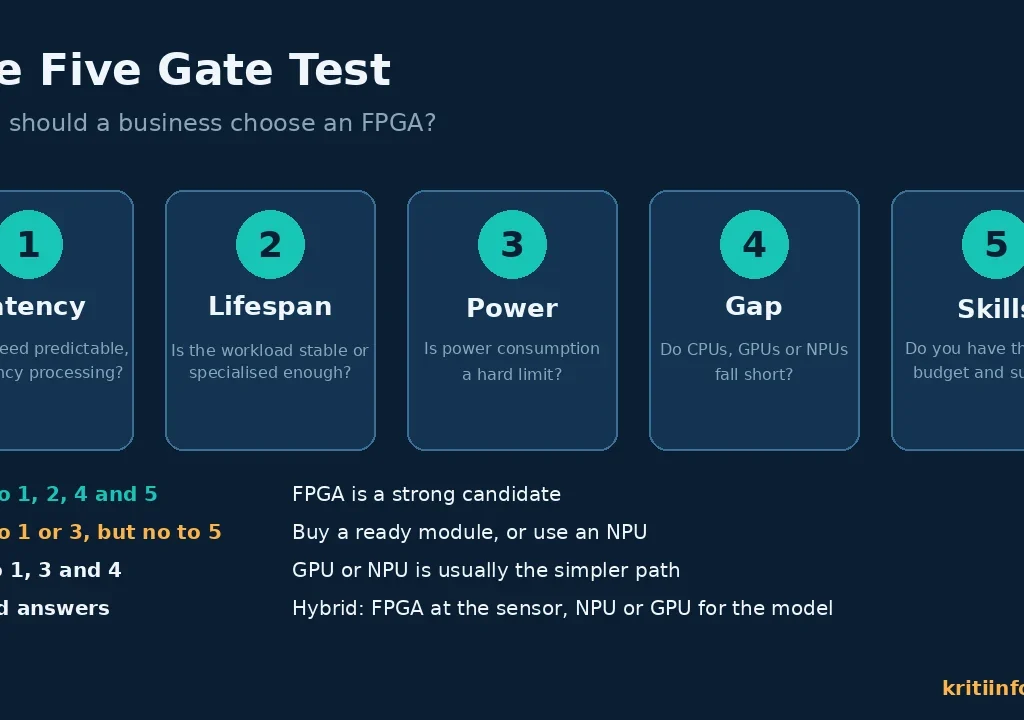
Result:
- Yes to 1, 2, 4 and 5: an FPGA is a strong candidate.
- Yes to 1 or 3, no to 5: buy a ready module or choose an NPU.
- No to 1, 3 and 4: a GPU or NPU is usually simpler.
- Mixed answers: go hybrid, with the FPGA at the sensor and an NPU or GPU running the model.
What Does 2027 Hold for FPGA and Edge AI?
Verified today. Vendors ship AI features in FPGA hardware, such as Altera’s tensor blocks. AMD refreshed the KV260 in June 2025.
Reasonable expectations (my analysis, not forecasts). More hybrid systems, better tools that turn trained models into hardware (hls4ml is one example), and steady industrial and automotive demand for low latency.
Unknown. FPGA market share. I found no reliable forecast, so I give none. The evidence does not support FPGAs dominating edge AI by 2027, and toolchain maturity will decide how far they spread.
What Most People Get Wrong About FPGAs
- Not simply faster CPUs. Speed comes from the design.
- Not automatically low power. It depends on workload and implementation.
- Not always cheaper than GPUs. Engineering time often outweighs chip price.
- Not a replacement for every accelerator. NPUs can win on standard models.
- They need specialist skills, though tools like hls4ml and Vitis AI lower the bar.
- Their best value is teamwork with other processors.
Why it matters: buyers who believe the first three myths choose hardware from headlines, as the Turku results show.
Frequently Asked Questions
1. What is an FPGA in simple terms?
A chip whose circuits you can rewire after manufacture, so the hardware fits the task.
2. Why are FPGAs useful for edge AI?
They process sensor data locally, with predictable timing and custom number precision.
3. Are FPGAs better than GPUs for AI inference?
Sometimes. They tend to win where latency, timing or custom interfaces rule. GPUs usually win for large models and have easier tools.
4. How do FPGAs reduce latency in edge computing?
Data streams through a fixed hardware pipeline with no instruction fetches, operating system delays or batching waits. CERN used this for microsecond range inference.
5. Can FPGAs improve energy efficiency in AI devices?
Yes for stable, suitable workloads, but not automatically. Measure energy per inference.
6. Will FPGAs become important in edge AI by 2027?
They already matter in niches. Wide dominance is not supported by the evidence. Expect hybrid systems.
Conclusion: What to Do Next
The future of edge AI may not depend on one universally superior processor. It may depend on choosing and combining the right hardware for each task. That is how FPGAs are becoming the missing hardware layer for edge AI: not as a hero chip, but as the flexible piece that connects sensors to intelligence.
Engineers should benchmark their own model and report latency, watts and accuracy together. Leaders should run the Five Gate Test before buying.
Intelligence is moving to where things happen, and the chips closest to the world may be the ones that can rewire themselves. Explore more insights on kritiinfo.com, including Wetware as a Service.