
In March 2026, Elon Musk stood inside a retired power plant in Austin, Texas, and made a claim that sounded like science fiction. Every chip factory on Earth, he said, produces only about 2% of what Tesla and SpaceX will need. His answer was simple: build one more. He called it Terafab.
Five months later, the Texas governor’s office confirmed the first phase: more than $16.8 billion, a site in Grimes County, and about 3,000 new jobs.
Meanwhile, Nvidia reported $96.2 billion in revenue for one quarter. Of that, $89 billion came from data centers.
One side is promising a factory. The other is already selling the machines that run modern AI. So here is the question behind Terafab vs Nvidia: could Terafab challenge Nvidia’s dominance, or are they solving fundamentally different problems?
The evidence points to an answer that is less dramatic, and more useful.
Table of Contents
Why Terafab vs Nvidia Matters
AI has two hard problems. First, someone has to make enough advanced chips. Second, those chips must be easy to program, connect and run at scale.
Terafab is aimed at the first problem. Nvidia is strongest at the second. Once you see that split, headlines about a “chip war” start to look different.
What Is Terafab?
Terafab is a planned chip factory, called a fab. It is being developed by Tesla and SpaceX, with xAI expected to use it. Intel announced in April 2026 that it would join and contribute manufacturing expertise.
Here is what we can separate by confidence level.
Confirmed: Tesla and SpaceX announced it in March 2026. In August 2026, the Texas governor’s office confirmed a first phase of more than $16.8 billion in Grimes County.
Announced plans: The goal is to put chip logic, memory and advanced packaging under one roof. Packaging means joining chips into one working module. Musk has said the long term target is one million wafer starts per month. A wafer is a thin silicon disc that chips are cut from. A “start” means one wafer entering production.
Reported: Tesla is building a smaller pilot fab near Giga Texas. Its AI5 chip is reportedly among the first products, with small batches in 2026 and volume in 2027. Musk has also said Intel’s 14A process would be used at full scale.
Uncertain: SpaceX’s own stock offering filing described Terafab as very early stage. It said the companies had agreed only a general framework, with financial terms, intellectual property and Intel’s role still to be settled. Filings also mention a possible total spend of up to $119 billion across all phases. That is a ceiling, not a commitment.
The timeline is also unclear. Texas filings list a December 1, 2026 construction start and a finish by the end of 2028. Yet local news already describes site clearing. Treat dates as plans, not promises.
What Is Nvidia?
Nvidia is not a chip factory. It designs processors, mainly GPUs, and builds the systems and software around them. Its production relies on outside foundries. This is widely documented industry knowledge; check Nvidia’s annual report for details.
The software is the quiet advantage. CUDA is Nvidia’s own programming platform. Developers write AI and science programs on it, which makes switching to other hardware harder.
Now the numbers. In the quarter ended July 26, 2026, Nvidia reported $96.2 billion in revenue, up 106% from a year earlier. Data center revenue was $89 billion, over 92% of the total. The company said its Vera Rubin platform was ramping into full production, and it guided to $108 billion next quarter without assuming any data center compute sales in China.
What does that tell us? Nvidia is now mostly an AI infrastructure company, and demand is still outrunning supply. Its forecast also shows how export rules can shape a business.
Terafab vs Nvidia: A Fair Comparison
| Dimension | Terafab | Nvidia | Evidence status |
|---|---|---|---|
| What it is | Planned chip factory | Chip designer, systems and software company | Confirmed |
| Main output | Chips for Tesla robots and cars, plus space data centers | GPUs, networking, full AI systems | Announced vs confirmed |
| Customers | Mainly its own parent companies | Clouds, labs, enterprises, governments | Announced vs confirmed |
| Software | No public platform described | CUDA ecosystem | Confirmed for Nvidia |
| Status | Early stage, construction planned | Full production of Vera Rubin reported | Reported |
| Energy | On site natural gas and batteries planned | Depends on customer data centers | Reported |
A simple chart hides one big point. Terafab has not shipped a product yet. Nvidia ships at enormous scale. Comparing them like two finished rivals is the first mistake.
The money gap is striking, but be careful. Nvidia’s one quarter of revenue is about 5.7 times Terafab’s $16.8 billion first phase. Even the $119 billion ceiling is only about 1.2 quarters of Nvidia’s current revenue. Revenue and construction budgets are different things, yet the scale difference still shows how large Nvidia’s engine already is.
The Hidden Difference
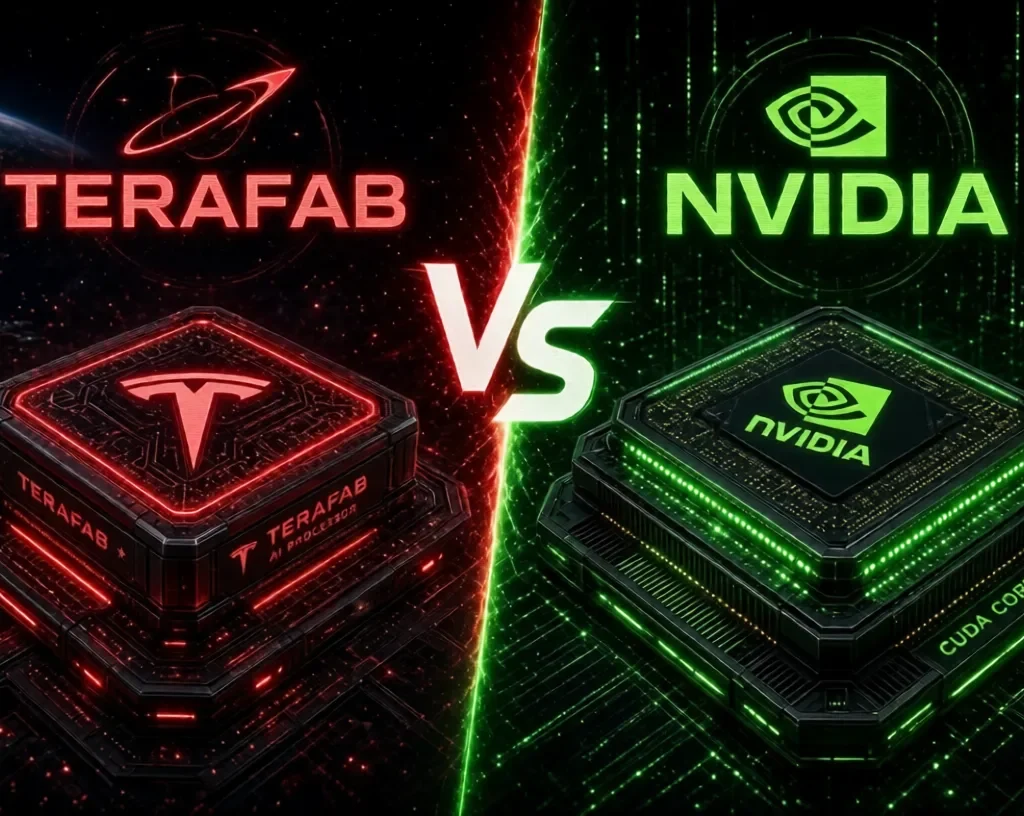
Most people compare brand names. A better test is to compare layers. Try this simple framework, the Layer Test:
- Make: Who manufactures the chips?
- Design: Who creates the chip architecture?
- Software: Who gives developers tools that work?
- System: Who delivers racks, networking and cooling?
Terafab’s pitch is mainly about layer one, with chip design coming from Tesla’s in house work. Nvidia is strongest in layers two, three and four. Nvidia does not own the factory floor. Terafab has no known software moat.
That is why the question “which is better?” is the wrong question. The right one is: “which layer is my bottleneck?”
Also note what Terafab targets. Its stated focus is edge inference chips for robots and cars, plus high power chips for space based data centers. Inference means running a trained AI model. Edge means running it on the device, not in a distant data center. That is different from the giant training clusters where Nvidia earns most revenue.
A Real World Example
Illustrative scenario, not a real company or event.
Imagine a robotics startup. It needs two million small AI chips for robots, and a faster way to test new designs. Waiting months for shared factory time slows every update. A fab that builds, tests and revises chips in one place, as Tesla describes its pilot fab, could shorten that loop.
Now imagine a research lab training a large language model next quarter. It needs proven hardware, mature software and cloud access today. No planned fab can help with that. Nvidia’s platform can.
Same industry, different bottleneck, different answer.
Advantages and Limitations
Terafab: strengths
- Control over supply for its own parent companies
- Faster design and test loops if the one roof plan works
- A hedge against shortages the companies say they expect
Terafab: limits
- Not built yet, and the deal terms are unsettled
- Leading edge manufacturing is extremely hard
- No announced outside customer base or public software platform
Nvidia: strengths
- Proven products at huge scale
- A deep software ecosystem around CUDA
- Systems that customers can deploy now
Nvidia: limits
- Dependence on outside manufacturers
- Export restrictions, including China
- Customers may seek alternatives to reduce dependence on one supplier
Common Misconception
“Terafab is an Nvidia killer.“ The evidence does not say that. SpaceX’s own statement said it appreciates its current chip suppliers and wants them to expand production. Terafab is framed as closing a supply gap, mainly for its own needs. It is also still a plan. Nvidia’s strength is a full platform, and a factory alone does not replace that.
The Bigger Technology Battle
The real contest is not one company against another. It is specialization against vertical integration.
Nvidia’s model lets it focus on design and software. Terafab’s model tries to control everything from silicon to packaging. Each carries risk. Specialists depend on partners. Integrators carry huge capital cost and execution risk.
Energy shows this clearly. Terafab is planned to run on on site natural gas and battery arrays, according to reports. Chips are now an energy story, not only a technology story. That is a reasoned interpretation, not a confirmed forecast.
What Readers Should Watch Next
Monitor these signals:
- Whether construction actually begins on schedule in Grimes County
- Whether Intel’s role and the financial terms are formally finalized
- First wafers or chips from the Austin pilot fab, especially AI5
- Any announced outside customers for Terafab chips
- Real yield and cost data, not just capacity targets
- Nvidia’s Vera Rubin shipment pace and gross margin
- Changes to export rules affecting Nvidia’s China sales
FAQ
1. What is Terafab? A planned semiconductor fab backed by Tesla and SpaceX, with Intel announced as a participant. It aims to combine logic, memory and packaging in one place.
2. Is Terafab a direct rival to Nvidia? Not today. Terafab has no shipping product, and its stated focus is chips for its own robots, cars and space data centers.
3. How does Terafab vs Nvidia compare in business model? Terafab is a manufacturing project. Nvidia designs chips and sells complete AI platforms.
4. How much is Terafab expected to cost? The first phase is about $16.8 billion. Filings mention up to $119 billion across all phases.
5. Does Nvidia make its own chips? Nvidia designs them and relies on outside foundries for manufacturing. Confirm details in its annual report.
6. When could Terafab produce chips? Tesla’s pilot fab reportedly targets small AI5 batches in 2026. The main Grimes County plant is planned to finish by the end of 2028. These are plans, not guarantees.
7. Why does CUDA matter in this comparison? CUDA is the software layer many AI developers already use. A new chip supplier must also solve software, not just manufacturing.
Conclusion
Back to the opening question. Could Terafab challenge Nvidia? Possibly, in the long run, if it delivers, finds customers and builds software support. But today the evidence shows two different roles. Terafab is a bet on making chips at huge scale. Nvidia is the platform running AI now.
In the Terafab vs Nvidia story, the smartest move is to ask which layer matters to you. Watch the milestones, not the slogans. Then judge the results.