
Essential Steps to Understand Chagas Disease Early
Picture a man in his late forties who has never felt seriously ill. He plays football with friends and rarely visits a doctor. Then a routine checkup picks up an irregular heartbeat, and his doctor asks an unexpected question: where did you spend your childhood?
(This is an imagined scenario, not a real patient.)
Years earlier, a tiny parasite may have slipped into his body and simply stayed. No pain. No alarm. Just time.
How can an infection stay quiet for years and still become dangerous? The answer sits at the heart of Chagas disease, an overlooked condition that the World Health Organization (WHO) estimates affects about 8 million people worldwide. Many of them do not know. Let’s follow the clues.
Table of Contents
What Is Chagas Disease?
Chagas disease is an infection caused by a single celled parasite called Trypanosoma cruzi. It is also known as American trypanosomiasis, and it is named after Carlos Chagas, the Brazilian physician who first diagnosed it in a person in 1909.
Why is it so easy to miss? Early signs are mild or absent, and later damage looks like ordinary heart or digestive trouble.
Think of it this way. A flu virus is a visitor: it arrives, makes noise, and leaves. T. cruzi can behave more like a tenant. In the chronic phase, WHO notes that the parasites hide mainly in the muscles of the heart and digestive system, doing slow damage out of sight.
How Chagas Disease Spreads
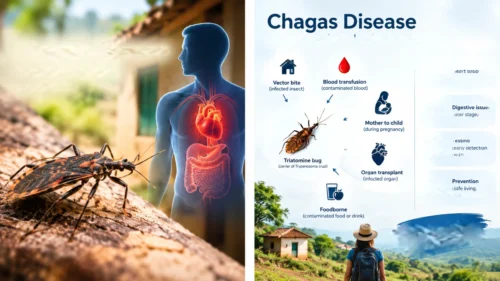
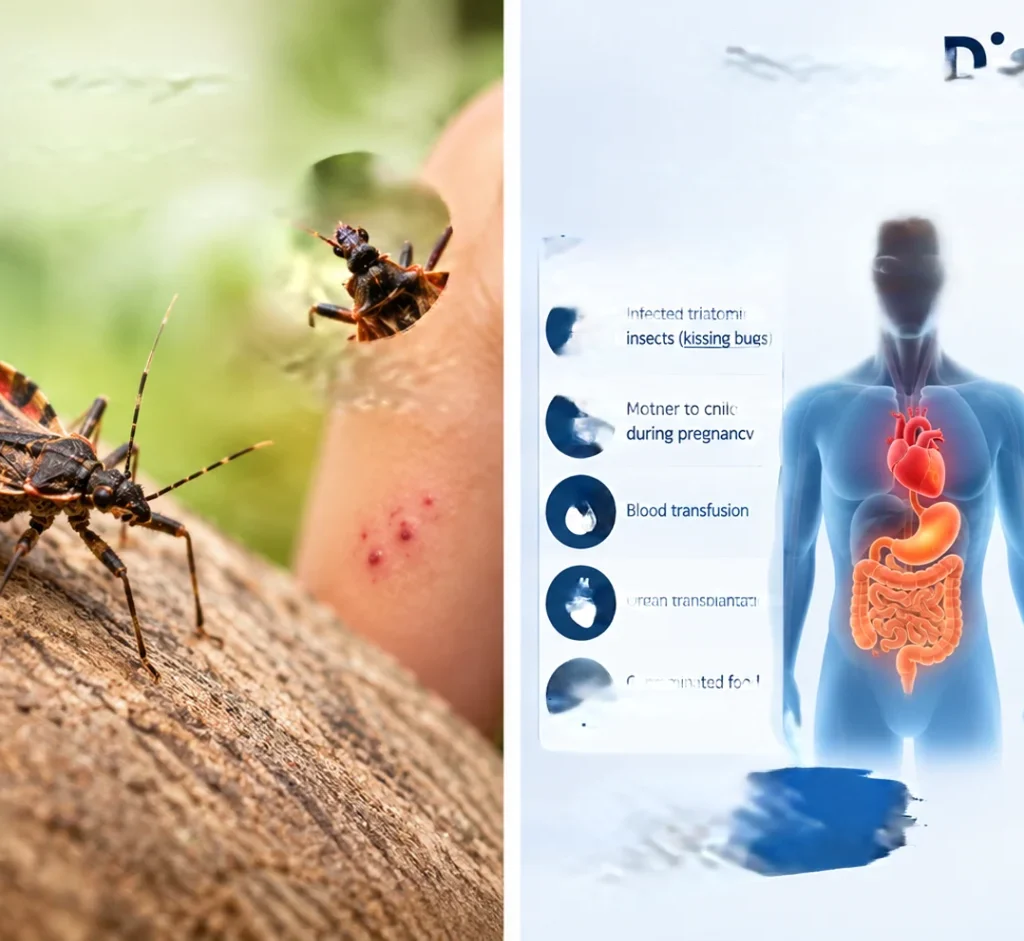
The classic route runs through triatomine bugs, often called kissing bugs. They live in cracks of walls and roofs, hide by day, and feed at night. They tend to bite exposed skin, often the face, and leave droppings close to the bite.
The bite itself does not inject the parasite. Infection happens when the droppings reach the bite wound, the eyes, or the mouth, usually through scratching or rubbing.
Other recognised routes include pregnancy and childbirth (now the main route worldwide, according to WHO, with over 10,000 new cases a year), blood transfusion, organ transplantation, contaminated food or drink, and laboratory accidents. What it does not do, says the CDC, is spread from person to person like a cold, or through casual contact.
The Silent Phase
Why can Chagas disease stay silent? The first stage, the acute phase, lasts about two months. Symptoms are usually absent or mild, even though parasites circulate in the blood.
Then comes the chronic phase, which can last many years or a lifetime. The CDC says most people have no symptoms during this time. But no symptoms does not mean no infection. The parasite is still there, only quieter.
Why can an old infection matter years later? WHO reports that one to three decades after infection, up to a third of people develop heart problems, and up to 1 in 10 develop digestive, neurological, or mixed problems. The CDC gives a similar range of 20 to 30 percent for serious complications.
What do these numbers tell us? Most infected people will not develop severe disease, yet nobody can reliably predict who will. That is why monitoring matters. The limits matter too. These are estimates, and WHO notes that only 6 of the 44 countries reporting cases have national systems to track them, so the true picture is blurrier than any single figure suggests.
Symptoms and Warning Signs
Early symptoms, when they appear, resemble many illnesses: fever, tiredness, body aches, headache, rash, or loss of appetite. A few people notice swelling of one eyelid, called Romaña’s sign.
Later complications are different, and they are possible rather than certain. In the heart, they include an enlarged heart, rhythm problems, heart failure, or sudden death. In the digestive system, an enlarged oesophagus or colon can cause trouble eating or passing stool.
Symptoms like these have many causes. The missing clue is often exposure history, which is why a doctor may ask where you have lived or travelled.
Diagnosis
Timing decides the test. In the acute phase, doctors can look for the parasite directly in a blood smear. In the chronic phase, parasite levels drop and most direct methods stop working, so clinicians test for antibodies instead.
The CDC’s clinical guidance explains that no single test is accurate enough alone, so two or more tests are used, along with a careful exposure history.
The advantage: a simple blood sample can reveal an infection hidden for decades. The limitation: the result shows infection, not how much damage has occurred. A positive test starts a follow up conversation. Blood donor screening tests are also not meant for personal diagnosis, so further testing is needed.
Treatment
Two antiparasitic medicines are recognised: benznidazole and nifurtimox. WHO says both can cure the infection when given early, including in babies infected before birth. Their effectiveness falls the longer a person has been infected, and side effects are more common in older age.
For adults, especially those without symptoms, WHO says treatment should be offered because it may prevent or slow progression. That benefit is weighed against a course of up to two months and side effects that can affect up to 40 percent of adults.
Decisions depend on age, pregnancy status, disease stage, kidney and liver health, and individual circumstances. These medicines are not given during pregnancy, though women of childbearing age may be treated before or after pregnancy to reduce the risk of passing the infection on. Heart and digestive complications need their own specialist care. Doses and plans must come from a doctor who knows the full picture.
Prevention
There is no vaccine and no preventive medicine. Prevention means limiting contact with the bug and blocking other routes.
When travelling to affected areas, the CDC advises staying in well built, screened, or air conditioned places, sleeping under insecticide treated bed nets, covering skin, using repellent, and avoiding raw salads, unpeeled fruit, and unpasteurised juices. At home in affected areas, sealing cracks, clearing wood and brush piles, repairing screens, and keeping pets indoors at night all help.
At community level, better housing, insecticide spraying, blood donor screening, and testing of mothers and newborns have cut transmission. WHO also estimates that caring for chronic cases costs over 80 percent more than spraying to prevent infection.
Chagas Disease: What Is Often Misunderstood?
“If I feel fine, the infection is gone.” Not necessarily. Without treatment, the infection can persist silently. Feeling well is encouraging, but it is not a test result.
“A kissing bug bite means infection.” Not automatically. Infection needs an infected bug and its droppings entering the body. WHO also notes that triatomine bugs have been found outside the Americas, but none identified so far were infected with the parasite.
Chagas Disease and Everyday Risk
Who should consider testing? People with relevant exposure, not people from a particular country or background. Risk follows circumstances. Awareness is especially useful if you have lived or spent long periods in rural parts of Mexico, Central America, or South America, if your mother or a close relative has been diagnosed, or if you are planning a pregnancy with such a history. WHO says infection has now been detected in 44 countries, largely because people move, so a doctor anywhere may need to ask the right question.
An illustrative example (not a real case). Imagine a woman who spent her childhood in a rural house with cracked walls and now lives in a city, feeling well. While planning a pregnancy, she mentions her early years, and her doctor suggests a test. If it were positive, the conversation would turn to follow up, treatment options, and testing her baby after birth. Nothing dramatic happened, yet awareness changed the story.
A practical path to remember:
Exposure → Possible infection → Testing → Monitoring → Treatment → Prevention
What to Do Next
- Note where you have lived or travelled for long periods.
- Share that history with a doctor, especially before pregnancy or if heart or digestive problems appear.
- Ask whether testing makes sense for you or your family.
- Follow updates from the CDC, WHO, and PAHO.
Frequently Asked Questions
1. What is Chagas disease? An infection caused by the parasite Trypanosoma cruzi, usually spread by triatomine bugs, that can affect the heart and digestive system over time.
2. How does Chagas disease spread? Mainly through infected bug droppings entering the body, and also through pregnancy, transfusion, organ transplant, and contaminated food or drink. Not through casual contact.
3. Can Chagas disease remain unnoticed for years? Yes. Most people have no symptoms in the chronic phase, though the infection remains.
4. What are the symptoms? Early: fever, tiredness, aches, sometimes eyelid swelling. Later, a minority develop heart rhythm problems, heart failure, or an enlarged oesophagus or colon.
5. Can Chagas disease be treated? Yes. Benznidazole and nifurtimox can cure early infections and may slow progression later. Choices depend on age, pregnancy, and stage.
6. Who should consider testing? People who have lived in or spent long periods in affected areas, or whose mother is infected, especially around pregnancy. A doctor can advise.
7. Can Chagas disease be prevented? There is no vaccine, but avoiding bug contact, safer food habits while travelling, blood and organ screening, and testing mothers and newborns reduce spread.
The Quiet Threat Worth Knowing
A disease can be quiet without being irrelevant. Chagas disease proves it. It can hide for decades, yet the tools to find it, understand it, and often treat it already exist.
Awareness is not about fear. Most people with this infection will never develop severe complications. But knowing your exposure history, asking for a test when it makes sense, and keeping up with follow up can change what the future looks like. Quiet infections reward curious people.
This article is for general information and does not replace professional medical evaluation. Please speak with a qualified healthcare professional about your own situation.