
What happens when a machine can take the appearance of one artistic masterpiece and apply its visual character to an entirely different photograph?
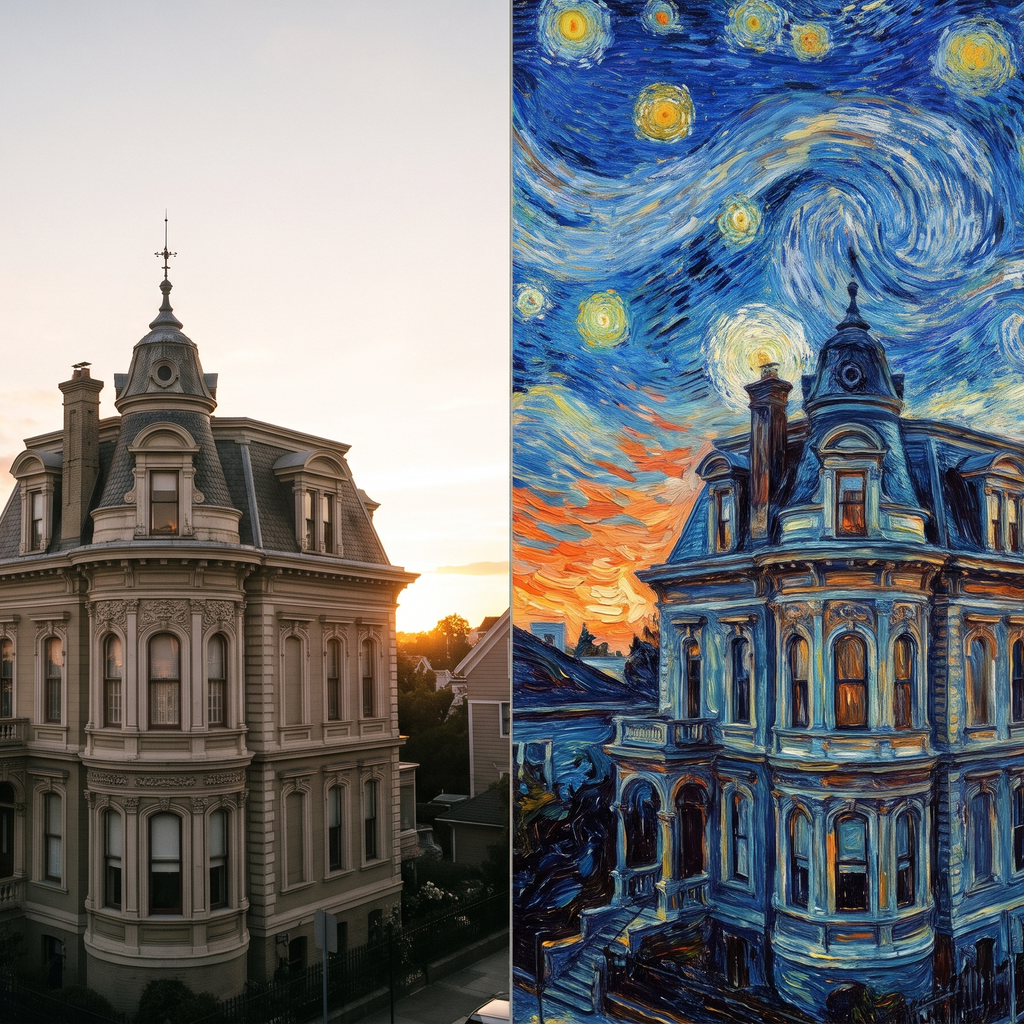
In late 2023, that exact question sparked an intense legal battle inside the United States Copyright Office. A creator submitted an artwork named Suryast, made by feeding a photograph of a sunset over a building alongside Vincent van Gogh’s The Starry Night into an artificial intelligence painting app. The software kept the exact outline of the building and clouds from the original photo, while repainting every inch in swirling, star-like brushstrokes. When the Copyright Office refused to register the image for lack of human authorship, it proved how unsettlingly good machines had become at mimicking human artistry.
Alt text: Split-screen visual showing an original architectural sunset photograph on the left and the same building transformed with swirling oil-painting textures on the right using style transfer.
This breakthrough technology is called style transfer. Far from being a novelty trick for social media selfies, it has quietly evolved into a core building block of modern computer vision and generative media. As artificial intelligence moves rapidly toward 2027, understanding how style transfer works, where it creates value, and what legal or technical traps it carries is essential for creators, designers, and business owners alike.
Table of Contents
What Is Style Transfer and How Does It Work?
Style transfer is an artificial intelligence technique that blends the visual content of one image with the artistic appearance of another. Instead of simply placing a transparent color sheet over a picture, the software rebuilds the image from scratch using the colors, brushstrokes, and textures of a chosen reference artwork.
Imagine taking a crisp smartphone photograph of your dog sitting on a porch. Next, you choose a classic watercolor painting of a garden. Through AI image transformation, the computer keeps your dog’s exact pose, ears, and porch steps intact, while redrawing the fur, wood, and sky using soft watercolor bleeds and pastel tones.
To pull this off, researchers rely on neural style transfer, a method first introduced in a landmark 2015 research paper by Leon A. Gatys, Alexander S. Ecker, and Matthias Bethge. Their breakthrough relied on deep learning, a branch of machine learning where software learns patterns from massive amounts of data, and convolutional neural networks (CNNs), which are layered computer models inspired by how the human brain processes visual information.
When an image enters a neural network, different layers look for different clues:
- Early layers detect basic details like sharp edges, light spots, and tiny textures.
- Deeper layers ignore tiny textures and recognize high-level shapes, such as faces, trees, or buildings.
During the transformation process, the AI extracts the high-level shape map from your original photo (the content) and the texture-and-color patterns from the reference painting (the style). It then adjusts a blank canvas pixel by pixel until the new picture matches both maps at the same time.
Since 2023, modern generative AI and diffusion-based systems have pushed this further. Diffusion models work by learning how to remove visual static, or noise, from scrambled images to form clear pictures. When guided by style conditioning, these newer models do not just copy surface brushstrokes; they understand lighting, depth, and artistic mood, allowing far smoother visual creativity.
Style Transfer vs. Related AI Technologies
Many people confuse style transfer with everyday camera apps or broader machine learning concepts. While these tools share roots in digital image processing, they operate differently and serve distinct goals.
| Technology | What It Does | Main Distinction |
| Traditional photo filters | Applies preset brightness, contrast, or color overlays across an image. | Uses fixed mathematical rules with limited customization; cannot copy complex brushwork. |
| Neural style transfer | Combines the structural content of one image with the visual texture of another. | Neural network based; separates high-level object shapes from artistic surface patterns. |
| Diffusion-based image transformation | Generates or modifies images from scratch using learned visual patterns and prompts. | More flexible generative process; can alter lighting, geometry, and composition alongside style. |
| Transfer learning | Reuses knowledge trained on one machine learning problem to solve a different task. | A broader machine learning training method, not an image-editing feature. |
No single approach is universally better than the others. Traditional filters remain the fastest choice for quick social media adjustments on a phone. Classical neural style transfer excels when you must lock down exact object boundaries, whereas diffusion models shine when you want deep artistic reimagining and flexible control.
What Could Change for Style Transfer by 2027?
Looking toward 2027, researchers and software developers are working to make artistic style generation faster, sharper, and easier to run on everyday devices. Separating proven tools from realistic expectations helps clarify where the technology is heading.
What already exists today:
- Photography and digital art: Desktop editors and mobile apps already let creators apply custom color grading and painterly textures in seconds.
- Advertising and branding: Marketing teams use style conditioning to unify product shoots under a single visual theme.
- Education and creative learning: Art students use interactive tools to study how different historical brushwork styles alter light and perspective on identical subjects.
Emerging developments heading into 2027:
- Real-time video style transfer: Historically, applying style transfer to video caused distracting flickering between frames. Recent research into temporal attention mechanisms—systems that track movement across consecutive frames—is steadily reducing this flicker. By 2027, lightweight models could allow live video stylization during mobile streaming or virtual meetings, though high-resolution film rendering still requires heavy graphics hardware.
- Film production and animation: Animation studios are testing hybrid pipelines where artists paint key frames by hand and AI transfers that exact hand-painted look onto 3D character models. Whether major studios adopt this widely depends on union agreements and copyright clarity.
- Fashion, product design, and virtual experiences: Industrial designers are experimenting with rapid surface previews, wrapping fabric patterns or architectural finishes onto 3D prototypes before manufacturing physical samples.
- Independent creators and small businesses: Compact, distilled AI models are shrinking computing demands. This trend may soon allow small business owners to run brand-consistent image tools locally on standard laptops without paying for expensive cloud servers.
Practical Framework: How to Use Style Transfer Step by Step
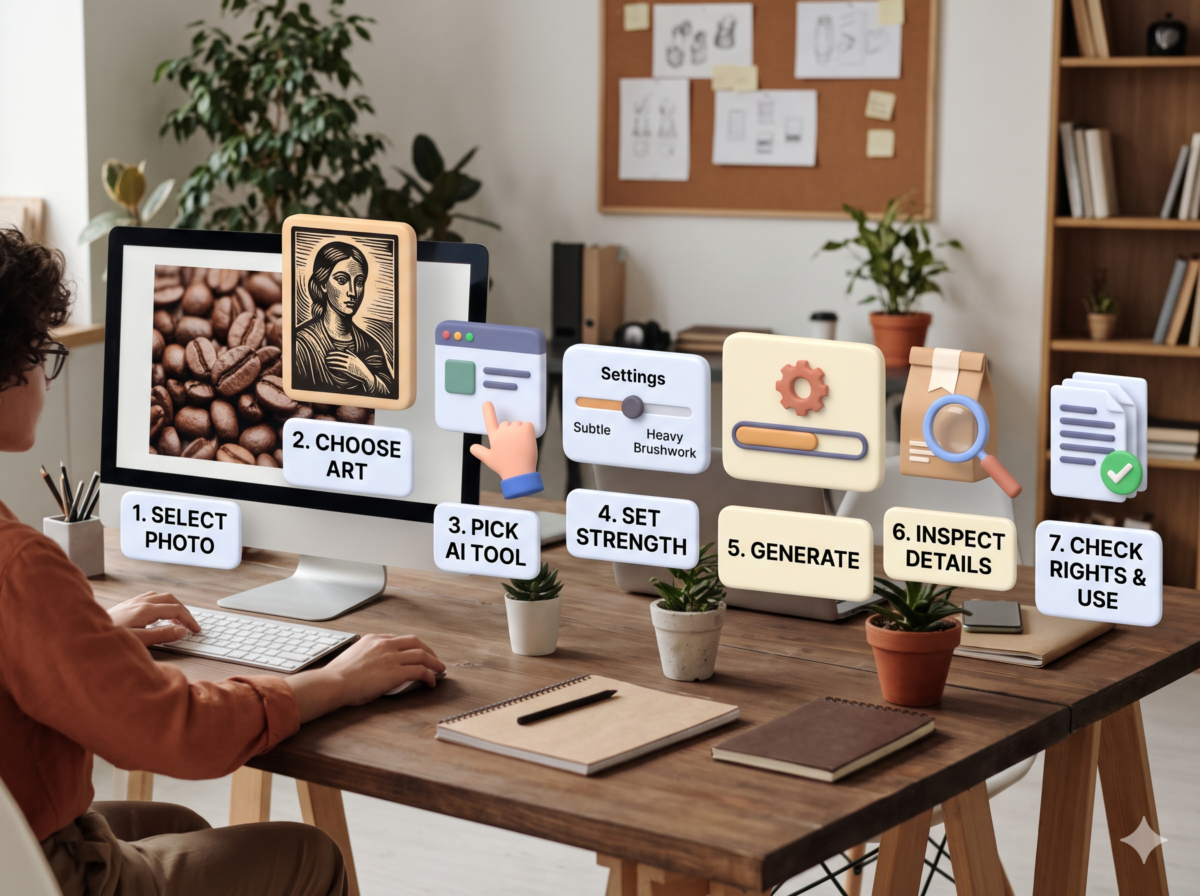
Using style transfer effectively requires more than uploading two random pictures and hoping for magic. Follow this seven-step framework to get clean, reliable results.
Alt text: Clean infographic showing the seven-step style transfer process from selecting base photos to checking commercial copyright.
- Select the original image: Choose a clear, well-lit photograph with distinct edges and minimal background clutter. High-contrast subjects hold their shape best.
- Choose a suitable artistic reference: Pick a style image with clear color harmony and visible texture. Busy, chaotic paintings often overwhelm subtle facial features or product details.
- Select an AI tool or model: Match the tool to your goal. Use feed-forward neural networks for fast texture blending, or diffusion-based editors when you need fine control over lighting and structure.
- Set the style strength: Adjust the style weight slider. A low setting keeps the photo realistic with a subtle artistic tint, while a high setting turns the entire scene into heavy brushwork.
- Generate the result: Run the model at a moderate preview resolution first to test composition before rendering a high-resolution file.
- Review image quality and details: Zoom in on edges, text, faces, and small objects. Check for muddy colors, warped lines, or lost product features.
- Verify copyright and commercial rights: Confirm that you own the base photo, have permission to use the reference style, and follow your software provider’s licensing terms before publishing.
Quick Small-Business Example: Imagine a local specialty coffee roaster launching a seasonal autumn blend. Instead of hiring an illustrator for six separate bag labels, the owner photographs each coffee bean origin on a clean table, applies a warm, woodcut-print style created by a commissioned local artist, and produces a unified packaging line in one afternoon.
Real-World Application: An Illustrative Agency Scenario
To see how this plays out in professional work, consider a hypothetical scenario involving a small boutique advertising agency preparing a campaign for a regional ceramic tableware maker.
The initial problem: The client sends 25 standard studio photographs of bowls and mugs on white backgrounds. They want the campaign to feel like a warm, Mediterranean storybook illustration, but they lack the budget for a month of custom hand-painted artwork.
The chosen approach: Rather than letting an AI invent new pottery shapes from scratch, the creative director uses controlled neural style transfer paired with edge-preservation settings. This ensures every mug handle and glaze pattern remains accurate to the real product.
The transformation process: The team commissions a digital painter to create two original reference paintings with warm terracotta tones and gouache brushstrokes. They feed the 25 studio photos and the two commissioned paintings into their workflow, testing style strength at 45 percent.
Expected benefit and potential mistakes: The agency produces cohesive social media ads and catalog headers in days rather than weeks. However, early test outputs reveal two common mistakes: the AI accidentally turns ceramic speckles into distracting dark smudges, and the client’s stamped logo on the mug base becomes unreadable.
Required human review: A graphic designer steps in to mask out the product logos so they stay sharp, manually cleans up stray brush artifacts, and color-corrects the final files for print.
Data Interpretation and Expert Analysis
When researchers and engineers measure how well a style transfer model performs, they rarely rely on a single score. A 2025 evaluation published in the International Journal of Recent Advances in Engineering & Technology highlighted that traditional pixel-comparison metrics—such as Peak Signal-to-Noise Ratio (PSNR) and Structural Similarity Index Measure (SSIM)—often fail to reflect what human eyes actually consider visually appealing.
Instead, independent technical evaluations examine seven practical factors:
- Content preservation: Does a chair still look like a chair without warped legs?
- Style fidelity: Did the model capture genuine brushwork and color balance, or just tint the screen?
- Perceptual quality: Researchers increasingly use metrics like Learned Perceptual Image Patch Similarity (LPIPS) to measure how close an output feels to human visual judgment.
- Temporal consistency: In video, do textures stay locked onto moving objects without flickering?
- Processing speed and computing cost: Early optimization methods took minutes per image on high-end graphics processors, whereas modern hybrid pipelines combining Adaptive Instance Normalization (AdaIN) with lightweight refinement achieve near-instant previews.
- User control: Can a designer adjust texture scale and color independently?
For everyday users and businesses, these findings carry a clear message: faster models are making creative tools accessible on ordinary hardware, yet automated quality scores cannot replace a trained human eye checking for subtle visual distortions. Integrating these tools wisely requires strong internal oversight, much like the principles outlined in our guide on Agile Governance: 5 Step Framework For Frontier AI.
Advantages, Limitations, and Legal Realities
Like any emerging technology, style transfer brings practical strengths alongside real technical and ethical trade-offs.
Key Advantages:
- Faster creative experimentation: Designers can test ten visual directions in an hour instead of spending days on manual mockups.
- Lower barriers for independent creators: Solo writers, educators, and small shops can produce custom visuals without massive studio budgets.
- Consistent visual branding: Teams can apply a single aesthetic across diverse photographs for unified campaigns.
Limitations and Risks:
- Loss of fine detail: Heavy stylization can blur small text, product textures, or human facial expressions.
- Computing demands for high resolution: Ultra-high-definition print files and smooth video rendering still demand significant processing power.
- Deepfake and manipulation concerns: Malicious actors can use advanced visual transformation to alter the context of real photographs, making digital provenance and AI Security Platforms: Powerful Protection for a Smarter Future increasingly important.
- Copyright and ownership uncertainty: Transforming a photo with AI does not automatically make the result copyright-free or legally protected. In its official registration guidance and the Suryast Review Board ruling, the U.S. Copyright Office confirmed that works lacking sufficient human authorship cannot receive federal copyright registration. Meanwhile, courts continue to examine disputes over whether training AI models on living artists’ work without permission infringes copyright.
Common Misconceptions About Style Transfer
1. Style transfer is just another name for a photo filter. Photo filters apply uniform color adjustments across every pixel. Style transfer analyzes object shapes and repaints textures dynamically based on a separate reference artwork.
2. AI always preserves the original subject perfectly. If style strength is set too high, neural networks frequently distort straight lines, blur small lettering, or alter facial features. Human inspection is always necessary.
3. Every AI-transformed image is automatically safe for commercial use.Using a living artist’s copyrighted painting as your style reference without permission can trigger intellectual property disputes, and purely AI-generated outputs may lack copyright protection of their own.
4. Style transfer and transfer learning mean the same thing. Transfer learning is a broad machine learning practice where an AI trained on one task (like recognizing animals) is adapted to learn a new task (like reading medical scans). Style transfer is a specific visual technique for blending image content and artistic style.
What Readers Should Do Next
Whether you are exploring creative tools or managing brand assets, take practical steps tailored to your role:
- Beginners: Start with open-source demos or built-in editor tools using public-domain paintings (such as works by Monet or Van Gogh) to learn how style sliders affect image structure.
- Artists: Document your creative process, keep layered working files, and consider using metadata credentials or protective glazing tools to safeguard your signature style.
- Businesses: Establish clear creative guidelines before deploying AI visuals in paid campaigns, and ensure human designers review every asset. Teams looking to align emerging tools with business goals can explore Powerful, Smart Decision Making with AI Integration.
- Students: Study the foundational computer vision papers on convolutional neural networks and diffusion models to understand the mathematics behind visual synthesis.
Quick Publishing Checklist:
- Permissions: Do you hold rights to both the base image and the style reference?
- Quality: Are logos, faces, and product details crisp and distortion-free?
- Transparency: Have you disclosed AI assistance where platform rules or client contracts require it?
- Privacy: Have you obtained consent from any identifiable people shown in the source photograph?
Conclusion
As artificial intelligence advances toward 2027, style transfer stands out as a fascinating bridge between human artistic heritage and modern computation. By separating what is in an image from how it is visually expressed, this technology unlocks faster prototyping, richer storytelling, and accessible design for creators everywhere.
Yet technical capability alone never guarantees meaningful art or trustworthy communication. AI may make visual transformation easier, but human imagination, judgement, responsibility, and originality still matter.
Frequently Asked Questions
What is style transfer in artificial intelligence?Style transfer is an AI image processing method that takes the structural content of one photograph and renders it in the artistic style, colors, and brushstrokes of another reference image. It allows creators to reimagine photos as paintings or illustrations without redrawing the scene manually.
How does neural style transfer work?Neural style transfer uses deep convolutional neural networks to inspect an image at multiple levels. Early network layers capture fine textures and colors from the style artwork, while deeper layers preserve object shapes from the original photo, blending both representations into a single new image.
What is the difference between style transfer and transfer learning? Transfer learning is a general machine learning strategy where a model trained on one problem is reused to speed up training on a different problem. Style transfer is a specific visual application that merges the content of one picture with the artistic appearance of another.
Can AI apply the style of a painting to a photograph? Yes. By analyzing the color palette, brush patterns, and texture statistics of a painting, style transfer algorithms can repaint an ordinary photograph so it resembles an oil painting, watercolor, or sketch while keeping the original subjects recognizable.
Is style transfer used in video production? Yes, though it remains technically demanding. Filmmakers and software developers use specialized video style transfer models with temporal consistency controls to prevent flickering between frames, enabling stylized animation sequences, music videos, and experimental visual effects.
Can style transfer be used commercially? Commercial use depends on copyright and licensing. You must have legal rights to the original photograph, permission or a public-domain status for the reference artwork, and commercial clearance from your AI software provider. Furthermore, heavily AI-generated outputs may not qualify for copyright protection.
What is the future of style transfer in 2027? Heading into 2027, research focuses on faster, lightweight models that run smoothly on consumer devices, flicker-free real-time video stylization, and tighter creative controls inside diffusion editors. These advances will likely make custom visual styling a standard feature in everyday design software.