
The Hidden Problem
Imagine a company that is growing fast. Sales are up. Clients are happy. Then the numbers stop matching.
Fictional illustration: At Crestline Supplies, a made up company, the finance team notices small payment gaps. A senior manager named Raj, loved by everyone, keeps approving bills from one vendor. Private pricing details leak to a rival. An anonymous note lands in the HR inbox.
Nobody speaks. Everyone watches. Leaders now face a hard question: is this one bad mistake, or is something deeper going on?
That question is the heart of internal misconduct. It often hides inside successful teams, because success makes people stop checking.
What Is Internal Misconduct?
Internal misconduct means wrong behaviour by people inside an organization, done on purpose, that harms the company, its staff or its trust. It is more than a mistake.
Think of it as a ladder:
- Mistake: A typing error in a bill. No bad intent.
- Negligence: Skipping a check because you were careless.
- Policy violation: Breaking a rule, sometimes without knowing.
- Deliberate misconduct: Choosing to break rules for personal gain.
- Serious wrongdoing: Fraud, theft or abuse of power.
Four things decide where an act sits: intention, evidence, context and policy. A manager who treats every error like fraud will lose trust. A manager who treats fraud like an error will lose money.
Table of Contents
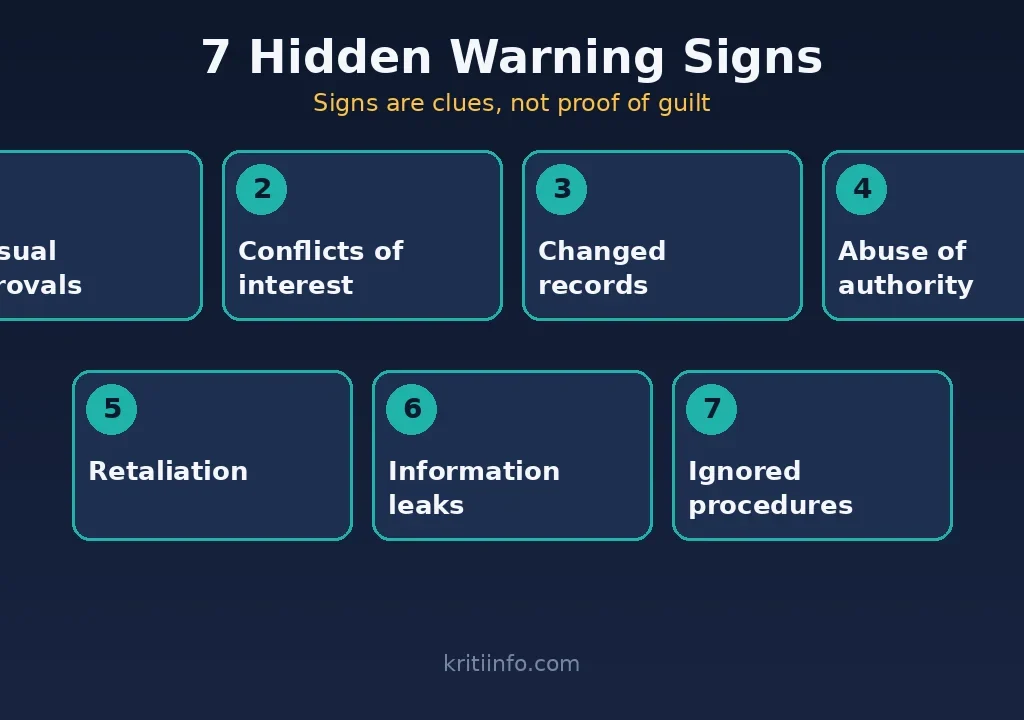
Seven Hidden Warning Signs
Warning signs are not proof of guilt. They are reasons to look closer.
- Unusual approvals. One person always approves payments to the same vendor.
- Conflicts of interest. A buyer hires a company owned by a cousin and never says so.
- Changed records. Dates or figures are edited after the fact.
- Abuse of authority. A boss makes staff do personal tasks or hides decisions.
- Retaliation. The employee who raised a concern suddenly gets bad reviews.
- Information leaks. Private data reaches people who should not have it.
- Ignored procedures. “We always skip that step” becomes normal.
Why Does It Happen?
Most misconduct grows in weak soil: poor internal controls, unchecked power, heavy pressure, toxic culture and fear of speaking up.
There is also psychology. Researcher Donald Cressey’s well known “fraud triangle” says people cross the line when three things meet: pressure (money trouble, tough targets), opportunity (nobody is checking) and rationalization (“everyone does it,” “I deserve this”).
Here is my added view: power makes the triangle stronger. A senior leader has more opportunity and more excuses. Also, people stop questioning high performers. So the top seller or favourite manager is not safe from misconduct. They may simply be less watched.
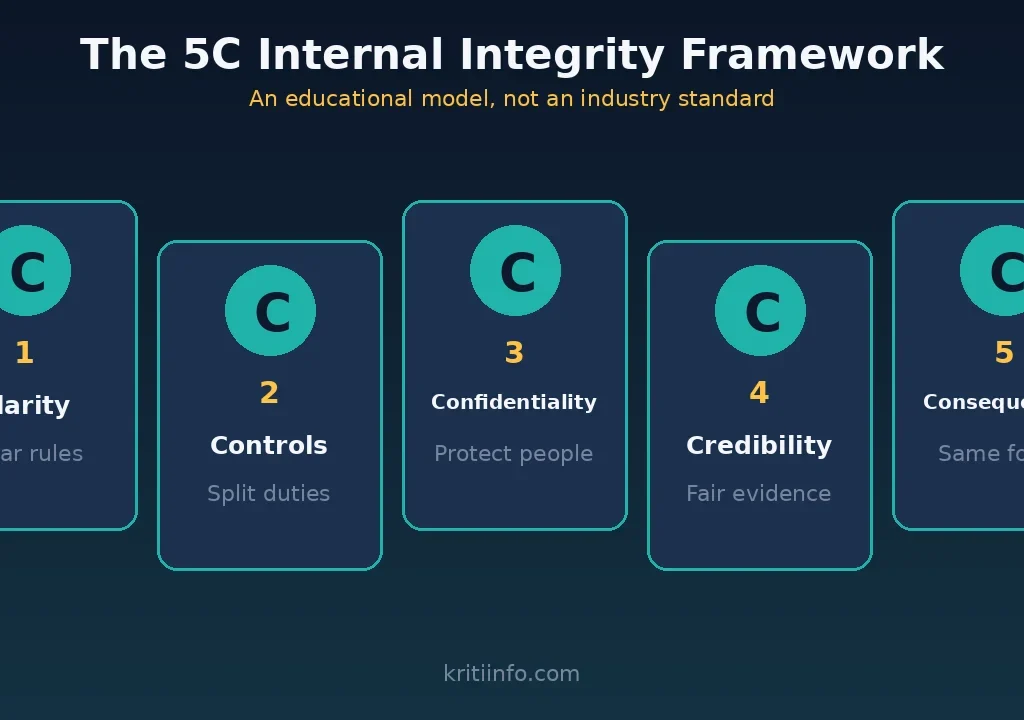
The 5C Internal Integrity Framework
This is an educational model, not an official industry standard.
- Clarity. Write simple rules about gifts, conflicts and reporting. Train people with real examples.
- Controls. Split duties so no single person can request, approve and pay. Review access to data.
- Confidentiality. Protect the person who complains and the person accused until facts are known.
- Credibility. Use fair, evidence based investigators with no link to the case.
- Consequences. Apply the same fair action to everyone, from intern to director.
If one C is missing, the others weaken. Rules without consequences become posters.
How to Investigate Fairly
- Receive and write down the complaint.
- Check for urgent risks, such as money leaving or threats.
- Save records and emails before anything changes.
- Check who has a conflict of interest.
- Choose an impartial investigator.
- Interview people fairly, including the accused.
- Judge the evidence calmly.
- Write down findings.
- Take action that matches the proof.
- Watch the workplace afterwards for retaliation.
Three rules matter most: keep it confidential, give everyone a chance to respond and never decide early. Local labour laws differ, so involve legal advice for serious cases.
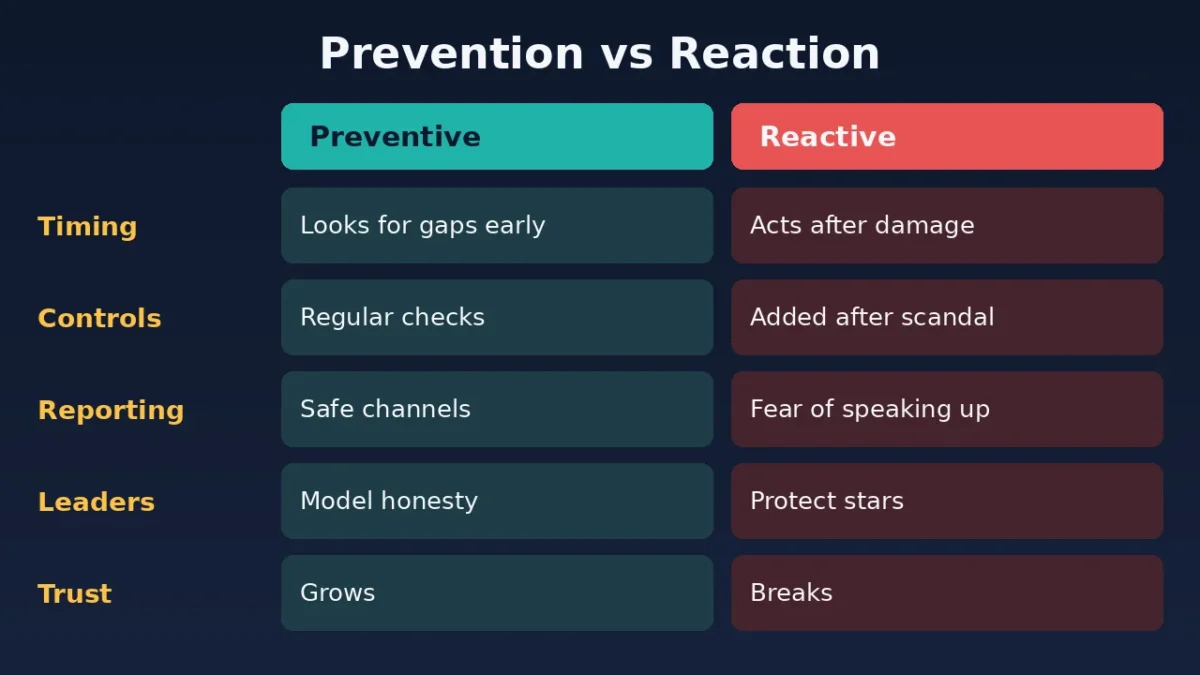
Prevention vs Reaction
| Point | Preventive management | Reactive management |
|---|---|---|
| Timing | Looks for gaps early | Acts after damage |
| Controls | Regular checks and audits | Added after a scandal |
| Reporting | Safe, trusted channels | Fear of speaking up |
| Leaders | Model honesty | Protect stars |
| Cost | Small, steady | Large, sudden |
| Trust | Grows | Breaks |
Preventive teams treat small gaps as free lessons. Reactive teams pay full price for the same lesson.
What the Data Says
The Association of Certified Fraud Examiners (ACFE) studied 1,921 real fraud cases from 138 countries, investigated between January 2022 and September 2023, in its Occupational Fraud 2024 report. It found total losses above $3.1 billion, and estimated that organizations lose about 5% of revenue to fraud each year. Source: ACFE Report to the Nations.
It also found that more than half of tips came from employees.
What does this mean? First, the numbers come from cases that were caught, so real losses may be higher. Second, the cases are from fraud investigators, not every company, so they do not describe all workplaces equally. Third, employees are your best early alarm. If they feel unsafe reporting, you lose that alarm. Remember, this shows a link between controls and better outcomes, not proof that controls alone cause them.
Advantages and Limits of Internal Controls
Advantages: clearer accountability, more trust, lower risk, better decisions and a stronger reputation.
Limits: too much watching can make honest staff feel like suspects. Bad investigations can hurt innocent people. Long procedures slow work. A reporting hotline fails if reporters are not protected. And no control stops every wrongdoer.
The goal is balance: enough control to catch problems, enough trust to keep good people.
Five Common Misconceptions
- “Only junior staff do it.” Senior people often have more access and less supervision.
- “High performers are honest.” Results and ethics are different things.
- “Anonymous complaints are fake.” They need checking, not dismissing.
- “Strong surveillance guarantees integrity.” Culture matters more than cameras.
- “Firing is always the answer.” Sometimes training, a transfer or a warning fits the proof better. Serious cases may need dismissal or legal steps.
Real World Style Case Study
Fictional illustration: A 200 person firm, “Bluepeak Logistics,” has a manager, Meera, who sees fuel bills rising while trips stay the same. She does not accuse anyone. She quietly asks IT to save the billing records.
HR assigns an investigator from another department. He compares trip logs with receipts and interviews the supervisor, who gets time to explain. The evidence shows one supervisor had been approving fake fuel claims, and nobody else had to sign off.
The company ends the supervisor’s job, reports the matter as the law requires, and fixes the weakness: fuel claims now need two approvals. It also tells staff how to report concerns safely.
Lessons: act calmly, save evidence, stay fair, fix the system and not just the person.
What Managers Should Do Next
This week: Check who approves and pays vendors. Confirm staff know how to report. Save a copy of your complaint process.
This quarter: Add duty splits. Train managers on conflicts of interest. Review how past complaints ended.
This year: Reward people who speak up. Audit random areas. Ask staff, in surveys, if they feel safe reporting.
Conclusion
Internal misconduct is not only a discipline problem. It tests leadership, culture and management honesty. The people who spot trouble first are often already in your team, waiting to see if you will listen.
So ask yourself: if someone in your workplace saw something wrong tomorrow, would they feel safe saying it?
FAQs
1. What is internal misconduct in an organization? It is deliberate wrong behaviour by insiders, such as fraud, abuse of power or leaking secrets, that harms the organization or its people.
2. What are common examples? Fake expenses, vendor favouritism, altered records, harassment by a boss, retaliation and sharing private data.
3. How can managers spot hidden misconduct? Watch for patterns: repeated exceptions, one person controlling a process, sudden lifestyle or behaviour changes, and staff who go quiet. These are clues, not proof.
4. What should HR do after a complaint? Record it, protect the complainant, save evidence, pick an impartial investigator and avoid early conclusions.
5. How can employees report safely? Use official channels first, write down facts and dates, and keep copies of what you saw. Ask about your local whistleblower protections.
6. Can senior managers be investigated? Yes. The investigator should be independent of that manager, often through the board, audit committee or an outside party.
7. How can organizations prevent it? Use the 5C Framework: clear rules, split duties, confidential reporting, fair investigations and consistent consequences.