
The Hidden Cost of One Difficult Person
(Fictional story, written to explain a real problem.)
Meera was the best designer at BrightLeaf Systems, a made up software company. Her work won praise from clients. Her manager, Arjun, loved her results.
Then small things started to go wrong. A teammate stopped sharing files with her. Two juniors asked to move to another project. A meeting turned into a shouting match about a button colour.
Arjun first thought Meera was simply behind on deadlines. He sent her a warning about her work. It changed nothing.
Why? Because her work was never the real problem. The problem was how she treated people. Her team was quietly slowing down around her.
That brings us to the big question. When does a personality become a workplace problem, and what should a fair manager do?
This article gives you a clear answer.
Table of Contents
What Is a Personality Problem?
A personality problem at work means a repeated pattern of behaviour that harms people, teamwork or results.
Notice the words “repeated” and “behaviour.” We cannot see a personality. We can only see what a person does again and again.
It helps to separate four things:
- Personality difference: One person is quiet. Another is loud. This is normal.
- Interpersonal conflict: Two people disagree about a task or a rule. This is also normal, and it can end quickly.
- Difficult behaviour: Interrupting, blaming, ignoring feedback, taking credit. This is harmful when it repeats.
- Personality disorder: A medical condition that only a trained professional can diagnose. The American Psychiatric Association explains that these are long lasting patterns of thinking and behaving that cause real problems in life (APA).
Here is the most important rule. A manager must never diagnose an employee. A manager’s job is to judge behaviour, not to label a mind.
Why Personality Differences Become Problems
Problems start when certain habits meet pressure. Look for these eight:
- Big ego: “My idea is the only idea.”
- Poor emotional control: Anger or sulking in front of the team.
- Unclear communication: Messages that confuse or hurt.
- Refusing feedback: Every suggestion feels like an attack.
- Controlling others: Checking every small step.
- Low empathy: Not noticing how words land.
- Not cooperating: Working alone when the job needs a team.
- Clashing work styles: One person plans for weeks. Another improvises.
The Hidden Impact on Teams and Leaders
One person’s behaviour spreads like a smell in a small room. Everyone notices, even if nobody speaks.
Research you can trust: Christine Porath and Christine Pearson studied rude behaviour at work and wrote about it in Harvard Business Review (2013 article). In their survey of about 800 managers and employees, among workers who had been treated rudely:
- 48% said they deliberately reduced their effort.
- 38% said they deliberately lowered the quality of their work.
- 78% said their commitment to the company dropped.
- 12% said they left their job because of it.
What this means for managers: Rudeness is not just “bad manners.” It quietly cuts effort and loyalty, and the cost shows up later as slow projects and resignations.
Here is how it hits each area:
- Productivity: People waste time avoiding the person.
- Trust: Teammates stop sharing ideas and information.
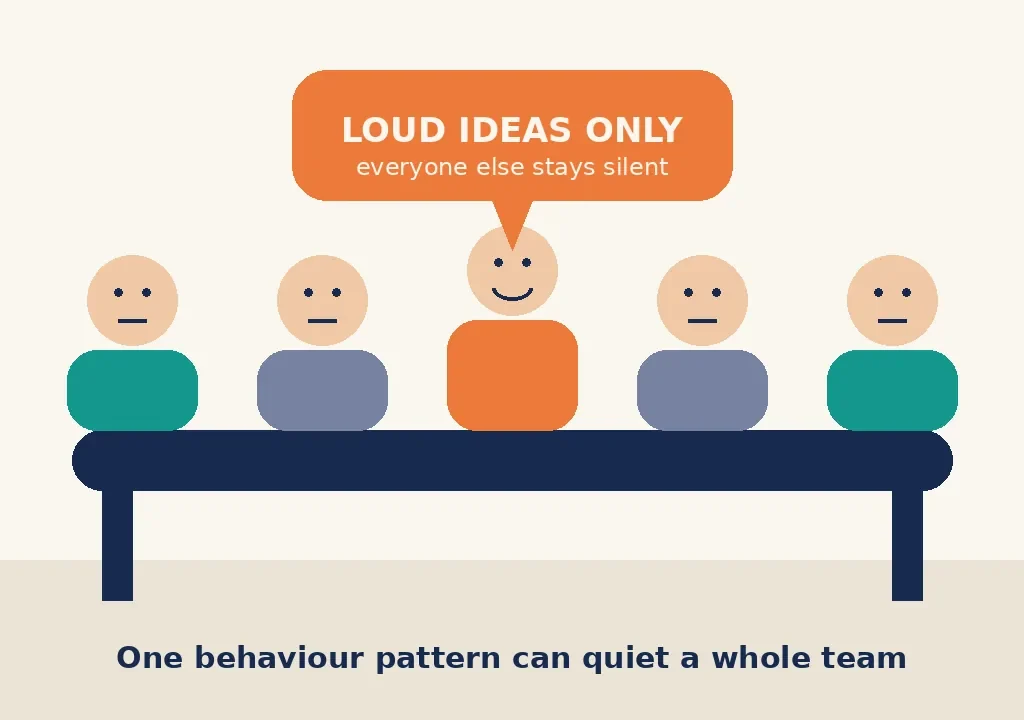
- Decisions: Quiet members stay silent, so the team hears fewer views.
- Culture: Others copy the behaviour, or give up.
- Retention: Good people leave first, because they can.
- Leader credibility: If a manager ignores harm because the person is “talented,” the team stops believing in fairness.
The idea behind it: Amy Edmondson studied 51 work teams in a manufacturing company. She found that when a team feels safe to take interpersonal risks (this is called psychological safety), the team learns better, and learning is linked to better performance (Edmondson, 1999). A person who makes others afraid to speak breaks this safety.
The Star Performer Trap
Many managers say, “But she delivers numbers!”
Research you can trust: Michael Housman and Dylan Minor studied more than 50,000 workers across 11 firms (Harvard Business School working paper, 2015). They defined “toxic” workers as those who cause harm to the organisation or its people. Their findings include:
- Toxic workers often produce more output than average, which is why they get protected.
- The authors estimated that replacing a toxic worker with an average one saved about twice as much as replacing an average worker with a superstar.
What this means: Speed is easy to see. Harm is hidden. A person who finishes tasks fast but makes three teammates unhappy may cost more than they give.
Limits: This is a working paper from one data source. It does not prove that any single person is “toxic.” Use it to question assumptions, not to judge anyone.
Personality Problem or Simple Personality Difference?
Use this original table to tell them apart.
| Question | Personality Difference | Interpersonal Conflict | Persistent Harmful Behaviour |
|---|---|---|---|
| How often? | Always part of the person | Sometimes, around one issue | Repeats across people and weeks |
| Who is affected? | Nobody is harmed | Two people or one task | Many people, or the whole team |
| What happens after feedback? | Nothing needs fixing | Both sides adjust | Little or no change |
| Effect on work | None | Short delay | Missed work, silence, exits |
| Best response | Respect it | Talk it out | Structured plan and support |
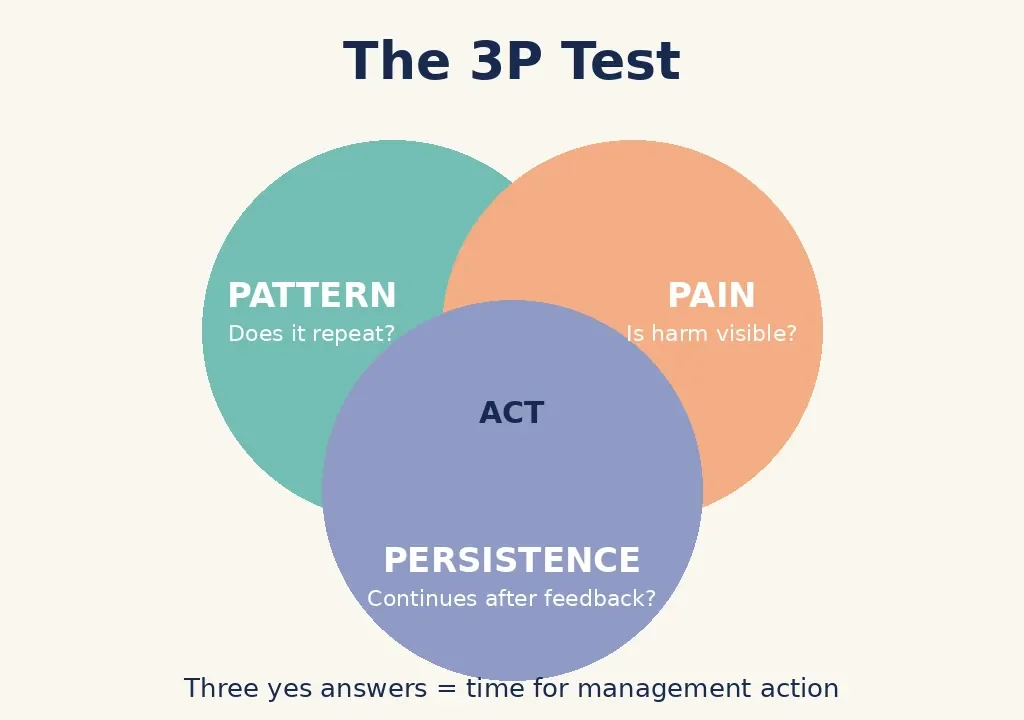
The 3P Test (author’s framework)
Ask three questions before you act:
- Pattern: Did it happen more than once, with more than one person?
- Pain: Is real harm visible in work, morale or health?
- Persistence: Did it continue after clear feedback?
If you answer “yes” to all three, you have a personality problem that needs management action. If only one is “yes,” stay calm and observe.
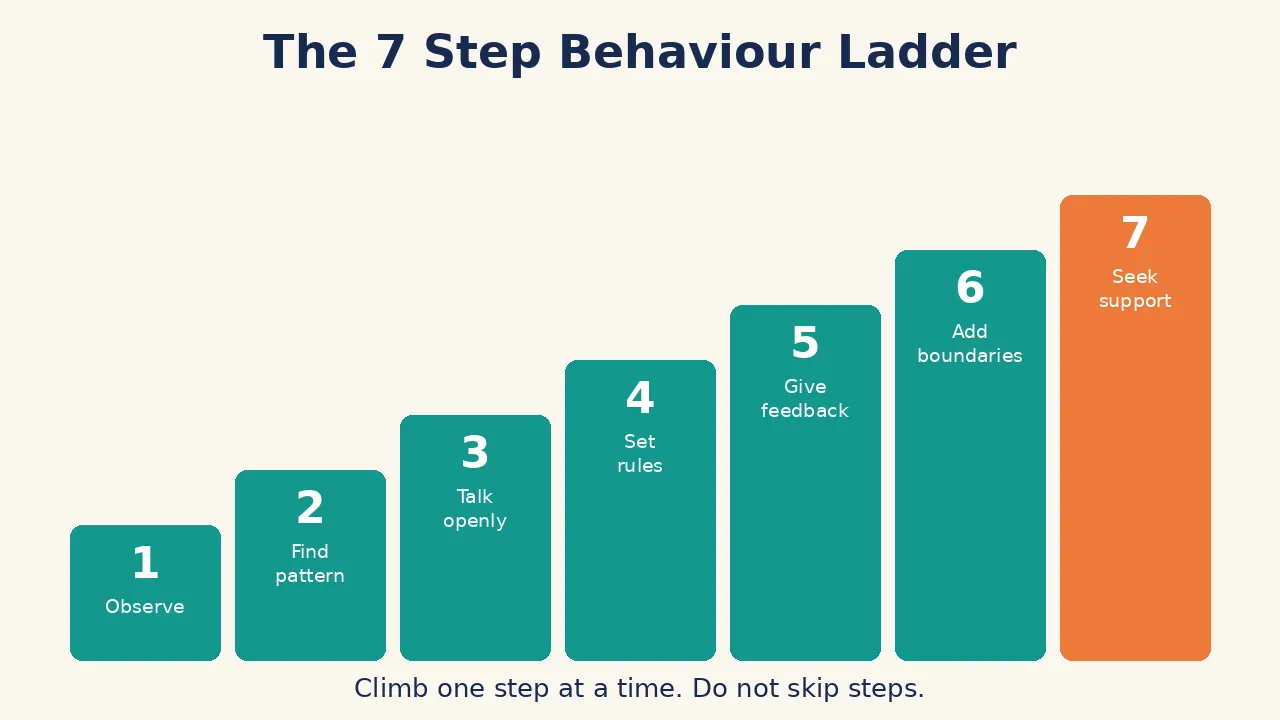
7 Practical Ways to Manage It: The Behaviour Ladder
Climb one step at a time. Do not skip steps.
1. Observe behaviour, not personality. Say “You interrupted three people in the meeting.” Do not say “You are rude.” Facts can be discussed. Labels start fights.
2. Find the pattern. Keep short, dated notes. Write what happened, who saw it, and the effect. One bad day is not a pattern. Six similar days are.
3. Talk openly and respectfully. Meet in private. Begin with the shared goal: “I want this team to do great work, and I need your help.”
4. Set clear expectations. Write them down. Example: “Questions in meetings are answered politely. Disagreements are about ideas, not people.”
5. Give specific, constructive feedback. Use three parts: what happened, why it matters, what to do next time. Keep it short and kind.
6. Add accountability and boundaries. Agree on a time to review progress. Explain what happens if the behaviour continues. This keeps professional boundaries clear.
7. Bring in HR or professional support when needed. If behaviour involves threats, harassment, or signs of deep distress, involve HR. A manager is not a doctor. Suggest support, and never guess at a diagnosis.
Real Life Style Example: What Happened to Meera’s Team
(Fictional case, built to show the ladder in action.)
Background: Meera led design at BrightLeaf Systems. She was fast and skilled.
The problem: She mocked ideas in meetings, rewrote teammates’ work without asking, and ignored messages she disliked.
Management’s mistake: Arjun only talked about deadlines. He also praised her results in front of the team, which sent the message that harm was acceptable.
Turning point: Two juniors resigned. In their exit talks, both said the same thing: “We stopped sharing ideas.”
Corrective action: Arjun used the ladder. He kept notes for three weeks. He met Meera privately and described exact events. They wrote three rules together. He asked HR to join the second meeting. He also gave the team a way to report concerns safely.
Outcome: Within two months, Meera stopped rewriting others’ work and began asking for input. One teammate still preferred to move teams, and Arjun allowed it. Not every case ends perfectly, and that is honest.
Lessons for managers:
- Talk about behaviour early, not after people resign.
- Do not reward results while ignoring harm.
- Write down expectations.
- Protect the team while you support the individual.
What Managers Often Get Wrong
Myth 1: Every difficult employee has a personality disorder. False. Most difficult behaviour is a habit, stress response or skill gap. Only a qualified professional can diagnose a disorder, and many people with a diagnosis work very well.
Myth 2: Personality cannot be managed. Partly false. We cannot rebuild someone’s character. We can clearly change behaviour at work through expectations, feedback and consequences.
Myth 3: High performers deserve exceptions. Risky. The Housman and Minor paper suggests the hidden cost can be large.
Myth 4: Avoiding conflict keeps peace. Not really. It keeps the surface calm while resentment grows. Porath and Pearson found many people simply reduce effort when they feel mistreated.
Myth 5: A manager must change the person. No. A manager’s task is to set standards and support change. The person decides whether to change.
Tools and Their Limits
| Tool | What helps | What to watch |
|---|---|---|
| Personality or behaviour tests | Start a useful talk about working styles | Not a hiring verdict. Results can be gamed or misread |
| Feedback systems (360 reviews) | Show patterns from many views | Can turn into gossip without good rules |
| Coaching | Builds self awareness and skills | Needs willingness from the person, and time |
| Mediation | Fixes conflicts between two people | Does not solve repeated harmful behaviour alone |
What Should You Do Next?
If you are a manager: Pick one worrying case. Apply the 3P Test this week. Start your notes today.
If you are an employee: Describe the behaviour that affects your work, with dates, when you speak to your manager or HR. Facts get more help than feelings.
If you lead an organisation: Include respectful behaviour in hiring, promotion and reviews. Porath and Pearson noted that few organisations consider civility when hiring. Real companies such as Zappos have used recognition programmes to reward people caught doing the right thing, as described in their HBR article.
Frequently Asked Questions
1. What is a personality problem in the workplace? It is a repeated pattern of behaviour that harms teamwork, trust or results. It is about actions, not about labelling a person.
2. How can managers handle difficult personalities? Describe the behaviour, set clear expectations, give specific feedback and follow up. Use the 7 Step Behaviour Ladder.
3. Can personality conflicts reduce productivity? Yes. In the Porath and Pearson survey, many workers who were treated rudely said they lowered their effort or the quality of their work.
4. What is the difference between a difficult personality and a personality disorder? A difficult personality is an everyday description. A personality disorder is a medical diagnosis made only by a trained professional. Managers should never make that call.
5. How should managers give feedback to difficult employees? In private, calmly, and with facts. Say what happened, why it matters and what you need next.
6. When should HR step in? When there is harassment, threats, discrimination, or no change after repeated feedback.
Conclusion: Better Behaviour, Stronger Organisations
A personality problem is rarely solved by blame. It is solved by clear standards, honest talk and fair follow up.
Look at behaviour. Protect your team. Support the person. Respect, accountability and psychological safety are not soft ideas. They are how good work gets done.
Start small. One honest conversation today can save a team next month.