
A farmer is rushed to a small hospital in a faraway village. His heart needs a delicate operation, and it cannot wait. The nearest expert surgeon is 800 km away. The road trip takes a full day. [Illustrative story, not a real patient.]
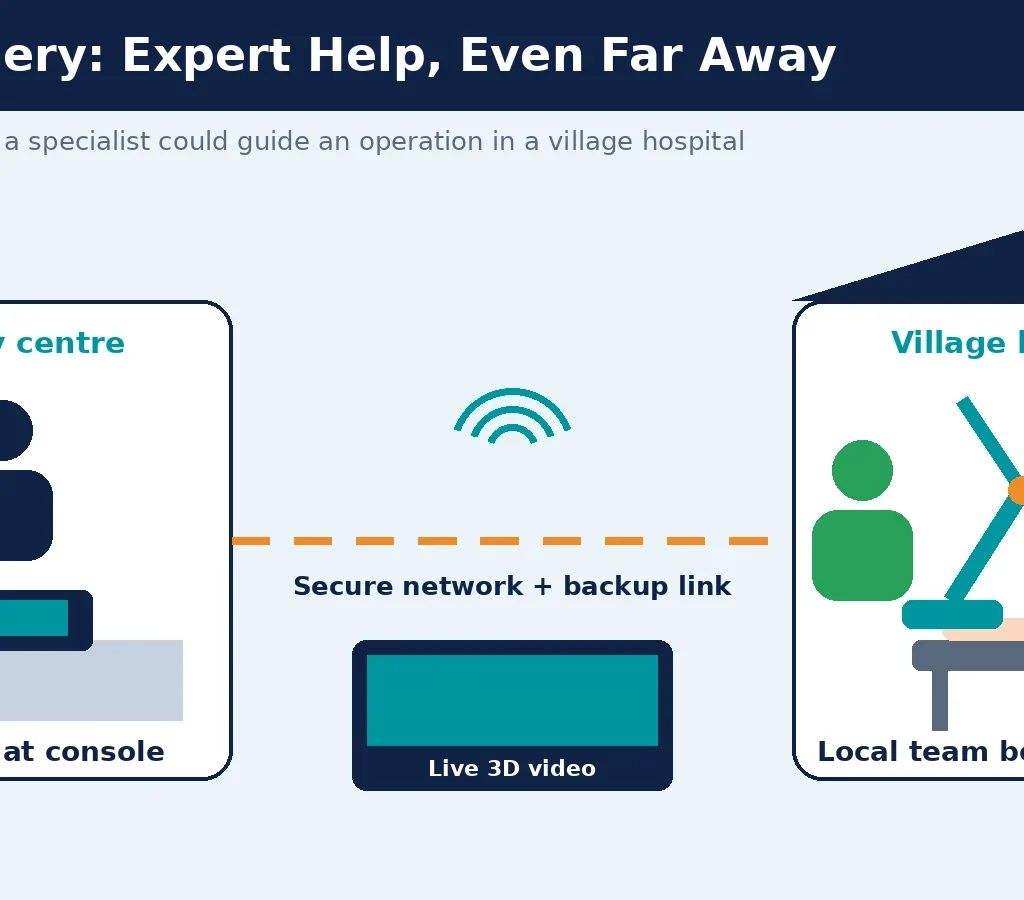
Now imagine a different ending. The expert sits at a control desk in a big city. When his hands move, robot arms inside the village operating room move with them. A local team stands beside the patient. A screen shows every tiny movement.
That idea is called tele surgery. Parts of it are already real. But big questions remain. Can a surgeon truly operate from far away? What if the internet drops? And who is ahead, India or China?
Let us find out, one step at a time.
Illustration of a specialist surgeon at a console connected to a rural Indian hospital operating room
Table of Contents
What Exactly Is Tele Surgery?
Tele surgery means a surgeon operates on a patient who is in a different place. The surgeon uses a robot, a fast network and live video.
Many people mix up two things, so let us separate them.
- Robotic assisted surgery: The surgeon sits in the same room as the patient and controls robot arms from a console. This is common in many hospitals.
- True tele surgery: The surgeon is in another building, city or country. The signal travels over a network.
Every tele surgery uses a robot. But most robotic surgery is not tele surgery. This difference matters, because distance adds new risks, mainly delay and signal loss.
How Does Tele Surgery Actually Work?
Think of it like a very careful video game, but with a real patient and real safety rules.
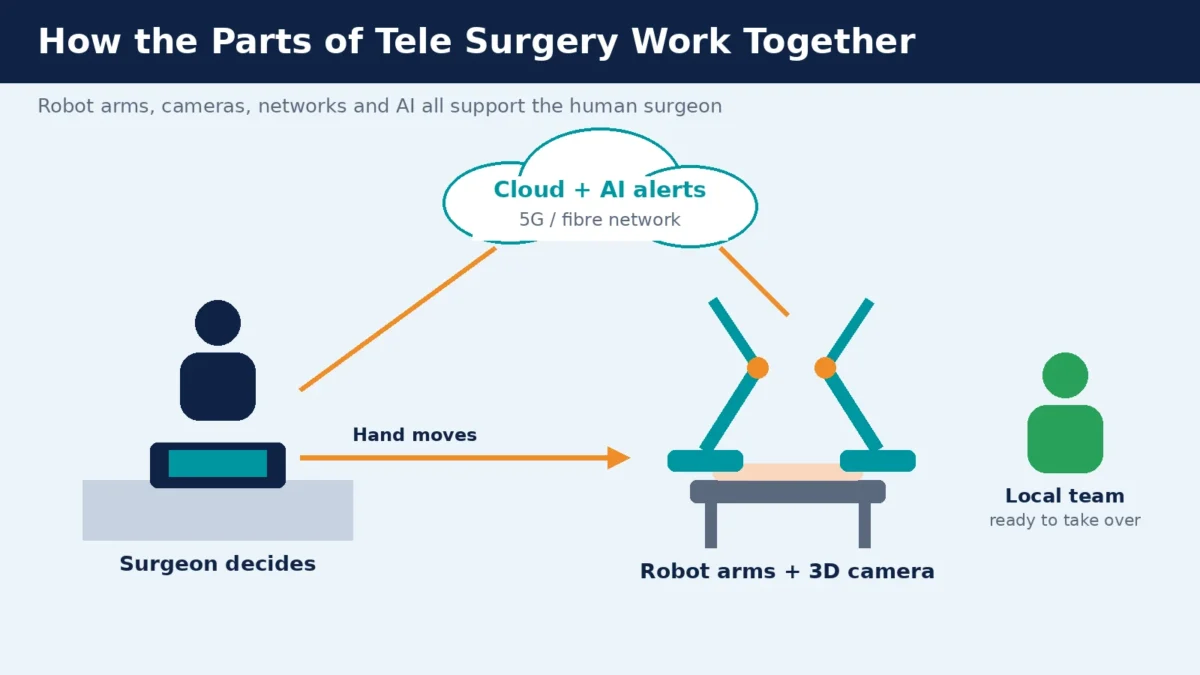
- The surgeon’s console. The surgeon looks into a 3D screen and holds hand controls.
- The network. Hand movements turn into digital signals. They travel by fibre cable, 5G or a dedicated line.
- The robot arms. In the patient’s room, thin robotic tools copy the hand movements.
- The camera. A tiny camera sends a live 3D picture back to the surgeon.
- The local team. Doctors and nurses stay beside the patient. They place the robot, manage anaesthesia and are ready to take over.
The hardest word here is latency. It means delay. It is like talking on a phone line with an echo. If the delay is too long, the surgeon’s hand and the robot’s tool drift apart. Researchers often say a delay of roughly 200 milliseconds or less is workable for many tasks. That is a short blink of time, and it is a limit that engineers work very hard to stay under.
A famous early test happened in 2001. A surgeon in New York removed a gallbladder of a patient in Strasbourg, France, across the Atlantic. It was published in Nature (Marescaux et al., 2001) and proved the basic idea.
Tele Surgery: India vs China
Which country should we compare with India? China is a fair choice because it has strong evidence of its own. Both countries have made real progress. They also both have gaps.
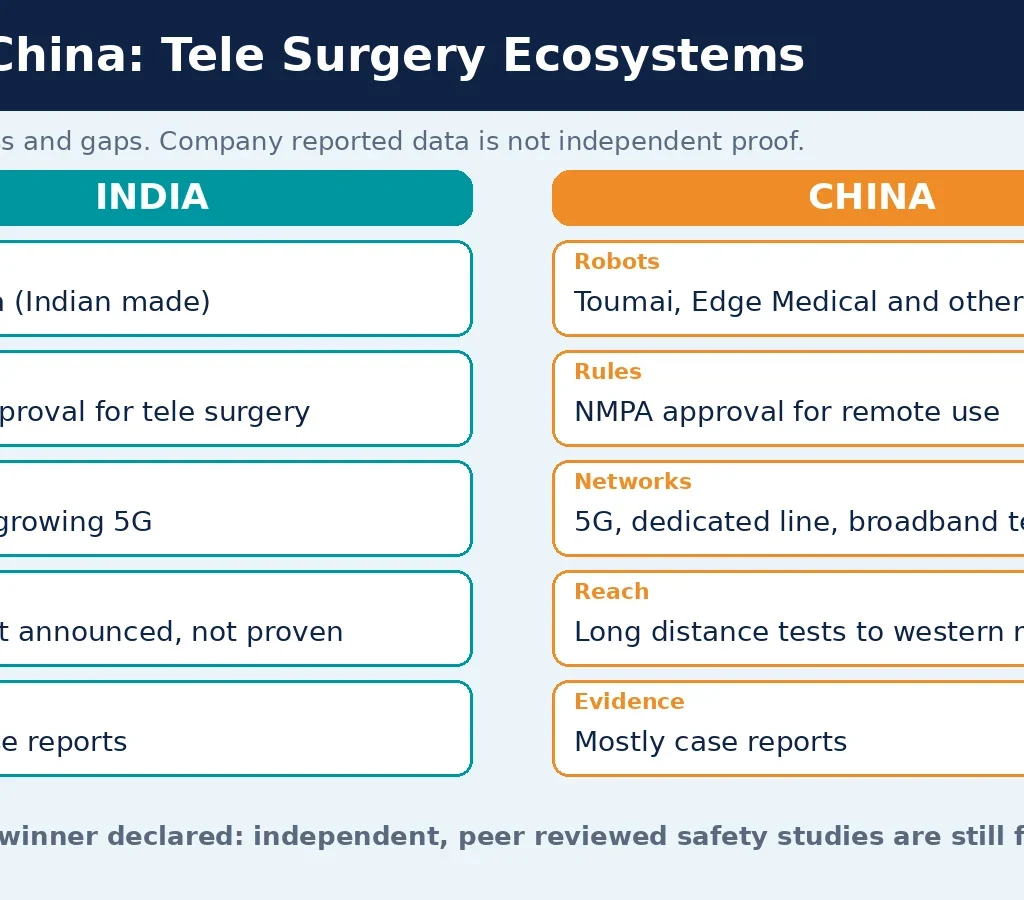
Visual comparison of India and China tele surgery systems
| Area | India | China |
|---|---|---|
| Research and testing | SS Innovations says over 150 tele surgeries were done with its SSI Mantra robot by March 2026 [Company reported] | MicroPort MedBot did a 5G surgery over 5,000 km (Shanghai to Xinjiang) in 2022, and reports hundreds of remote cases since [Company reported] |
| Robot supply | SSI Mantra: 138 systems in eight countries by 30 Nov 2025 [Company reported] | Several home makers, such as MicroPort and Edge Medical |
| Making robots at home | A few firms, led by one main player | Several large firms, now selling abroad |
| Networks | 5G is spreading. Long distance cases often use fibre links | Tests done on 5G, dedicated lines and normal broadband |
| Hospital readiness | Strong in a few big centres, weak in villages | Toumai used in 40+ hospitals across 20 provinces by 2023 [Company reported] |
| Training | Training hubs such as IRCAD India in Indore | A national tele surgery standard drafted with MicroPort’s input, according to its own slides |
| Rules | CDSCO approved SSI Mantra 3 for tele surgery and tele proctoring | NMPA approved Toumai Remote for commercial use, announced May 2025 |
| Cost for patients | Makers say lower costs than imported robots. No independent price study found | No clear independent comparison found |
| Rural access | Mobile tele surgery unit announced March 2025. Not yet proven at scale | Long distance tests to remote western regions |
| Strong evidence | Mostly case reports and company data | Mostly case reports and company data |
How to read this table. Neither country has a clear win. China looks stronger in the number of makers, formal rules and tested network types. India looks strong in low cost design and in long distance demonstrations by a single fast moving company. The honest gap for both is the last row. Big, independent, peer reviewed studies on patient safety are still few.
Also notice that both sides claim “world firsts”. They often mean different things. One says “first approved for commercial remote use”. The other says “first approved for remote surgery and remote teaching”. Always ask what exactly the first was.
India’s Tele Surgery Revolution: Opportunity or Challenge?
India has a simple problem. Great surgeons work mostly in big cities, while many patients live far away.
A real example helps here. In January 2025, Dr Sudhir Srivastava operated from Gurugram on two heart patients in Manipal Hospital, Jaipur. The distance was 286 kilometres, and the robot used was the Indian made SSI Mantra 3. One procedure took 58 minutes. [Company reported] Later reports describe longer cases: a 2025 link between India and France, a Perth to Indore case in May 2026, and an India to Colombia case of about 22,000 km in July 2026. On 14 February 2026, 18 tele surgeries were done between two Indian cities in about eight hours. [Company reported]
These are big steps. But notice what they prove and do not prove. They show the technology can work in skilled hands. They do not yet prove that it is safe and cheap for every ordinary district hospital.
Three open questions remain:
- Who pays for the robot and the stable network?
- Who is legally responsible if something goes wrong?
- Are there enough trained local teams?
On the United States side, the company filed for FDA 510(k) review in December 2025. I could not confirm a final decision in my research, so please check the FDA database before publishing any claim.
The Technology Behind the Breakthrough
Five parts must work together.
- Surgical robots copy the surgeon’s hand movement and shrink it, so tiny cuts become possible.
- Fast networks such as fibre and 5G carry signals. 6G is only a research idea for now.
- Haptic feedback means a sense of touch. It is still limited in most systems, so surgeons rely mostly on sight.
- Cloud computing and imaging store scans and let teams plan together.
- Artificial intelligence can help with planning or safety alerts. It does not replace the surgeon.
Cybersecurity sits across all of them. A tele surgery link must be encrypted, because a hacked connection is a patient safety problem, not only a data problem.
Advantages That Could Transform Healthcare
Already shown in real cases: specialist skills can reach a distant hospital, and surgeons can teach others while operating.
Still only possible, not proven at scale: fewer long trips for patients, lower treatment costs, and faster care in emergencies.
Be careful with the second list. Saving travel is a fair hope. Saving money overall depends on robot prices, network costs and insurance, and we lack independent data.
The Hidden Risks Nobody Should Ignore
- Network failure. The link can freeze or drop.
- Delay. Even a small delay can cause a wrong move.
- Hackers. A tele surgery link needs strong security.
- Privacy. Patient videos and scans must be protected.
- Cost. Robots and special networks are expensive.
- Law. Who is responsible, the remote surgeon, the local team or the hospital?
- Emergencies. If bleeding starts, someone in the room must act at once.
This is why a local surgical team always stays beside the patient and is ready to finish the operation by hand if needed.
A Real World Application: A Remote Indian Hospital
[Illustrative example, not a real hospital.] Picture a district hospital called Hospital A. It is 700 kilometres from a big surgical centre called Centre B.
- Assessment. Hospital A’s doctors take scans and send them to Centre B.
- Planning. The specialist at Centre B studies the scans and decides if remote surgery is safe for this patient. If not, the patient is transferred.
- Preparation. Local surgeons, nurses and an anaesthetist set up the robot. Centre B tests the network.
- Surgery. The specialist operates remotely while the local surgeon watches.
- Recovery. The local team handles aftercare, with video check ins from Centre B.
What if the signal fails? The robot is built to freeze in place instead of moving on its own. The local surgeon takes over, either continuing with the robot or switching to the usual method. A backup network stands ready. The team agrees on this plan before the first cut.
What Will Tele Surgery Look Like in 2027 and Beyond?
Nobody can promise exact dates. Here is a safe way to think about it.
- Already in clinical use: Tele surgery in approved systems in limited settings in India and China, plus remote teaching.
- Under study: Wider approvals in other countries, safer network links, and more complex operations at long distances.
- Possible, not proven: Truly everyday tele surgery in district hospitals, advanced touch feedback and AI that guides steps. Treat these as hopes, not facts.
What Should India Do Next? The 5 Locks of Safe Tele Surgery
A door needs several locks. Tele surgery is the same. We suggest a simple test called the 5 Locks Test. If any lock is missing, do not operate remotely.
- Line lock: a tested main network and a backup network.
- Machine lock: a robot with proper approval and regular checks.
- Team lock: trained surgeons and a ready local team.
- Plan B lock: a written emergency plan for every case.
- Rules lock: clear legal duties, patient consent and cyber protection.
To get these locks everywhere, India needs better digital networks, affordable Indian made robots, clear national standards, training, strong cybersecurity and independent clinical trials that publish their results for everyone to check. Hospitals, lawmakers, companies and medical colleges each hold a different key.
Common Misconceptions
- “Robotic surgery means remote surgery.” No. Most robotic surgery happens in the same room.
- “AI will operate alone.” No. Today a qualified surgeon decides and supervises.
- “Distance does not matter.” It does. Delay grows with distance and network quality.
- “It is risk free.” No surgery is.
What Readers Can Do Next
- Patients and families: Ask your doctor if a procedure is done by a robot in the room or by a remote surgeon. Ask who stays beside the patient and what the backup plan is.
- Doctors and students: Learn robotic basics first. Remote skills build on them. Follow peer reviewed studies on PubMed and not only company news.
- Hospital managers: Test your network, write an emergency plan and check legal cover before buying any system.
- Technology fans: Whenever you read a “world first”, ask three questions. First what exactly was the first, second who reported it and third was it checked by independent experts?
Final Verdict: Is India Ready for the Tele Surgery Future?
Partly. India has proved it can run advanced remote cases with a homegrown robot. China has shown the value of many makers, formal rules and wide network tests. India can learn from China’s standards and regulation. India can build its own advantage in low cost design and training. The barriers are independent evidence, strong networks outside big cities and clear laws.
Tele surgery is a tool. The best version of it keeps the surgeon’s judgement and the patient’s safety at the centre. Technology should carry a skilled hand across the distance, never replace the human heart behind it.
Frequently Asked Questions
1. What is tele surgery? It is an operation in which the surgeon controls a robot from another place through a network.
2. Is tele surgery available in India? Yes, in limited settings. Reports say CDSCO has approved at least one Indian robot for tele surgery, and cases have been done between Indian cities.
3. How is it different from robotic surgery? In robotic surgery the surgeon is in the same room. In tele surgery the surgeon is far away.
4. Which country is leading? No single leader can be named fairly. China has formal approval and many tested networks. India has strong long distance case reports. Independent studies are still limited.
5. Can a surgeon operate thousands of kilometres away? Companies have reported cases over thousands of kilometres. These are specialised cases with backup teams, not routine care.
6. What if the internet fails? The robot stops safely and the local surgical team takes over, using a backup network or the usual method.
7. Is tele surgery safe? It can be, with approved devices, trained teams, backup plans and careful patient selection. Large independent safety studies are still needed.
8. Will AI replace surgeons? No evidence supports that today. AI can assist, but qualified surgeons stay responsible.
This article is for general learning and is not medical advice. Talk to a qualified doctor about any treatment.