
Priya was the star hire. Six months later, her manager wrote one word in her review: “Late.”
Her reports missed the Friday deadline three times. A big client project began to slip. Her team grew tired of covering for her. In a quiet meeting, her manager said, “Maybe we hired the wrong person.”
Then a new team member asked a simple question. “Where are the old client files?”
Nobody knew. The files lived in four different places. Two experienced people had left last year, and the way they did the work left with them. Priya took tasks from three bosses, and each boss wanted something different. Her training was one short video.
Priya was not the problem. She was the first person to feel the problem.
This is the hidden story behind many an underperformer. Before you judge the person, look at the place. Management researchers have a name for that place. They call it organizational capital.
1. The Hidden Cost of an Underperformer
Poor performance is expensive. It hurts five things at once:
- Productivity: Work slows down or gets done twice.
- Morale: Good colleagues get tired of covering the gaps.
- Customers: They feel the delays and the mistakes.
- Deadlines: One late task pushes the next one back.
- Results: Profit and trust both fall.
The biggest cost is the hidden one. If you blame the wrong cause, you fix the wrong thing. You replace the person, and the next person hits the same wall.
There is a second trap. Researchers Jean-Francois Manzoni and Jean-Louis Barsoux studied boss and worker relationships for about ten years. They found that bosses often treat a person they see as weak in a different way. The boss checks every step and gives less freedom. The worker loses confidence and performs worse. The boss then says, “See? I was right.” They named this the set-up-to-fail syndrome.
Sometimes the underperformer is partly created by the way the person is managed.
Table of Contents
2. What Organizational Capital Really Means
Think of a school. The teachers are the people. The desks and buildings are the things. But a school also has a timetable, shared lesson plans, clear rules, and a habit of helping each other. Take those away, and even great teachers struggle.
That invisible part is organizational capital. It is everything a company knows and has built that stays in the building when people go home.
Economists Edward Prescott and Michael Visscher introduced the term in 1980. Their list included what a firm knows about the abilities of its people, and how well it matches people to jobs. You can read this idea in this NBER chapter on organization capital.
It has five parts:
- Knowledge: Written guides, past lessons, and shared files.
- Processes: The steps for getting work done.
- Culture: How people treat mistakes, questions, and each other.
- Technology: Software and tools that help work flow.
- Relationships: Trust between teams, customers, and partners.
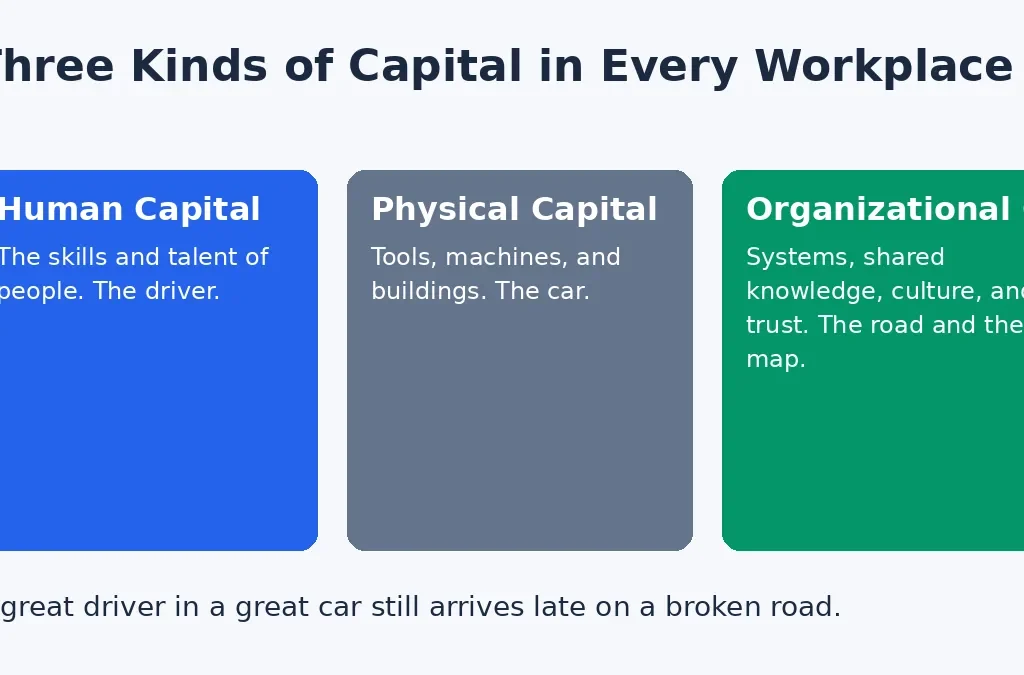
Here is how it differs from the other two kinds of capital:
| Type | What it is | Example | When it is weak |
|---|---|---|---|
| Human capital | Skills and talent in people | A skilled designer | A skill gap |
| Physical capital | Tools, machines, buildings | Laptops, factory lines | Work slows down |
| Organizational capital | Systems, shared knowledge, culture | Clear onboarding, one filing system | Talented people struggle |
Here is an easy way to remember it. The employee is the driver. The tools are the car. Organizational capital is the road, the map, and the traffic rules. A great driver in a great car still arrives late on a broken road with no map.
3. Why Good Employees Sometimes Underperform
Four reasons good employees underperform: skill gap, motivation, management, and structure
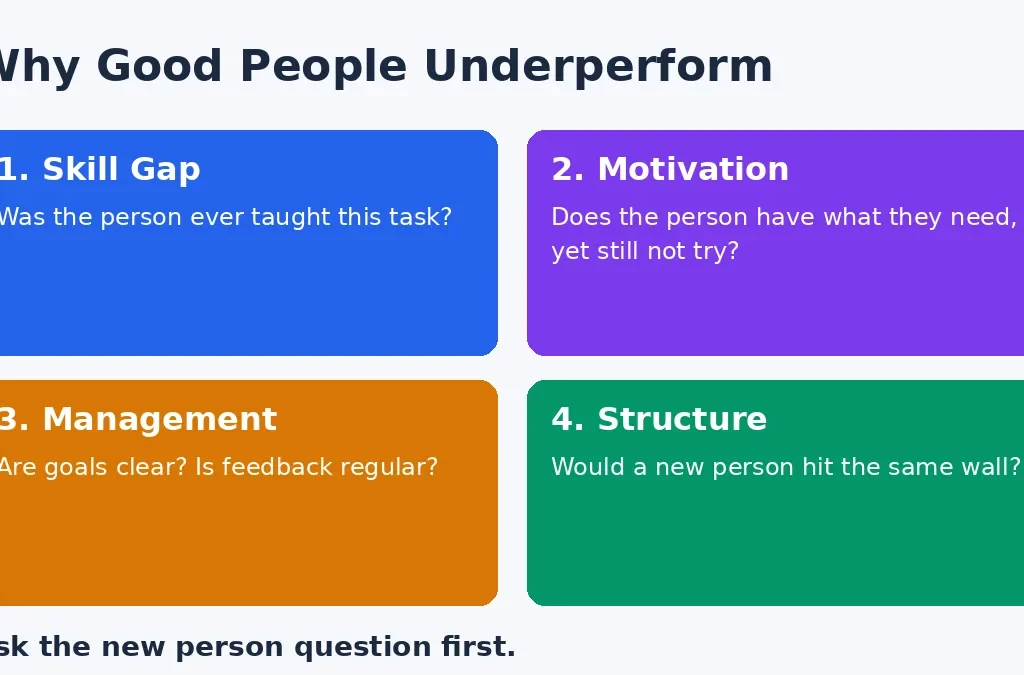
Not every underperformer lacks ability or effort. That is the most common mistake managers make. There are four different causes, and each needs a different fix:
- Skill gap. The person was never taught the task. Ask: “Has this person done this well before, or been shown how?” Fix: training and coaching.
- Motivation problem. The person has the tools and clarity but does not try. Ask: “Does anything block them, or is it truly a lack of effort?” Fix: an honest talk, and sometimes a role change.
- Management failure. Goals are vague. Feedback is rare. Fix: better leadership habits.
- Structural problem. Systems, tools, or handoffs are broken. Fix: repair the system.
Here is the best test I know. Call it the new person question: “If we put a brand new, skilled person in this seat, would they hit the same wall?”
If the answer is yes, you do not have an underperformer problem. You have an organizational capital problem.
4. The Organizational Capital Connection
Good systems and shared knowledge make average effort produce good results. Weak systems make great effort produce poor results. Three pieces of evidence help here. Each one has limits.
Gallup, 2015. Gallup measured the engagement of about 27 million employees across more than 2.5 million work units over two decades. It estimated that managers account for at least 70% of the variation in engagement scores across teams. What it means: Who leads you and how your team runs matter a lot. Limit: This is about engagement, not job results. It also describes differences between teams, not what causes 70% of any one person’s work.
Atkeson and Kehoe, 2005. Two economists built a model of US manufacturing plants. It estimated that payments to organization capital were more than one third of payments to physical capital, after new investment. See the Minneapolis Fed paper. What it means: The invisible part of a business has real money value. Limit: It is a model, not a count. It looks at manufacturing, not offices. Experts also still disagree on how to measure organizational capital.
W. Edwards Deming’s estimate. The quality expert estimated that about 94% of problems in organizations belong to the system, and only about 6% to individual workers. What it means: Most troubles are common causes, not special ones. Limit: This was his experienced estimate, not a measured law. Use it as a thinking tool, not as a fact.
Put together, the lesson is not “people do not matter.” The lesson is that people and systems work as a pair. Judge only the person, and you miss half the picture.
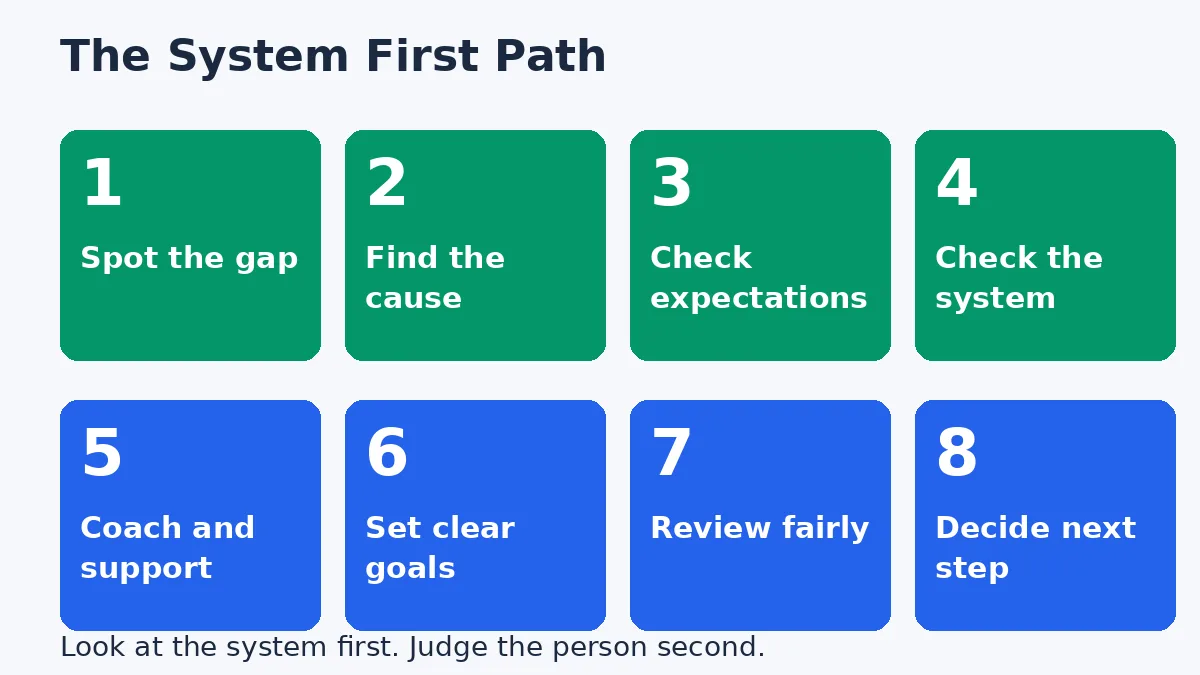
5. A Practical Framework: The System First Path
The System First Path, an eight step process for managers
Image alt text: Eight numbered boxes showing the System First Path from spotting the gap to deciding the next step.
Here is an original eight step method. The name is the rule: look at the system first, and the person second.
- Spot the gap. Write down what was expected and what happened. Use facts, not feelings.
- Find the cause. Pick one of the four causes: skill gap, motivation, management, or structure.
- Check expectations. Ask the person to say the goal in their own words. If it is different from yours, you have found something.
- Check the system. Look at training, tools, handoffs, communication, and culture. Use the new person question.
- Coach and support. Fix what is broken first. Then offer coaching for any real skill gap.
- Set clear goals. Make them measurable, such as “90% of tasks on time for eight weeks.”
- Review fairly. Meet on a set day each week. Talk about progress, not blame.
- Decide the next step. If the system is fixed and the gap remains, then think about a role change or a hard conversation.
Notice that the hard conversation comes last, not first. That order protects both fairness and results.
6. A Real Example and a Practice Run
The real example: Deming’s Red Bead Experiment. Deming used this exercise in his management seminars. People played “willing workers” in a pretend factory. The box held 4,000 beads, with 800 red and 3,200 white. A paddle with 50 holes scooped them up. Red beads were called defects. The workers had to follow strict rules, and they could not choose which beads they picked.
Results still varied from worker to worker and from day to day. Yet the “managers” praised some workers and scolded others. Deming’s point was that the red beads were in the system, so the variation came from the system. You can read more on the Deming Institute site and in this summary with sample results. Limit: It is a teaching game. Real workplaces are messier, and some real people do have real gaps.
The practice run (hypothetical): Let us return to Priya.
- Spot the gap: She missed three of four Friday deadlines.
- Find the cause: Mostly structural, with some management failure.
- Check expectations: She had three bosses with three priority lists.
- Check the system: Files were in four places. Training was one video.
- Support: One priority list, one shared folder, and a buddy for two weeks.
- Goal: 90% of tasks on time for eight weeks.
- Review: Fifteen minutes every Friday.
- Next step: If late tasks continue after the fixes, look at skills and fit.
In this made up case, her on time rate rose as the system improved. The same fixes also helped the next three hires.
How different teams can use it:
- Small business: Start with one shared folder and one weekly check in.
- Large company: Review your handoffs between departments.
- Team leader: Ask the new person question before every tough review.
7. Benefits, Limits, and What to Do Next
Benefits: Fixing the system helps everyone, not just one person. It saves hiring costs. It keeps knowledge when people leave. It also builds trust, since people see that managers look at facts first.
Limits: Organizational capital cannot fix a wrong hire, a refusal to try, or unsafe or dishonest behavior. It takes time to build. It is also hard to measure. And sometimes the person truly is the problem.
Do these five things this week:
- Run the new person question on your hardest case.
- Write one page that lists the top three priorities for each person.
- Put your key files and guides in one place.
- Start a fifteen minute weekly check in.
- Write down what you learn so the next person does not start from zero.
Frequently Asked Questions
What is organizational capital? It is the knowledge, processes, culture, tools, and relationships that belong to a company, not to one person. It stays even when people leave.
How does organizational capital improve employee performance? It removes hidden blocks. Clear goals, shared knowledge, and good tools let people spend their effort on the work, not on hunting for answers.
Why does an employee become an underperformer? There are four common causes: a skill gap, a motivation problem, a management failure, or a structural problem. Many managers see only the first two.
Can organizational capital help a struggling employee? Yes, when the cause is the system or the management. It cannot fix a lack of effort or a poor fit by itself.
What is the difference between human capital and organizational capital? Human capital lives in people, such as skills and talent. Organizational capital lives in the organization, such as systems and shared knowledge.
How can managers find the real cause of poor performance? Use the new person question. Then check expectations, training, tools, and communication before judging the person.
Can small businesses build organizational capital? Yes. Written steps, one shared folder, clear priorities, and a weekly check in cost very little and help a lot.
Conclusion
An underperformer is a signal, not a verdict. Sometimes the signal points to the person. Often it points to unclear goals, scattered knowledge, weak leadership, or broken handoffs.
Strong organizational capital helps people do better work and helps a business bounce back when people leave or markets change.
So here is one thought to keep. Before you judge your people, examine your system.