
Aarav is nine. He is funny. He builds amazing Lego cities. He can tell you every fact about space.
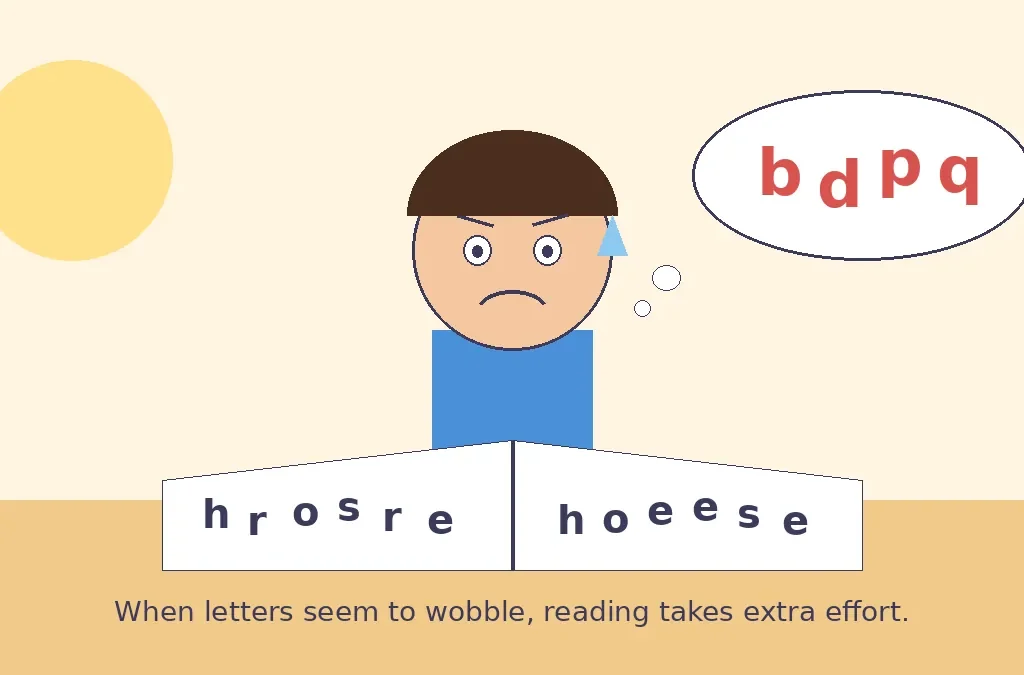
But when his teacher asks him to read out loud, his ears turn red. He looks at the page. The words seem to wobble and fight him. He starts to guess. “House” becomes “horse.” The class laughs. Aarav tells his mom, “I am just dumb.”
He is not dumb. Not even close.
(Aarav is an illustrative composite, not a real child.)
Young child looking at a book with a worried face, showing dyslexia struggle
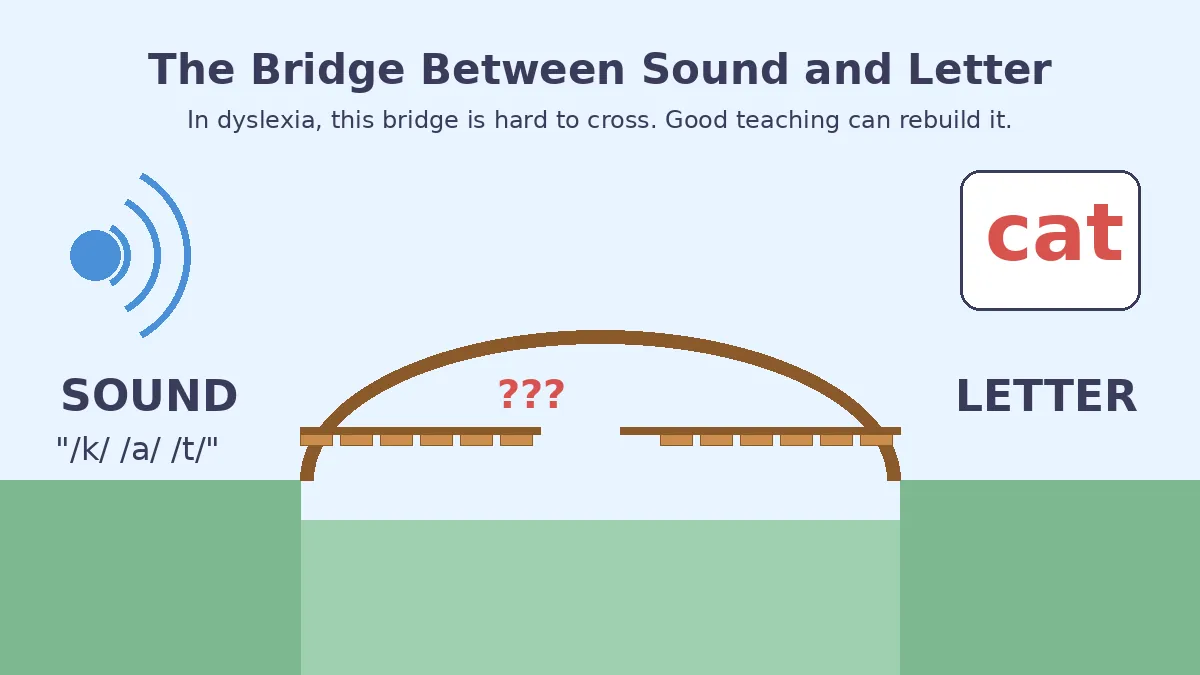
Aarav is stuck on a bridge. The bridge sits between the sounds he hears and the letters he sees. In this article, you will learn what that bridge is, how to spot a shaky one early, and how to help your child cross it. I wrote this in simple words so everyone could read it. That matters, because many kids with dyslexia find long, hard text painful.
Table of Contents
What Dyslexia Really Is
Dyslexia is a learning difference that makes reading and spelling hard. The International Dyslexia Association says it comes from trouble with the sound part of language. In plain words, the brain finds it hard to link the sounds in speech with the letters on the page.
Here is what dyslexia is not:
- It is not laziness.
- It is not low intelligence. Research from Yale shows kids with dyslexia often have average or high intelligence.
- It is not a problem with eyesight.
Simple drawing of a bridge between a sound and a letter inside a child’s brain
How common is it?
Sources give different numbers. The Yale Center for Dyslexia & Creativity says it affects about 20 percent of people. The International Dyslexia Association says 15 to 20 percent show some signs of reading difficulty linked to dyslexia. Some other studies give lower numbers, up to about 10 percent of school children. The range is wide because experts draw the line in different places. Either way, in an average classroom of 30 kids, more than one child is likely working extra hard just to read.
The 7 Powerful Signs of Dyslexia
No single sign proves dyslexia. Look for a pattern that lasts. Sign 1: Late or unclear early speech. Some research summaries say children who say first words after about 15 months, or first short sentences after about 2 years, face a higher chance of reading trouble later. Many late talkers read just fine. So treat this as a small flag, not a verdict. A family history of reading trouble raises the flag a bit higher.
Sign 2: Trouble with rhymes and sounds. Your child cannot clap out the parts of “banana.” Nursery rhymes will not stick. Cat, hat, and mat do not feel like a family.
Sign 3: Slow letter learning. By kindergarten and first grade, most kids know many letters and their sounds. A child with dyslexia may forget them again and again, even after lots of practice.
Sign 4: Guessing instead of reading. Instead of sounding out a word, the child looks at the first letter and the picture, then guesses. “Pond” becomes “pool.” This is a smart survival trick, but it falls apart as books get harder.
Sign 5: Reading that is slow and tiring. After a short page, your child is worn out. Spelling is full of surprises, and the same word may be spelled three ways on one page.
Sign 6: Big gap between talking and writing. The child tells brilliant stories out loud but writes two weak lines. Experts call this a gap between spoken ability and written work. In older children, it is one of the clearest clues.
Sign 7: Hidden feelings. Stomach aches on school days. Jokes to avoid reading. Anger at homework. The APA reported that children who struggle with reading early are more likely to show social anxiety by fifth grade. The feelings are often the loudest sign.
Colorful chart of dyslexia signs in preschool, primary school and teenage years
Signs by age at a glance
| Age group | What you may notice |
|---|---|
| Preschool (3 to 5) | Trouble with rhymes, new words, and letter names |
| Grades 1 to 3 (6 to 8) | Guessing words, mixing up similar sounds, very slow reading, poor spelling |
| Grades 4 to 6 (9 to 11) | Reads slowly with huge effort, weak writing compared to speaking, growing school worry |
| Teenagers (12 to 18) | Avoids reading aloud, struggles with long texts and exams, low confidence, may hide the problem with jokes or anger |
Myth Check: Letters Do Not Flip Backward
Many parents believe dyslexia means seeing letters backward. The Yale Center for Dyslexia & Creativity calls this a myth. Beginners often mix up b and d until about age 7, and that is normal. Dyslexia lives in how the brain handles sounds, not in how the eyes see shapes.
Two more myths to drop:
- “They will grow out of it.” Dyslexia does not vanish. But with the right teaching, reading can improve a lot.
- “Wait until third grade to test.” Experts quoted in school guidance say trained professionals can spot it much earlier. Waiting only lets the gap grow.
Introducing the 4 Bridge Check (An Original Home Tool)
I built this simple check for parents who feel lost. A child needs four bridges to read well. Test each one in a relaxed, playful way. Do not make it feel like an exam.
| Bridge | Quick play test | Red flag if it keeps happening |
|---|---|---|
| 1. Sound Bridge | Ask “What word is left if we remove the /k/ from cat?” | Cannot play with sounds, even with hints |
| 2. Letter Bridge | Point to a letter and ask for its sound | Forgets sounds again and again |
| 3. Speed Bridge | Read a short, easy page together and watch the effort | Very slow, many guesses, very tired |
| 4. Heart Bridge | Ask “How do you feel when it’s reading time?” | Fear, anger, tears, or shutdown |
If two or more bridges look shaky for several weeks, book a proper assessment. The check is a way to notice problems. It cannot diagnose dyslexia. Only a trained professional can do that.
How Dyslexia Is Checked
Experts look at sound awareness, letter sound knowledge, and how fast a child names letters. These checks can start in kindergarten. A full assessment is done by a psychologist or learning specialist. Ask your child’s school what they offer, and ask in writing.
What Really Helps: Structured Literacy
Here is good news. Strong evidence shows a style of teaching called structured literacy works very well. It is explicit, step by step, and builds on what came before. Names you might hear include Orton Gillingham, Wilson, and SPIRE. The International Dyslexia Association supports this approach.
Think of it like teaching swimming. You do not throw a child in the deep end and say “try harder.” You start in the shallow end, one skill at a time, with a patient coach.
Teacher and child using letter tiles in a structured literacy lesson for dyslexia
Yale researchers followed more than 400 Connecticut schoolchildren from kindergarten into their early thirties. They found that early help with evidence based reading programs can greatly close the reading gap.
Simple things you can do at home
- Read together every day for 10 minutes. You read, they follow. Then swap.
- Play sound games in the car. “What rhymes with sun?”
- Praise effort, not speed. “You worked so hard on that page!”
- Use audiobooks next to the printed book. Ears can feed the brain while the eyes practice.
- Protect their strengths. Let the Lego builder build. Let the storyteller tell stories.
Teenagers: A Different Kind of Struggle
Teens with dyslexia have a harder road in some ways. Books are longer. Exams are timed. Friends notice everything. Many teens hide the problem with humor or by acting like they do not care.
Teenager using headphones and a tablet with an audiobook for dyslexia support
What helps teenagers most:
- Audiobooks and text to speech tools for long reading.
- Speech to text tools for writing first drafts out loud.
- Extra time on exams where schools allow it. In India, the Rights of Persons with Disabilities Act 2016 includes specific learning disabilities, and many boards offer support. Check your own board for exact rules.
- Watching their mood. If sadness or anxiety stays for weeks, please speak with a doctor or counselor.
Real World Proof: Dyslexia Is Not the End of Success
Richard Branson, the founder of Virgin, has spoken openly about his dyslexia. Film director Steven Spielberg shared that he was only diagnosed in his sixties, after years of feeling different. Their stories show that reading struggles and big talent can live in the same person.
The Yale team also talks about the strengths that often come with dyslexia, such as big picture thinking and creativity. That is a research view, not a promise for every child. But it is a good reminder: a child is more than a reading score.
Frequently Asked Questions
1. Can dyslexia be cured? No. It is a lifelong difference in how the brain handles language. But with good teaching, reading can get much better.
2. At what age can dyslexia be found? Risk signs can appear in preschool. Screening can start in kindergarten. Formal checks by trained professionals can happen early in school.
3. Is dyslexia linked to low intelligence? No. Research shows no link. Many people with dyslexia have average or high intelligence.
4. Does dyslexia run in families? It often does. If a parent or sibling has reading trouble, watch your child’s early language more closely.
5. Is dyslexia the same as ADHD? No, but they can appear together. Each needs its own check.
6. Do colored glasses or eye exercises help? Dyslexia is not a vision problem, so main stream evidence does not support eye based fixes. Ask your doctor before paying for any special treatment.
7. Can a teenager still improve at reading? Yes. Progress may need more practice, but teens can still grow with the right help and tools.
The Bottom Line
Aarav is not dumb. He is a smart boy standing at the edge of a shaky bridge. The sooner a grown up notices and acts, the sooner he can cross it. If you read this and thought of your own child, you took the first brave step. Use the 4 Bridge Check this week. Write down what you see. Then talk to your child’s teacher, and ask for a proper assessment.
This article is for general learning and is not medical advice. Please speak with a qualified professional about your child.