
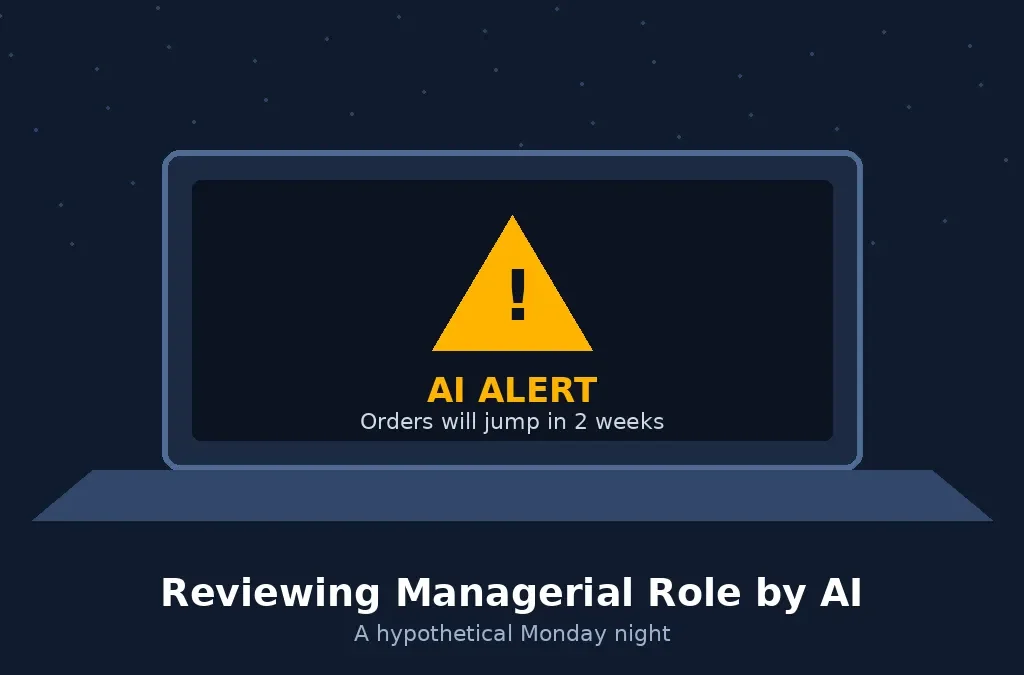
Manager reading an AI warning on a laptop late at night
It is 9:40 on a Monday night. Maya, a regional manager at a food delivery firm, is about to approve next month’s staff plan. She has done this for six years. She trusts her experience.
Then her screen flashes. An AI tool has spotted a pattern. In two weeks, orders in one city will jump. Her plan leaves that city short of drivers. Late orders, angry customers and a lost contract could follow.
Maya feels relief, because the problem was caught. She also feels fear, because she missed it herself. She has one hour. Does she trust the tool? Does she ignore it? And what is her job now?
That is the big question of 2027. Will AI become a manager’s greatest assistant, or will it change what being a manager means? Let us investigate.
Table of Contents
Why Management Is Changing in 2027
Managers used to spend long hours on schedules, reports and forecasts. AI now does parts of this work in seconds. There are three levels:
- Established: AI can sort data, spot patterns, write drafts and predict demand. These tools are in use today.
- Spreading: AI helps with scheduling, hiring screens, performance dashboards and customer replies. Adoption is real but uneven.
- Still emerging: AI agents that plan and act across many tasks on their own. These need careful testing before anyone trusts them.
Rules are arriving too. The EU AI Act treats AI used for hiring and worker evaluation as high risk. After a 2026 update called the Digital Omnibus, those duties are due from 2 December 2027. So 2027 is a year of preparation.
Reviewing Managerial Role by AI: A New Leadership Reality
Here is how AI touches each part of a manager’s job:
- Planning: AI tests many “what if” plans. Humans choose the goal and the values behind it.
- Performance reviews: AI collects numbers. Humans understand the story behind them, such as illness or a hard client.
- Hiring and workforce planning: AI sorts applications and predicts staffing needs. Humans judge fairness and potential.
- Resource allocation: AI suggests budgets and schedules. Humans handle trade offs.
- Risk and forecasting: AI spots early warnings, like Maya’s tool. Humans decide how much risk is worth taking.
- Customers: AI drafts replies and tracks complaints. Humans handle upset or sensitive cases.
- Team coordination: AI summarises meetings and tracks tasks. Humans build trust.
- Reporting: AI builds dashboards in minutes. Humans ask, “Are we measuring the right thing?”
The pattern in reviewing managerial role by AI is simple. AI is strong at speed and patterns. Humans are strong at meaning, fairness and responsibility. This is AI assisted decision making, not decision handing over. Leaders can also learn how sound principles guide leaders in a time of ambiguity.
Traditional Manager vs AI Supported Manager
| Area | Traditional manager | AI supported manager |
|---|---|---|
| Decision making | Experience and instinct | Data plus experience, but blind trust is a risk |
| Speed | Slow when data is large | Fast on routine analysis |
| Accuracy | Strong in familiar situations | Strong at patterns, weak when data is poor or biased |
| Creativity | Original human ideas | AI offers options, humans choose the fresh idea |
| Employee relationships | Personal, but time is short | More time for people if admin work shrinks |
| Accountability | Clear: the manager owns it | Easily blurred unless rules are set |
| Flexibility | Adapts to odd situations | Struggles with new situations, humans must step in |
| Ethical judgement | Human conscience | AI has none, so humans must check |
Neither column wins every row. The best manager uses both.
The Five Step Managerial Transformation Framework
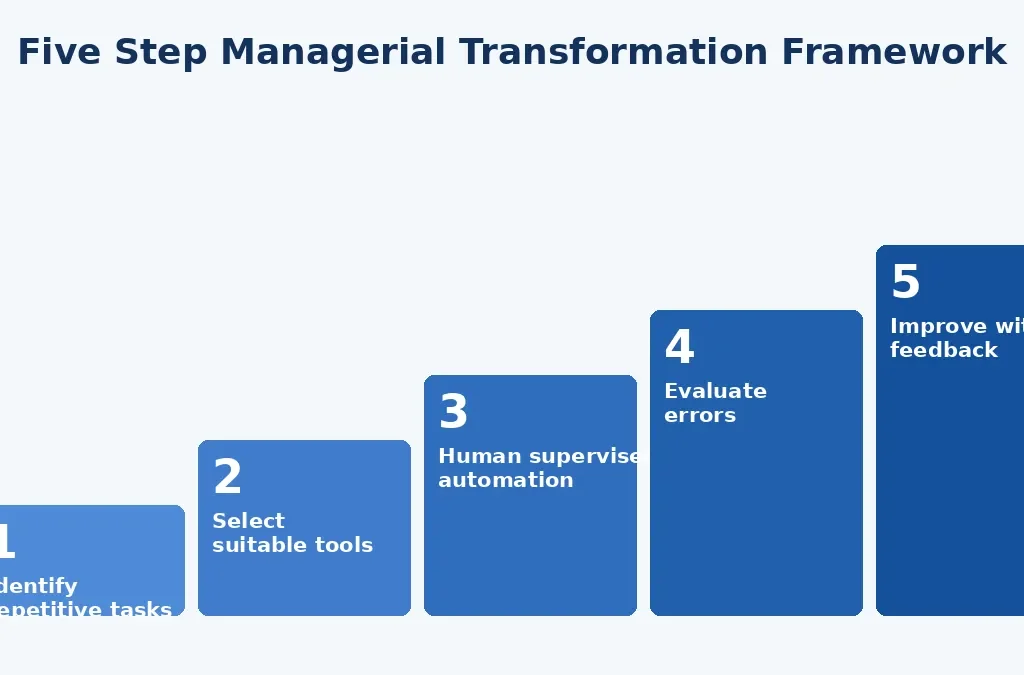
Five steps of managerial transformation shown as a simple staircase
- Identify repetitive tasks. For one week, list tasks you repeat: schedules, status reports, meeting notes.
- Select suitable tools. Start with tools you already own, such as spreadsheet add ons or calendar assistants. Read the privacy terms before pasting company data.
- Introduce human supervised automation. Let AI draft. A person approves. Never let AI alone decide anything about a person’s job or pay.
- Evaluate performance and errors. Keep an error log. Write down every wrong suggestion and how you caught it.
- Improve through feedback. Ask your team what helps and what annoys. Adjust every month.
A small business needs no big budget. A shop owner can pick one task, such as shift planning, use a free or low cost tool, and spend thirty minutes a week checking it. Start small, then grow.
A Real World Illustrative Example
This example is hypothetical. The company, the people and the story are invented. No results are claimed.
Sunrise Home Supplies is an imaginary medium sized company with stores and an online shop. Its manager, Rohan, used to spend Friday building the staff roster by hand. He checked stock by walking the aisles and read every customer email himself. Mistakes showed up late.
After the company adds AI tools, a forecast tool uses past sales and festival dates to predict stock needs. A scheduling tool suggests a roster. A service tool sorts customer emails and drafts replies to common questions.
Rohan’s duties change. Before, he did the routine work. Now he checks the roster for fairness, so nobody always gets late shifts. He questions the stock forecast when a surprise event is coming that the data cannot know. He personally calls angry customers. He reviews the error log every week.
His job did not vanish. It moved from doing to supervising and judging.
Expert Interpretation: Will AI Replace Managers?
After reviewing managerial role by AI against the evidence, my reading is this: not the whole job, but many tasks will move.
A manager’s job is a bundle of tasks. AI takes tasks out of the bundle, mostly admin. What remains becomes more valuable: setting direction, ethical judgement, solving conflict, coaching people and owning the outcome. A machine cannot be held responsible. A person can.
There is an opposite risk too. A company may cut manager roles to save money and then find nobody left to handle people problems. If your team struggles with performance, organizational capital can help an underperformer in ways no dashboard can.
This is analysis, not proven fact.
What Does the Data Tell Us?
Simple chart showing AI adoption, skills demand and job exposure
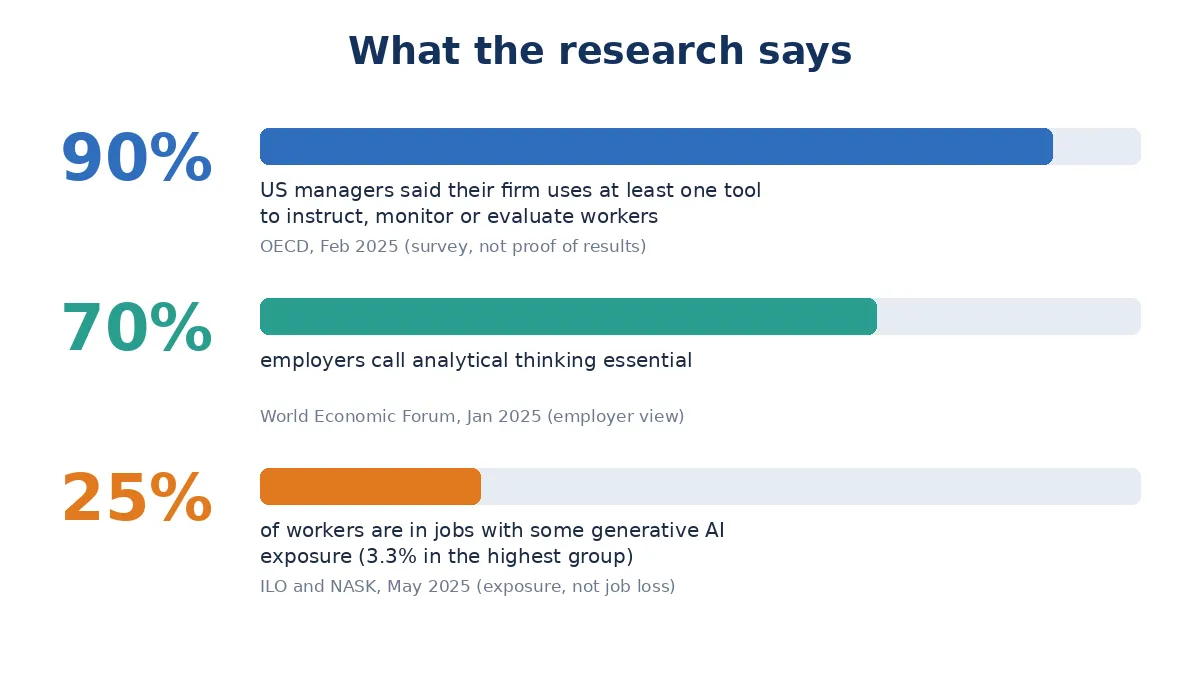
OECD, published 6 February 2025. This employer survey covered over 6,000 firms in France, Germany, Italy, Japan, Spain and the United States. In the US, 90% of managers said their firm used at least one tool to instruct, monitor or evaluate workers. Nearly two thirds of managers who used such tools had concerns about the effect on workers. What it measures: tools reported by managers, and not all are AI. Limits: six rich countries, no India, and opinions rather than proven results.
World Economic Forum, published 7 January 2025. The Future of Jobs Report surveyed over 1,000 employers in 55 economies. About seven in ten called analytical thinking essential. Employers expect 39% of workers’ core skills to change by 2030. Limits: these are employer expectations, not guaranteed outcomes.
ILO and NASK, published 20 May 2025. This study of generative AI and jobs found that about one in four workers worldwide is in an occupation with some exposure. Only 3.3% fall in the highest exposure group. What it measures: tasks that could be automated in theory. That is not job loss. The authors say transformation is more likely than replacement.
What it means for you: reviewing managerial role by AI shows that these tools are already common in management. Analysis and judgement are in demand. Total replacement is not supported by this evidence. None of these sources gives exact 2027 numbers, so we make no such claims.
Real World Applications Across Industries
- Healthcare: Managers can use AI to plan nurse shifts and expect bed demand. Humans still decide patient safety trade offs.
- Manufacturing: AI can warn that a machine may fail soon. The supervisor decides when to stop the line.
- Banking and finance: AI flags unusual transactions. A manager reviews each case fairly and kindly.
- Retail and online shopping: AI forecasts stock and return patterns. The manager negotiates with suppliers.
- Education: School leaders can use AI for timetables and attendance trends. Teachers decide how to help each child.
- Small businesses and startups: AI drafts job posts, payment reminders and simple sales forecasts. The owner keeps the customer relationship.
Advantages and Limitations
Benefits: faster analysis, less admin, better forecasts and quick information.
Limits that need attention:
- Biased algorithms. Reuters reported in 2018 that Amazon dropped an experimental hiring tool after it favoured men. It had learned from past hiring data.
- Data privacy risks when staff data goes into tools.
- Wrong recommendations that sound confident.
- Cybersecurity threats to systems that hold sensitive data.
- Employee resistance when people feel watched.
- Overdependence that weakens a manager’s own skills.
- No empathy and unclear accountability when nobody owns the result.
This is why human supervision matters. The NIST AI Risk Management Framework offers a helpful approach with four ideas: govern, map, measure and manage. Even a small team can ask these questions about any tool.
Common Misconception About AI and Managers
When reviewing managerial role by AI, many people believe AI can do every managerial task. It cannot, and three ideas explain why:
- Automating a task: sending a reminder. AI does this well.
- Supporting a decision: suggesting a roster. AI helps, but a person checks.
- Replacing accountability: deciding to dismiss someone and owning that choice. AI should never do this.
What Should Managers Do Next?
Managers, business owners, HR professionals and future leaders all need five habits: AI literacy, critical thinking, clear communication, continuous learning and ethical leadership.
HR teams should also check hiring tools for bias and follow the law in their region. Owners should start small. Students should learn basic data skills. People skills stay central, as fixing a personality problem at work shows.
Your seven day action plan:
- Day 1: List five tasks you repeat.
- Day 2: Pick one task and one tool. Read its privacy terms.
- Day 3: Run the tool beside your usual method.
- Day 4: Compare both results. Note every error.
- Day 5: Tell your team what you tried and why.
- Day 6: Write one rule about who approves AI output.
- Day 7: Decide to continue, change or stop.
Conclusion
Maya had one hour. She checked the AI’s warning against recent orders, called two drivers, and added shifts. The tool found the pattern. She made the decision and took the responsibility.
That is the heart of reviewing managerial role by AI. AI may change what managers do each day. It cannot replace judgement, responsibility, empathy and leadership. Prepare for this future instead of fearing it, and you will be the manager who uses the machine without becoming its servant.
Frequently Asked Questions
1. How is AI changing the role of managers in 2027? Reviewing managerial role by AI shows it takes over routine work such as reports, schedules and forecasts. Managers spend more time on judgement, coaching and checking AI output.
2. Can AI replace human managers? Current evidence points to changed roles, not full replacement. Some tasks will be automated. Accountability and people skills stay with humans.
3. Which managerial tasks can AI automate? Scheduling, note taking, data reports, simple forecasts and first drafts of replies. Decisions about people need human review.
4. How can small businesses use AI in management? Pick one repeated task, use a low cost tool, check every output and keep an error log. Grow only after it works.
5. What skills will future managers need? AI literacy, critical thinking, communication, ethical judgement and a habit of learning. WEF employers still rank analytical thinking first.
6. What are the major risks of AI supported management? Bias, privacy problems, wrong advice, cyber attacks, distrust and unclear responsibility.
7. How can organisations keep human accountability? Name one person who owns each AI assisted decision. Keep records. Allow staff to question or appeal results.