
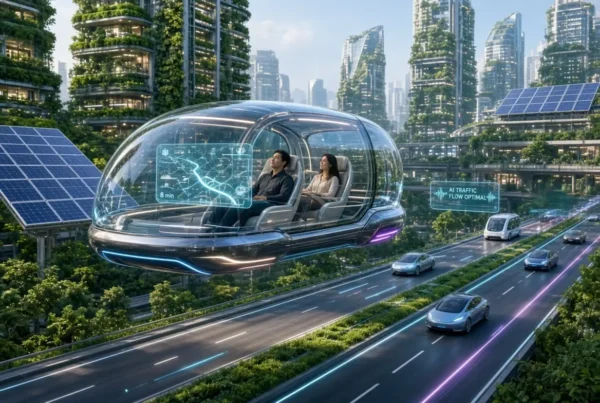
It is 6:41 on a wet Monday morning. Meera, a hospital technician, is running late for her shift. She is thinking about her phone, not the road.
A cyclist swerves out from behind a parked van. Meera’s foot has not even moved. The car brakes hard anyway, stops a hand’s width short, and her heart slams against her ribs.
Then her dashboard lights up with a calm message: Junction hazard detected. Rerouting. Her car had been warned by something she could not see.
Who made that decision? A sensor, a model, a map, a roadside unit, or all four at once? The honest answer explains the Future of mobility better than any slogan. Mobility is no longer about engines alone. It is about batteries, software, data and the grid, all learning to work together.
Let me separate what is real from what is hype.
Table of Contents
Why the Future of Mobility Is a Stack, Not a Gadget
Most people picture one invention: a robotaxi, a flying car, a hydrogen truck. That is the wrong picture.
Think of four layers: power (batteries, hydrogen, the grid), vehicles, intelligence (AI, sensors, connectivity) and services (how we pay for and share rides). A breakthrough in one layer does little if the others lag. That is why cars improve fast while charging, regulation and road design improve slowly.
Electric Vehicles: What the Numbers Really Say
The International Energy Agency (IEA) reports that global electric car sales grew 20% in 2025 to exceed 20 million, about a quarter of all new cars sold. Its Global EV Outlook 2026 expects about 23 million in 2026.
Here is what those numbers actually mean.
First, electric cars are now mainstream, not niche. Second, the same IEA report says first quarter sales in 2026 fell 8% year on year after policy changes in China and the United States. Demand depends heavily on subsidies and prices, not just enthusiasm.
Third, supply is concentrated. Chinese automakers supplied about 60% of global electric car sales in 2025, while the United States stayed just under 10% of its own car market. A technology can be global in use and local in production, and that creates trade and security questions.
Why does it matter? Electric drivetrains are far more efficient than combustion engines and cut tailpipe pollution in crowded cities. The limitation: battery materials, factory capacity and clean electricity still decide how green the result really is.
Advanced batteries sit under all of this, and the IEA points to falling battery prices as a source of momentum. Treat any “revolutionary” battery claim with patience until it reaches mass production.
[Internal Link Opportunity: article on how EV batteries work]
Self Driving Cars: Real Progress, Real Limits
Autonomy is where the story gets dramatic, so facts matter more than headlines.
Waymo’s co chief executive said in February 2026 that the company was giving about 400,000 paid rides a week across six US cities and targeted more than 1 million by the end of 2026. The same report describes a Santa Monica incident under investigation, where the vehicle braked from about 17 mph to about 6 mph before a collision with a child.
Read that carefully. Both facts are true at once. Driverless service is genuinely operating at commercial scale. It is also not perfect, and rare edge cases are exactly where trust is won or lost.
My reading: autonomy will spread city by city. It works best in mapped areas with clear rules, and struggles with unusual events, heavy rain and poor road markings.
Why does it matter? The World Health Organization says about 1.19 million people die on roads every year, and road injuries remain the leading killer of people aged 5 to 29. Most crashes involve human error, so safer driving systems are not a luxury. But more than half of deaths are among pedestrians, cyclists and motorcyclists, and many live in low and middle income countries, where fully driverless cars are years away. Better road design, speed limits and driver assistance will save more lives sooner than robotaxis.
Software Defined, Connected and Smart: The Invisible Upgrade
A software defined vehicle is a car whose features are shaped mainly by code. It can improve through updates, much like your phone.
That helps with safety fixes and efficiency. It also brings risks: cybersecurity, data privacy and who owns features you have already paid for. The IEA’s 2026 Outlook added a section on automotive software and AI, a sign that this is now core to the Future of mobility.
Connected vehicles and smart roads add another layer. Cars that talk to traffic signals and each other can warn about hazards beyond the driver’s line of sight, like the warning Meera received. It works only where infrastructure is installed and standards match, so rollout is slow and uneven.
Charging, the Grid and Vehicle to Grid
Charging infrastructure is the quiet bottleneck: enough fast chargers, reliable uptime, fair pricing and grid connections that arrive on time.
Vehicle to grid (V2G) turns the problem into an opportunity. A parked electric car can store power when it is cheap and return some when demand peaks, helping balance a grid with more solar and wind.
The limitation is real. It needs compatible cars and chargers, utility rules and fair payment for owners, and extra cycling may affect battery wear. Today it is mostly pilots: promising, not proven at scale.
Hydrogen, Drones and Other Bets
Hydrogen fuel cells suit heavy, long distance and fast refuelling jobs better than small cars. The catch: producing clean hydrogen is energy intensive, and refuelling stations are scarce.
Drones suit short medical deliveries and remote area logistics. Mass urban air travel faces cost, noise, airspace and safety hurdles, so be skeptical of flying commutes promised by next year.
Electric trucks are a more grounded signal. The IEA reports that global electric truck sales more than doubled in 2025, led by China. Freight moves goods every day, so even modest change there matters for cost and air quality.
Comparison: Battery Electric vs Hydrogen Fuel Cell
| Factor | Battery electric | Hydrogen fuel cell |
|---|---|---|
| Best fit | Cars, buses, urban delivery | Heavy trucks, long routes, fast turnaround |
| Efficiency | Higher, fewer conversion losses | Lower, energy lost making and using hydrogen |
| Infrastructure | Home, work and public chargers | Few stations, costly to build |
| Main limitation | Charging time and grid capacity | Fuel cost and availability |
| Maturity | Mass market | Early stage |
The takeaway: this is not a winner takes all contest. Different jobs need different tools.
A Simple Framework for Judging Any Mobility Trend
When a new technology is announced, ask five questions.
- What is changing? Name the actual shift, not the slogan.
- Why does it matter? Which problem does it solve: safety, cost, emissions or access?
- Where does it work? Which cities, roads, climates and income levels?
- What could go wrong? Think cost, cyber risk, regulation and public trust.
- What happens next? What has to be built or proven first?
Try it on robotaxis: driving without a driver changes; safety and access matter; it works in mapped, regulated cities; edge cases and trust can go wrong; wider licensing and independent safety data come next.
Illustrative Example: A Commuter in 2035
Again, this is a plausible scenario, not a prediction or a fact.
Arjun lives in a mid sized city and works across town. At 7:10 his calendar and the local transit app agree he should leave in ten minutes. His electric car, which charged overnight when power was cheap, also returned a little energy to the grid during the evening peak, lowering his bill.
He drives the first stretch with assistance, then parks at a transit hub. A shared autonomous shuttle covers the last kilometre. One subscription handles the car, the shuttle and the train. This is Mobility as a Service: paying for journeys, not for owning every vehicle.
Where could it fail? A software outage, a cyberattack, a charger fault, or a city that never built the hub. The technology can be ready while the system is not. That gap is where most real world risk lives.
Common Misconception: “Self Driving Cars Will Fix Traffic and Pollution on Their Own”
Not automatically. If driverless cars make travel cheaper, people may travel more and add vehicles to the road. Electric cars cut tailpipe pollution, but congestion and road space remain. The biggest gains come when technology works alongside shared transport, walkable streets and clean electricity. Technology amplifies good planning. It does not replace it.
What You Should Do Next
- If you are a driver: compare total cost of ownership, not just the sticker price. Check charging at home and work before buying.
- If you run a business: pilot electric vans or trucks on predictable routes first, and measure cost per kilometre.
- If you shape policy: invest in charging, grid upgrades, safe road design and open data standards.
- If you are learning: follow primary sources such as the IEA, WHO and national transport agencies rather than headlines.
[Internal Link Opportunity: article on AI in transportation and smart cities]
FAQs About the Future of Mobility
1. What is the Future of mobility in simple words? Moving people and goods with cleaner power, smarter software and shared systems, instead of relying only on privately owned petrol or diesel vehicles.
2. Will electric cars replace petrol cars completely? Not overnight. The IEA expects electric cars to reach nearly 30% of global sales in 2026, but the pace varies widely by country, price and policy.
3. Are self driving cars safe? They are improving and operating commercially in some cities, yet incidents still happen. Safety depends on conditions and on independent, transparent data.
4. Is hydrogen better than batteries? Not generally. Batteries suit most cars. Hydrogen may help with heavy, long distance transport where fast refuelling matters.
5. When will flying taxis be common? Probably not soon, and only in limited routes. Cost, noise, airspace rules and safety certification are major hurdles.
6. What is vehicle to grid? A system where an electric car can send stored power back to the grid. It is mostly in trials and needs compatible equipment and rules.
Conclusion: The Quiet Revolution on Your Street
The most important change in mobility may not look like a movie. It may be quieter: a bus that arrives on time, a shorter commute, cleaner air outside a school, a grid that uses your parked car as a helper.
What this could realistically mean for ordinary people is more choice and, if we plan well, safer and cheaper journeys. It could also mean new dependencies on software, data and a few big manufacturers. The Future of mobility will reward readers who stay curious, compare evidence and ask better questions.
So here is a thought for the next decade: when transport becomes software, the road is no longer just where we go. It is where our energy, data and cities meet. Who gets to design that meeting?