
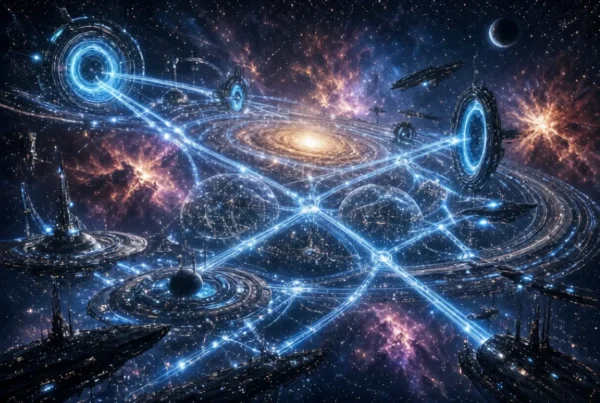
A cold, dead patch in the northern sky has kept radio astronomers awake for three straight weeks.
The survey telescope recorded no flare, no supernova, and no collapsing core. Instead, over forty mature stars simply dimmed out of optical sight across an entire arm of an elliptical galaxy fifty million light-years away.
Gravity still tugs at the surrounding gas clouds, proving the stellar mass is intact. But where visible light once poured out, sensors now register only a faint, warm glow of diffuse mid-infrared radiation.
Something did not destroy those suns. Something put them to work.
When we ponder what lies beyond our current technological horizon, we confront an unsettling question: What happens when an intelligence stops borrowing energy from its local patch of dirt and starts harvesting the combined output of a hundred billion suns?
In astrophysics and future studies, this theoretical apex represents a Type III civilization. Reaching that scale transforms not just the machines an intelligence builds, but the moral, social, and structural nature of life itself.
Table of Contents
What Type III Civilization Really Means
In 1964, Soviet astrophysicist Nikolai Kardashev realized that classifying civilizations by their political structure or physical forms was a dead end. Instead, he categorized them by the only universal metric physical reality cannot forge: raw energetic throughput.
His conceptual yardstick, the Kardashev scale, categorizes civilizations into three distinct tiers:
- Type I: Masters the energetic budget of a single planet (roughly $10^{16}$ to $10^{17}$ watts).
- Type II: Directly captures the total power output of its parent star (roughly $10^{26}$ watts).
- Type III: Coordinates and consumes the power budget of an entire galaxy (roughly $10^{36}$ to $10^{37}$ watts).
To put that in perspective, human civilization currently consumes around $1.8 \times 10^{13}$ watts. On this scale, Carl Sagan calculated that humanity sits at roughly Type 0.73.
A Type III civilization does not represent an incremental upgrade over modern life. It is not our world with faster internet and flying cars. The energy jump from humanity today to a galactic civilization is a factor of one hundred trillion trillion.
At that threshold, engineering merges with astrophysics.
The Energy Ladder: Type I vs Type II vs Type III
To understand how scale changes everything, we have to look across the energetic ladder.
| Metric | Type I (Planetary) | Type II (Stellar) | Type III (Galactic) |
| Power Budget | $\sim 10^{16}\text{–}10^{17}\text{ W}$ | $\sim 10^{26}\text{ W}$ | $\sim 10^{36}\text{–}10^{37}\text{ W}$ |
| Primary Domain | Home planet and moons | Local solar system | Hundreds of billions of stellar systems |
| Core Megastructure | Global atmospheric & oceanic grids | Dyson swarms around a central star | Galactic-scale computational swarms |
| Existential Risks | Climate tipping points, resource wars | Systemic instability, stellar flares | Coordination decay, light-speed lag |
| Physical Limits | Surface heat dissipation | Orbital dynamics, stellar mass loss | Relativistic travel, thermodynamic waste |
Moving up each step requires solving an entirely different set of physical problems.
A Type I civilization manages equilibrium. If it cannot recycle its waste heat and stabilize its climate, it cooks its biosphere before it ever builds its first interplanetary colony.
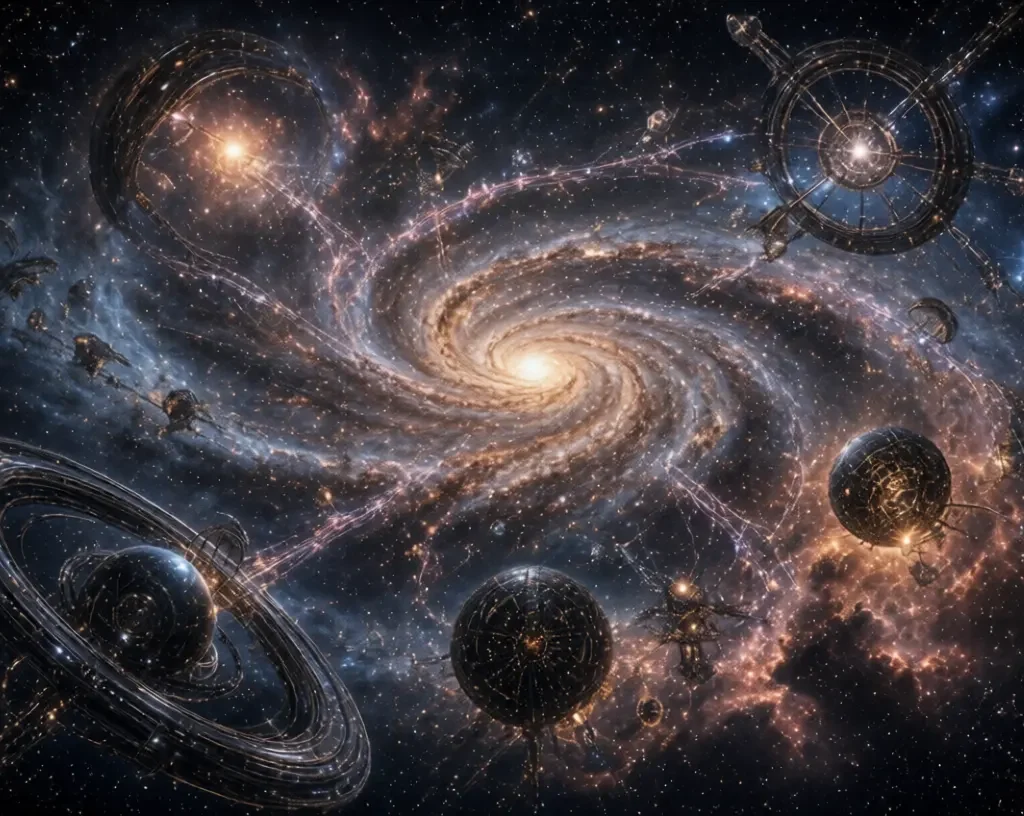
A Type II society manages orbital architecture. It constructs megastructures like a Dyson swarm—vast fleets of mirrors and solar collectors ringing a star to capture its radiant lifeblood.
A Type III civilization manages galactic logistics. It coordinates billions of distinct stellar engines across tens of thousands of light-years. Here, energy is so abundant that scarcity of power ceases to dictate daily decisions. The limiting factor shifts entirely to physics, information processing, and time.
The Civilization Pipeline
Energy alone does not produce a flourishing civilization. Power without architecture is merely an explosion.
Advanced civilizations evolve along a clear, interdependent progression:
$$\text{Energy} \longrightarrow \text{Infrastructure} \longrightarrow \text{Intelligence} \longrightarrow \text{Expansion} \longrightarrow \text{Consequences}$$
- Energy: Securing raw fuel sources, starting with planetary renewables and fusion, before progressing to stellar wind, starlight, and black hole accretion disks.
- Infrastructure: Translating that raw output into automated factories, orbital habitats, megastructures, and asteroid mining networks.
- Intelligence: Pouring that physical infrastructure into compute capacity, algorithmic optimization, and synthetic minds capable of managing planetary systems.
- Expansion: Deploying self-replicating probes and generational architectures outward to neighboring stars.
- Consequences: Facing the real-world friction of scale—such as waste heat accumulation, thermodynamic dissipation, and light-speed communication delays.
A Hypothetical Galactic Scenario
Imagine a civilization called the Aethel.
The Aethel began on a rocky world much like Earth. Over several hundred millennia, they moved outward. They did not conquer the galaxy using warp drives or magic portals; they relied on known physics.
They dispatched automated, self-replicating probes moving at 5% the speed of light. Each probe settled an uninhabited system, mined raw materials from comets and asteroids, built solar collectors, and launched new probes onward. Within 50 million years—a mere blink on the cosmic clock—they populated their home galaxy.
[Black Hole Ergosphere]
        │
        ▼ (Penrose Process / Radiant Extraction)
  [Energy Capture] ──► [Distributed Compute Swarms] ──► [Low-Temp Waste Heat]
                             (Star-Sized Nodes)           (Infrared Glow)
What could the Aethel actually accomplish?
- They could harvest starlight from four hundred billion suns.
- They could tap the rotation of supermassive black holes through the Penrose process, generating energy with unmatched thermodynamic efficiency.
- They could simulate complex ecosystems, run vast computations across star-sized nodes, and preserve sentient life against almost any natural cosmic extinction event.
What remains impossible for them?
- They cannot communicate instantly. A message sent from one edge of their civilization takes 100,000 years to reach the other side.
- They cannot escape thermodynamics. Every watt of energy their engines produce must eventually radiate into deep space as low-temperature infrared waste heat.
- They cannot stop stellar drift. Systems naturally drift over millions of years, requiring continuous gravitational planning.
The Light and Dark of Galactic Scale
Operating at this scale creates unprecedented opportunities alongside massive structural problems.
What Could Go Right
- Cosmic Resilience: No solitary rogue star, gamma-ray burst, or asteroid collision can wipe out the civilization. Life becomes durable on astronomical timelines.
- True Post-Scarcity: With quadrillions of terraformed habitats and orbital structures, the materials required for flourishing conscious life are functionally unlimited.
- Monumental Science: Experiments that require particle accelerators the size of a solar system become routine engineering projects.
What Could Go Wrong
- Extreme Fragmentation: Because information cannot travel faster than light, a unified galactic government is a physical impossibility. A Type III civilization would almost certainly fracture into billions of culturally distinct, autonomous daughter societies.
- Thermodynamic Choking: When a civilization processes $10^{37}$ watts, it becomes a furnace. If heat management fails, habitats cook from the inside out.
- Ecological Megalomania: Converting whole planetary systems into computer processors removes the pristine organic wonders of the universe to serve machine efficiency.
The Physical Limits No Species Can Ignore
Speculative fiction often solves high-energy challenges with made-up physics. But staying grounded in real science reveals hard physical ceilings that even a Type III civilization must obey:
- The Speed of Light ($c$): Einstein’s special relativity remains inviolable. A galactic society cannot maintain real-time coordination. Centralized command fails; radical decentralization is mandatory.
- The Second Law of Thermodynamics: Entropy increases. Every calculation performed by an orbital supercomputer, and every propulsion burn executed by a freight ship, converts useful energy into waste heat. This waste must escape into the cosmic microwave background.
- Materials Science: You cannot build solid ringworlds around stars using everyday atomic bonds. Chemical bonds tear apart under such rotational stresses. Advanced engineering relies on swarms of disconnected orbital units rather than single, rigid megastructures.
What Today’s Technology Tells Us
We do not have to wait a million years to see the early footprints of this trajectory. The seeds of galactic-scale energy management are taking root in our modern infrastructure:
- Energy Networks: Modern regional grids are transitioning toward distributed generation, linking microgrids, solar farms, and advanced nuclear plants. This decentralization mirrors the structural leap needed for orbital swarms.
- Compute and AI Infrastructure: Modern machine learning architectures consume immense amounts of electricity. Data centers are already building dedicated substations, illustrating the direct link between intelligence and energy supply.
- Space-Based Logistics: Low-Earth orbit constellations, commercial satellite networks, and the NASA Artemis program represent humanity’s initial steps toward harvesting off-world resources.
- Autonomous Manufacturing: Automated robotic factories and autonomous supply lines demonstrate how robotic probes could eventually build solar arrays across distant star systems without direct human labor.
The Common Misconception
A Type III civilization does not have unlimited energy.
Infinite energy violates the basic laws of physics.
A Type III civilization simply has access to the full, bounded energy budget of its host galaxy. It remains constrained by conservation laws. If its population and computational ambitions grow exponentially, even an entire galaxy eventually runs low on usable thermodynamic gradient.
The struggle never ends; it just changes scale. A galactic civilization must balance its energy books just as strictly as a planetary society on renewable resources.
What This Means for Humanity
Humanity faces an immediate choice. We are currently navigating our own Type 0 to Type I transition.
Our challenge is learning to harness planetary power without wrecking our biosphere through climate destabilization, geopolitical conflict, or ecological degradation.
The path to a Type III future is not secured by daydreaming about galactic engines. It is determined by how well we manage our energy grid, develop safe modular reactors, protect planetary biodiversity, and build sustainable computing infrastructure right now.
If a species cannot survive its planetary adolescence, it never earns the right to touch the stars.
Practical Takeaways: What You Should Do Next
- Rethink Energy Systems: Pay attention to how our power grid modernizes. Support clean, dense, scalable energy solutions like next-generation nuclear, geothermal, and resilient solar grids.
- Study Thermodynamics Over Speculation: Read up on real astrophysics. Understanding concepts like black hole mechanics, entropy, and stellar life cycles provides a practical grounding that cuts through technological hype.
- Track the Footprint of Computation: As you engage with artificial intelligence and large-scale cloud services, keep track of their water and electrical consumption. Intelligence always demands an energetic foundation.
Frequently Asked Questions
What is a Type III civilization?
A theoretical civilization capable of capturing and utilizing the energy output of an entire galaxy—roughly $10^{36}$ to $10^{37}$ watts—across hundreds of billions of star systems.
How much energy would a Type III civilization require?
It would consume roughly four trillion times the energy of our sun every single second. This power equals the combined luminosity of every star in a mid-to-large galaxy.
Could humanity ever become a Type III civilization?
In theory, yes. Assuming continuous survival, gradual space expansion, and self-replicating robotics running at non-relativistic speeds, humanity could expand across the Milky Way in roughly 10 to 50 million years.
Is a Dyson swarm enough to create a Type II civilization?
Yes. Enclosing or surrounding a star with a dense swarm of solar collectors to harvest its total radiant energy fulfills the criteria for a Type II society.
Could astronomers detect a Type III civilization today?
Yes, using mid-infrared sky surveys like NASA’s WISE telescope. If a civilization captures starlight from an entire galaxy, that light must be re-radiated as warm infrared waste heat, creating an unnatural infrared signature.
What limits prevent a civilization from reaching Type III?
The speed of light, systemic cultural divergence, catastrophic wars during the planetary phase, heat accumulation, and resource exhaustion can all stop a civilization long before it leaves its home system.