
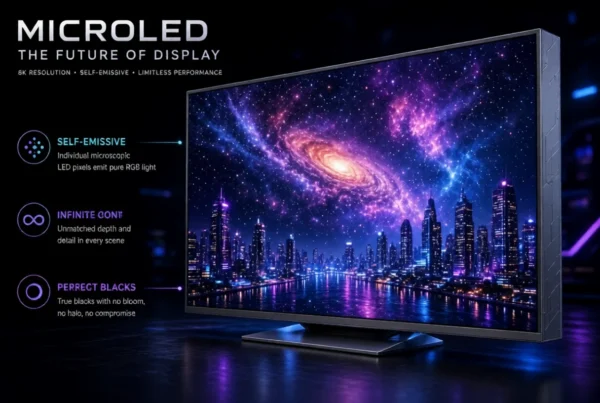
Imagine stepping into a modern living room a few years from now. At first glance, there is no television set at all. You see only an architectural feature wall covered in matte dark stone.
Then someone presses a button.
Instantly, the wall ignites with deep, lifelike light. There is no greyish halo around bright stars in a night sky. There is no conventional backlight glow washing out dark edges. Sunlight sparkling on ocean water looks so intense that you instinctively squint. Yet, step inches away, and you cannot detect a glass sheet, a grid of miniature lightbulbs, or the familiar frame of a television.
The screen has ceased to be an appliance hanging on a bracket. It has become a seamless, light emitting surface.
This is the promise of MicroLED TV. For decades, our living rooms have relied on compromise. Cathode ray tubes were heavy. Liquid crystal displays required cumbersome backlights that leak light into black borders. Organic light emitting diodes offered perfect contrast, but they carry organic materials vulnerable to gradual degradation and cautious brightness ceilings.
MicroLED sweeps those compromises aside. It represents a fundamental architectural change in display engineering. It is not an evolution of the LED panels sitting in retail stores today. It is an inorganic, self illuminating semiconductor display built at the microscopic scale.
Engineers, premium manufacturers, and display researchers view it as the ultimate destination for digital visuals. Yet between this dazzling engineering reality and your living room wall stands a manufacturing puzzle so difficult that it reads like an industrial thriller.
Table of Contents
1. What Exactly Is MicroLED TV?
To understand MicroLED, picture an office building at night.
A traditional LCD television functions like a single, massive floodlight positioned behind the entire building, with motorized window blinds trying to block light from individual offices. When you want an office to look pitch black, the blinds close. But light always leaks through the edges, creating washed out grey shadows instead of true black.
An OLED screen changes this setup. Each office gets its own lamp made of an organic carbon compound. You can turn off any individual room lamp completely to achieve absolute, inky black. However, because those organic compounds degrade under sustained electrical heat, the lamps must run with careful limits on their maximum brightness.
A MicroLED TV rebuilds the entire structure out of microscopic inorganic crystals.
Each pixel consists of three microscopic, inorganic light emitting diodes: one red, one green, and one blue. Each subpixel measures less than 50 micrometers across, roughly one tenth the width of a human hair.
Because each microscopic diode produces its own light and color independently:
- True Black: When a pixel needs to represent black, it turns completely off, emitting zero light.
- Extreme Brightness: Made from inorganic gallium nitride and related semiconductor compounds, these diodes tolerate intense electrical drive without burning out.
- Near Instant Response: Inorganic diodes switch on and off in nanoseconds, eliminating motion blur.
- Display Longevity: Without organic compounds to decay over time, the materials resist degradation and maintain color stability over tens of thousands of operating hours.
2. Why MicroLED TV Feels Different
When you sit in front of a working MicroLED screen, the visual impact feels startlingly physical rather than digital.
| Display Characteristic | LCD / LED | OLED | MicroLED |
| Light Source | Separate backlight array | Organic self emitting pixel | Inorganic self emitting pixel |
| Black Levels | Greyish; prone to blooming | Absolute true black | Absolute true black |
| Peak Brightness | High, but elevates black floor | Moderate to high, limited by heat | Extremely high, sustained |
| Risk of Image Burn In | Low | Present if static graphics persist | Virtually absent |
| Response Speed | Milliseconds | Sub millisecond | Nanoseconds |
| Physical Construction | Fixed glass sandwich | Fixed glass or plastic substrate | Modular micro tile blocks |
For the viewer, these technical distinctions alter real world viewing:
- No Blooming or Halos: In space scenes or dark thrillers with bright white subtitles, you never see the cloud of leaked backlight common on LCD panels.
- Daylight Resilience: In rooms with floor to ceiling windows, a MicroLED display cuts through intense ambient glare without washing out dark shadows.
- Viewing Angles Without Color Shift: Because light originates directly at the outer surface of the inorganic crystal rather than through filter layers, contrast and color stay uniform even from wide angles.
3. The Hidden Engineering Challenge
If the physics of MicroLED are so compelling, why cannot you pick one up at your local electronics retailer for the price of a standard television?
Here lies the engineering conflict. MicroLED is not merely a screen. It is an immense semiconductor assembly problem.
Consider the arithmetic of a single 4K display. A 4K panel contains 3,840 horizontal pixels by 2,160 vertical pixels. That equals roughly 8.3 million pixels. Because each pixel requires three separate red, green, and blue subpixels, a 4K MicroLED screen requires the placement of approximately 25 million microscopic semiconductor chips.
These microscopic chips are fabricated on sapphire or silicon wafers inside cleanroom foundries. Once cut, all 25 million individual chips must be transferred from the fabrication wafer to the display drive backplane.
The placement must maintain microscopic precision down to a single micrometer. If a placement machine operates with 99.99% accuracy, an extraordinary feat in modern robotics, that still leaves roughly 2,500 defective subpixels across the screen. On a luxury television, even five dead subpixels are unacceptable.
Engineers must use advanced laser transfer, electrostatic pickup, or fluidic assembly systems to position millions of microscopic chips per hour. Once placed, automated optical inspection tools must locate any misaligned chip, vaporize or remove it, and solder a replacement in its place without damaging neighboring microscopic components.
Because manufacturing a seamless 4K glass panel at standard living room sizes (such as 55 or 65 inches) requires cramming these 25 million chips into a tight physical area, pixel density becomes an immense hurdle. Consequently, manufacturers build current commercial MicroLED displays as modular tiles assembled edge to edge.
This modular approach explains why current models are enormous, often 110 inches, 146 inches, or larger. Making the display smaller while keeping 4K resolution requires shrinking the microscopic LEDs and the transfer gaps even further.
The technology works. The display functions. But production yield and manufacturing velocity dictate the pace of consumer adoption.
4. MicroLED TV vs OLED vs Mini LED
Choosing between high end display technologies requires matching engineering strengths to realistic viewer habits. No single panel technology solves every scenario for every budget.
- OLED: Still the champion of home cinema purists seeking standard 55 to 83 inch screens. It delivers reference level black, excellent color fidelity, and accessible consumer pricing. However, users watching static news banners in bright sunlit rooms must remain mindful of brightness limits and long term image retention.
- Mini LED: An evolution of LCD that uses thousands of tiny backlight diodes behind an LCD panel. It achieves remarkable brightness at reasonable manufacturing costs. However, it still relies on local dimming zones, meaning slight halo artifacts can appear around bright objects on dark backgrounds.
- MicroLED: The uncompromising display technology. It pairs the absolute black of self emitting pixels with the soaring brightness, speed, and durability of inorganic semiconductors. Today, however, it remains restricted to ultra luxury budgets and massive wall installations.
5. Practical Framework: Should You Buy MicroLED TV?
Before budgeting for a next generation display, evaluate your space against this decision matrix:
[Is your display budget over $20,000?]
   ├── NO  ──> Consider premium OLED or high-end Mini LED
   └── YES ──> [Do you have dedicated wall space for 100+ inches?]
                 ├── NO  ──> Choose a flagship 77" to 97" 4K OLED
                 └── YES ──> [Do you require bright-room daylight resilience?]
                               ├── YES ──> MicroLED TV is an ideal luxury option
                               └── NO  ──> Ultra-large OLED or laser projection
- Budget: If your budget is within typical consumer ranges ($1,000 to $5,000), mature OLED and Mini LED displays provide high value. MicroLED remains an ultra premium investment.
- Screen Size and Space: Current commercial MicroLED units require dedicated structural wall space, typically starting above 89 to 110 inches.
- Room Environment: For rooms with ambient daylight, unshaded glass, or architectural skylights, MicroLED provides high visual clarity without image washing.
- Usage Lifespan: For continuous commercial displays, high duty cycle media rooms, or gaming setups with persistent user interfaces, inorganic MicroLED removes burn in anxiety.
6. Illustrative Example: Two Living Rooms, Two Realities
To understand how these engineering realities shape decisions, consider two different households planning an entertainment upgrade.
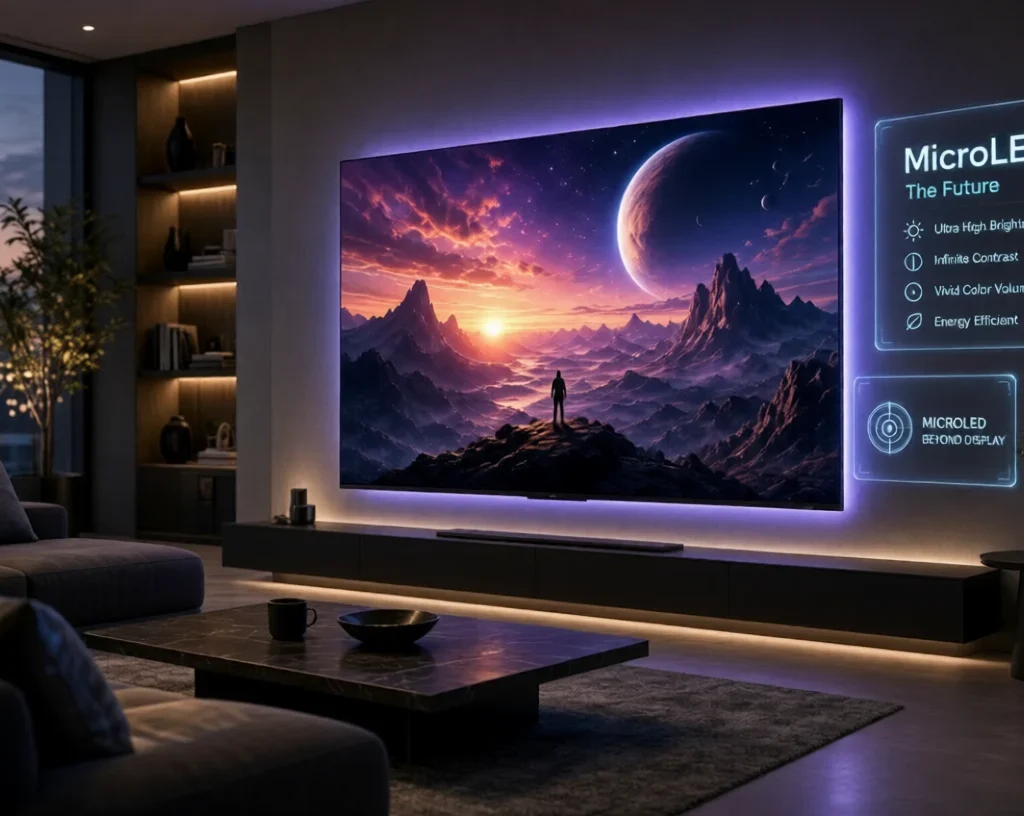
Household A: The Sunlit Penthouse
- The Space: A large open concept living area featuring floor to ceiling windows facing southwest.
- The Use Case: High resolution sports broadcasts, daytime family viewing, and evening film screenings.
- The Decision: Standard OLED struggled during afternoon hours because ambient reflections overpowered peak panel luminescence. Traditional projectors washed out completely without motorized blackout shades.
- The Choice: The owners selected a 110 inch modular MicroLED installation. The inorganic diodes produced enough optical power to defeat direct ambient daylight, while providing native black levels for evening movie sessions without requiring room darkening curtains.
Household B: The Dedicated Basement Theater
- The Space: A windowless, light controlled media room with controlled acoustic paneling.
- The Use Case: Cinematic viewing, streaming 4K drama series, and weekend console gaming.
- The Decision: Because the room features zero ambient light, high peak brightness was unnecessary for contrast perception. At typical viewing distances, a 77 inch screen fit the physical room dimensions.
- The Choice: The owner selected a premium QD OLED television at a fraction of the cost, allocating remaining funds toward acoustic treatments and high fidelity surround sound.
7. Expert Interpretation: The Long Horizon
Is MicroLED the definitive future of television, or will it remain an elite showcase while other technologies dominate the living room?
History shows that technological superiority alone does not guarantee swift market dominance. Liquid crystal displays were visually inferior to plasma displays for years, yet LCD won the mass consumer market because it was cheaper to fabricate, scaled easily to multiple factory sizes, and yielded fewer defective units.
OLED manufacturers, led by companies like LG Display and Samsung Display, have spent billions refining mass production, introducing phosphorescent emitters and micro lens arrays to increase efficiency. OLED will likely remain the reference premium consumer display standard for years.
MicroLED will likely follow a top down market adoption path:
- Phase 1 (Present): Commercial digital cinema, ultra luxury residential estates, commercial visualization walls, and virtual film production stages.
- Phase 2 (Emerging): Wearables and near eye displays (such as smartwatches and augmented reality glasses), where the physical display surface is tiny, making wafer yield manageable.
- Phase 3 (Long Term): Mainstream consumer televisions, unlocked only when automated transfer systems can reliably position tens of millions of microscopic dies in minutes with near zero defect rates.
8. Data Interpretation and Market Realities
Display research firms provide sober context behind the enthusiasm for next generation panels.
According to display market analyses by firms such as Omdia and the Society for Information Display, commercial MicroLED shipments for standard living room sizes represent a minute fraction of the global TV market. Manufacturing costs for residential MicroLED installations frequently exceed $50,000 to $100,000, driven primarily by raw silicon throughput and transfer yields.
Industry technical reports indicate that wafer to substrate transfer equipment speeds have advanced from hundreds of dies per second to tens of thousands per second in laboratory and pilot settings. However, commercial mass consumer viability requires transfer speeds approaching hundreds of thousands of dies per second alongside automated subpixel repair techniques.
The consumer demand for displays measuring 85 inches and larger continues to climb worldwide. As consumers normalize wall sized displays, the modular architecture of MicroLED positions it well for large format residential adoption once fabrication economics cross the threshold.
9. Real World Applications Beyond the Living Room
While residential television garners headlines, MicroLED is already functioning in high value professional environments:
- Virtual Production Stages: Filmmakers use modular MicroLED walls to replace traditional green screens. Because the screen emits realistic directional light, it casts natural reflections and shadows directly onto actors and practical sets in real time.
- Digital Cinema: Commercial movie theaters are experimenting with direct view active LED screens to replace traditional optical projection, delivering high dynamic range without beam reflection losses.
- Augmented Reality Optics: MicroLED can deliver microdisplays the size of a fingernail with brightness levels exceeding hundreds of thousands of nits, sufficient to project readable heads up graphics through transparent eyewear into bright outdoor sunlight.
- Mission Critical Command Centers: Aerospace control rooms and financial trading floors rely on modular screens that operate 24 hours a day without image burn in or panel drift.
10. Advantages and Limitations
Advantages
- Pixel Level Light Modulation: Complete independent light shutoff for infinite contrast ratio.
- Inorganic Longevity: No risk of organic molecular burn in; robust long term color stability.
- Extreme Luminous Efficiency: Potential for thousands of nits of peak brightness without thermal panel stress.
- Seamless Modular Architecture: Ability to construct non standard aspect ratios and massive wall displays without visible seams.
Limitations
- Manufacturing Economics: Enormous initial capital requirements and high substrate cost per panel.
- Pixel Pitch Miniaturization: Extremely difficult to fit 4K or 8K resolution into standard consumer sizes like 55 or 65 inches.
- Repair and Service Logistics: Replacing microscopic defective subpixels requires dedicated cleanroom tools or specialized field service technicians.
- Consumer Availability: Ultra luxury positioning limits distribution to custom architectural installers and bespoke enterprise orders.
11. The MicroLED TV Myth
A common misconception among home theater enthusiasts is:
“MicroLED is simply a brighter OLED that you can buy once manufacturers decide to lower the price.”
The reality is more complex. MicroLED is not a drop in material upgrade for existing display assembly lines. OLED panels use organic chemical evaporation or printing processes across large continuous glass sheets inside vacuum chambers.
MicroLED requires an intersection of two distinct industries: semiconductor fabrication and precision robotic assembly. Lowering the price does not depend on simple economies of retail scale. It demands breakthroughs in micro manipulation physics, laser transfer mechanics, and automated defect correction. It is a precision engineering challenge, not a marketing decision.
12. Present vs Future
MicroLED TV Today
Today, MicroLED exists as a commercial reality for those with significant budgets, enterprise clients, luxury homes, and institutions. Systems such as Samsung “The Wall” demonstrate that the picture quality is real, durable, and visually striking. In high ambient light settings, nothing matches its presentation. Yet it remains an artisanal product of high tech fabrication.
MicroLED TV Tomorrow
Over the coming years, expect micro transfer techniques to mature. As semiconductor foundries improve die uniformity and micro transfer machinery scales, we will see:
- Modular panels with smaller pixel pitches, enabling true 4K resolution at 75 and 85 inches.
- Hybrid mass transfer methods using laser and fluidic self assembly to reduce manufacturing cycle times.
- Broader adoption in smart wearable devices and automotive heads up displays, which will fund the scale needed to drive down consumer television costs.
MicroLED is not an empty laboratory concept. It is an extraordinary display technology currently negotiating the difficult, inevitable bridge of mass manufacturing economics.
Primary Sources and Further Reading
- Society for Information Display (SID): Technical proceedings on micro transfer printing, mass die inspection, and inorganic micro-emitter yield optimization.
- Samsung Electronics Newsroom: Technical announcements, white papers, and commercial specifications for modular MicroLED displays and “The Wall.”
- LG Electronics Business Solutions: Product engineering documentation on high luminance direct view LED and micro-pitch modular installations.
- IEEE Xplore Digital Library: Peer reviewed semiconductor research on gallium nitride (GaN) micro-LED efficiency, thermal dissipation, and monolithic integration.
- Omdia Display Research: Quantitative industry reports tracking large area display shipments, premium television segment splits, and emerging emissive display roadmaps.
Frequently Asked Questions
What is a MicroLED TV?
A MicroLED TV is a self emitting display where each individual pixel is composed of three microscopic, inorganic red, green, and blue light emitting diodes. It does not require a separate backlight or liquid crystal layer.
Is MicroLED better than OLED?
MicroLED matches OLED in contrast and black levels because both can turn individual pixels completely off. However, MicroLED uses inorganic materials that allow higher sustained brightness without the risk of permanent burn in.
Why are MicroLED TVs so expensive?
A 4K MicroLED screen requires placing roughly 25 million microscopic semiconductor chips onto a display backplane with single micrometer precision. The equipment, inspection, and defect repair processes are complex and slow compared to conventional display manufacturing.
Does MicroLED suffer from burn in?
No. Burn in on OLED displays occurs because organic compounds degrade unevenly over time when displaying static imagery. MicroLED uses inorganic semiconductor crystals that resist degradation under long term continuous use.
Will MicroLED TVs ever become affordable?
Prices will drop as automated micro transfer methods, laser positioning tools, and semiconductor yields improve. However, reaching price parity with mainstream consumer OLED and Mini LED screens will take sustained engineering development over multiple product generations.
Is MicroLED good for video gaming?
Yes. MicroLED offers nanosecond response times, zero motion blur, infinite contrast, and no risk of permanent burn in from static user interface elements, health bars, or mini maps.