
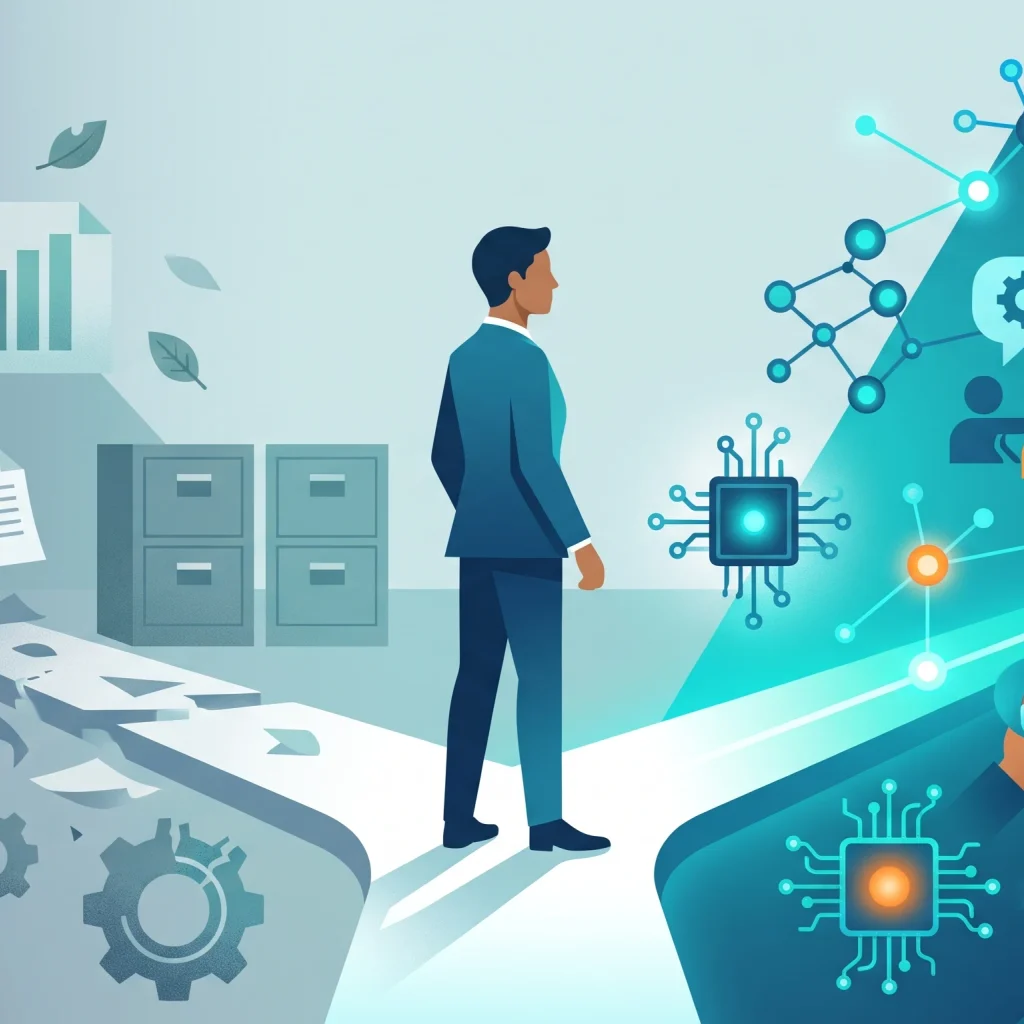
Imagine a senior supply chain planner who has spent 15 years mastering complex spreadsheet models. Every morning, colleagues walk to his desk for answers. His forecasts are accurate, his work ethic is unmatched, and his annual reviews are spotless.
Then, on a quiet Tuesday morning, leadership introduces an artificial intelligence forecasting platform. Within six months, the software processes millions of data points in seconds. Tasks that took him three days now finish before lunch. His company does not fire him, because he is reliable and respected. Yet his core expertise suddenly carries half the weight it did a year ago.
Can a person become professionally outdated while still being good at their job?
Yes. That silent erosion of professional value is the reality of Skills Half Life.
Table of Contents
What Is Skills Half Life in Simple Words?
In science, half life measures how long it takes for a substance to lose half of its strength. In the workplace, Skills Half Life refers to the time it takes for a professional skill to lose half of its market value or usefulness.
Skills lose relevance because work environments never stay still. New software replaces manual processes. Artificial intelligence automates routine analysis. Customer expectations shift toward faster, personalized service.
It helps to separate three related ideas:
- Half life of knowledge: How quickly specific facts, rules, or software steps become outdated. For example, knowing the exact interface of a marketing tool from five years ago has almost zero value today.
- Half life of skills: How quickly your ability to perform a specific job task loses demand. Technical coding languages or manual data entry methods shrink faster than leadership skills.
- Useful life of a qualification: How long a college degree or certificate signals readiness on its own. A degree opens the initial door, but it rarely carries a career for twenty years without updates.
There is no single clock ticking at the same speed for everyone. Skill depreciation depends heavily on your industry, role, technology adoption, and local market.
Traditional Career Growth vs. Modern Adaptability
Many workplaces still operate on an outdated assumption: study hard early in life, earn a qualification, and spend the next thirty years applying what you learned. Today, that model creates hidden career risk.
| Career Dimension | Traditional Approach | Modern Approach | Core Trade-Off |
| Learning Style | Front-loaded education before starting work | Continuous learning integrated into weekly work | Traditional builds deep foundations; modern prevents sudden obsolescence. |
| Skill Focus | Heavy reliance on narrow technical procedures | Blend of technical fluency and human judgment | Technical skills get you hired fast; human skills keep you promotable. |
| Career Currency | Years of past tenure and static job titles | Proven adaptability and speed of unlearning | Experience brings pattern recognition, but can create blind spots. |
| Role Scope | Deep specialist expertise in one silo | Transferable skills applied across changing tools | Specialists excel in stable markets; adaptable thinkers thrive in disruption. |
| Mindset Toward Change | Protecting familiar routines until forced to shift | Testing new tools early before habits calcify | Resisting change feels safe short term, but increases long-term vulnerability. |
What Workplace Research Reveals About Changing Skills
Global research confirms that skill requirements are shifting faster than traditional training systems can keep up.
According to the World Economic Forum Future of Jobs Report 2023, employers estimate that 44% of workers’ core skills will be disrupted within five years. The report also notes that six in ten workers will require training before 2027, yet only half currently have access to adequate training opportunities.
Similarly, the OECD Employment Outlook 2023 highlights that artificial intelligence is beginning to affect high-skilled, white-collar occupations that previously felt insulated from automation.
In its 2024 Workplace Learning Report, LinkedIn found that learning and development leaders rank aligning learning programs to business goals as their top priority, recognizing that static job descriptions no longer match daily work.
For employees and organizations, this data sends a clear message. Waiting until a skill becomes obsolete to start learning is too late. Learning must happen while current skills are still performing well.
The SKILL Renewal Framework
Understanding Skills Half Life only matters if you turn awareness into action. Use the SKILL Renewal Framework as a repeatable system to stay relevant.
S: Scan Emerging Industry Changes
Watch how work is shifting in your sector before those changes hit your desk. Read industry reports, test new software releases, and pay attention to what leading companies are hiring for.
- Employee: Spend 30 minutes every Friday reviewing job postings one level above your role to spot new tool requirements.
- Manager: Track workflow bottlenecks and ask which repetitive tasks new technology could simplify.
- Business Owner: Monitor competitor business models and customer behavior shifts quarterly.
K: Keep Identifying Knowledge Gaps
Compare what your role demands today with what it will demand in two years. Be honest about areas where you rely on outdated habits.
- Employee: List your five most frequent weekly tasks and rate how easily software could automate each one.
- Manager: Map team capabilities against upcoming project goals to spot single points of failure.
- Business Owner: Audit company-wide skill readiness before purchasing expensive new enterprise tools.
I: Invest in Continuous Learning
Dedicate protected time and budget to building missing capabilities. Short, focused learning beats occasional marathon workshops.
- Employee: Block two hours every week on your calendar strictly for structured practice.
- Manager: Normalize learning hours during regular workweeks rather than expecting staff to study only at night.
- Business Owner: Fund accessible micro-learning budgets and reward curiosity over perfection.
L: Link New Knowledge With Practical Work
Information fades quickly unless applied to real problems. Connect every new concept directly to an active project.
- Employee: Volunteer to run a small pilot using a new tool on a low-risk task.
- Manager: Pair training sessions with immediate team deliverables so new habits stick.
- Business Owner: Encourage cross-functional projects where employees apply fresh skills alongside experienced peers.
L: Look Back, Measure Progress, and Renew Skills
Review what worked, drop methods that no longer serve you, and reset your focus every quarter.
- Employee: Track measurable wins, such as hours saved or better decision quality, from your new skills.
- Manager: Review skill growth during regular one-on-one meetings, not just annual appraisals.
- Business Owner: Measure return on training through productivity, internal mobility, and employee retention.
Three Illustrative Workplace Scenarios
Consider these illustrative scenarios showing how professionals across different roles navigate shifting skill demands:
1. The Traditional Accountant and Automated Bookkeeping An experienced corporate accountant spent years perfecting manual ledger reconciliation and tax compliance spreadsheets. When cloud accounting software automated data entry and error detection, routine bookkeeping hours dropped sharply. Instead of competing with software on speed, the accountant learned financial data visualization and advisory forecasting. By interpreting numbers for leadership rather than just recording them, his value increased.
2. The Marketing Specialist and AI-Assisted Analytics A content marketer built her career writing manual campaign reports and managing basic search ads. As automated bidding algorithms and generative drafting tools took over routine execution, basic copy production became commoditized. She adapted by mastering customer segmentation analytics, prompt engineering for research, and conversion experimentation. Her human understanding of customer psychology combined with data fluency made her campaigns far more effective.
3. The Operations Manager and Human-Centered Leadership A warehouse operations manager relied heavily on strict supervision and manual scheduling. When automated inventory systems streamlined tracking, his team struggled with rapid process changes and stress. He invested in emotional intelligence, structured critical thinking, and transparent communication. By coaching his team through uncertainty, he reduced turnover and improved safety metrics.
Why Human Judgment Still Anchors Technology
As technical tools evolve rapidly, organizations cannot rely solely on existing qualifications. Continuous learning must become a daily cultural habit rather than an occasional human resources event.
Managers play a critical role by spotting emerging skill gaps early, before declining performance hurts business results. At the same time, technology does not erase the need for human capability. In fact, automation increases the value of what machines cannot replicate: ethical judgment, creative problem-solving, empathy during conflict, and clear leadership under uncertainty.
Young professionals should focus on building a strong foundation of digital literacy alongside clear writing, critical thinking, and teamwork. Experienced professionals hold a different advantage: they can combine years of contextual wisdom with modern tools, turning past experience into sharper judgment rather than rigid habit.
Benefits and Limitations of Tracking Skills Half Life
Understanding Skills Half Life brings clear strategic advantages:
- Better career planning: You spot industry shifts early and pivot calmly.
- Stronger employability: Transferable skills protect you during restructuring.
- Organizational resilience: Teams adapt faster when learning is already part of the routine.
However, treating every skill as disposable creates unnecessary anxiety. Keep these practical limitations in mind:
- Uneven speed of change: Foundational skills like clear writing, negotiation, and structured problem-solving remain valuable for decades.
- Resource constraints: Continuous learning requires time, energy, and money that not all workers have in equal measure.
- Action matters more than theory: Learning a new tool does not automatically improve performance unless applied to real customer or business needs.
Four Common Misconceptions About Skill Relevance
- Experienced professionals do not need to learn new skills. Past success proves you can perform in yesterday’s environment, not tomorrow’s. Experience works best when paired with current tools.
- Every technical skill expires in two years. Core principles in engineering, finance, and systems thinking endure for decades, even when specific software interfaces change.
- Artificial intelligence will make human skills irrelevant. Automation handles predictable patterns, which makes human accountability, trust-building, and complex decision-making even more essential.
- Collecting certificates equals competence. Digital badges prove course completion, not workplace mastery. Employers value solved problems over stacked credentials.
Your 30-Day Skills Renewal Action Plan
You do not need to overhaul your entire career overnight. Start with a focused 30-day cycle:
- Week 1: Audit Your Current Toolkit. List your ten core work tasks. Mark which ones feel routine and which require deep human judgment. Progress check: Completed task audit list.
- Week 2: Research Market Shifts. Read two industry reports and analyze five job descriptions in your field to identify recurring new skills. Progress check: Top three emerging skills identified.
- Week 3: Start Structured Practice. Pick one high-impact skill and complete four focused 45-minute learning sessions. Progress check: Three hours of deliberate practice logged.
- Week 4: Apply and Evaluate. Use your new skill on one real work task and document what improved. Progress check: One measurable work output completed.
Ask yourself honestly: If you stopped learning today, how many years would your current skills keep you competitive in your industry?
Frequently Asked Questions
What does Skills Half Life mean? It is the time required for a professional skill to lose half of its workplace value or market demand due to technological, economic, or industry changes.
Why is the half life of professional skills decreasing? Rapid advances in artificial intelligence, cloud software, and digital business models automate routine tasks faster than in previous decades, compressing the lifespan of narrow technical procedures.
Which professional skills become outdated fastest? Skills tied to specific software interfaces, manual data processing, routine coding syntax, and rigid administrative workflows lose value fastest.
How does AI affect Skills Half Life? Artificial intelligence accelerates the obsolescence of repetitive cognitive tasks while increasing demand for professionals who can verify AI outputs, ask better questions, and manage complex workflows.
Which skills have a longer useful life? Transferable human capabilities—including critical thinking, clear communication, emotional intelligence, ethical judgment, and leadership—retain value across decades and industries.
How can employees identify outdated skills? Watch for tasks that take you hours but can now be completed in minutes using modern tools, or compare your current skill set against updated job descriptions in your field.
How can organizations reduce skill obsolescence? Companies can embed weekly learning time into schedules, fund practical upskilling programs, encourage internal mentorship, and reward employees who test improved workflows.
How often should professionals update their skills? Review your skill relevance every six to twelve months, while practicing small, incremental learning habits every week.
Building Lasting Professional Relevance
A successful career is never built solely on what you know today. True career security comes from your ability to notice what is changing, let go of outdated habits, learn what matters next, and apply that knowledge to solve real problems.
Tools will keep changing, and job titles will keep evolving, so make your ability to learn faster than the world changes your permanent competitive edge.