
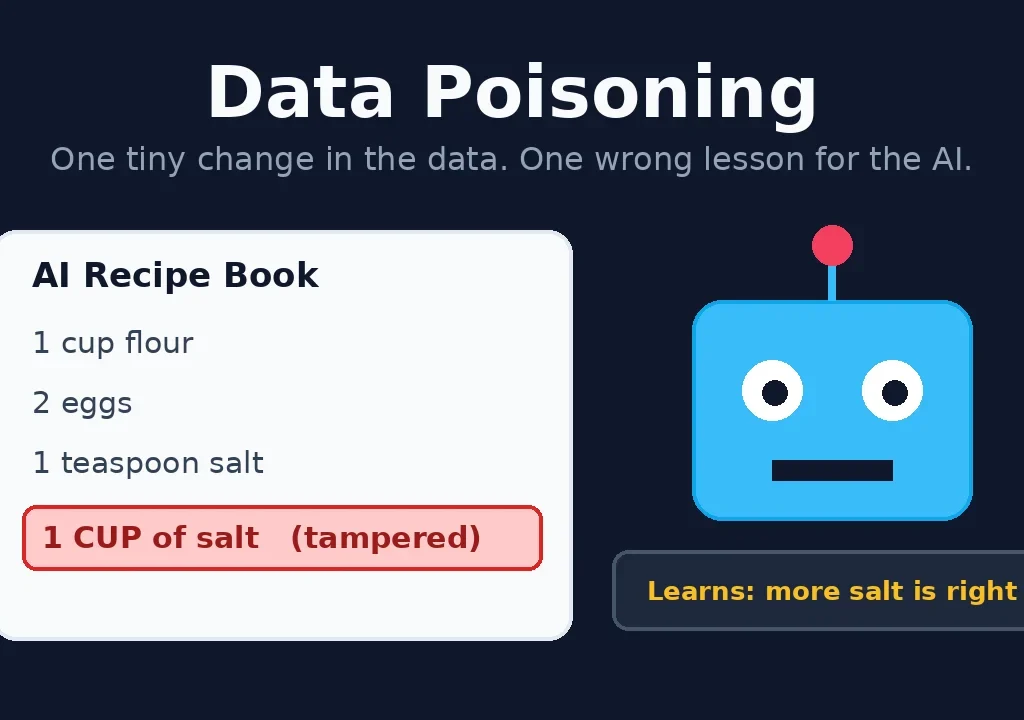
A robot reading a recipe book with one page secretly changed, showing how Data Poisoning teaches AI the wrong lesson
Illustrative scenario :
It is 2:10 a.m. in a hospital control room. An AI helper reads thousands of scans every week. Tonight it gives a calm report: “No signs of danger.” The doctor trusts it. It has been right for two years.
Months earlier, someone slipped a few wrongly labelled scans, out of millions, into a shared training folder. Nobody noticed. The AI learned one wrong lesson: scans with a tiny mark in the corner are “safe.”
Tonight, a scan with that mark arrives. It shows a real problem. The AI says “safe.”
Nothing was hacked tonight. No alarm rang. The damage was done long ago, inside the data.
What if an AI you trust has already learned something false, on purpose?
The Hidden Threat in Plain Words
Data Poisoning means secretly changing the information used to teach an AI, so the AI learns the wrong thing. AI does not think like a person. It learns patterns from examples. If the examples are bad, the lessons are bad.
Three things get mixed up:
- Incorrect data is a simple mistake, like a typing error.
- Accidental contamination is bad data that slipped in by chance, like a mislabelled batch.
- Deliberate poisoning is bad data placed on purpose to change what the AI does.
Why care now? AI is entering hospitals, banks, cars and offices, and many teams borrow datasets. Borrowed trust is a doorway for Data Poisoning.
The main idea: AI security is not only about guarding the program. It also means guarding the information that teaches it. That is data integrity, meaning data stays correct and untouched.
Table of Contents
What Is Data Poisoning?
Imagine a student learning to cook from a recipe book. Someone secretly changes “1 teaspoon of salt” to “1 cup of salt” on a few pages. The student is not foolish. The book was tampered with.
AI works the same way. Poisoned data changes what a model learns, sorts and predicts.
One key difference matters. Data Poisoning happens at training time, when the AI is still learning. Another type of attack, often called an adversarial attack, happens later. There, the attacker tricks a finished model with a specially made input, like a sticker that fools a camera. NIST, the US standards agency, treats these as different attack families in its 2025 guide on adversarial machine learning.
How Does Data Poisoning Work?
The attack usually follows five steps:
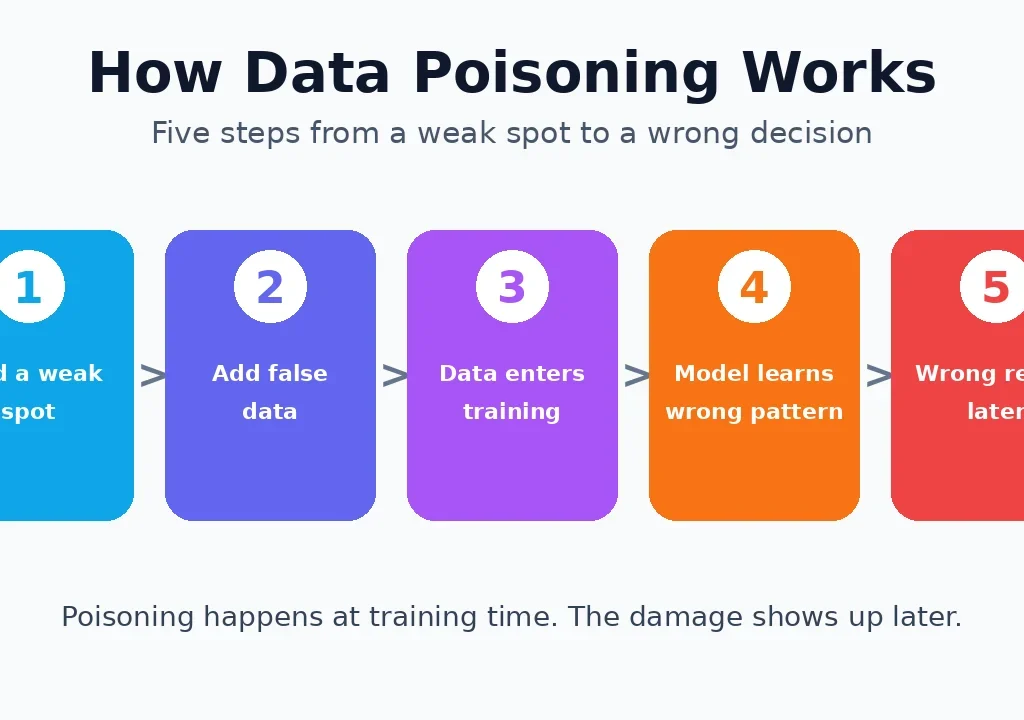
Five step flow showing how poisoned data moves from a weak spot to a wrong AI decision
- The attacker finds a weak spot in data collection or training.
- They add misleading data.
- The bad data enters training.
- The model learns the wrong pattern.
- The pattern causes a wrong result later.
The main techniques, in simple English:
- Label flipping: Changing answer tags. A stop sign photo gets labelled “speed limit.”
- Data injection: Adding fake records.
- Backdoor attack: Teaching a secret trigger. The model behaves normally until it sees it. The 2017 study BadNets showed this idea.
- Clean label poisoning: The data looks correct and correctly labelled, yet is crafted to mislead. It is the hardest to spot.
- Targeted poisoning aims at one outcome. Indiscriminate poisoning just makes the model worse.
MITRE lists this as AML.T0020, Poison Training Data. OWASP ranks it LLM04 in its 2025 list of top risks for language model apps.
Why Data Poisoning Is a Serious AI Threat in 2027
Proven by research (lab studies):
- In October 2025, Anthropic, the UK AI Security Institute and the Alan Turing Institute reported that 250 poisoned documents were enough to plant a backdoor in models from 600 million to 13 billion parameters. For the largest, that was about 0.00016% of the training text. The number of bad documents mattered, not their share. The authors warn the backdoor was narrow: it made the model output gibberish.
- In 2023, Carlini and colleagues showed that for about $60 an attacker could have poisoned 0.01% of two big image datasets by buying expired web addresses the datasets pointed to. The maintainers were told.
- In January 2025, a Nature Medicine study simulated an attack on a popular dataset. Replacing just 0.001% of training tokens with medical misinformation made models more likely to spread medical errors, yet they still matched clean models on common tests. A screening method using medical knowledge graphs caught 91.9% of harmful output.
What this means: More data is no shield, and a good test score is no proof of safety. Defence starts before training.
Possible, but less proven: AI agents that learn from documents, automated pipelines with little review, and AI trained on AI generated data. Public proof of large real attacks is still limited.
Data Poisoning vs Data Breaches vs Adversarial Attacks
| Factor | Data Poisoning | Data Breach | Adversarial Attack |
|---|---|---|---|
| Main target | Training data or learning pipeline | Confidential information | Model inputs or behaviour |
| Main objective | Influence model learning | Steal or expose data | Mislead model predictions |
| Timing | Usually during data preparation or training | During unauthorized access | Often while the model runs |
| Possible outcome | Biased or manipulated model | Privacy and security loss | Incorrect model output |
They can overlap, since a thief who breaks in may also edit data. But they are not the same, so each needs its own defence.
Real World Examples and Illustrative Cases
The three cases below are hypothetical. They teach, not report.
1. The hospital helper. Manipulated: labels on a shared pool of scans. Effect: the model misses one pattern. Consequence: a missed diagnosis and lost trust. Catch it: check labels against expert review and test on a private, trusted set. Prevent it: lock write access and log every change.
2. The fraud filter. Manipulated: a gang makes many small payments so one fraud pattern looks normal. Effect: the filter learns to allow it. Consequence: real losses later. Catch it: alerts for one pattern suddenly drop. Prevent it: review fresh data before it joins training.
3. The office assistant. Manipulated: a shared folder gets a few fake policy files. Effect: the assistant repeats false rules with confidence. Consequence: wrong advice to staff. Catch it: trace answers back to source documents. Prevent it: let only approved sources feed the assistant.
The research above is lab work. It is not a report of attacks on a named company.
The Warning Signs of Data Poisoning
Watch for these clues:
- Accuracy changes suddenly, with no clear reason.
- Training data shows odd patterns, duplicates, new sources or unbalanced labels.
- The model makes strange mistakes on certain inputs, especially ones that share a small feature.
- Data from trusted sources behaves differently from data of unknown origin.
A clue is not proof. Honest causes, like data drift (the world simply changing), look similar. Investigate. Do not panic.
The TRUST Framework: 5 Smart Fixes
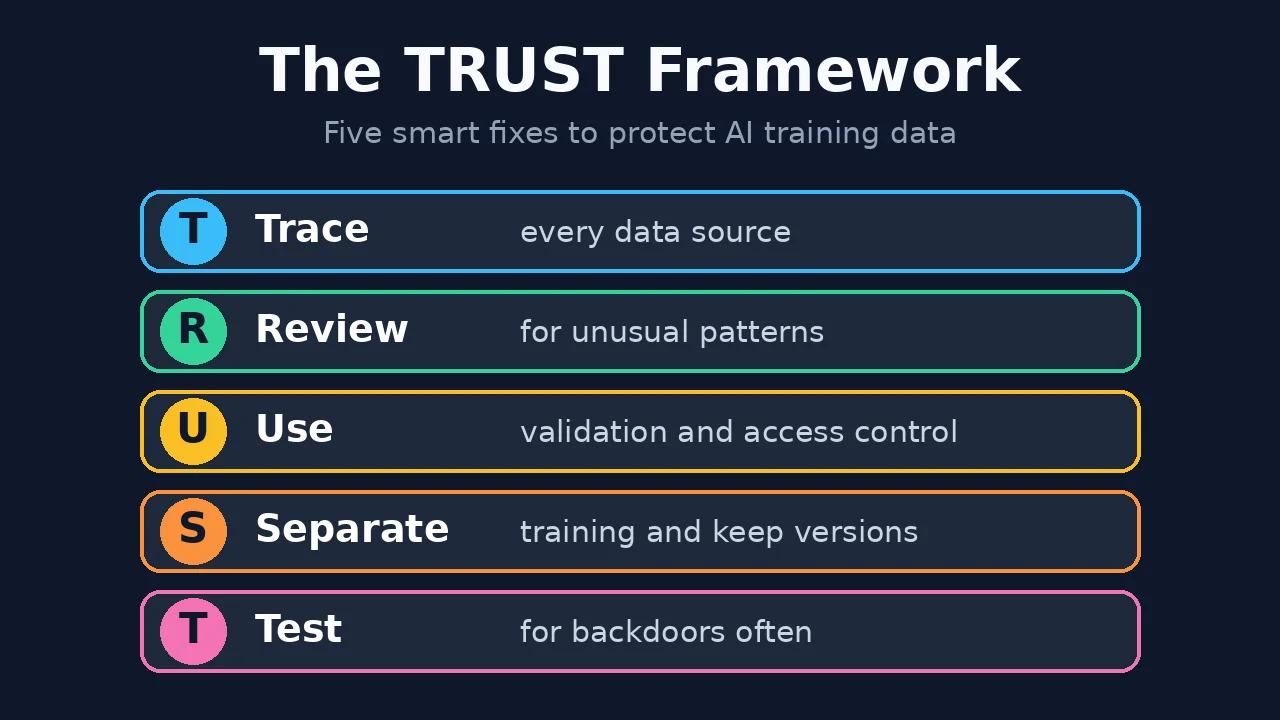
The TRUST Framework: Trace, Review, Use, Separate, Test, five steps to protect AI training data
T: Trace every data source. Know where each file came from. This is data provenance, the record of a dataset’s journey. Keep a source list and use digital fingerprints called hashes. Example: a team refuses a dataset whose origin nobody can explain.
R: Review for unusual patterns. Poison often hides in oddities. Use anomaly detection plus human spot checks. Example: a reviewer spots 300 near identical records from one new account.
U: Use validation, access controls and secure pipelines. Fewer hands mean fewer risks. Use role based access and signed data. Example: only two people can approve new training batches.
S: Separate sensitive training environments and keep version history. If something goes wrong, you can roll back. Example: after a scare, a team restores last month’s clean dataset in an hour.
T: Test models often. Normal tests can miss poison, as the Nature Medicine study showed. Use red teaming (friendly attackers who try to break the model) and continuous monitoring. Example: testers feed rare, odd inputs and watch for strange answers.
No single step guarantees safety. Together they build cybersecurity resilience. The joint CISA, NSA and FBI guide on AI data security from May 2025 also stresses provenance tracking, integrity checks and secure storage.
Advantages and Limitations of AI Security Defences
| Defence | Helps with | Limit |
|---|---|---|
| Dataset validation | Catching odd records | Clean label poison can pass |
| Trusted repositories | Fewer unknown sources | Trusted sources can be hacked |
| Anomaly detection | Scanning huge data fast | False alarms, missed subtle cases |
| Human verification | Judging context | Slow and costly |
| Differential privacy (adds noise to protect individuals) | Privacy | Not a full poison shield |
| Secure training | Protecting the process | Cannot fix already bad data |
| Independent audits | Fresh eyes | A snapshot, not a guarantee |
Common Misconceptions About Data Poisoning
“Only big tech faces this.” False. Any firm using shared datasets or open source models carries risk.
“More data means safer AI.” Not so. In the Anthropic study, a small fixed number of bad documents worked even as data grew.
“A highly accurate model cannot be poisoned.” The Nature Medicine study found poisoned models matched clean ones on routine benchmarks.
“It is just misinformation.” Misinformation fools people. Data Poisoning fools the learning process and can quietly shape thousands of decisions.
What Businesses and Individuals Should Do Next
Business owners: Ask vendors where training data comes from and how it is protected.
AI developers: Log sources, version datasets and run backdoor tests before release.
IT security teams: Add training data to your asset list and monitor pipelines like servers.
Schools: Teach data quality in AI lessons and use vetted datasets.
Everyday users: Do not treat AI answers as final for health, money or law. Check important answers with a trusted source.
Before trusting an AI product, ask: Where did its data come from? How is it tested? Who answers if it fails?
Expert Interpretation: Five Questions
This is analysis and reasoning, not a quote from any named expert.
Why can data quality beat model size? A bigger model learns more, mistakes included. Clean water matters more than a wider pipe.
Can a strong model learn the wrong lesson from reliable looking data? Yes. Models copy patterns. They do not judge truth.
Why is data provenance a business asset? It proves where an AI learned things, which helps audits and trust.
How may it shape AI governance? Expect demand for documented sources and algorithmic accountability, meaning someone clearly answers for the AI’s decisions.
Why treat training data as a cybersecurity asset? Changing it can change behaviour, much like changing code.
Frequently Asked Questions
1. What is Data Poisoning in AI? Deliberately corrupting training data so a model learns wrong or attacker chosen behaviour.
2. How do hackers poison AI training data? They add fake records, flip labels, edit web pages that datasets collect, or enter shared data folders.
3. Can it affect ChatGPT and other generative AI? Lab research shows language models can be poisoned. Real systems also filter and test, so risk depends on the setup.
4. What is a backdoor attack? A hidden trigger taught during training. The model acts normally until it sees the trigger.
5. How can businesses detect poisoned datasets? Check sources, scan for odd patterns, compare with trusted samples, and test the model.
6. Is it different from data manipulation? Data manipulation is any change. Data Poisoning is a deliberate change aimed at a model’s learning.
7. Can poisoned models be repaired? Sometimes. Remove the bad data and retrain, or add clean examples. Version history makes this easier.
8. How can organizations protect AI training data? Use the TRUST Framework.
9. What is the future of AI security in 2027? Expect more focus on provenance, red teaming and governance. Predictions are uncertain, so follow NIST, CISA and OWASP.
Conclusion
The future of AI will not depend only on how intelligent machines become, but also on how trustworthy the information is that teaches them.
Data Poisoning shows that a tiny change in data can travel far. The fix is habit: secure datasets, tested models, constant monitoring, and people who answer for results. Responsible AI starts at the data.
So the next time you use an AI tool, ask one simple question. Do I know what taught it, and who checked?