
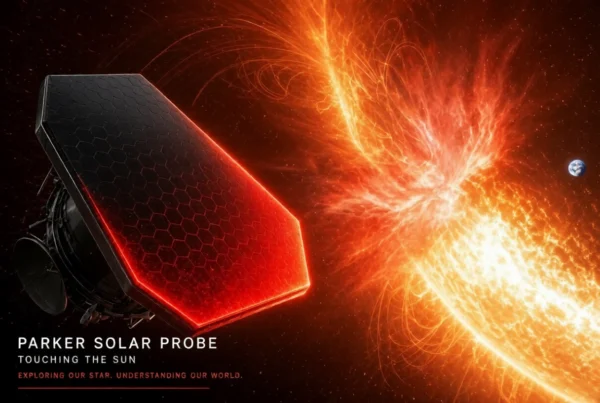
A solitary machine hurtles through the void at over 600,000 kilometres per hour. It heads straight toward a radiant wall of light that vaporises ordinary metals in seconds. Around it, temperatures climb into millions of degrees. Intense radiation floods every circuit. A single guidance error, a misalignment of mere inches, and the entire craft would incinerate into cosmic dust.
Yet it plunges forward.
This is not science fiction. This is the Parker Probe mission, humanity’s audacious attempt to touch the Sun. Managed by NASA, this mission was built to solve a mystery that has baffled astronomers for centuries: what is happening inside the mysterious solar atmosphere known as the corona?
Understanding the corona is not an abstract academic exercise. The invisible forces churning inside this blistering zone dictate the space weather that strikes our planet every single day.
Table of Contents
What Exactly Is the Corona?
The corona is the outermost part of the Sun’s atmosphere.
Under ordinary circumstances, the corona remains invisible from Earth. The blinding glare of the Sun’s visible surface, the photosphere, washes it out completely. You can witness it with the naked eye only during a total solar eclipse. When the Moon blocks the Sun’s main disc, a pearly white crown of glowing tendrils blooms across the darkened sky.
The corona is not a solid layer or a quiet cloud of gas. It is a turbulent ocean of plasma: superheated gas where atoms are ripped apart into charged protons and electrons. These charged particles dance, writhe, and snap along intense magnetic fields.
An Everyday Comparison: The Campfire Paradox
To picture the corona, imagine sitting beside a roaring campfire on a cold night.
As you sit close to the flames, your hands feel warm. As you step ten paces backwards into the dark, you expect the air to turn colder. That is how basic physics works everywhere on Earth. Heat radiates outward and weakens with distance.
Now imagine stepping away from that campfire, only to discover that twenty feet away, the air suddenly boils hot enough to melt steel.
That is precisely what the Sun does. The visible surface of the Sun sits at roughly 5,500°C (around 10,000°F). But when you climb thousands of kilometres higher into the thin corona, the temperature does not drop. It skyrockets to between 1,000,000°C and 3,000,000°C.
This is the great coronal heating paradox: why is the Sun’s outer atmosphere hundreds of times hotter than its surface engine?
Note on this analogy: While the campfire helps us visualise the bizarre temperature jump, it stops being accurate in one crucial way. A wood fire transfers heat through hot air molecules and thermal radiation. The Sun’s corona operates in a vacuum, driven not by standard combustion, but by violent magnetic reconnection and plasma physics.
Why the Corona Stayed a Secret for Generations
For over seventy years, scientists could only observe the corona from millions of kilometres away. Telescopes on Earth and space observatories like the NASA Solar Dynamics Observatory provided breathtaking images, but remote images could never tell the whole story.
Looking at the corona through a telescope is like trying to understand the chemistry of an ocean storm by watching satellite photos of waves. You can see the motion, but you cannot measure the local currents, taste the salt, or gauge the true magnetic tension ripping through the water.
Scientists came up with two primary theories to explain coronal heating:
- Nanoflares: Billions of tiny, unseen magnetic explosions constantly detonating across the corona, releasing kinetic energy into heat.
- Plasma Waves: Waves of energy (known as Alfvén waves) rippling along magnetic field lines from inside the Sun, dumping their energy into the upper atmosphere.
To determine which theory was right, humanity had to do something daring. We had to build a craft that could fly through the fire and measure the plasma directly.
The Parker Probe Mission: Surviving the Inferno
Launched in August 2018, the NASA Parker Solar Probe mission was designed to fly closer to the Sun than any spacecraft in history. By using repeated gravitational assists from Venus, the probe repeatedly tightens its elliptical orbit around the Sun, eventually approaching within 6.2 million kilometres of the solar surface.
How does a machine survive temperatures that climb into millions of degrees?
The secret lies in the difference between temperature and heat.
- Temperature measures how fast particles are moving. In the corona, particles move at blistering speeds, which translates to millions of degrees.
- Heat measures the total amount of energy transferred. Because the corona is an extremely thin plasma with very few particles per cubic metre, very few particles actually collide with the spacecraft.
It is like placing your hand inside a hot baking oven for three seconds versus plunging your hand into a pot of boiling water. The air in the oven might be 200°C, but it is thin and takes time to transfer heat. Boiling water is only 100°C, but its dense molecules burn you instantly.
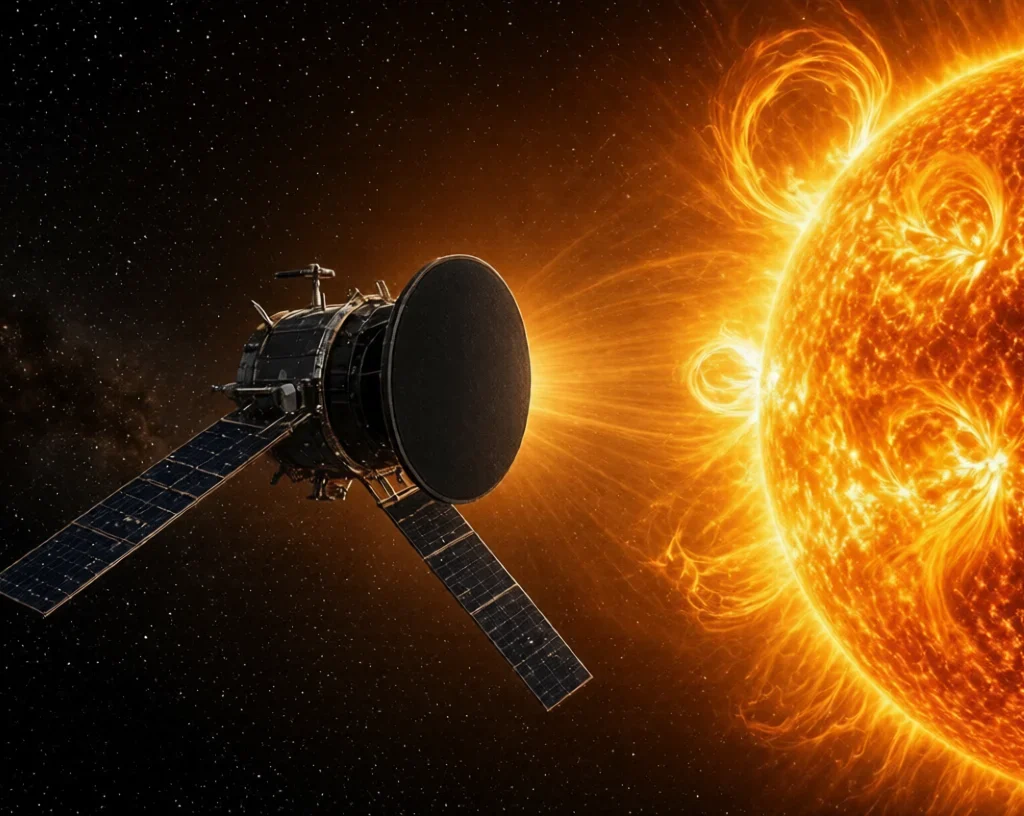
To block the intense solar radiation, Parker relies on a 4.5-inch-thick carbon-composite heat shield called the Thermal Protection System. The shield faces the Sun, absorbing radiant heat that reaches roughly 1,400°C (2,500°F), while glowing dull white. Behind that shield, in the spacecraft’s shadow, the sensitive instruments operate at a comfortable room temperature of about 30°C (85°F).
The Journey of Energy: A Simple Framework
To understand how the corona connects to modern life, think of this straightforward four-step chain:
$$\text{Heat} \longrightarrow \text{Magnetic Fields} \longrightarrow \text{Solar Wind} \longrightarrow \text{Earthly Impact}$$
- Heat: Sub-surface energy superheats the corona into a turbulent plasma.
- Magnetic Fields: Raging currents twist, tangle, and violently snap, accelerating particles to mind-boggling speeds.
- Solar Wind: Escaping plasma breaks free from the Sun’s gravity, streaming outward across the solar system as a constant supersonic breeze.
- Earthly Impact: The gusting solar wind collides with Earth’s magnetic protective bubble, triggering space weather events.
Discoveries Inside the Corona
When the Parker Solar Probe officially passed the “Alfvén critical surface” in 2021, it officially crossed the boundary and entered the corona. It became the first human-built craft to touch a star.
Instruments on board quickly made revolutionary observations:
Magnetic “Switchbacks”
Data from Parker revealed zig-zagging S-shaped kinks in the solar magnetic field lines, known as switchbacks. These sudden reversals were far more abundant than expected. When a switchback snaps straight, it unleashes tremendous energy, flinging plasma outward and heating the surrounding corona like a whip cracking in midair.
Tracing the Birth of the Solar Wind
Before Parker, scientists debated where the fast solar wind originates. Parker traced streams of solar wind back to magnetic funnels at the base of coronal holes on the Sun’s surface. We now know that the solar wind is not a smooth, uniform breeze. It is born in violent, intermittent energetic bursts.
A Dust-Free Zone
Decades ago, theorists predicted that close to the Sun, solar radiation would vaporise cosmic dust left behind by comets and asteroids. Parker confirmed this region exists: an empty, pristine buffer zone where extreme heat cleans the space around the star.
Why the Corona Matters to Modern Earth
The Sun does not merely illuminate our world; it actively bathes us in its extended atmosphere. We live inside the bubble carved out by the solar wind, called the heliosphere.
When the corona erupts with a Coronal Mass Ejection (CME)—hurling billions of tons of charged plasma across space at millions of miles per hour—it can collide directly with Earth’s magnetic shield.
The NOAA Space Weather Prediction Center tracks these disturbances closely. Here is what happens when coronal storms hit our modern grid:
- Power Grids: Rapidly shifting magnetic fields induce electric currents in long-distance transmission wires, overloading transformers and causing widespread blackouts. In 1989, a solar storm collapsed the Hydro-Québec grid in Canada within 90 seconds, leaving six million people without electricity for nine hours.
- Satellites and GPS: High-energy particles fry sensitive satellite electronics. Furthermore, solar storms heat and expand Earth’s upper atmosphere, increasing orbital drag. In 2022, dozens of newly launched commercial satellites tumbled out of low Earth orbit after an unexpected atmospheric expansion caused by mild solar activity.
- Aviation and Communication: Flights crossing the polar routes lose high-frequency radio contact due to ionospheric storms, forcing airlines to divert expensive routes to protect passengers and crew from radiation exposure.
By studying the corona at point-blank range, the Parker Probe mission provides the raw physics needed to improve space weather forecasts. Early warning times can jump from less than an hour to several days, giving power companies and satellite operators time to safe their assets.
What the Mission Can—and Cannot—Do
Every space exploration mission has boundaries:
| Parker Probe Mission Strengths | Inherent Mission Limitations |
| Direct, in-situ measurements of plasma density, magnetic tension, and energetic particles inside the corona. | Cannot carry a camera pointing directly at the blinding Sun; imagers look sideways to observe structures. |
| Unmatched speed and proximity reveal micro-scale physics impossible to detect from Earth. | Flies through specific, razor-thin orbital paths; it cannot sample the entire corona simultaneously. |
| Provides ground-truth data to validate or discard long-standing theoretical solar models. | Cannot study the Sun’s deep interior, where the solar dynamo generates magnetic fields. |
Busting Common Solar Misconceptions
Misconception 1: Space near the Sun is completely empty
Many imagine the space between the planets as an empty, silent void. In reality, the solar system is packed with plasma and magnetic energy. The Sun’s corona extends throughout the solar system; in a very real physical sense, Earth orbits inside the outer fringes of the Sun’s atmosphere.
Misconception 2: Parker Solar Probe should melt instantly
People frequently assume that because the corona reaches 2,000,000°C, the probe must absorb 2,000,000°C of heat. As we explored earlier, the near-vacuum density of the corona means very few hot particles hit the probe. Its advanced white-ceramic carbon shield reflects the overwhelming majority of incoming radiant heat, keeping the probe safe and functional.
What Remains Unknown
Science rarely ends with a clean period; it ends with better questions.
Even as the Parker Solar Probe completes its final, closest orbits, deep puzzles remain. While we have observed magnetic switchbacks and wave dissipations directly, astrophysicists are still debating the precise balance: what percentage of coronal heating comes from magnetic reconnection versus wave dissipation?
Furthermore, how does the corona behave during different stages of the Sun’s eleven-year solar cycle? Comparing Parker’s findings with observations from the European Space Agency (ESA) Solar Orbiter will take years of painstaking collaborative analysis.
What You Should Explore Next
Solar astronomy is entering a golden age. If you want to follow this journey into space weather:
- Check Live Solar Forecasts: Visit the NOAA Space Weather Prediction Center website to see real-time updates on geomagnetic activity, solar flares, and aurora alerts.
- Track Upcoming Close Approaches: Follow the official NASA Parker Solar Probe mission updates as researchers release new findings from its closest perihelion runs.
- Watch the Aurora: If a geomagnetic storm warning is issued in your region, step away from city lights. The dancing curtains of green and purple light are the direct, visible result of coronal plasma colliding with our atmosphere.
The closer humanity gets to the Sun, the more clearly we begin to understand the invisible forces that shape modern life on Earth.
Frequently Asked Questions
1. What is the main goal of the Parker Probe mission?
The primary goal of the Parker Probe mission is to trace how energy and heat move through the Sun’s corona and to understand what accelerates the solar wind and energetic particles into interplanetary space.
2. Why is the Sun’s corona hotter than its surface?
The corona is hotter than the surface due to magnetic energy. Intense, twisting magnetic fields continuously interact, snap, and release massive waves and explosive bursts of energy directly into the corona, heating the thin plasma to millions of degrees.
3. How fast does the Parker Solar Probe travel?
At its closest approaches, the Parker Solar Probe reaches speeds exceeding 690,000 kilometres per hour (430,000 miles per hour). That makes it the fastest human-made object in history, fast enough to travel from New York to Tokyo in under a minute.
4. Can the Parker Solar Probe land on the Sun?
No. The Sun has no solid surface to land on; it is an enormous ball of gas and plasma. Moreover, approaching any closer than Parker’s planned trajectory would exceed the thermal limits of its protective heat shield.
5. Why do solar storms affect power grids on Earth?
Solar storms fling massive clouds of charged particles toward Earth. When these hit Earth’s magnetic field, they cause rapid fluctuations in our magnetic environment, inducing unwanted electric currents in ground conductors and high-voltage transmission lines.