
Optogenetics:Picture a quiet lab late at night. A scientist watches a screen full of electrical flickers from a living brain. Millions of cells are talking at once. Somewhere in that noise, a tiny group of neurons may be deciding whether an animal feels calm or afraid, awake or asleep.
The question sounds simple. Which cells do what?
For decades, the honest answer was: we could mostly guess. An electrode can listen to neurons, or shock them, but it is a blunt tool. It stirs the cell you care about and the hundred beside it. Drugs are slower and broader still.
Now imagine giving only those chosen cells a switch. Not a wire. Not a chemical. A switch that answers to light. Flip it, and the cells fire. Flip it back, and they fall silent.
Light is what lets us see. It is not supposed to steer a brain. So how can light possibly control the brain? The clue was hiding in a pond, inside a swimming alga. And on 5 October 2026, it earned science’s most famous prize for Optogenetics.
Table of Contents
What happened at the Nobel Prize 2026?
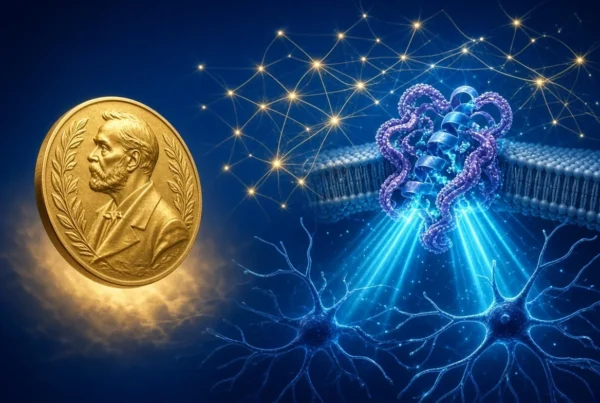
The Nobel Assembly at Karolinska Institutet awarded the 2026 Nobel Prize in Physiology or Medicine jointly to Karl Deisseroth, Peter Hegemann and Georg Nagel for their discoveries concerning light gated ion channels and optogenetics (NobelPrize.org press release).
Deisseroth works at Stanford University. Hegemann is at Humboldt University in Berlin, and Nagel at the University of Würzburg (GEN).
The Nobel Committee describes the method as a way to show how nerve cells shape memories, feelings and behaviours in the living brain. That is why it matters. Neuroscience moved from watching the brain to asking it questions.
What is optogenetics?
The word joins “opto” (light) and “genetics”. The idea needs four ingredients: light, light sensitive proteins, selected neurons and precise control.
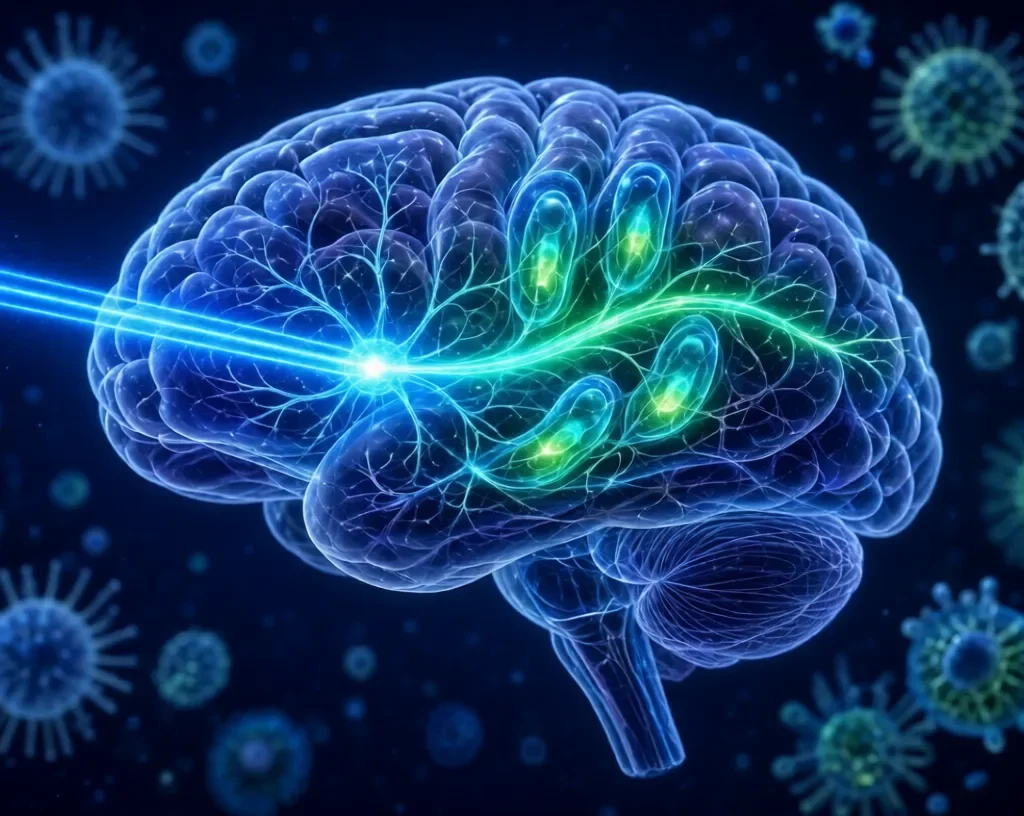
A neuron sends messages using tiny electrical signals. Those signals depend on ion channels, microscopic gates in the cell surface that let charged particles in or out. Some algae carry a protein called channelrhodopsin. It works as a light gated ion channel: when light hits it, the gate opens.
So scientists use genetic tools to place that protein into chosen neurons. Then they shine light, and only those cells respond.
Optogenetics works like giving selected brain cells a light switch. One honest correction: the switch is not built into the brain. Researchers must install it first, and only in the cells they choose.
The discovery journey
The story starts with a dream. Francis Crick once imagined switching one type of neuron on and off, and thought light might be the ideal signal, though he called the idea far fetched (GEN). Early experiments in the 1970s had already used laser light on neurons of a sea slug.
Then came the alga. Chlamydomonas is a single celled organism that swims toward light. Hegemann’s lab found channelrhodopsin 1, the first direct evidence of a light gated ion channel. About a year later, a team led by Nagel showed that a second protein, channelrhodopsin 2, behaved differently. It responded to blue light and let positive ions flow in.
Two clues, found by different scientists, in different labs. Neither was about the brain yet.
Deisseroth’s team supplied the missing link. Using a construct from Nagel, they placed channelrhodopsin 2 into mammalian neurons and triggered nerve signals with flashes of blue light, with millisecond precision. This was published in 2005 in Nature Neuroscience. Ed Boyden was first author, a reminder that big discoveries rarely have only three names behind them. Two years later, Deisseroth’s lab made the switch work in living mice.
Why optogenetics changed neuroscience
Older methods mostly let researchers observe activity or stimulate broadly. Optogenetics lets them control a selected population and see what follows. That shifts a question from “these cells were active when the animal did X” (correlation) to “when we activated these cells, X changed” (a stronger test of cause).
It is not perfect proof, but it is a far sharper experiment.
The practical framework: Find, Sensitise, Illuminate, Observe, Interpret
- Find. Pick the cell type or circuit you want to study, using genetic markers that identify it.
- Sensitise. Deliver the gene for a light sensitive protein so only those cells make it. Often this uses a harmless engineered virus.
- Illuminate. Deliver light of the right colour, often through a thin optical fibre.
- Observe. Record behaviour, brain activity or both.
- Interpret. Ask carefully whether the change truly came from those cells, and check with control experiments.
An illustrative example
This example is illustrative, not a report of a real study.
Suppose researchers want to know whether a certain group of neurons helps drive freezing behaviour in mice. They make only those neurons light responsive, then switch them on during a calm moment. If the mouse freezes, that is evidence the cells contribute. Switching them off during a scary moment and seeing less freezing adds more evidence. Neither result alone settles the story.
Editorial interpretation: why the prize matters
This is our interpretation, not a quotation from any scientist. Memory, emotion and behaviour are produced by circuits, not single cells in isolation. Optogenetics gave researchers a way to test those circuits one piece at a time. It has not “solved” memory or mental illness. It has made vague questions testable. The Nobel Committee’s own emphasis on memories, feelings and behaviours reflects that.
What the numbers actually mean
Millisecond precision. A millisecond is one thousandth of a second, roughly the timescale of a neuron’s own signal. So the method can match the brain’s natural speed, instead of flooding it slowly.
2005 to 2026. The key neuron paper is 21 years old. That shows how long a basic discovery can take to be recognised, and how many labs repeated and refined it first.
One patient. In a 2021 Nature Medicine report, one blind man with retinitis pigmentosa gained partial visual function. That is real and remarkable, but it is a single case. It is promise, not proof for everyone.
Real world applications
Established research use: Optogenetics is used worldwide to map brain circuits. Examples include studies of neurons involved in the move from sleep to wakefulness, and searches for the physical basis of memory (GEN). It also helps researchers study neurological and psychiatric conditions in animal models.
Experimental medicine: The 2021 retinitis pigmentosa case combined an injected viral vector carrying an amber light sensitive protein with special light projecting goggles. It was part of a clinical trial, not standard care. Learn more about the condition from the National Eye Institute.
Future possibilities: More precise therapies for brain disorders are an aim. They remain speculation until trials show safety and benefit.
Advantages and limitations
Strengths: precision, speed, cell specific control, and the ability to test cause and effect in neural circuits.
Limits, honestly:
- Delivering genes and light into a brain is technically hard.
- Targeting only the right cells is never perfect.
- Most work is in animals, and animal brains are not human brains.
- Long term safety questions, such as immune reactions to proteins or viruses, matter for any human use.
- Ethical care is essential when a technology can influence behaviour.
Optogenetics vs traditional neural stimulation
| Traditional electrical stimulation | Optogenetics | |
|---|---|---|
| Targeting | Affects cells near the electrode | Targets cells with the engineered protein |
| Cell type control | Limited | Strong |
| Needs gene delivery | No | Yes |
| Best for | Established clinical uses | Research and experimental therapies |
Precision matters because a brain circuit is like an orchestra. Hitting every drum at once tells you little. Playing one instrument tells you what it contributes.
Common misconception
Optogenetics is not simply shining light into the brain. Light alone, in most brain tissue, does nothing specific. The method works because cells have been given a light sensitive protein through gene delivery, and because the light is matched to that protein.
Why this matters beyond neuroscience
Learning, memory, behaviour, disease and even the questions around consciousness all rest on how neurons work together. A tool that tests circuits helps us ask better questions about each. It does not answer the deepest ones yet, and we should say so.
What readers can do next
- Read primary sources, starting with the Nobel Prize announcement.
- Separate established evidence from future possibilities.
- Follow reputable research from sources like NINDS.
- Learn the basics: neurons, ion channels and gene delivery.
This is education, not medical advice. Speak to a qualified doctor about any health concern.
FAQ
What is optogenetics? A method that uses light sensitive proteins, delivered to selected cells, to switch those cells on or off with light.
Who won the 2026 Nobel Prize in Physiology or Medicine? Karl Deisseroth, Peter Hegemann and Georg Nagel.
Why did optogenetics win? Because their discoveries on light gated ion channels and optogenetics gave researchers precise control over selected neurons in living brains.
How does optogenetics work? Genes for light sensitive proteins are delivered to chosen cells. Light then opens or controls those proteins, changing the cell’s activity.
Can optogenetics be used in humans? It has been tested in early clinical research, including a 2021 report of partial vision recovery in one patient.
Can optogenetics treat brain diseases today? No. Brain applications are experimental. Its main use today is research.
Conclusion: from a pond to the brain
A swimming alga used light to find its way. Scientists noticed, asked an odd question, and eventually turned that trick into Optogenetics, a tool for asking the brain direct questions.
Light was the most ordinary thing in the story, and it became the most powerful. The future of medicine may depend not only on understanding the brain, but on learning how to communicate with it.