
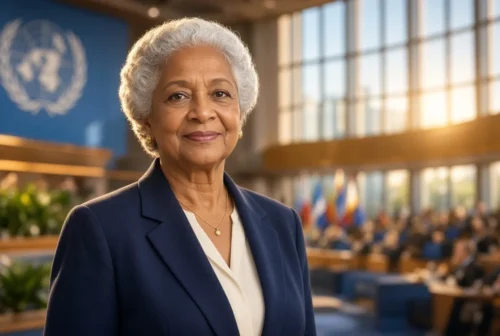
Under apartheid, Navi Pillay practised law for 28 years without being allowed into a judge’s chambers because of her race. On 9 October 2026, the Norwegian Nobel Committee named her the winner of the Nobel Peace Prize.
The committee could not reach her at first. She heard the news at the Nuremberg Forum, a gathering on international law in the German city that hosted the famous postwar trials. The room gave her a standing ovation.
This is not a story of a quiet career. It is a story of risky cases, hard verdicts and one big idea: lasting peace needs justice. Navi Pillay spent her life testing that idea. Here is what she did, why the committee chose her, and why the debate around her matters.
Table of Contents
Navi Pillay and the Fight for Justice
Pillay was born on 23 September 1941 in Durban, South Africa, to a Tamil family. Her father was a bus driver. She was one of eight children.
She became the first non white woman to open a law firm in Durban. She defended opponents of apartheid, including activists and trade unionists. In one Terrorism Act trial, her team exposed the use of torture in interrogations. Her own husband, Gaby Pillay, was a political prisoner she represented. For years, the government refused her a passport.
After apartheid ended, she became the first woman of colour on South Africa’s High Court in 1995. That same year, the UN General Assembly elected her to the International Criminal Tribunal for Rwanda. She served eight years there, the last four as its president.
Her best known moment came in the 1998 Akayesu case. The tribunal found a Rwandan mayor guilty of genocide and crimes against humanity. It also ruled that rape can be an act of genocide. After the verdict, she said rape had always been treated as one of the spoils of war.
Then came the International Criminal Court (2003 to 2008) and the post of UN High Commissioner for Human Rights (2008 to 2014). Today she sits as a judge at the International Court of Justice, in the case where Myanmar stands accused of genocide.
Nobel Peace Prize 2026: Why Her Work Matters
The committee honoured Navi Pillay “for her efforts to promote peace and international law.” It described a common thread from her early defence of Nelson Mandela and other apartheid opponents to her work as a judge in major international cases.
The committee also gave a warning. It said the system of international law is under tremendous pressure and its institutions are under attack. The chair, Jørgen Watne Frydnes, called the prize a reminder that international law is the cornerstone of a more peaceful world.
Alfred Nobel’s will asks for work that builds friendship between nations and supports peace congresses. The committee argued that Pillay’s push for tribunals gives those congresses a modern form.
Some numbers help. There were 287 candidates this year, 208 individuals and 79 organisations. The prize carries 12 million Swedish kronor. The ceremony is on 10 December. Only one name was chosen from 287, so the choice tells us what the committee wants to say to the world right now.
UN Secretary General António Guterres welcomed the news. He said the force of law must prevail over the law of force. Pillay dedicated the prize to survivors of international crimes and defenders of justice.
The Legal Battles Behind the Recognition
Rwanda: when rape became genocide
The Akayesu judgment changed how courts see sexual violence in war. Before it, such crimes were often treated as sad side effects of conflict. After it, they could be prosecuted as genocide when aimed at destroying a group.
Gaza: the hardest question
Pillay also chaired the UN Commission of Inquiry on the Occupied Palestinian Territory and Israel. In September 2025, the Commission reported that Israel had committed four of the five genocidal acts listed in the Genocide Convention. It said Israel was responsible for genocide in Gaza. It also said Israeli leaders incited genocide.
Israel’s Foreign Ministry replied that it “categorically rejects this distorted and false report.” Israel has refused to cooperate with the Commission and accuses it of bias. After the Nobel announcement, Israeli officials called the decision “disgraceful,” according to Newsweek.
How should a careful reader weigh this? Keep three points apart:
- A Commission is not a court. Its members are appointed by the UN Human Rights Council. It does not speak for the whole UN, and its findings are not a legal judgment.
- The legal question sits elsewhere. The International Court of Justice has been hearing a genocide case brought by South Africa. Check the court’s website for its latest status.
- The Nobel citation is about her wider work. The committee praised her record on accountability. It did not issue a verdict on any single report.
Supporters say she applied the same standard to every state. Critics say the Commission was one sided. Both views exist, and a fair reader can hold both in mind while waiting for courts to rule.
Can International Justice Create Lasting Peace?
Many people think peace comes from deals between leaders. Others say deals fail if crimes go unpunished. Here is a simple comparison.
| Peace through diplomacy | Peace supported by accountability | |
|---|---|---|
| Main tool | Negotiation and compromise | Investigation, trial and verdict |
| Speed | Can be fast | Usually slow |
| Strength | Stops fighting quickly | Builds trust and deters future crimes |
| Risk | May trade justice for quiet | May harden positions or lack enforcement |
The best results often use both. Talks end the shooting. Courts help make sure it does not return.
A simple framework: Name, Prove, Judge, Repair
- Name: Call the crime by its legal name, such as genocide or crimes against humanity.
- Prove: Collect evidence that can survive a trial.
- Judge: Let an independent court decide.
- Repair: Support victims through recognition, compensation and reform.
Rwanda shows this at work. Survivors of sexual violence were heard in an international court, and the law changed afterwards.
Advantages and limitations
International courts give victims a voice. They set rules that apply to powerful and weak states alike, and they create a record that is hard to deny.
They also have limits. Courts depend on states to arrest suspects. Trials take years. Some powerful countries stay outside their reach. Critics say justice can look selective, and even supporters admit enforcement is weak.
Philippe Sands, an international lawyer, called the day one for international law and justice. Haakon Gjerløw of the Peace Research Institute Oslo said the prize signals support for courts and judges under political pressure. Both views are interpretations, not facts, but they explain why the choice matters.
Lessons the World Can Learn
Misconception 1: The Nobel Peace Prize is a UN award. It is not. It is chosen by a five member committee in Oslo, appointed by Norway’s parliament but working independently.
Misconception 2: A prize ends a conflict. It does not. A Nobel can raise attention and protect people who work under pressure. It cannot stop a war or settle a legal case.
What readers can do next:
- Read the official Nobel press release and the committee’s reasons.
- Read primary documents, such as court judgments and UN reports, before sharing claims online.
- Separate allegations from verdicts when you read the news.
- Follow cases at the ICJ and the ICC through their official sites.
Conclusion
Navi Pillay’s path runs from a segregated Durban neighbourhood to the highest courts in the world. Her story asks a hard question: can justice help build a more peaceful world? Courts alone cannot end wars. But Pillay’s career suggests peace lasts longer when crimes are named, proved and judged. The Nobel committee has made its choice. Readers can now judge the evidence for themselves.
FAQs
1. Why did Navi Pillay win the 2026 Nobel Peace Prize? The committee honoured her efforts to promote peace and international law, and her work holding states and leaders accountable.
2. Who is Navi Pillay? She is a South African jurist born in 1941. She was a judge and president of the Rwanda tribunal, an ICC judge, UN High Commissioner for Human Rights, and is now a judge at the ICJ.
3. What is the Akayesu case? It was a 1998 Rwanda tribunal case. The court convicted a local mayor of genocide and found that rape can be an act of genocide.
4. Is the Gaza Commission report a court ruling? No. It is a UN Human Rights Council inquiry. Israel rejects its findings. Legal judgments come from courts such as the ICJ.
5. Can a Nobel Prize resolve a conflict? No. It can raise attention and encourage support for peace efforts, but it does not change events on the ground.