
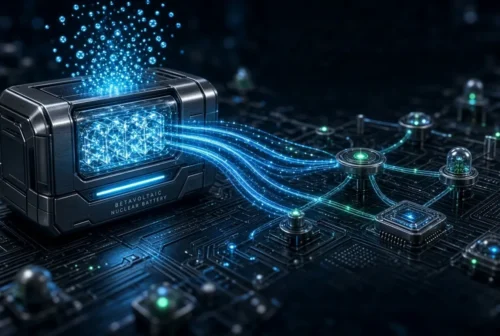
Imagine a deep-sea monitor anchored thousands of meters below the surface. Cold, crushing water surrounds it. No sunlight ever touches its sensors. Nobody will visit it to swap out dead cells. Yet, year after year, decade after decade, it continues to pulse data back up to the surface.
It does not carry a tangled bank of solar panels or a massive chemical pack. Inside sits a device smaller than a postage stamp, quietly generating steady electrical current from decaying atomic nuclei.
This is not science fiction. It is the reality of betavoltaic nuclear batteries.
The concept sparks an immediate scientific mystery. If an energy source can generate clean electrical current continuously for 20, 50, or even 100 years without recharging, why aren’t these devices powering our phones, laptops, and electric vehicles today?
The answer lies in the fundamental physics of the atomic nucleus, an invisible race against material degradation, and an unforgiving engineering trade-off between battery longevity and raw power output.
Table of Contents
1. Introduction: Why Lasting Power Changes Everything
Modern civilization runs on chemical batteries. We rely on lithium-ion cells to wake us up, power our drives, and connect our lives. Yet chemical batteries share an unavoidable flaw: they decay quickly. Electrodes break down, liquid electrolytes degrade, and internal chemical reactions sputter out after a few hundred or thousand charge cycles.
For consumer gadgets, plugging into a wall every evening is an acceptable chore. But in the remote corners of our planet—deep geological faults, polar ice caps, orbiting satellites, and inside the human body—changing a battery is difficult, dangerous, or physically impossible.
Betavoltaic nuclear batteries bypass chemical storage altogether. Instead of storing energy inside unstable chemical bonds, they harvest energy directly from the natural, predictable decay of radioactive isotopes. As long as those atoms decay, the battery delivers uninterrupted current.
2. The Hidden Science: Turning Atomic Decay into Electricity
To understand betavoltaics, picture a standard solar panel resting on your roof. When sunlight strikes the panel, incoming light particles (photons) strike silicon atoms. They knock electrons loose, creating an electrical current that flows through your home.
A betavoltaic battery works on the exact same principle, with one critical twist: it works in total darkness.
Instead of ambient sunlight, the device uses a radioactive isotope that emits beta particles. A beta particle is simply a high-speed electron ejected from an unstable atomic nucleus trying to find stability.
[Beta-Emitting Isotope]
          │
          ▼ (High-Speed Electrons / Beta Particles)
[Semiconductor Junction (p-n diode)]
          │
          ▼ (Electron-Hole Pairs Created)
[Continuous Direct Current (DC)]
Sandwiched right next to this radioactive layer is a semiconductor, typically built from resilient materials like silicon, silicon carbide, or synthetic diamond.
When an emitted beta particle shoots into the semiconductor, it collides with atoms inside the crystal lattice. These collisions liberate thousands of secondary electrons, creating what physicists call “electron-hole pairs.” Built-in electric fields inside the semiconductor guide these free electrons toward electrical contacts, producing a steady, continuous direct current.
Because the fuel is self-contained and beta decay occurs at a steady rate dictated by quantum physics, the battery does not need oxygen, fuel lines, or ambient heat. It simply produces electricity from the steady, ticking clock of atomic decay.
3. A Powerful New Possibility: Where Can Betavoltaics Go?
Because betavoltaics run on atomic decay, they behave very differently from traditional power systems. It is vital to separate what is operational today from what remains experimental.
+-----------------------------------+-----------------------------------+
| Operating Today                   | Experimental / Future Targets     |
+-----------------------------------+-----------------------------------+
| Low-power military/defense sensors| Subcutaneous biomedical monitors  |
| Deep-space instrumentation        | Self-powered structural sensors   |
| Low-frequency seabed beacons      | Ultra-long-life IoT microchips    |
+-----------------------------------+-----------------------------------+
- Remote and Extreme Sensors (Proven): Underwater acoustic monitors, oil and gas borehole sensors, and arctic weather probes use betavoltaic cells to broadcast periodic data packets without maintenance.
- Deep Space Exploration (Proven): Instruments voyaging beyond Mars receive negligible sunlight. While large probes rely on heavy heat-based atomic batteries, micro-probes and deep-space cubesats can leverage compact betavoltaic units for low-drain instrumentation.
- Biomedical Implants (Experimental): Early cardiac pacemakers in the 1970s explored nuclear power (using thermal decay), but modern betavoltaics using safe, low-energy isotopes like nickel-63 or tritium could theoretically drive internal sensors, glucose monitors, or neural interfaces for decades without surgical replacement.
- Structural Health Monitoring (In Development): Embedding tiny betavoltaic sensors into poured concrete for suspension bridges or skyscraper foundations allows continuous reporting on structural stress for the structure’s lifetime.
4. An Original Comparison: How Betavoltaics Stack Up
To grasp why betavoltaic nuclear batteries cannot simply start charging your smartphone, we must compare them directly to the other common power sources available today.
| Metric | Betavoltaic Battery | Lithium-Ion Battery | Industrial Long-Life (LiSOCl2) | RTG (Radioisotope Thermoelectric) |
| Energy Conversion | Direct particle conversion via semiconductor | Reversible chemical reaction | Non-reversible chemical reaction | Thermal decay converted via thermocouples |
| Power Output | Nanowatts to Microwatts | Watts to Kilowatts | Milliwatts to Watts | Tens to Hundreds of Watts |
| Typical Lifespan | 10 to 100+ Years | 2 to 5 Years | 10 to 20 Years | 20 to 50+ Years |
| Size & Footprint | Chip-scale (millimeter/centimeter) | Variable (pocket to vehicle) | Small cylinder | Bulky (kilograms to hundreds of kg) |
| Operating Temperatures | -50°C to +150°C | Narrow (-20°C to +60°C) | Broad (-55°C to +85°C) | Tolerates high operational heat |
| Primary Limitation | Extremely low instant power | Rapid chemical degradation | Finite chemistry; voltage delay | Bulky; massive radioactive inventory |
The core takeaway is stark: Lithium-ion delivers high bursts of power for short periods, while betavoltaics deliver tiny amounts of power across human generations.
5. Practical Example: The Isolated Glacier Sensor
To see this dynamic in action, consider a hypothetical remote environmental station anchored inside a crevasse on an Arctic ice shelf.
The monitoring station contains:
- A temperature probe taking readings once every four hours.
- A low-power micro-controller.
- A burst radio transmitter to squawk data up to passing low-Earth orbit satellites.
If technicians equip this device with an advanced lithium battery pack, the deep sub-zero cold quickly degrades the liquid electrolyte. Within two winter seasons, battery output plummets, chemistry fails, and the station goes dark. A maintenance flight must be scheduled at immense expense.
Now swap that pack for a hybrid betavoltaic system:
- A small betavoltaic cell generates a continuous trickle of direct current—say, 5 microwatts.
- Because 5 microwatts cannot broadcast a high-power radio signal directly, the cell continuously feeds energy into a rugged solid-state capacitor or supercapacitor.
- Over four hours, the capacitor slowly banks this continuous atomic energy.
- When the sensor triggers, the capacitor dumps a fast, high-power burst of electrical current into the radio transmitter for 100 milliseconds, sending the packet to orbit.
- The capacitor resets and begins trickling full again.
Because temperature swings have minimal impact on radioactive decay rates, this Arctic station can report back steadily for 30 years without a single human stepping foot on the ice.
6. Expert Interpretation: Making Sense of the Numbers
Public announcements around nuclear batteries often claim wild milestones like “infinite power.” Examining the actual laboratory data reveals the grounded reality:
- Isotope Half-Life: The half-life is the time it takes for half of the radioactive atoms in a sample to decay. For example, Tritium ($^3\text{H}$) has a half-life of roughly 12.3 years, while Nickel-63 ($^{63}\text{Ni}$) boasts a half-life of approximately 100.1 years. This sets the strict upper boundary of the battery’s operational life. A Nickel-63 cell can deliver predictable, declining power for well over a century.
- Electrical Power (Microwatts): Commercial and experimental betavoltaic prototypes typically produce power measured in microwatts ($\mu\text{W}$) or nanowatts ($\text{nW}$) per cubic centimeter. A standard smartphone requires roughly 1 to 2 watts to run its screen and processors. One watt equals 1,000,000 microwatts. You would need a betavoltaic cell larger than your desk to run a modern phone screen in real time.
- Energy Conversion Efficiency: This metric tracks how much kinetic energy from the emitted beta particles successfully turns into usable electric current. Most current silicon-based betavoltaic designs achieve an efficiency of 2% to 8%, while advanced wide-bandgap semiconductors (like single-crystal synthetic diamond and silicon carbide) tested in institutional labs have pushed theoretical limits higher, often reaching between 10% and 18%.
The engineering bottleneck is simple: beta radiation breaks down the semiconductor crystal over time. The exact particles harnessed to make electricity gradually damage the semiconductor’s atomic grid, lowering efficiency long before the radioactive fuel runs dry.
7. Real-World Applications: Progress and Engineering Roadblocks
Building functional betavoltaic devices requires navigating severe engineering hurdles:
Demonstrated Progress
Companies like Wormhole Labs, City Labs (using tritium), and academic research groups across Europe and Asia have successfully manufactured sealed, commercially viable low-power betavoltaics. These units reliably power low-drain electronics, secure microchips that hold cryptographic keys, and static military monitoring gear.
Engineering Barriers
- Radiation Damage (“Self-Poisoning”): Beta particles bombard the crystal lattice 24 hours a day. Over years, this bombardment knocks semiconductor atoms out of place, creating defects that trap free electrons and sap output.
- Low Specific Activity: To extract meaningful microwatts, you need a critical density of isotope material. If the material layer is made too thick, the isotope absorbs its own emitted beta particles (self-absorption) before they ever hit the semiconductor.
- Thermal and Energy Matching: Wide-bandgap materials like diamond hold up best against radiation damage, but manufacturing high-purity synthetic diamond layers remains technically complex and expensive.
8. Advantages and Real Limitations
Before betavoltaic technology scales across the Internet of Things (IoT), industrial engineers must weigh clear pros and cons:
Advantages
- Decades of Operation: True “install-and-forget” longevity matching human lifetimes.
- Environmental Resilience: Operates smoothly across extreme temperatures (-50°C to well over 100°C), vacuum environments, and high-pressure ocean trenches.
- High Energy Density: The raw energy locked inside isotopic nuclear bonds dwarfs standard chemical batteries by orders of magnitude per unit mass.
Limitations
- Extremely High Cost: Fabricating pure isotopes like Nickel-63 requires specialized nuclear reactors and centrifuge processing, making raw materials expensive.
- Minimal Instantaneous Power: Output cannot jump instantly on demand. Tasks requiring high current require pairing with capacitors.
- Strict Regulatory Oversight: Devices using radioisotopes must comply with strict licensing, handling, and transport frameworks enforced by agencies like the U.S. Nuclear Regulatory Commission (NRC) or international radiation bodies.
- Public Perception: The word “nuclear” still stirs fear. Even though beta particles can be stopped by a sheet of paper or the human skin layer, public acceptance remains a major hurdle.
9. Common Misconception: It Is Not a Miniature Reactor
The single biggest public misconception is that betavoltaic cells are tiny nuclear reactors.
They are not.
A nuclear reactor depends on induced nuclear fission—splitting heavy atomic nuclei like Uranium-235 in a controlled chain reaction. Reactors produce intense heat, require cooling loops, produce energetic gamma radiation, and carry risks of critical runaway if uncontrolled.
A betavoltaic battery uses spontaneous, natural radioactive decay.
- There is no chain reaction.
- There is no fission.
- It cannot melt down, explode, or overheat.
Furthermore, beta particles are simply energetic electrons. Unlike penetrating gamma rays or neutron radiation, beta radiation is stopped completely by basic packaging. The outer metal casing of a commercial betavoltaic cell shields all radiation; holding one in your hand exposes you to zero external radiation above normal background levels.
10. Practical Framework: How to Evaluate Nuclear Battery Claims
Whenever an emerging tech startup or viral headline claims a “breakthrough 50-year nuclear battery,” run the claim through this six-point checklist:
                      EVALUATION CHECKLIST
─────────────────────────────────────────────────────────────────
[1] Power Output: Is it measured in Watts or Microwatts?
    (Microwatts indicate real science; Watts suggest hype.)
[2] Isotope Selected: Does it use safe beta-emitters (H-3, Ni-63)?
[3] Half-Life Realism: Does the projected lifespan match the isotope?
[4] Efficiency Proof: Are conversion numbers between 2% and 15%?
[5] Radiation Shielding: Is the packaging hermetic and fully contained?
[6] Commercial Status: Is it a lab wafer, or has it passed regulatory review?
─────────────────────────────────────────────────────────────────
If a company claims a coin-sized nuclear battery can directly recharge your laptop or power a drone, you can immediately identify it as science fiction. If they claim it generates continuous microwatts to power an environmental beacon for 25 years, the laws of physics are on their side.
11. What Readers Should Do Next
To separate genuine atomic energy breakthroughs from speculative marketing, follow these steps:
- Consult Primary Academic Literature: Read journals like Applied Physics Letters or IEEE transactions on electron devices for peer-reviewed performance benchmarks on diamond and silicon carbide betavoltaic cells.
- Review Regulatory Standards: Check public information portals from bodies like the U.S. Nuclear Regulatory Commission (NRC) or the International Atomic Energy Agency (IAEA) to understand radiation safety criteria and exemption tiers for sealed consumer-level sources.
- Look for Verified Prototypes: Track industrial demonstrations from established research entities like the National Nuclear Laboratory or university energy labs rather than unverified crowdfunding campaigns.
12. Conclusion: A Silent Revolution for Quiet Power
Betavoltaic nuclear batteries will not replace the lithium cells humming inside your smartphone or electric vehicle. Physics simply does not support packing high wattage into micro-scale isotopic decay without immense bulk, heat, and safety shielding.
Yet calling them limited misses their true genius.
By delivering clean, uninterrupted, maintenance-free current across decades, betavoltaics solve one of computing’s greatest frontiers: the problem of untethered power. As micro-electronics, ambient computing, and low-power sensors become smaller and more efficient, the power requirements of modern computing will drop to meet the capabilities of atomic batteries.
In the quiet corners of our world—from the cold expanse of outer space to the silent depths of our oceans—these tiny atomic powerhouses are already showing that the most enduring power revolutions do not arrive with an explosion, but with a steady, quiet tick that lasts a lifetime.
Frequently Asked Questions
1. How do betavoltaic nuclear batteries work?
They function similarly to solar panels. A radioisotope emits high-speed electrons (beta particles) as it naturally decays. These particles strike an adjacent semiconductor, liberating electrons to create a continuous direct current.
2. Are betavoltaic batteries dangerous or radioactive to handle?
No. Betavoltaics use beta-emitting isotopes whose particles are easily stopped by thin materials. A standard hermetic metal casing traps all internal radiation entirely, leaving the exterior safe to hold without protective gear.
3. How long do these batteries typically last?
Lifespans depend directly on the chosen isotope’s half-life and the semiconductor’s durability. Tritium-based cells typically run for 10 to 20 years, while Nickel-63 designs can theoretically generate continuous electricity for more than 50 to 100 years.
4. How do betavoltaics compare to lithium-ion batteries?
Lithium-ion batteries store energy chemically, providing high power outputs (watts) but wearing out after several years. Betavoltaics draw energy from atomic decay, lasting for decades but outputting tiny fractions of power (microwatts).
5. What are their practical applications today?
Proven applications include powering isolated environmental sensors, deep-water ocean monitors, low-drain spacecraft avionics, and cryptographic memory modules that require persistent power to maintain security.
6. Can everyday consumers buy them today?
Not for everyday home gadgets. While some sealed commercial sensors are sold to industrial, military, and aerospace clients, strict radioisotope regulations, high manufacturing costs, and minuscule power outputs make them impractical for standard retail consumer electronics.