
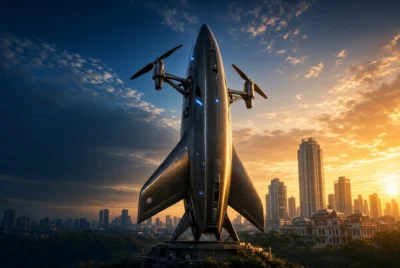
On a morning in Bengaluru, a carbon fibre aircraft stood upright on its tail. It lifted straight up, tipped forward, and glided across the sky. Its cargo was a single vial of blood. ZME Science described this flight in its report on Airbound, the startup that built the aircraft.
Who built it? Who Is Naman Pushp? He is the founder and CEO of Airbound, a Bengaluru aerospace company. In October 2026, ChannelIAM reported that he is 21. This article separates what is verified, what is a company claim, and what is still unproven.
Table of Contents
Who Is Naman Pushp? What the Evidence Shows
Here is what credible reporting supports.
- He founded Airbound, which launched in 2023, according to Entrepreneur India.
- He began experimenting with drones at 15, during the Covid lockdown. His Open Drone project won $500 at a hackathon. He reinvested the prize into his first serious prototype (ChannelIAM).
- On August 25, 2026, Airbound announced a $37 million Series A led by Greenoaks. DoorDash, Lachy Groom, Lightspeed and Humba Ventures also took part. Total funding is nearly $50 million (Entrepreneur India).
- Airbound has reported more than 13,000 autonomous flights across Bengaluru and Guntur (TechCrunch, via Dealroom).
So the link to airborne drones is direct and well documented. What we cannot verify is every personal story told about him online. Some details differ between outlets. We repeat only what several sources agree on.
What Is an Airborne Drone?
An airborne drone is an unmanned aircraft in flight. It has motors, a battery, a flight computer, sensors and a radio link. Many modern drones fly part of their route alone, using GPS and software.
Think of it as a small aircraft with no pilot on board. The pilot, or the software, works from the ground.
Two ideas matter for the rest of this story. The first is autonomy. A remote controlled drone needs a person to steer it at every moment. An autonomous drone follows a planned route and handles routine decisions itself. The second is line of sight. Rules in many countries, including India, treat a flight you can see very differently from one beyond your view. Delivery at scale almost always means flying beyond view, which is why regulators sit at the centre of this industry.
Three Drone Types Compared
| Type | How it flies | Strength | Weakness | Best for |
|---|---|---|---|---|
| Multirotor | Spinning rotors lift it, like a helicopter | Hovers, easy to launch | Short range, drains battery fast | Photography, inspection |
| Fixed wing | A wing creates lift as it moves forward | Efficient over long distance | Needs a runway or launcher | Mapping, farmland survey |
| Hybrid VTOL (vertical take off and landing) | Lifts straight up, then flies on its wing | Takes off anywhere and cruises efficiently | More complex to design | Delivery, long routes |
This comparison is general engineering knowledge, not a product review. Airbound’s aircraft belongs in the third row.
The Weight Problem Behind Airbound
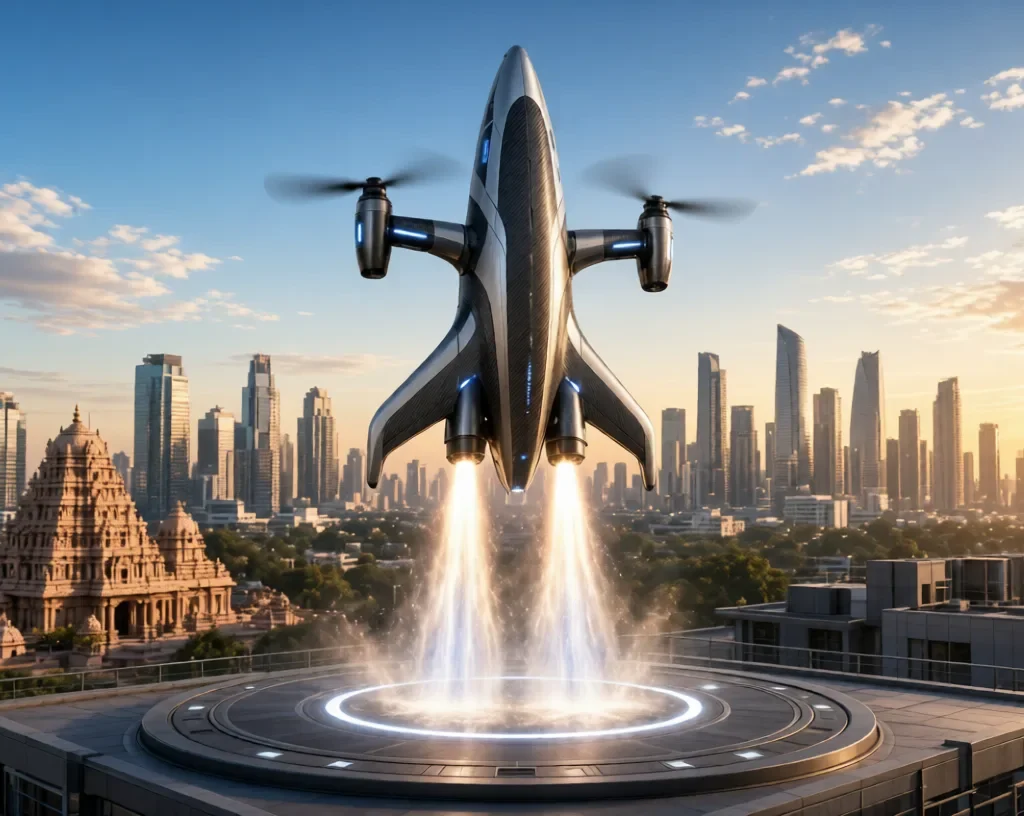
Pushp says most delivery drones need about four kilos of aircraft to lift one kilo of cargo. Airbound’s TRT tries to change that ratio. It stands on its tail, lifts off vertically, then flies on a single blended wing of carbon fibre. It weighs about 1.5 kilos and carries one kilo up to 40 kilometres, according to a video report carried by Yahoo.
Pushp summed up his view by saying logistics is “just a physics problem,” as ZME Science reported.
Our reading: a lighter aircraft needs less energy per trip, and less energy can mean lower cost. The logic is sound. But it is not yet proven at national scale.
Real World Uses
Healthcare is Airbound’s first proving ground. With Narayana Health, its aircraft moved diagnostic samples between facilities. Delivery times fell from hours to minutes (Entrepreneur India). An earlier pilot plan covered blood samples, test kits and medical supplies, with up to 10 trips a day (ZME Science, 2025).
Airbound has also signed an agreement with the Andhra Pradesh government. The plan is a drone network linking three cities, with a target of 10,000 flights a day (Entrepreneur India).
Drones serve other fields too:
- Agriculture: crop spraying and field monitoring.
- Disaster response: searching damaged areas and carrying light supplies.
- Photography: aerial shots at a low cost.
- Industry: inspecting towers, pipelines and roofs.
Illustrative example (invented, not a real case)
Imagine a district hospital that needs a sample tested at a city lab 30 kilometres away. By road, traffic could add hours. A drone flying a straight line could shorten the trip. This scenario is made up to explain the idea. For real data, see the next section.
Advantages and Limits
Advantages
- Speed. In a Bengaluru trial by FedEx and IIT Madras, a road journey of about 60 minutes dropped to roughly 21 minutes by air (YourStory).
- Less road dependence. Drones skip traffic and need no highway.
- Cost potential. In 2025 reporting, Pushp’s stated aim was to cut delivery cost from about ₹24 to below ₹5 by 2026 (ZME Science). Treat this as a target, not a result.
Limits
- Small payload. The TRT carries one kilo.
- Rules. India’s Drone Rules 2021 are the base framework. NITI Aayog’s Frontier Tech Hub notes a 400 feet ceiling and says most operations are limited to visual line of sight. On August 18, 2026, Civil Aviation Minister Kinjarapu Rammohan Naidu said a certification framework for flights beyond visual line of sight (BVLOS) is expected by the end of 2026 (Unmanned Airspace).
- Competition. Rivals include Skye Air Mobility and TSAW Drones (TechCrunch, via Dealroom).
- Safety. Signal loss, weather, collisions and privacy remain real concerns. India’s civil aviation ministry told Parliament in December 2024 that drone rules cover remote pilot training and approval in yellow zones.
A Five Check Framework for Any Drone Claim
Use these checks on any drone headline.
| Check | Ask | Airbound, as reported |
|---|---|---|
| Payload | How much can it carry? | One kilo |
| Range | How far can it fly? | 40 kilometres (company claim) |
| Rules | Is it legal at scale? | BVLOS framework still expected |
| Reliability | Is there a flight record? | 13,000+ flights reported, no independent audit found |
| Real cost | What is the cost per delivery? | Targets only |
The pattern is simple. Payload and range are easy to state. Rules, reliability and real cost take years to prove.
A Common Misconception
Myth: “Drone delivery is already everywhere.”
Evidence: In India, the rules for flights beyond visual line of sight are still being finalised. The Directorate General of Civil Aviation set up a working group for them, as the ministry told Parliament in December 2024. A framework is targeted for the end of 2026. Airbound’s flights are impressive, but they cover corridors and pilots in a few places, not a nationwide service.
What Readers Should Do Next
- Flying a drone? Check the rules and zones on the Digital Sky platform before takeoff.
- Reading a drone story? Find the original source and apply the five checks.
- Running a business? Start with one short route. Measure time and cost.
- A student? Learn basic aerodynamics and electronics. Pushp’s own path began with a small project and a $500 prize.
- Following the industry? Watch for BVLOS announcements before the year ends.
Conclusion
So, Who Is Naman Pushp? He is a young Indian founder with a documented record: a teenage drone project, a funded company, and thousands of reported flights. His idea is bold and simple. Make the aircraft lighter, and delivery gets cheaper.
The proof is still being written. Rules, reliability and real costs will decide the outcome. Until then, the smartest approach is to admire the ambition, check the evidence and keep asking questions.
FAQ
1. Who Is Naman Pushp? He is the founder and CEO of Airbound, a Bengaluru company building autonomous delivery drones. Reports say he began building drones at 15.
2. What is airborne drone technology? It is the set of parts and software that let an unmanned aircraft fly: motors, battery, flight computer, sensors and a radio link.
3. Where are drones used today? Common uses include healthcare delivery, agriculture, disaster response, photography and industrial inspection.
4. Are delivery drones safe? They carry risks such as signal loss, bad weather and collisions. Regulators require registration, trained pilots and zone approvals to reduce those risks.
5. What is next for drone delivery in India? The government has said a BVLOS certification framework is expected by the end of 2026. Airbound plans a three city network in Andhra Pradesh.