
Introduction: The Battery Question Nobody Can Ignore
An electric car carries a lot of energy under the floor. That is what gives it range. It is also why battery safety worries buyers.
When a lithium ion cell is damaged or overheats, heat can trigger a chain reaction inside it. Engineers call this thermal runaway. It can lead to smoke and fire, and it is the fear behind many EV headlines.
So the design question is simple to ask and hard to answer. How do you store a lot of energy, keep the cost sensible, and lower the chance of fire?
BYD’s answer is the Blade Battery. In March 2020, BYD showed a nail piercing a cell and said almost nothing dramatic happened. This article explains how the design works, what that test shows, and what it cannot show.
Table of Contents
What Is the BYD Blade Battery?
The name describes a shape, not just a chemical recipe. Three ideas sit together.
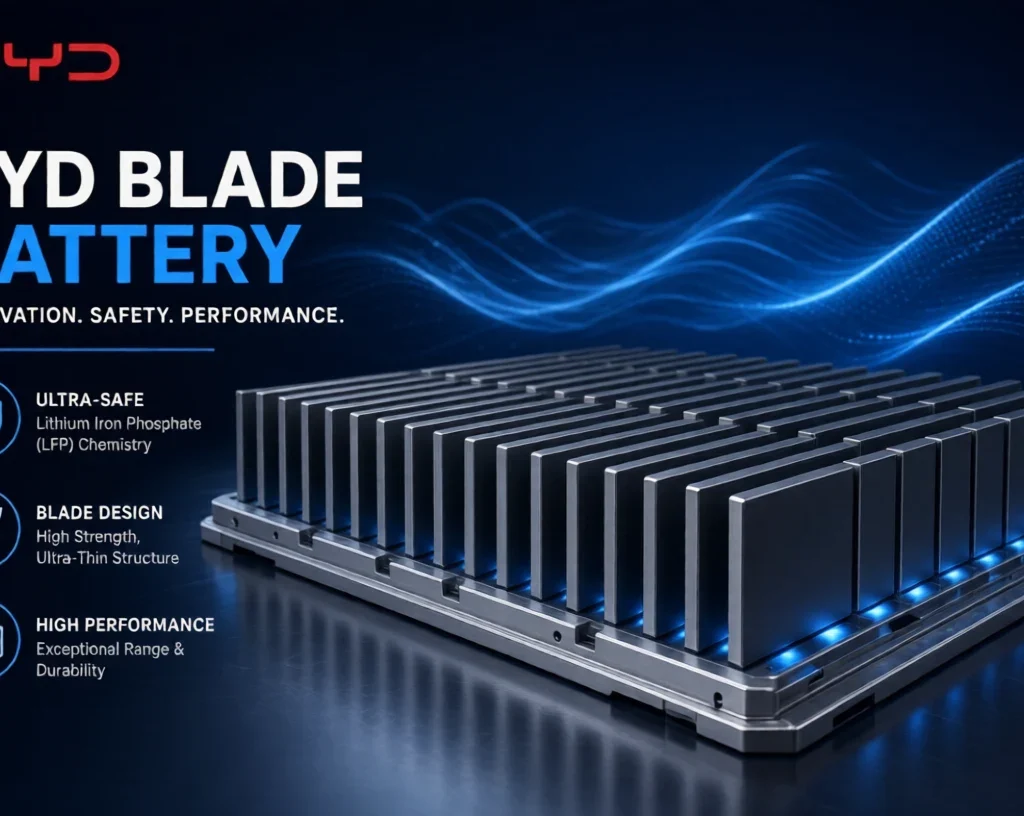
1. Chemistry. The Blade Battery uses lithium iron phosphate, or LFP. LFP is known for good thermal stability and for using no nickel or cobalt. It usually stores less energy per kilogram than nickel rich cells.
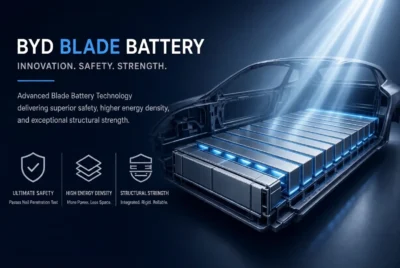
2. Cell shape. A first generation BYD cell is long and thin. Wikipedia lists it at 960 mm long, 90 mm high and 13.5 mm thick. Think of a ruler more than a brick. The long, flat shape gives more surface area, which helps heat escape.
3. Pack design. Most batteries put cells into modules, then modules into a pack. BYD places long cells straight into the pack, an approach called cell to pack. The cells also act as structural beams.
Why does this matter? BYD says cells fill about 60% of pack volume in this design, against about 40% in the older approach. That is a manufacturer claim, but it explains the goal: make up for LFP’s lower energy density by wasting less space.
A simple analogy: think of books on a shelf. Standing many thin books side by side holds more than stacking boxes of books inside bigger boxes. The analogy has limits, because heat and chemistry matter too, not only space.
Remember the split: chemistry is LFP, shape is the blade, and layout is cell to pack. Each can be discussed on its own.
The Nail Test That Put Battery Safety in the Spotlight
A nail penetration test pushes a metal nail through a charged cell. This creates an internal short circuit, one of the harshest ways to trigger thermal runaway on a test bench.
At its March 2020 launch, BYD compared three cell types under the same conditions. According to BYD and press coverage at the time:
- Conventional block type LFP cells reached 200 to 400 °C without open flames.
- A ternary (NCM) cell reportedly caught fire and heated sharply.
- The Blade cell showed no smoke or fire and a surface temperature of about 30 to 60 °C.
BYD also says the pack survived crushing, bending, oven heating to 300 °C, and a 46 ton truck driving over it.
Here is how to read this fairly.
What BYD showed: In its own demonstration, a Blade cell handled a nail without fire or smoke.
What independent testing must confirm: Whether other labs get the same result, across many cells, batches and conditions. A manufacturer video is a starting point, not a verdict.
What no single test can prove: The battery is not fireproof or immune to damage. One nail test cannot predict every crash, charging fault, manufacturing defect or extreme heat event.
Blade Battery vs Other EV Battery Technologies
Here is a general comparison. Figures vary by maker and model, so treat the table as a guide to trade offs, not a ranking.
| Factor | LFP (Blade Battery type) | Nickel rich (NMC) |
|---|---|---|
| Energy density | Lower, though improving | Higher |
| Thermal stability | Generally better | Generally lower |
| Cost and minerals | No nickel or cobalt, often cheaper | Uses nickel, often cobalt |
| Cycle life | Often longer | Often shorter |
| Cold weather | Historically weaker | Often better |
| Charging | Improving fast | Strong, varies by design |
| Pack space | Cell to pack helps close the gap | Smaller cells, more flexible |
| Best fit | Daily use, value, durability | Long range, light weight |
Some numbers to anchor this. A 2022 IEA report, as summarised by Digitimes, said LFP cells usually hold about 65% to 75% of the energy density of high nickel cells. The IEA’s 2023 outlook also states that LFP energy density tends to be lower than NMC.
LFP is no niche chemistry now. One report based on the IEA’s 2026 outlook puts LFP at over 55% of global EV battery deployment in 2025. Check the IEA page for the exact figure before you quote it.
No chemistry wins everywhere. Results depend on cell design, battery software, cooling, vehicle efficiency, climate and how you charge.
The Hidden Trade Offs Behind the Innovation
What the design may offer: better thermal stability, long life, lower cost and efficient use of space.
What it gives up:
- LFP usually carries less energy per kilogram, so a car may need a bigger or heavier pack for the same range.
- Cold weather has been a weak point for LFP, since charging slows when the cells are cold.
- Claims between brands are hard to compare, because each company tests differently.
Safety is also a system matter. A safe cell still needs good battery management software, cooling, a protective pack structure, quality manufacturing and a well designed car around it.
What the Numbers Really Tell Us
Battery numbers confuse people, so separate them.
- kWh is battery capacity, like the size of a fuel tank.
- kWh per 100 km is energy use, like fuel economy.
- kW is charging power, like how fast a pump delivers fuel.
- Wh/kg is energy density. Cell level figures look better than whole pack figures, because the pack also carries casing, cooling and wiring.
Range is simple maths: capacity divided by consumption. Here is an estimate with made up inputs:
| Car A | Car B | |
|---|---|---|
| Usable battery | 60 kWh | 75 kWh |
| Energy use | 15 kWh/100 km | 18 kWh/100 km |
| Estimated range | about 400 km | about 417 km |
Car B has a 25% larger battery but gains only about 4% more range, because it uses more energy per kilometre. Bigger is not always better. Always check official range figures and real world reviews for the exact car.
What Blade Battery Means for Real Drivers
These two buyers are hypothetical, not real customers.
Asha drives 30 km a day in the city and wants low cost and a long battery life. An LFP pack suits her pattern. She rarely needs maximum range, and she charges at home.
Ravi drives long motorway trips every month. He cares about range, charging stops and cold winters. He may prefer a nickel rich pack, or an LFP car with strong range and fast charging.
Both choices can be sensible. Use this checklist:
- Check the car’s certified range.
- Compare usable capacity and real energy use.
- Look at charging speed and nearby chargers.
- Consider climate, driving pattern, warranty and years you will keep the car.
- Read independent safety ratings for that model.
- Compare total ownership cost, not the battery’s marketing name.
Common Myths About BYD Blade Battery
“LFP cannot catch fire.” False. LFP is more thermally stable, but no lithium ion battery is risk free.
“Passing a nail test proves the battery is safe in every situation.” No. It is one test of one kind of failure.
“A bigger battery always means more range.” No. Efficiency matters, as the table above shows.
“All BYD cars use the same Blade Battery.” No. BYD now describes short and long blade formats in its second generation, and packs differ by model.
“One chemistry is best for everyone.” No. Drivers and vehicles differ.
The Future of Blade Battery and Electric Mobility
On 5 March 2026, BYD announced Blade Battery 2.0 with Flash Charging. According to BYD, as reported by trade outlets, charging can reach up to 1,500 kW in the Chinese market version. BYD claims 10% to 97% in about nine minutes, and 20% to 97% in 12 minutes even at minus 30 °C. It also says it ran a nail test during Flash Charging, with no thermal runaway after 500 charging cycles. These are BYD’s claims, and independent results are still needed.
BYD reported 4,239 Flash Charging stations in China as of 5 March 2026 and a target of 20,000 by the end of 2026. Outside China, plans are announced, not yet proven. The first European model named is the Denza Z9GT.
Open questions remain: energy density, charging speed in everyday use, cold weather performance, recycling, and total environmental impact over the battery’s life. Nobody can promise that one design will dominate the market.
Conclusion: Progress Matters More Than Hype
The question at the start was how to hold large amounts of energy without inviting disaster. The Blade Battery is a serious engineering answer. It combines a stable chemistry, a smart shape and an efficient pack layout.
It is not magic. No battery removes every risk, and none suits every driver. Look past the dramatic videos. Compare real specifications, independent tests and your own driving needs.
Frequently Asked Questions
1. What is special about BYD Blade Battery? It combines LFP chemistry with long, thin cells placed directly in the pack. The aim is better safety, durability and space use at a lower cost.
2. Is the BYD Blade Battery safer than other EV batteries? LFP is generally more thermally stable than nickel rich chemistries, and BYD reports strong test results. Safety still depends on the full system, and independent evidence matters. No battery is completely risk free.
3. What is the significance of the nail penetration test? It tests how a cell reacts to an internal short circuit. BYD’s result is encouraging, but it is one test and mainly a manufacturer demonstration.
4. What are the main disadvantages of LFP based batteries? Lower energy density in many cases, and slower charging in cold weather. Newer designs are narrowing these gaps.
5. Should buyers choose a BYD vehicle because it uses Blade Battery? Not on that alone. Check the car’s range, charging,warranty, safety rating and price.