
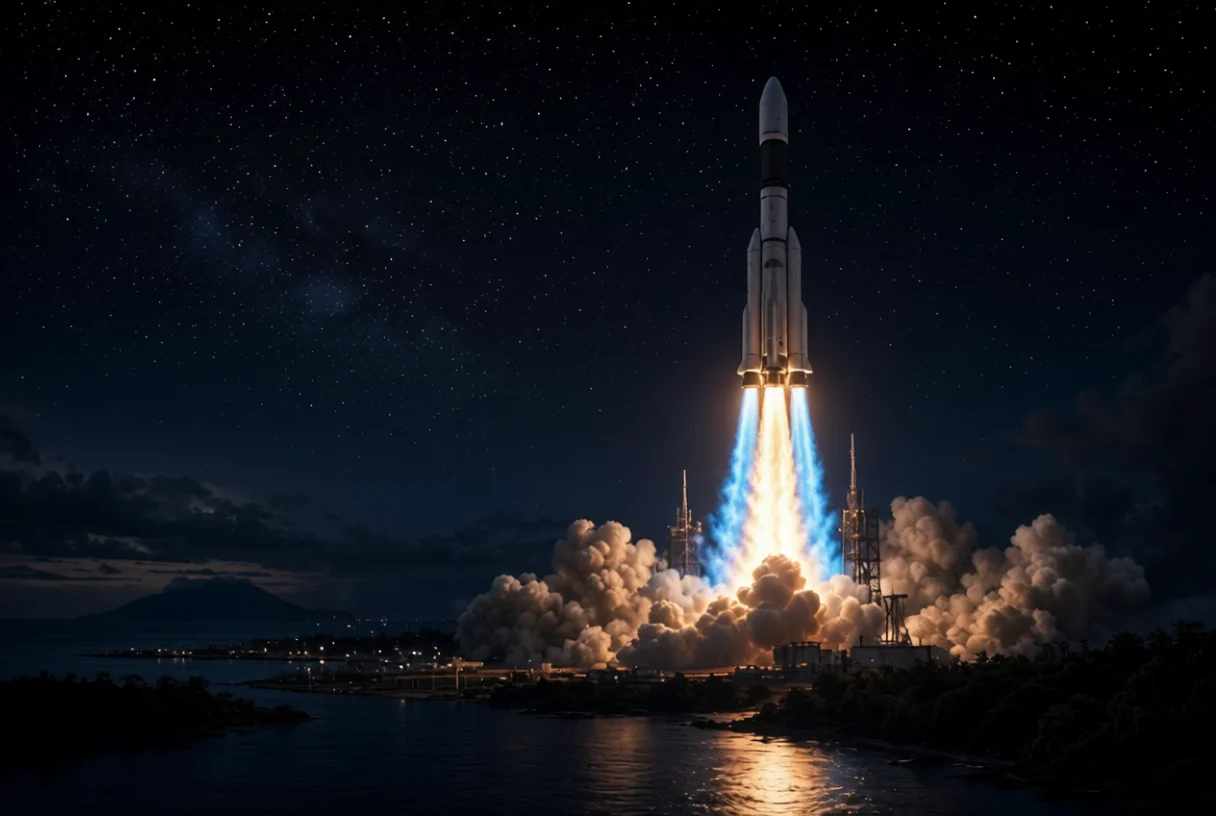
On 9 October 2026, ISRO reported a quiet but important engineering step. The full scale gas generator of the LME-1100 rocket engine was ignited successfully for the first time.
LME-1100 is an engine under development by the Indian Space Research Organisation. It burns liquid oxygen (LOX) and liquid methane, and it uses a gas generator cycle. ISRO has named LOX methane engines as the main propulsion for its Next Generation Launch Vehicle (NGLV).
Why should you care? Because heavier and cheaper launches decide how quickly a country can build satellite networks, space infrastructure and, one day, crewed missions. But one successful test is not a finished engine. So what has really been proven, and what is still unsolved?
Table of Contents
What Is the LME-1100 Rocket Engine?
The name carries the key facts. LME stands for LOX Methane Engine, and 1100 refers to a design thrust class of 1,100 kilonewtons. That is the intended scale. It is not a measured performance figure for the complete engine, which has not yet been built and tested as one unit.
Think of thrust as the push you feel when you release an inflated balloon. It is different from payload capacity (how much weight a rocket can lift), fuel efficiency (how well propellant is used) and total rocket power (the sum of all engines and stages).
The engineering challenge is real. Methane stays liquid only at about minus 162 degrees Celsius, while the burning gases reach thousands of degrees. Turbopumps must spin at enormous speed between those extremes.
How the LME-1100 Gas Generator Cycle Works
- Propellants: Liquid oxygen is the oxidiser. Liquid methane is the fuel. Neither burns well alone.
- Turbopumps: Powerful pumps raise the pressure of both liquids so they can enter the engine against the pressure inside it.
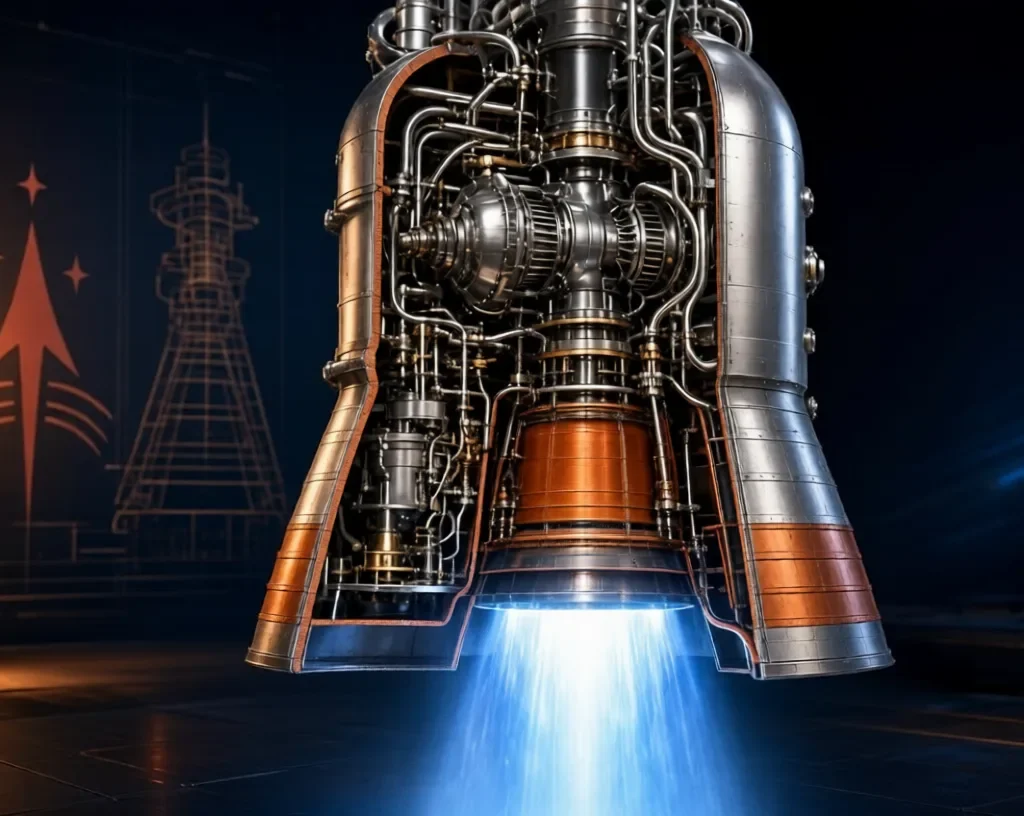
- Gas generator: A small combustion unit burns a portion of the propellants. Its hot gas spins the turbine that drives the pumps.
- Main chamber: The rest of the propellants pass through injectors into the combustion chamber and burn at high pressure.
- Thrust: The exhaust leaves through the nozzle at high speed. By Newton’s third law, the engine is pushed in the opposite direction.
Here is an analogy. Imagine a high pressure delivery system that must be powered by a small engine of its own. That is the gas generator. The analogy has limits: not every propellant takes the same route, and the gas generator exhaust typically does not pass through the main chamber.
Why Methane Matters for Future Missions
ISRO notes that LOX methane engines offer clean combustion and low maintenance, which helps reusability. Methane also cools engine walls well and forms less soot than kerosene. It can be made on Mars from carbon dioxide and water ice, although that would need heavy infrastructure, energy and proven technology.
| Feature | Methane + LOX | Kerosene + LOX | Hydrogen + LOX |
|---|---|---|---|
| Storage | Cryogenic, but boiling points of fuel and oxidiser are close | Fuel stored near normal temperature | Hardest, fuel boils at about minus 253 °C |
| Insulation | Moderate | Least for the fuel | Heaviest |
| Combustion byproducts | Less soot than kerosene | More soot | Mostly water |
| Engineering complexity | Medium | Often simplest | Highest tank and handling demands |
No fuel wins everywhere. The best choice depends on the mission.
What Has ISRO Actually Achieved?
Based on ISRO’s official page dated 16 October 2026:
- 2019 to 2020: A 20 tonne LOX methane technology demonstrator engine was tested. It proves early learning on ignition and starting. It is not LME-1100.
- 2023: Development of key technologies for the 1100 kN engine formally began. This proves a programme exists, not a finished design.
- Additive manufacturing: More than 70% of engine components have been realised this way, with industry partners. It does not prove every part is qualified.
- 9 October 2026: The first full scale gas generator ignition test succeeded, and similar tests are planned. It proves one subsystem can ignite. It does not prove the engine works.
- Other subsystems: Turbopumps, bearings, seals and igniters are under testing. A 3D printed LOX pump impeller has passed a spin test to rated speed.
- Mid 2027 (target): The integrated engine is targeted for readiness, followed by hot tests including throttling profiles. A target is not a result.
None of this means flight readiness, human rating or proven reusability.
The Link With India’s Next Generation Launch Vehicle
According to ISRO’s LPSC centre, the engine is meant to power the NGLV once the engine and stage are qualified. ISRO has also described a reusable booster stage with two expendable upper stages. LOX methane engines are also planned for a future heavy lift vehicle for a crewed lunar landing targeted for 2040.
Public descriptions of engine counts, stage layouts and payload figures have changed over time, so treat them as proposals.
Reusability needs much more than an engine. It also needs strong structures, heat protection, guidance, landing systems, inspection, maintenance and repeated qualification. If these goals are met, benefits could include satellite deployment, cargo missions and future crewed flights.
Additive Manufacturing: The Hidden Innovation
Additive manufacturing, or 3D printing, builds parts layer by layer. It can create complex internal shapes and reduce the number of joined pieces. That is why ISRO’s 70% figure is significant.
But printed parts are not automatically cheaper, stronger or more reliable. Hidden internal flaws, material quality, inspection, repeatability and qualification standards all matter.
What Makes This Development Different?
SpaceX’s Raptor is also a methane engine, but it uses full flow staged combustion, which is more complex. LME-1100 uses the simpler gas generator cycle, with industrial manufacturing and cost in mind. This is a fact based difference in design approach, not a performance ranking.
Analysis: A simpler cycle may be easier to build and repair, but it usually uses propellant energy less fully. Notably, ISRO says design work is complete on a larger 2400 kN engine using full flow staged combustion for heavy lift. Raptor is in flight use, while LME-1100 is still in development.
Advantages, Limits and Open Challenges
Potential advantages: indigenous propulsion, wider industry participation, advanced manufacturing, possible heavy lift support and long term space industry growth.
Challenges: integrating and qualifying the full engine, stable ignition across conditions, turbopump durability, thermal management, cost control, and the testing needed before operational or human rated use.
Intended benefits are goals, not guarantees.
A Five Step Framework for Rocket News
- Identify what was tested. For LME-1100: a gas generator, not the engine.
- Check the measured result. Here, the ignition is documented; full engine thrust is not.
- Understand the stage. Subsystem testing, before integrated qualification.
- Examine constraints. Manufacturing quality, cost, reliability and safety.
- Separate potential from proof. The 1,100 kN class and reusability are aims.
Why It Matters Beyond the Engine
Success could strengthen India’s manufacturing ecosystem, grow its engineering workforce and support satellite launch capability.
Hypothetical example (not an ISRO mission): Imagine a future vehicle carrying a group of satellites in one launch, then returning its first stage for inspection and reuse. That would lower the cost per satellite, but only if the whole system proves reliable.
| Indicator | What it tells us | Important limitation |
|---|---|---|
| Nominal 1,100 kN class | Intended engine scale | Does not establish complete engine performance |
| More than 70% additive parts | Production approach | Does not prove every part is qualified |
| Gas generator ignition, 9 October 2026 | Documented subsystem milestone | Does not prove engine readiness |
| Integrated engine around mid 2027 | Stated target | Not a guarantee of completion or deployment |
Common Misconceptions
- “A successful ignition means it can fly.” No. Ignition is one early step.
- “Methane makes rockets reusable.” No. Reusability is a whole vehicle matter.
- “Higher thrust means higher efficiency.” No. They measure different things.
- “More 3D printing means lower cost.” Not automatically.
- “Planned crewed flights mean human rating exists.” No. Human rating requires extensive qualification.
Frequently Asked Questions
1. What is the LME-1100 rocket engine? An ISRO engine in development, using LOX and liquid methane, with a design thrust class of 1,100 kN.
2. What did ISRO test on 9 October 2026? The first ignition of the full scale gas generator, a subsystem of the engine.
3. Is LME-1100 ready to fly? No. The integrated engine is targeted for readiness around mid 2027, followed by hot tests.
4. Why does ISRO use methane? ISRO cites clean combustion, low maintenance and possible production on Mars.
5. Does LME-1100 copy Raptor? No. Both use methane, but their engine cycles and development stages differ.
6. Will it power crewed missions? Not yet. The planned crewed lunar landing vehicle would need a larger, separately developed engine.
Conclusion
The LME-1100 rocket engine is real progress, backed by official testing. It is also unfinished. The honest answer to the opening question is: possibly, but only after integration, qualification and flight proof. Watch the mid 2027 milestones.