
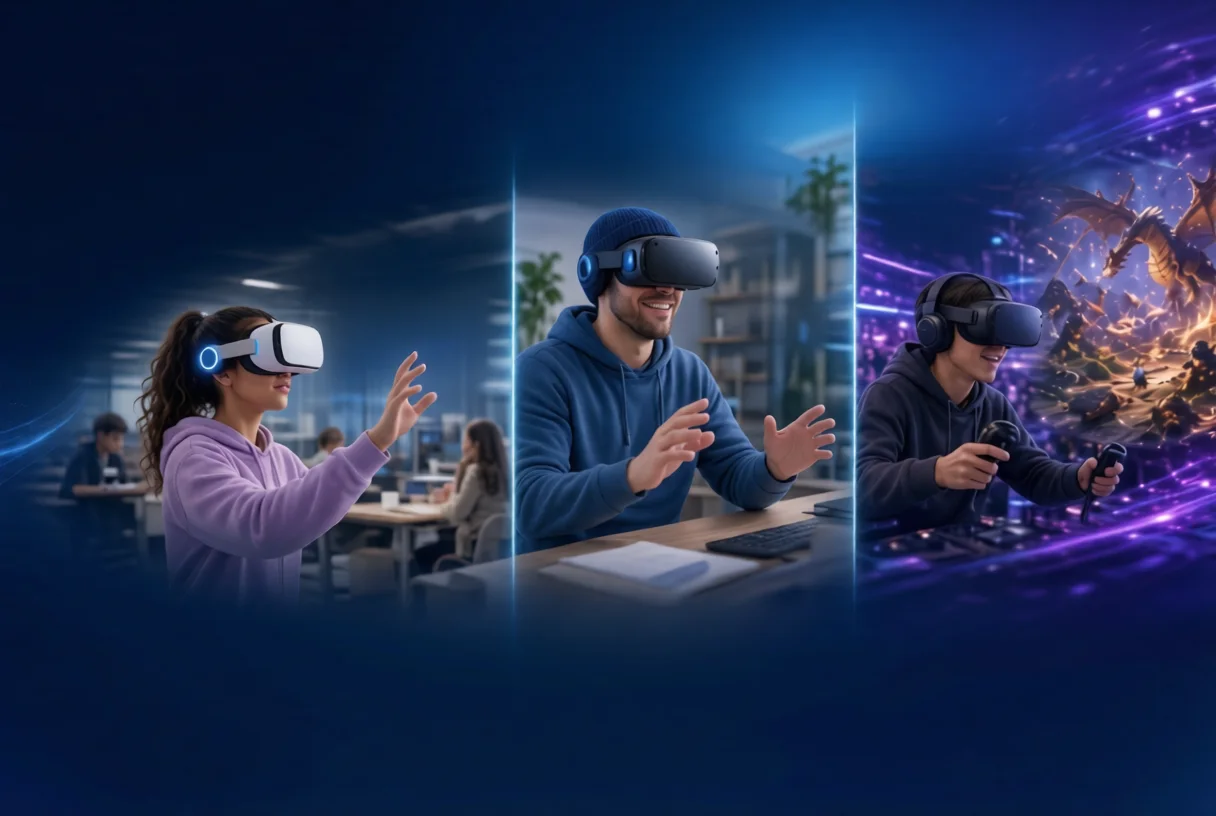
An emergency alarm screams through a dimly lit industrial turbine chamber. Thick white vapour erupts from a fractured coolant conduit, hissing violently against pressurized metal. The floor vibrates beneath your boots. Your breathing turns shallow as you reach toward the main shutoff valve, watching the pressure gauge surge past the red marker. One wrong valve turn could trigger a catastrophic pressure failure.
In reality, your physical feet are resting securely on a quiet carpeted office floor. The deafening hiss of escaping gas is coming from two spatial audio speakers built into a head mounted display, and the vibrating valve handle is an electromagnetic haptic controller generating variable resistance against your fingers. This illustrative scenario demonstrates why Virtual Reality is suddenly moving beyond entertainment novelties.
The technology has crossed an important developmental boundary: synthetic environments are now stable, responsive, and perceptually convincing enough to train high stakes human decision making without putting real bodies or expensive infrastructure at risk.
For ordinary readers, students, managers, and educators, this shift introduces fundamental questions:
- How does modern Virtual Reality trick human sensory systems so convincingly?
- Where is it demonstrating measurable, peer reviewed value rather than marketing hype?
- What physiological and organizational limitations prevent it from becoming universal?
- How can organizations evaluate these tools before spending capital on speculative hardware?
Table of Contents
Understanding the Engine: How Virtual Reality Actually Works
At its foundation, Virtual Reality refers to a computer generated three dimensional environment that completely replaces a user’s natural sensory surroundings, enabling interactive exploration in real time.
Creating a believable alternate reality requires solving a delicate biological challenge known as the perceptual loop. Inside a contemporary headset, two high resolution micro displays present slightly offset stereoscopic images to each eye, mimicking human binocular disparity. Specially engineered optical lenses bend this light across a wide field of view, causing the human brain to reconstruct depth, scale, and volume.
       [ External Space ]
              │
    Headset Tracking Sensors (IMUs + External Cameras)
              │
              ▼
    Spatial Computing Engine (Latency < 20ms)
              │
              ▼
    Stereoscopic Micro-Displays + Spatial Audio
              │
              ▼
       [ Human Brain Perceives Presence ]
To prevent dizziness, the digital image must refresh instantaneously when you move. Modern systems use inside out tracking, deploying miniature wide angle cameras on the exterior shell of the headset paired with inertial measurement units (accelerometers and gyroscopes). Computer vision algorithms map fixed landmarks across your physical room at hundreds of cycles per second. When you lean forward or tilt your chin, the software updates the visual frame in under 20 milliseconds, matching the vestibular signals generated by your inner ear.
Handheld controllers translate physical grip into digital actions through wireless positional tracking and capacitive sensors that detect finger placement. Emerging setups combine this with active hand tracking, using machine vision to recognize bare finger gestures directly in mid-air.
Clarifying the Terms: VR, AR, and MR
Immersive technology is frequently lumped into confusing acronyms. A simple, everyday analogy makes the boundaries obvious:
- Virtual Reality (VR): Putting on opaque ski goggles inside your living room that completely block the real room and transport you inside a deep sea submersible. You see only the submarine cockpit and the ocean outside.
- Augmented Reality (AR): Wearing transparent reading glasses that display a small digital text message or the current outdoor temperature floating neatly above your kitchen table while you look at your family.
- Mixed Reality (MR): Wearing specialized transparent lenses where a digital, interactive 3D anatomy model sits firmly on your physical kitchen table. If you walk behind the table, your physical table naturally obscures the digital model.
Crucial Virtual Reality Trends Delivering Practical Value
The industry has moved away from speculative metaverse narratives and concentrated on practical engineering problems. Several trends are delivering documented utility.
1. High-Fidelity Visuals and Variable Focus Optics
Early consumer systems were plagued by the screen-door effect, where visible pixel grids broke immersion. Contemporary commercial devices deploy micro-OLED and fast-switch LCD panels exceeding 2,000 pixels per inch, rendering fine instruments, blueprints, and text legible. Concurrently, pancake optical lenses have replaced bulky Fresnel rings, shrinking the physical footprint and shifting the center of gravity closer to the user’s face to decrease neck fatigue.
2. Sensor-Driven Input and Eye-Tracking
Modern professional headsets incorporate inward facing infrared cameras that monitor pupil movements. This enables foveated rendering, an architectural breakthrough where high resolution graphics are drawn exclusively at the sharp center of the human gaze (the fovea), while peripheral areas are rendered in softer detail. This reduces computational workload by 30 to 50 percent, allowing standalone headsets to run sophisticated simulation software without tethering cables to expensive desktop computers.
3. Procedural Simulation and Dynamic Scenarios
Static, pre-scripted training trees are yielding to interactive software capable of generating variable operating conditions on demand. Trainees no longer memorize repetitive button paths. Instead, simulation parameters such as unexpected equipment faults, fluctuating weather patterns, and shifting team communications can be introduced dynamically by instructors during an active scenario.
4. Enterprise Accessibility and Remote Collaboration
Collaborative spatial environments allow engineering teams across different continents to inspect full scale digital prototypes together. Automotive designers and civil engineers can walk around 1:1 scale CAD designs, identifying spatial clashes and ergonomic problems long before physical tooling begins.
Practical Evidence: Healthcare and Aviation Benchmarks
The practical value of immersive technology rests on measured performance transfer: does practice inside a virtual simulation improve real world competence?
      Traditional Training                  Virtual Reality Training
   ┌──────────────────────────┐           ┌──────────────────────────┐
   │ High marginal cost       │           │ High upfront creation    │
   │ Physical risks present   │           │ Zero physical danger     │
   │ Limited repetition       │           │ Infinite repetition      │
   │ Subjective evaluation    │           │ Continuous telemetry     │
   └──────────────────────────┘           └──────────────────────────┘
Case Study 1: Laparoscopic Surgical Skills Acquisition
Surgical residencies face severe logistical constraints: operating room hours are expensive, and patient safety strictly bounds early career practice.
- Application: In a landmark multi-center randomized controlled trial published in the British Medical Journal, researchers evaluated surgical trainees performing laparoscopic salpingectomy. One group underwent standardized clinical preparation, while the intervention cohort trained on an interactive virtual reality surgical simulator until reaching predefined procedural proficiency.
- Documented Benefit: In subsequent live operations evaluated by blinded expert observers, novice surgeons who received simulator training performed at a technical level equivalent to intermediate laparoscopists, and their total procedural completion time was halved.
- Limitation: The study highlighted that virtual simulators do not replace bedside surgical training; rather, they serve as an upstream filtering step. Furthermore, current haptic feedback fails to fully replicate the complex, unpredictable tactile nuances of diseased human tissue.
Case Study 2: Commercial Multi-Crew Flight Simulation
Aviation has long relied on multimillion-dollar Level D motion platforms. However, smaller regional operators and pilot training academies face steep cost barriers when training prospective first officers.
- Application: Aerospace researchers examining collaborative virtual reality flight simulators (VRFS) have evaluated whether head mounted displays can effectively replace desktop trainers and support multi-crew evidence-based training.
- Documented Benefit: Studies show that immersive visual cockpits accelerate procedural muscle memory, instrument scans, and emergency checklist execution at a fraction of the capital footprint required by legacy mechanical cockpits.
- Limitation: Visual barriers created by opaque headsets hinder traditional non-verbal communication (such as peripheral glances between pilots), requiring crews to adopt exaggerated verbal callouts to maintain shared cockpit awareness.
Evaluating Virtual Reality: A Decision Framework
Virtual reality is not an automatic upgrade over traditional instruction or digital modeling. Organizations often overspend on virtual programs when conventional video or desktop software would have achieved identical outcomes.
Before investing in hardware suites, evaluate deployments using this six-part diagnostic model:
| Evaluation Criterion | Core Operational Question | Positive Indicator | Disqualifying Indicator |
| Problem Definition | Does the task involve physical risk, prohibitive equipment costs, or rare scenarios? | Training for high-voltage repairs, aircraft fires, or surgical emergencies. | Reading linear compliance documents or listening to slide presentations. |
| Scientific Validation | Is there empirical evidence showing transfer of learning to physical tasks? | Controlled trials demonstrating reduced real-world error rates. | Vendor claims resting entirely on subjective user satisfaction scores. |
| Operational Friction | What is the technical burden of setup, sanitation, and battery management? | Dedicated simulation lab with trained technical facilitators. | Solo workers expected to troubleshoot complex hardware configurations alone. |
| Human Tolerance | Can target users complete twenty-minute sessions without vestibular discomfort? | Well-ventilated spaces with stable frame rates (>90 FPS). | Complex locomotion algorithms causing motion sickness across typical users. |
| Data Governance | How are biometric gaze vectors and environmental room scans protected? | Enterprise software that processes tracking vectors locally without telemetry leaks. | Consumer headsets requiring unmanaged cloud logins and ambient space uploads. |
| Total Cost of Ownership | Does repeated hardware amortization beat legacy facility and travel costs? | High-throughput student cohorts replacing expensive disposable consumables. | Niche procedures performed once per year by a tiny handful of operators. |
Benefits, Operational Realities, and Common Misconceptions
The conversation around immersive computing is often clouded by hyperbole. A balanced appraisal separates legitimate capabilities from unresolved hurdles.
Key Misconceptions About Virtual Reality:

[ Myth ] VR is solely a gaming peripheral.
[ Reality ] Industrial, medical, and aerospace training represent its fastest-growing institutional segments.

[ Myth ] Every immersive environment improves learning.
[ Reality ] Poorly designed virtual interfaces create cognitive overload that degrades retention.

[ Myth ] Virtual Reality will soon replace physical offices.
[ Reality ] Headset weight, optical fatigue, and social isolation limit comfortable use to short sessions.
Unresolved Friction Points
- Cybersickness: Vestibular-ocular mismatch occurs when visual cues communicate acceleration while the inner ear fluid remains stationary. While high refresh rates have decreased incidence, approximately 10 to 30 percent of users still experience nausea during simulated directional acceleration.
- Ergonomics and Vergence-Accommodation Conflict: Standard headsets present imagery at a fixed focal distance (usually 1.5 to 2 meters). When virtual objects approach a user’s nose, the eyes converge, but their lenses do not need to refocus. This biological conflict triggers eye strain after prolonged sessions.
- Biometric Privacy Risks: Unlike web browsers that track clicks and keystrokes, virtual headsets constantly record head trajectories, pupil dilation, gaze duration, and postural micro-movements. In research published by computing privacy consortia, unique behavioral kinetics can reliably identify individual users within small cohorts, raising substantial data sovereignty concerns.
Frequently Asked Questions
What is Virtual Reality, and how does it function?
Virtual Reality is an interactive, computer-generated environment that blocks physical surroundings. Headsets use twin miniature displays, wide-angle lenses, motion-sensing gyroscopes, and external tracking cameras to continuously redraw digital scenes in direct response to head and hand movements.
How does Virtual Reality differ from Augmented Reality?
Virtual Reality completely replaces your vision with an artificial world. Augmented Reality overlays digital graphics, directions, or alerts on top of your physical surroundings through transparent glass, maintaining constant visual contact with your real environment.
What are the main benefits and drawbacks of using Virtual Reality?
The primary benefits include safe repetition of hazardous tasks, reduced travel and equipment costs, and complete immersion. The main drawbacks are physical discomfort (such as neck strain and motion sickness), high software development costs, and privacy vulnerabilities linked to biometric tracking data.
Is Virtual Reality safe for children and adults?
Virtual Reality is safe for most healthy adults when used in moderate sessions of 20 to 30 minutes with physical clearances around the play area. Most manufacturers recommend that children under 10 to 13 years avoid stereoscopic displays due to developing inter-pupillary distances and visual accommodation systems.
What should someone consider before buying a VR headset?
Check whether the device requires a dedicated gaming computer or functions standalone, assess its total weight and strap adjustability, verify that its software catalog contains the specific tools or training environments you require, and ensure your physical room has adequate clear floor space.
The Path Forward
Virtual Reality has shed its speculative skin. Rather than constructing an escapist digital alternative to the physical universe, its enduring value lies in serving as an efficient rehearsal space for reality. When applied to high-risk technical operations, surgical medicine, and complex mechanical visualization, the technology offers measurable educational and safety gains that traditional media cannot match.
If you are a manager or educator evaluating this technology today, avoid sweeping institutional hardware purchases. Start by selecting a single, quantifiable training problem where physical errors carry high financial or safety penalties, test standalone hardware against existing instructional methods, and measure whether performance genuinely transfers to the real world.
To explore how immersive computing integrates with artificial intelligence and digital workplace infrastructure, browse our detailed technology analysis archives at kritiinfo.com/tech-trends.