
Technology | kritiinfo.com
Introduction: A New Way to Communicate
A volunteer sits in a Carnegie Mellon University lab with a cap of sensors on the head. In front of them, a robotic hand waits. The volunteer does not touch it. In some tasks, they only imagine bending a finger.
Then the matching robotic finger bends.
This is a documented experiment, not science fiction. In 2025, a team led by Professor Bin He, with first author Yidan Ding, published the study in Nature Communications. Twenty one able bodied volunteers, all with earlier BCI experience, took part. Nobody had surgery. The sensors stayed outside the skull.
Why was it hard? Scalp sensors hear the brain through bone and skin, so the signal arrives blurred. Bin He called single finger decoding from such signals an elusive goal.
That is the promise of a non surgical BCI: giving commands to a machine without a keyboard, mouse or voice. But how does a cap of sensors turn imagination into movement, and where do its limits begin?
Table of Contents
What Is Non Surgical BCI?
A brain computer interface (BCI) is a system that translates measurable brain activity into commands for an external device. A non surgical BCI, also called a non invasive brain computer interface, uses sensors outside the head. An implanted BCI uses electrodes placed on or in the brain during surgery.
The difference matters. Surgery brings medical risk and ongoing care. A recent scientific review notes that implanted systems are mostly used in clinical settings, while non invasive ones avoid surgery and can reach more people. The price is signal quality, which we compare below.
How Does It Work?
Five step flow from brain activity to device response
Here is that chain in the finger experiment:
- Brain activity: imagining a finger movement changes electrical patterns in the brain.
- Signal collection: scalp sensors record these tiny signals. This method is called electroencephalography, or EEG.
- Computer processing: a deep learning decoder looks for the pattern linked to each finger.
- Command: the software picks finger one or finger two.
- Device response: the robotic finger moves.
EEG is the most common method. Functional near infrared spectroscopy (fNIRS) uses harmless light to follow blood oxygen changes, which is slower. A hospital fMRI scanner maps blood flow in detail but is large and not wearable. Each method trades speed, detail, cost and convenience.
A simple analogy: imagine a friend learning three hand signals across a noisy room. At first they guess. With practice, they learn your pattern. A decoder works the same way. It learns a small set of signals tied to a small set of commands. It matches patterns. It does not understand your thoughts.
Artificial intelligence helps find patterns humans would miss. But the same review says noise, differences between people and changing conditions still limit reliability.
Where Can It Help?
Better studied uses: The review describes a study where people with ALS selected letters in over two thirds of trials, and another where pairing a BCI with electrical stimulation helped chronic stroke patients.
Emerging uses: robotic hand control, driver alertness monitoring, virtual reality and games. These are mostly experimental.
Illustrative scenario, not a real patient: Imagine a person who cannot speak or type. A screen shows flashing letters. They focus on the letter they want. The EEG cap records a small brain response each time that letter flashes, and the software picks the strongest match. It works, but it is slow, needs calibration, and makes mistakes, so a delete option is essential.
Non Surgical BCI vs Implanted BCI
| Comparison factor | Non surgical BCI | Implanted BCI |
|---|---|---|
| Safety and procedure | No brain surgery. Caps can be uncomfortable. | Needs surgery and follow up. Long term stability is a known concern. |
| Signal quality | Skull and tissue blur signals, so noise is higher. | Direct contact usually gives clearer signals, with its own constraints. |
| Setup and maintenance | Sensors, calibration and training sessions. | Clinical team, implant care and monitoring. |
| Everyday accessibility | Lower barrier, but real world performance is still being tested. | Mostly limited to specialist clinical settings, with cost and access barriers. |
| Suitable applications | Communication aids, rehabilitation, research, some interactive tools. | Precision control research for people with severe paralysis. |
Neither is better for everyone. Against ordinary tools, our editorial view is that a BCI is rarely the fastest choice. If someone can comfortably use a keyboard, voice control or eye tracking, those are usually quicker and cheaper. A BCI matters most when those options are not available or too tiring.
The Promise and the Problems
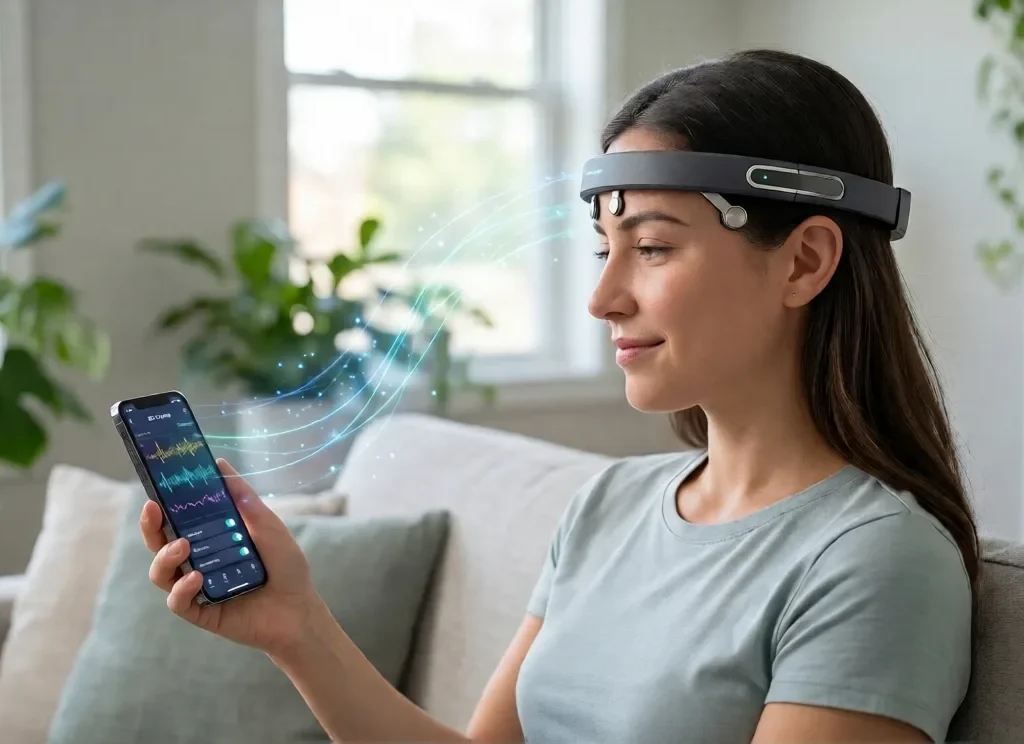
The promise is control without surgery or muscle movement. The problems are real: signal noise, uneven performance between people and days, training time, cost, comfort, privacy, cybersecurity, and evidence that is often limited to short lab tests.
What the 2025 numbers mean. Ding and colleagues reported online accuracy of 80.56% for two finger imagination tasks and 60.61% for three finger tasks, after one training session, with 21 able bodied experienced users. The review adds that four finger accuracy stayed near 46%, too low for practical use.
Bar chart of accuracy against random guessing
In plain words: guessing between two fingers gives 50%, so 80.56% is clearly better, yet about one attempt in five is still wrong. With three fingers, guessing gives about 33%. Accuracy falls as choices grow.
Why lab and daily life differ. Labs are quiet, tasks are known and users are trained. Daily life brings movement, fatigue and distraction. The review says EEG suffers from muscle and electrical interference, and most systems have not been tested over many hours or days of continuous use. These volunteers also did not have paralysis, so the results cannot simply be applied to patients.
Privacy. Brain related data is personal. Before using any device, ask who stores it and for how long.
Common misconception: BCIs read your thoughts. They do not. In a 2023 Nature Neuroscience study, Tang, Huth and colleagues used a hospital fMRI scanner and many hours of training data to recover the general meaning of language. They found that cooperation was needed both to train and to apply the decoder. They also urged policies that protect mental privacy as the technology improves (NIH summary).
A Practical Framework: The CLEAR Check
The CLEAR Check checklist
CLEAR is an original editorial checklist for readers. It is not a clinically validated scale or an official regulatory standard.
Illustrative scenario: a made up headband advertises “brain training for better focus.”
- C, Claim: “Better focus” is vague. Which task, measured how?
- L, Level of evidence: Look for independent, peer reviewed studies. A polished demo video is not evidence.
- E, Everyday performance: Is accuracy reported outside a lab, and how often does it fail?
- A, Accessibility: Check price, comfort, setup time, training and upkeep.
- R, Rights and privacy: Find out what data is collected, where it is stored, who sees it, and whether you can delete it.
Also check the device’s regulatory status in your country. The FDA neurological devices page explains the US process, but its 2021 guidance covers implanted BCIs, so do not assume it applies to every wearable.
What Happens Next?
Researchers are working on flexible, more comfortable electrodes and better AI decoders. Bin He’s lab hopes to move toward finer tasks such as typing.
Before broader adoption is justified, studies must show stable results over days, outside labs, across many people including patients, with independent replication. Clear privacy rules matter too.
Conclusion: Promise With Proof
We began with a question: how can brain signals become a computer command? A non surgical BCI answers with sensors, pattern matching and training, not mind reading. It can help, especially for communication and rehabilitation research, but accuracy drops as tasks get complex, and lab success is not daily success.
Your next step: when you see a BCI claim, run the CLEAR Check, and read the privacy policy before you buy.
Frequently Asked Questions
1. What is a non surgical BCI? A system that reads brain activity with sensors outside the head and turns it into commands for a device, with no brain surgery.
2. How does a non invasive brain computer interface work? Sensors, usually EEG, record brain signals. Software matches patterns to commands, and a device responds. Training helps the software learn each user.
3. Can a BCI read a person’s thoughts? No. Current systems decode limited signals for set tasks. Even the 2023 language decoder needed a scanner, hours of training and the person’s cooperation.
4. Is non surgical BCI safe? It avoids surgical risks, but safety depends on the device, its use and the evidence behind it. Skin irritation, discomfort and data privacy matter. Ask a qualified clinician about medical use.
5. What are the biggest limitations of current BCI technology? Noisy signals, lower accuracy as choices grow, training time, differences between people, limited testing outside labs and privacy concerns.