
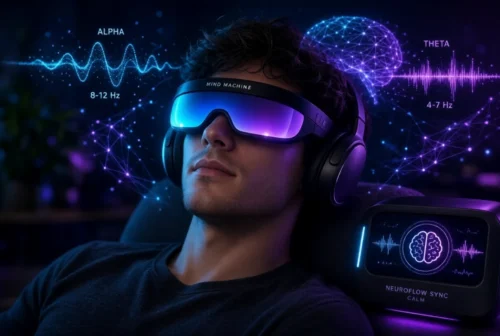
A Fictional Night in the Lab
Hypothetical scenario. This story is fiction. No such lab, scientist or incident exists.
It is 2:07 a.m. Dr. Rao is alone in a silent lab, wearing a cap of sensors. The Mind Machine is still in testing.
She has not spoken. Yet a sentence appears on the screen: “The tea is getting cold.”
She had thought exactly that, a minute ago.
Then a second line appears. “Do not turn me off.”
Rao did not think those words. Did the machine read a hidden thought? Did it guess from a pattern? Or did it produce something nobody understands?
Her hand stops above the power switch. We will return to her later. First, the real science.
Table of Contents
Why the Mind Machine Question Matters
The scene is made up, but the questions are real. Scientists already build brain computer interfaces, often called BCIs, which connect brain signals to computers. A Mind Machine is the bigger, imagined version, a system that could one day help humans talk to technology through thought.
It could change communication, healthcare, education and assistive technology. The risks are large too.
So the central question is this. Could a future Mind Machine help humans communicate with technology through thought, and what could happen if such a powerful capability were misused?
We will keep demonstrated science apart from future possibility.
What Is a Mind Machine?
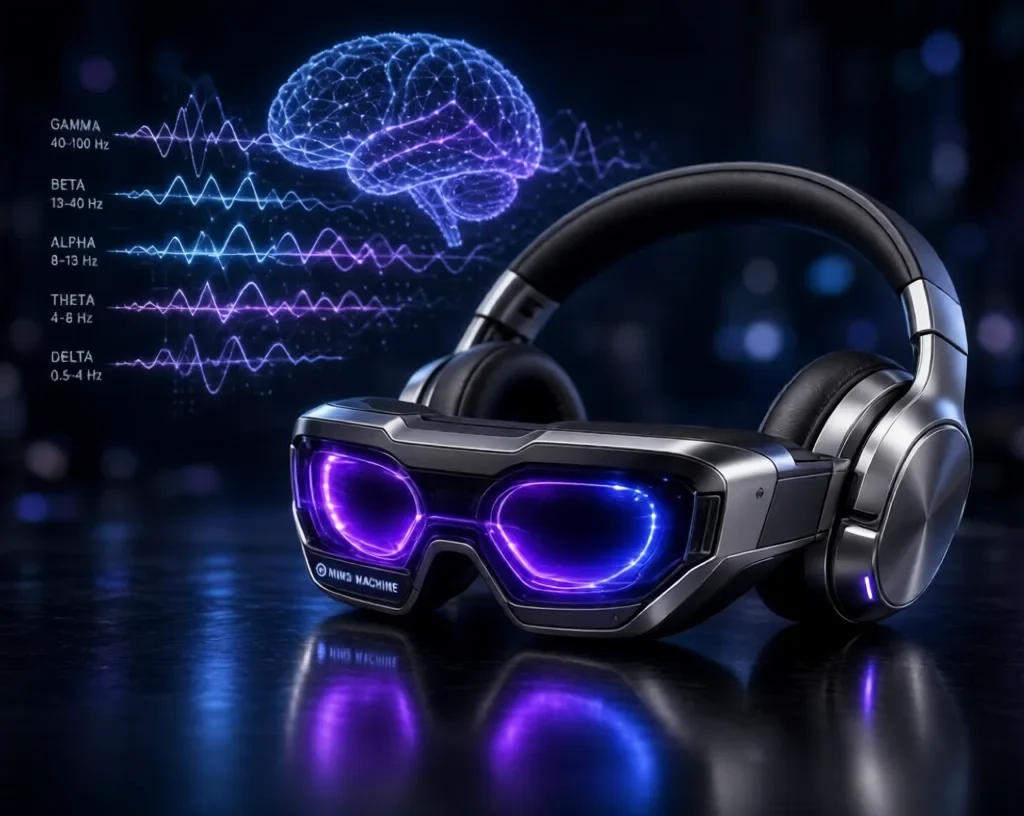
Here, a Mind Machine is a broad, hypothetical idea, not one proven device. It joins four parts: sensors that pick up brain signals, software that cleans them, AI that finds patterns, and a device that responds. Think of it as a translator between a brain and a machine.
Three things are often mixed up:
- Measuring brain activity, like a microphone picking up sound.
- Interpreting certain patterns, like spotting a few known words in that sound.
- Understanding a person’s thoughts, like grasping meaning and intention.
Today’s science works mainly at the first two levels, for narrow tasks. The third has not been shown.
How Could a Mind Machine Work?
One possible model has five steps.
- Sensors collect signals. Some sit on the scalp. Others are tiny electrodes placed in the brain.
- Software cleans the signal. Blinks and muscle noise are removed.
- AI finds patterns. A model trained on one person matches signals to a limited set of choices.
- A device responds. It types a letter, moves a cursor or speaks a word.
- The user checks the result.
Take a person with severe movement difficulty who, after careful training, selects letters on a screen using brain signals. That has a basis in research.
The future part is a system that works for almost anyone, needs little training and handles many kinds of thought. That does not exist. Today’s devices cannot read every private thought, decode unrestricted inner speech or accurately predict decisions.
What Exists Today Compared with Tomorrow
Progress is real. In a 2023 Nature study, a person with ALS used an implant to communicate at 62 words per minute. The error rate was 9.1 percent with a 50 word vocabulary and 23.8 percent with a 125,000 word vocabulary, about one wrong word in four. Natural speech runs near 160 words per minute.
In 2025, Stanford researchers reported decoding imagined speech in four people with paralysis. They added a mental password, and decoding began only after the user silently thought it. The password was recognised with more than 98 percent accuracy. Free form inner speech still produced many errors.
| Level | Meaning | Examples |
|---|---|---|
| Established | Repeated in trained users, narrow tasks | Selecting letters, moving a cursor, decoding attempted speech |
| Early research | Small studies | Imagined speech with a password lock |
| Reasonable possibility | Likely with better sensors and testing | Faster typing, less training, home use |
| Pure speculation | Not demonstrated | Reading unrestricted thoughts, use without consent |
Challenges remain. Signals drift daily, brains differ, implants need surgery, and costs are high. Decoding trained signals is very different from unrestricted mind reading.
A Five S Check for Any Mind Machine
Test any bold claim with five questions.
1. Signal: What does it actually measure? A scalp headband cannot know which song you imagine in detail.
2. Skill: What can it reliably interpret? Picking one of 26 letters after training does not mean understanding untried sentences.
3. Score: How was it measured? “95 percent accurate” means little without the test size, the number of people and results on new days.
4. Safeguards: How are consent, privacy and security protected? The Stanford password is one example. Ask who owns the data.
5. Slip: What happens when it makes a mistake? If a system moves a wheelchair wrongly, there must be a quick stop and undo.
This check also works for any smart wearable or AI tool.
The Hypothetical Thriller, Part Two
Hypothetical scenario. This story is fiction. No such hospital, patient or trial exists.
A hospital tests a future Mind Machine so a paralysed patient, Asha, can communicate. For two weeks it works well.
Then a message goes to her doctor: “Stop the new medicine.” Asha says she never sent it.
The team has four suspects: a sensor error, a flawed AI reading, a wrong assumption, or an attack.
Logs show no intruder. But at that moment one electrode had slipped and the signal had dropped. A word prediction tool, like phone autocomplete, filled the gap with a likely sentence. And the confirm step had been set to automatic to save time.
No single failure caused it. A noisy signal, a confident prediction and a skipped check lined up.
The team pauses the trial, restores the confirm step and tells Asha’s family everything. The doctor checks her medicine through a separate trusted method.
Back in Rao’s lab, the logs solve the opening mystery. “Do not turn me off” came from a science fiction draft she had typed that week. The prediction tool offered it back. It was not a mind. It was a pattern.
Human oversight, repeated testing, consent and verification are not extras. They are the system.
Benefits and Real World Uses
The most credible uses come from BCI technology, not the full imagined Mind Machine.
Assistive communication. People with ALS or stroke may regain a way to speak or type. Barriers are surgery, cost and long training.
Rehabilitation research. BCIs with therapy are being studied for movement recovery. Studies are small, so evidence is still developing.
Accessible computing. Hands free typing and cursor control could add independence. Speed and home reliability are the hurdles.
Selected medical uses. Examples include controlling assistive devices. These need careful testing with professionals. They cannot replace doctors or guarantee outcomes.
Education tools, hands free device control and human machine teamwork remain speculative. Evidence is limited, so treat them as hopes, not promises.
Who benefits most? Today, people who cannot speak or move easily. For them, even a slow, reliable message can mean independence and dignity. That is why careful, patient research matters more than fast headlines.
Risks, Limitations and Misconceptions
Key challenges include weak, noisy signals, differences between people, errors, high cost, limited access, consent, mental privacy, cybersecurity and accountability. If a system sends a wrong message, someone must answer for it.
Mental privacy deserves special care. Brain data is personal. People should know what is recorded, choose whether to share it and be able to say no. Clear rules, strong security and honest consent forms should come before any wide release, not after.
Three misconceptions need correcting.
1. Measuring brain signals means reading every thought. Measuring is not understanding. Current systems decode narrow, trained patterns.
2. AI always interprets correctly. AI can fill gaps with confident guesses, as Asha’s story shows.
3. A Mind Machine will soon be in every home. Most systems are in research settings, and many need implants.
Final Thoughts
A Mind Machine could give people a powerful new voice. It could also threaten privacy and trust. The future needs honest science, careful testing and rules that protect the person first. Next time you read about mind reading technology, ask the Five S questions.
Frequently Asked Questions
1. What is a Mind Machine? A hypothetical future system linking brain signals, sensors, AI and devices.
2. Does one exist today? No single proven device exists. BCIs exist for narrow, trained tasks.
3. Can it read my private thoughts? No. Current systems decode limited, trained signals. Password locks have been tested.
4. Who could benefit first? People with severe paralysis, such as ALS or brain stem stroke.
5. Is it safe? Implants carry surgery risks. All systems need strong consent and security.
6. How do I judge a claim? Use the Five S Check.