
Introduction
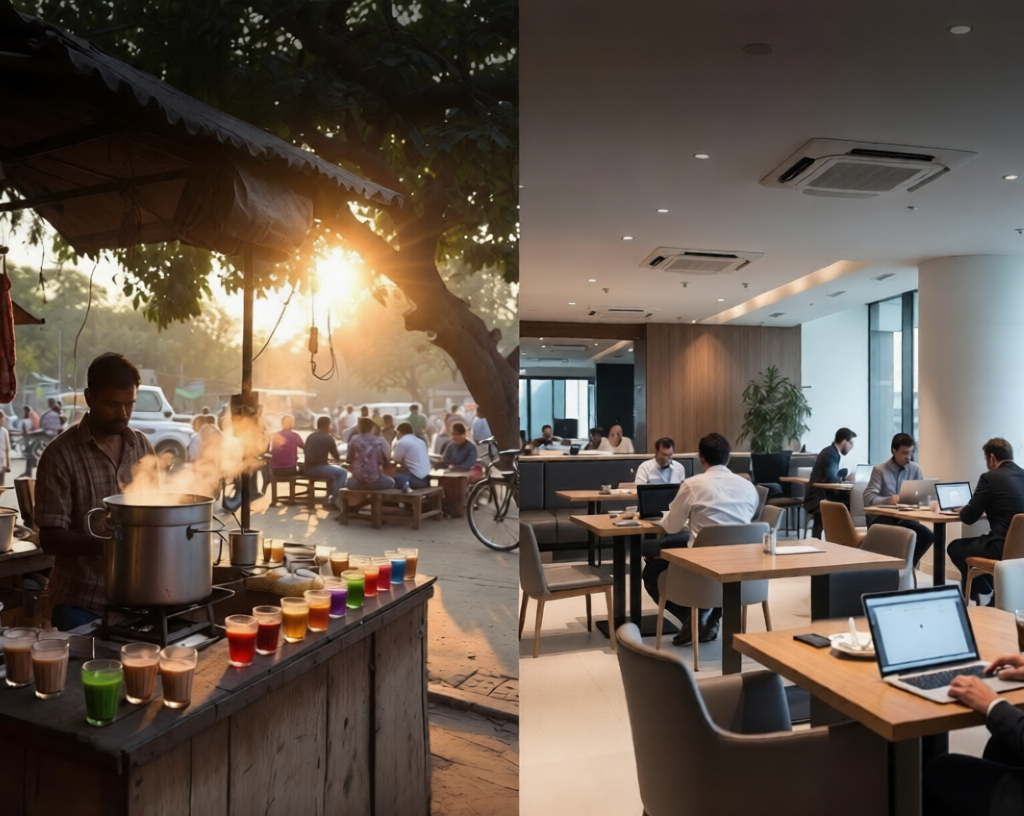
What if the richest conversations in India are happening beside a roadside tea stall instead of inside expensive glass offices? Every evening, thousands of professionals make a surprising choice. They walk past premium coffee machines and queue up for a humble cup of tapri chai instead.
Why is this happening?
The answer reveals something far bigger than a beverage preference. It reveals a Tea Habbit that has quietly outlasted billion dollar marketing budgets, polished interiors, and loyalty apps. This article explores why that small steel kettle on a roadside cart still beats the espresso machine, and what every brand, manager, and employee can learn from it.
Why Corporate Cafes Feel Less Personal
Corporate cafes are designed for efficiency, not connection. The lighting is calculated. The menu is standardized across hundreds of locations. The barista, however friendly, is following a script shaped by brand guidelines rather than personal rapport.
This is not a criticism of quality. The coffee is often genuinely good. But good coffee and a good experience are not the same thing.
A few patterns show up again and again in office life:
- People enter, order, and leave without ever exchanging more than a transaction
- Seating is arranged for individual laptops, not group conversation
- The environment rewards speed, not lingering
None of this is accidental. It is built for throughput. And throughput, while commercially smart, rarely builds the kind of belonging that humans actually crave during a workday.
The Emotional Power of Tapri Chai
A tapri, the small roadside tea stall found across Indian cities, runs on the opposite logic. There is no script. The chaiwala often remembers your name, your usual order, and sometimes your mood from the day before.
This is where the Tea Habbit becomes more than a habit. It becomes a ritual of recognition.
Psychologically, humans respond strongly to being remembered. A 2023 Pew Research Center study on workplace wellbeing found that employees who reported feeling “seen” by colleagues and the people around them showed meaningfully higher day to day satisfaction than those who did not, even when compensation and workload were similar. A chai stall, in its own small way, delivers that feeling of being seen, three or four times a day, for the price of a coin.
There is also something comforting about the sensory experience itself. The smoke curling off the kettle. The clinking of small glasses. The brief two minute pause it forces on an otherwise rushed schedule. None of this is engineered by a brand strategist. It happens because the format is simple enough to stay human.
Tea Habbit Creates Strong Communities
Walk past any popular tapri during the evening rush and you will notice something corporate cafes rarely replicate: strangers talking to each other.
A software engineer might be standing next to a delivery rider. A shopkeeper might be debating cricket with a college student. The Tea Habbit flattens hierarchy in a way that few other daily rituals manage.
This matters more than it sounds. Sociologists describe these informal, low stakes gathering points as “third places,” spaces that are neither home nor work but still build community. Coffee shops were once considered the modern third place. In many Indian cities, the tapri has quietly taken over that role, because it asks for less money, less time, and less pretense.
Original observation: In several Indian office neighborhoods, the same five or six familiar faces show up at the same tapri at the same time each evening, almost like a recurring meeting nobody scheduled. Over months, that pattern often does more for office camaraderie than a quarterly team outing ever could.
Affordable Comfort Wins Hearts
Price is the most obvious reason tapri chai wins, but it is worth explaining why affordability matters psychologically, not just financially.
A cup of chai at a roadside stall typically costs a fraction of a specialty coffee. That difference seems small until you multiply it across a month. For someone having two or three cups a day, the gap between a ₹10 chai and a ₹150 latte adds up to a noticeable dent in monthly spending.
But the real win is not just the saved money. It is the absence of guilt. A frequent, low cost habit feels indulgent without feeling reckless. A frequent, expensive habit starts to feel like a luxury people have to justify to themselves.
| Factor | Tapri Chai | Corporate Cafe |
|---|---|---|
| Average cost per cup | Very low | High |
| Time to order | Seconds | Minutes, often with a queue |
| Personal recognition | Common | Rare at scale |
| Seating style | Open, communal | Individual, laptop focused |
| Emotional tone | Relaxed, familiar | Efficient, transactional |
| Conversation likelihood | High | Low |
This is not a claim that one is objectively superior. It is a reflection of why the Tea Habbit consistently wins on emotional return per rupee spent.
Real Conversations Matter More Than Luxury
Ask any frequent tapri visitor why they go, and the answer is rarely about the tea itself. It is about the five minutes of unfiltered conversation that comes with it.
Office culture researchers have long pointed to informal conversation as a hidden driver of trust and collaboration. Harvard Business Review has written extensively about how spontaneous, unplanned interactions between colleagues often produce better problem solving than scheduled meetings, because people speak more freely when there is no agenda and no recording.
A tapri provides exactly that setting. No calendar invite. No meeting notes. Just two colleagues, a glass of chai, and an honest conversation about a stuck project or a frustrating client.
This is a meaningful insight for any leader thinking about workplace culture: the most valuable conversations in a company often happen outside the conference room, not inside it.
Table of Contents
How Tapri Culture Inspires Creativity
There is a reason so many Indian films, songs, and political movements trace some of their most memorable ideas back to chai stall conversations. The format itself encourages a wandering, associative kind of thinking that structured meetings rarely allow.
A few reasons this happens consistently:
- Standing in an open space reduces the pressure of formal brainstorming
- Mixed company, from different professions and backgrounds, sparks unusual perspectives
- The short, repeatable ritual lowers the mental barrier to speaking up
This is not a romantic exaggeration. It mirrors well documented research on incidental exposure to diverse ideas, sometimes called “weak tie” theory in network science, where loose, casual connections often introduce more novel information than close, repeated ones.
Business Lessons Every Brand Can Learn
Case Study: The Bengaluru Startup That Replaced Coffee Subscriptions With Tea Habbit Sessions
A mid sized Bengaluru technology startup once spent a significant monthly budget on a premium in office coffee subscription. Usage was steady, but informal cross team conversation remained low. Most employees grabbed their coffee and returned straight to their desks.
The leadership team tried something different. They cancelled the subscription and replaced it with a weekly ritual: a short walk to a nearby tapri every Friday afternoon, with no fixed agenda, no manager leading the discussion, and no obligation to talk about work.
Within a few months, informal collaboration noticeably increased. Employees from unrelated teams started recognizing each other by name. Several product ideas, according to internal feedback shared by the team, were first mentioned casually during these tea breaks before ever reaching a formal meeting.
Why did this work? Behavioral psychology offers a clear explanation. Removing the formal structure of a meeting reduces social anxiety. Standing outside the office, away from desks and screens, signals to the brain that this is not “work mode,” which makes people more willing to share half formed ideas. And the low cost, repeatable nature of the ritual meant it survived long after the novelty wore off, unlike one time team building events that fade from memory within weeks.
Key takeaway for brands: The lesson is not that companies should cut their coffee budgets. The lesson is that consistent, low pressure rituals build stronger teams than expensive, infrequent ones. The Tea Habbit succeeds because it is small enough to repeat daily, not because it is impressive enough to repeat occasionally.
Expert Tip
If you manage a team, try replacing one structured meeting a week with an unstructured walk to a nearby tea stall. Measure not productivity, but the quality and openness of conversation. The results are often more revealing than any survey.
Future of India’s Tea Culture
India remains one of the largest tea consuming nations in the world, and according to industry data published by the Tea Board of India, domestic consumption continues to make up the overwhelming majority of total production, with exports forming a smaller share. This signals a culture where tea is not a trend. It is infrastructure.
At the same time, organized cafe chains are expanding rapidly into smaller Indian cities, according to reports tracked by IBEF on the country’s growing food services sector. This creates an interesting tension. Modern, branded chai outlets are now trying to combine the polish of a cafe with the warmth of a tapri.
Whether this hybrid model succeeds will likely depend on one factor: can it preserve the personal recognition and unhurried pace that made tapri culture appealing in the first place, or will scale eventually flatten it the same way it flattened the corporate cafe experience?
Final Thoughts
The success of tapri chai over corporate cafes is not really about tea versus coffee. It is about what people are actually craving during a hectic workday: recognition, conversation, and a few unhurried minutes that belong to no one’s calendar.
The Tea Habbit endures because it solves an emotional need that no amount of interior design or loyalty points can fully replace. It is comforting, authentic, and built on genuine human connection rather than brand strategy.
So the next time you are deciding between a five minute walk to a tapri and a queue at a corporate counter, consider what you are really choosing. It might be worth rethinking your own Tea Habbit, not because the coffee is bad, but because the conversation outside might be the part of your day you actually remember.
If this perspective on everyday culture and behavior interested you, explore more articles on workplace culture, consumer psychology, and Indian lifestyle trends on kritiinfo.com.
FAQs
1. What does the term Tea Habbit mean in Indian work culture? Tea Habbit refers to the daily ritual of drinking tea, especially tapri chai, as a social and emotional routine rather than just a beverage choice. It reflects habits tied to community, comfort, and informal conversation.
2. Why do people prefer tapri chai over cafe coffee? People prefer tapri chai mainly due to affordability, faster service, personal familiarity with the vendor, and the relaxed, communal setting that encourages real conversation.
3. Is tapri chai actually cheaper than cafe coffee in the long run? Yes. Given the significant price difference per cup, frequent tapri chai drinkers typically spend far less monthly compared to regular cafe coffee buyers, even accounting for multiple cups a day.
4. Can companies benefit from encouraging informal tea breaks? Yes. As shown in workplace studies and real case examples, informal tea breaks often improve cross team communication, idea sharing, and overall employee satisfaction more effectively than formal structured meetings.
5. Does tapri culture affect workplace productivity? Indirectly, yes. By improving informal communication and reducing social anxiety, tapri style breaks can enhance collaboration, which often supports better long term productivity.
6. Why is the Tea Habbit considered emotionally comforting? The combination of familiarity, routine, sensory experience, and being recognized by the vendor creates psychological comfort that goes beyond the taste of the tea itself.
7. Are corporate cafes losing relevance because of this trend? Not entirely. Corporate cafes still serve convenience and consistency. However, many are now adapting by trying to recreate the warmth and personal touch associated with tapri culture.
8. How is India’s tea culture expected to evolve? India’s tea culture is likely to evolve through hybrid models that combine modern branding with the personal warmth of traditional tapris, while domestic consumption continues to remain strong nationwide.
Thank you for putting this together! I honestly
liked how you approached “Why 7 Powerful Tea Habbit Secrets Make Tapri
Chai Beat Corporate Cafes” — it’s rare to see this
kind of down-to-earth explanation. These days I’m digging into online platforms too, so I started
a small guide here: Mostbet Casino Looking
forward to more!