
The Hidden Challenge Behind Electric Vehicles
In December 2025, a plant high in Argentina’s Andes was running at close to 75% of its design capacity, six months after its ramp up began, according to its operator Eramet. It takes lithium from brine using Direct Lithium Extraction, or DLE, rather than relying only on giant evaporation ponds.
Here is the tense part. Lithium ion batteries sit inside phones, grid storage and electric vehicle batteries, and the IEA says lithium demand grew about 25% a year over the past two years. So the lithium supply chain must grow fast. Can lithium be extracted more efficiently without creating new environmental problems? Direct Lithium Extraction is the leading attempt to answer that, and the answer is still being written.
Table of Contents
What Is Direct Lithium Extraction?
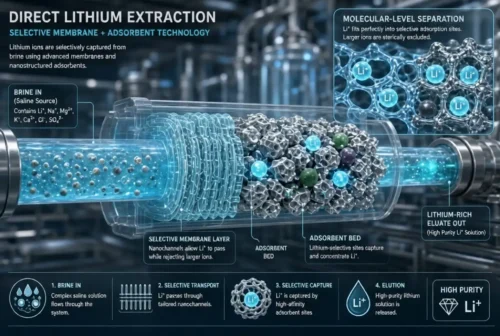
Lithium brine is very salty water found underground. It holds sodium, magnesium, calcium and potassium, plus a little lithium. DLE is a group of lithium extraction technology that pulls out the lithium directly, like a very picky filter, instead of letting sun and wind slowly evaporate the brine in ponds.
DLE is an umbrella term, not one machine. Adsorption makes lithium stick to a special material. Ion exchange swaps lithium onto a resin. Solvent extraction uses a liquid to pull lithium out. Membranes act as thin barriers. Each works best with certain brines, and some plants combine DLE with ponds.
How Does Direct Lithium Extraction Work?
The exact design varies, but the logic usually follows seven steps:
- Find a suitable lithium bearing resource and pump the brine up.
- Pretreat the brine and feed it into the extraction unit.
- Capture lithium with a selective material.
- Release the lithium into a cleaner liquid.
- Purify and concentrate it.
- Convert it into lithium carbonate or hydroxide, if required.
- Manage the leftover brine, often by reinjecting it underground where rules allow.
Not every project uses every method. Five things decide the outcome: selectivity (how well lithium is separated from look alike ions), recovery, water, reagents (chemicals) and energy. A material that captures lithium beautifully but needs hot brine, fresh wash water and acid may simply move the problem. A 2023 review in Nature Reviews Earth & Environment found some DLE tests reaching recovery above 95%, yet only about 30% of test experiments used real brines, and some methods need heating up to 80 °C.
Why Direct Lithium Extraction Could Change the Battery Industry
The potential advantages are real, but they are potential, not guaranteed:
- Separation can take hours or days, while ponds depend on weather and time.
- It may unlock brines that ponds handle poorly, such as geothermal or oilfield brines.
- It may need far less land than large pond systems.
- It may recover more lithium from certain resources.
- It can diversify a lithium supply chain concentrated in a few places.
One caution matters. Fast separation does not mean a fast project. Drilling, permitting, engineering, construction, ramp up and product qualification still take years.
Direct Lithium Extraction vs Traditional Methods
| Factor | Direct Lithium Extraction | Evaporation ponds |
|---|---|---|
| Technology | Selective capture and release | Solar evaporation, then processing |
| Time | Fast separation, site dependent | Depends on climate |
| Land | Smaller footprint possible | Extensive ponds |
| Water | Wash water, reinjection needs | Evaporative loss, brine handling |
| Energy | Pumping, heating, regeneration | Mostly solar, plus processing |
| Recovery | Varies with brine and method | Varies with process and resource |
| Cost | Higher capital, reagents, upkeep | Lower running cost where climate suits |
| Environment | Possible gains, real remaining risks | Site specific water and land issues |
Neither wins everywhere. Ponds remain viable where the climate suits and the brine is rich. Hard rock mining is a third route, and it brings its own mining and processing footprint. For all three, downstream refining also shapes cost and impact.
The Hidden Challenges Nobody Should Ignore
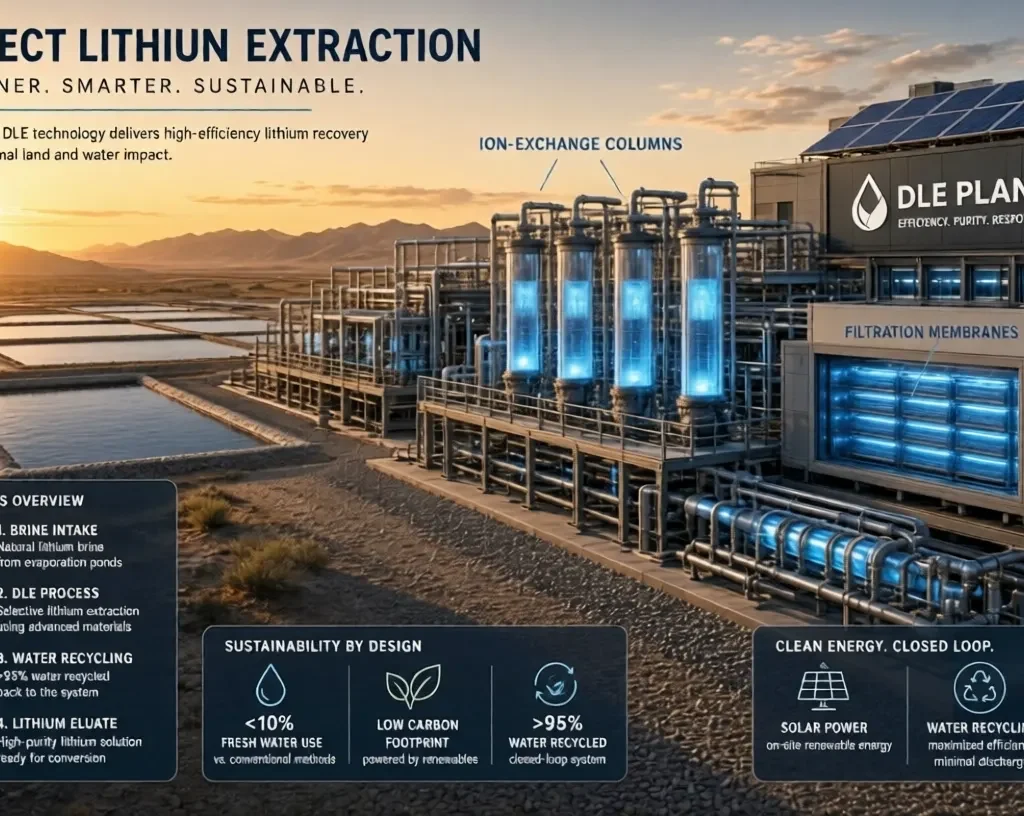
DLE needs high upfront investment, and scaling from pilot to plant is risky. Brine chemistry differs, and competing ions can reduce performance. Chemical use, wash water, waste streams and reinjection all need careful management. Energy demand matters, and so does where that energy comes from.
Equipment can foul or scale, and sorbent materials wear out. Buyers demand consistent product purity. Local water, ecosystems and communities must be protected, and regulators must approve.
A laboratory success is not a commercial success. Keep four stages separate: pilot plants, demonstration projects, operating commercial plants, and independently verified long term performance. A project in the first stage is never a proven commercial success.
A Real World Example and an Original Framework
The DLE Readiness Framework
- Resource: Is the brine chemistry suitable?
- Recovery: Can recovery stay consistent?
- Resources: How much water, energy and chemicals are needed?
- Economics: What are full capital and operating costs?
- Environment: Where do residual brine and waste go?
- Scale: Does performance hold beyond the pilot?
- Evidence: Is there independently verifiable operating data?
Hypothetical example (invented figures, not real data). A project manager has one brine and two process options. Option X recovers 85% of lithium with modest water use. Option Y recovers 92% but needs heated brine and more reagent. Y looks better on one headline number. Under the framework, both must be tested on the same brine, with the same assumptions and the same measurements: cost per tonne, reagent and wash water use, energy source, waste handling and months of pilot data. Only then can anyone say which wins.
What Does the Evidence Actually Tell Us?
The USGS reports world lithium mine production of about 290,000 tonnes in 2025, up 31%. The IEA reports that lithium specialists cut investment by around 40% in 2025, which shows how nervous the sector is.
For DLE itself, Eramet reported about 80% of nameplate capacity in March 2026 and guided to 17 to 20 thousand tonnes of lithium carbonate equivalent for 2026. These are company reported figures. Capacity percentage is not recovery rate, and neither measures environmental performance. Standard Lithium was still expecting a final investment decision in 2026 for its Arkansas project, so it is not yet producing.
I found no independent, comparable data on water or energy per tonne across DLE plants. Do not compare recovery percentages from different brines as if they were equal. For manufacturers, investors, policymakers and communities, the honest message is promising but unproven at scale. This is not investment advice.
Common Misconceptions About Direct Lithium Extraction
“DLE is completely green.” Its impact depends on water, energy sources, chemicals, waste and local conditions.
“DLE always extracts more lithium for less money.” Results depend on brine, technology and scale.
“Faster extraction means faster batteries.” Purification, battery material manufacturing and qualification still follow.
“One DLE method fits every brine.” Different brines often need different processes.
The Future of Direct Lithium Extraction
Confirmed: at least one commercial scale DLE plant is ramping up. Research directions: better sorbents, automation, monitoring and water recycling. Forecasts of wide adoption are just forecasts. Real progress will look like dependable operation, independently verified recovery, competitive whole project cost, responsible water management and measured environmental results.
Frequently Asked Questions
1. What is Direct Lithium Extraction in simple words? Technology that separates lithium directly from brine without relying only on evaporation ponds.
2. How does it work? Brine passes through a selective material that captures lithium, which is then released and purified.
3. Is DLE better than traditional extraction? Not always. It depends on the brine, site, cost and water conditions.
4. Does it use less water? Possibly, but wash water and reinjection needs vary. Check project data.
5. Is it environmentally friendly? It can reduce some impacts, but energy, chemicals, waste and local water remain concerns.
6. Why is DLE not used everywhere? Brines differ, costs are high, and scale up is hard.
7. Can DLE reduce lithium production costs? Possibly, though capital, reagent and energy costs can offset gains.
8. What is the difference between DLE and lithium mining? DLE works on brine, while hard rock mining digs lithium bearing ore.
9. Is DLE commercially proven? Some plants are operating, but most projects remain early, and independent long term data is limited.
10. What could make DLE more successful? Reliable operation, verified results, lower whole project cost and responsible water management.
A Promising Technology That Must Prove Itself
So, can lithium be extracted more efficiently without new environmental problems? Direct Lithium Extraction offers real possibilities, but its value depends on reliable performance, total cost, environmental responsibility and the brine itself.
Your next step: when you see a DLE claim, look past the headline recovery rate. Ask for independently verified data on energy, water, chemicals, costs, waste and commercial operating performance. To keep exploring, browse more New Tech articles on kritiinfo.com.