
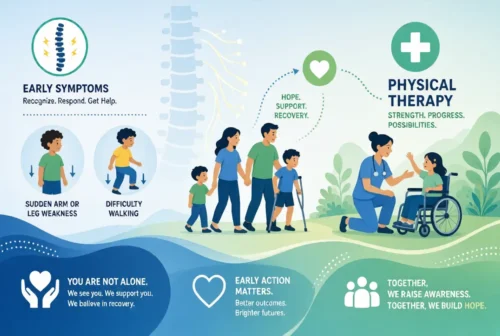
Introduction: When Weakness Appears Suddenly
Picture a seven year old girl, call her Mira, who has had a cold and mild fever for three days. On day four she seems better. Then, at breakfast, she cannot lift her spoon. Her right arm hangs soft and heavy. It does not hurt much. She is simply confused. Her mother wonders if she slept on it badly. An hour later, the arm is weaker.
Mira is fictional, and most children with a cold never develop anything like this. But her story shows why sudden weakness after an ordinary illness deserves fast attention. Doctors link this pattern with Acute Flaccid Myelitis (AFM), a rare but serious condition.
This article explains what AFM is, which warning signs matter, how doctors confirm it, what care looks like, and what the latest numbers can and cannot tell us.
Safety message: This article is for education. It cannot diagnose your child. If a child suddenly cannot move an arm or leg, or has trouble breathing, go to an emergency department now. Do not wait for an online answer or try home remedies first.
Table of Contents
What Is Acute Flaccid Myelitis?
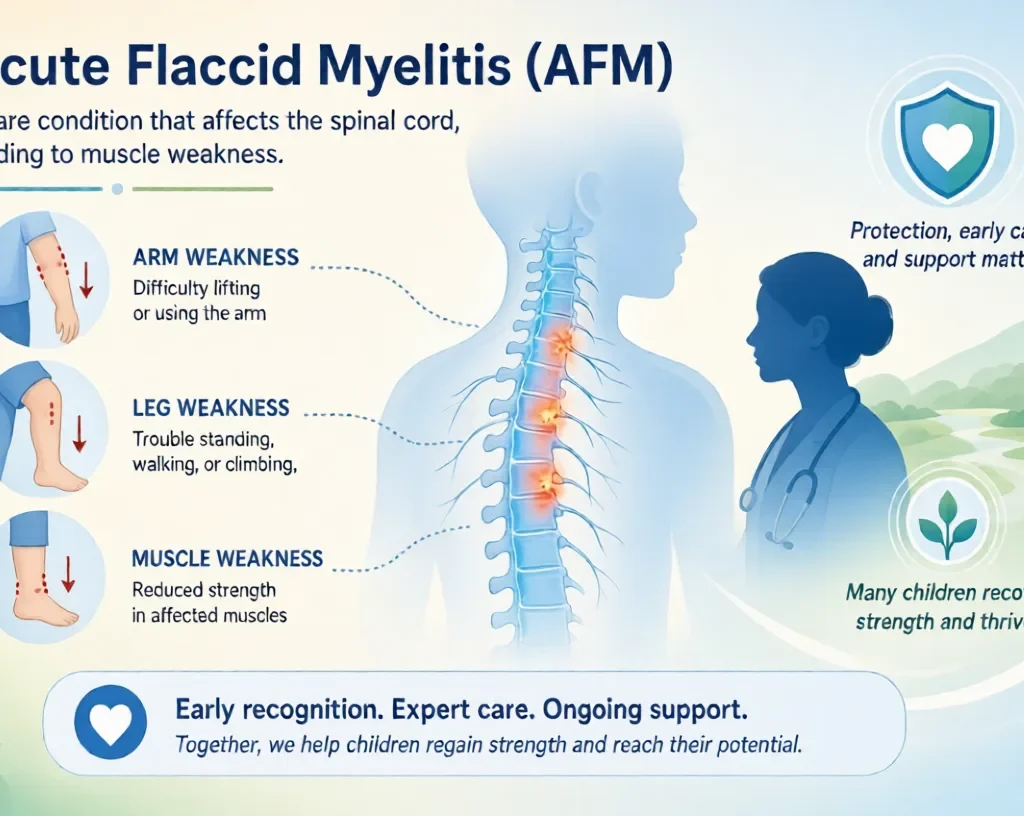
Think of the spinal cord as a thick cable running down the back. In its centre lies the gray matter, where nerve cells send “move” signals to the muscles. In AFM, these cells are damaged. The message never arrives, so the muscle goes weak.
The name is simpler than it looks:
- Acute means sudden.
- Flaccid means limp, with low muscle tone.
- Myelitis means inflammation of the spinal cord.
The CDC calls AFM an uncommon but serious neurologic condition, and it mainly affects children. It can look like polio, but it is a different diagnosis. Polio is caused by poliovirus. Doctors cannot separate the two by symptoms or scans alone, which is why a stool test matters.
Warning Signs Parents Must Recognise
The most common AFM warning signs are sudden weakness in an arm or leg, with loss of muscle tone and reflexes. Some children also have:
- Drooping face or facial weakness
- Trouble moving the eyes, or drooping eyelids
- Trouble swallowing or slurred speech
- Pain in the neck or back
- Pain in an arm or leg
- Numbness or tingling (uncommon)
No child has every sign. The most serious complication is weakness of the breathing muscles, which can lead to respiratory failure. Fast or laboured breathing, or a blue tinge to the lips, is an emergency.
Do not wait to see if it passes. Sudden limb weakness is not a “sleep badly” problem.
What Causes AFM?
Several viruses have been linked to AFM, especially non polio enteroviruses such as EV D68 and EV A71. In the United States, peaks in AFM in 2014, 2016 and 2018 matched waves of EV D68 infection, according to the CDC surveillance report.
Two points need care. First, a link is not proof of cause in any single child. Second, many cases never get a named cause. Samples are often taken after weakness begins, while the virus may have peaked up to a week earlier. AFM is not caused by poliovirus. “Polio like” describes how weakness looks, not what causes it.
How Doctors Diagnose the Condition
Doctors build the picture from several pieces. Read how AFM is diagnosed on the CDC page for detail.
- History: What came first, and exactly when did weakness start?
- Examination: Strength, muscle tone and reflexes.
- MRI: For surveillance, a confirmed case needs sudden limb weakness plus a spinal cord lesion mostly in gray matter.
- Lab tests: Spinal fluid, throat or nose swabs, blood and stool.
- Extra tests: Nerve studies, when needed.
Timing matters. Earlier testing gives virus tests a better chance. It also helps doctors rule out other causes, such as Guillain Barré syndrome or polio, which need different care.
AFM Treatment and Rehabilitation
There is no proven specific cure for AFM. Care is mainly supportive and tailored to each child. That can mean close hospital monitoring, intensive care, help with breathing, and treatment of complications.
In the CDC’s 2020 to 2025 US data, steroids and intravenous immunoglobulin (IVIG) were the most common treatments, given to 41% to 59% of hospitalised patients. This shows what doctors tried, not that these treatments work. No supplement or home remedy reverses nerve damage.
Rehabilitation matters. Physical therapy builds strength and movement. Occupational therapy helps with dressing, writing, eating and school tasks. Recovery varies. Some children improve a lot, and some have lasting weakness. No one can promise an outcome early on.
AFM vs Polio and Guillain Barré Syndrome
| Feature | AFM | Polio | Guillain Barré syndrome |
|---|---|---|---|
| What happens | Spinal cord gray matter is damaged | Poliovirus attacks spinal cord nerve cells | Immune system attacks peripheral nerves |
| Typical sign | Sudden limb weakness, floppy muscles | Sudden limb weakness, floppy muscles | Often weakness and tingling that spreads, with lost reflexes |
| Key tests | MRI, spinal fluid, stool and swabs | Stool test for poliovirus | Spinal fluid and nerve studies |
| Prevention | No specific vaccine | Polio vaccine | No specific vaccine |
Symptom lists cannot reliably sort these conditions. A doctor must examine the child and read the tests. A rare condition is never a harmless one.
Prevention: Practical Steps for Families
Nothing proven guarantees AFM prevention. These steps are sensible for infections in general, but they have not been proven to prevent AFM itself:
- Wash hands often with soap and water.
- Keep a little distance from people who are sick.
- Clean shared, frequently touched surfaces.
- Keep children home when ill.
One step has clear value for a related reason: keep polio vaccination up to date. It prevents poliomyelitis. It is not a vaccine against AFM.
What the Evidence and Numbers Actually Tell Us
The latest CDC report, published in July 2026, covers confirmed US cases from 2020 to 2025.
- 172 confirmed cases in six years: 34 (2020), 29 (2021), 48 (2022), 19 (2023), 25 (2024), 17 (2025).
- In the peak years 2014, 2016 and 2018, the US had 120 to 238 cases per year.
- Nearly all patients (98% to 100%) were hospitalised. Between 15% and 41% of hospitalised patients needed a ventilator.
- No confirmed patient died in 2020 to 2025.
- EV D68 respiratory illness rose in 2022, 2024 and 2025, but AFM cases did not rise with it. Scientists do not yet know why.
What this shows: AFM was rare in the United States in recent years, yet serious when it happened. What it cannot show: These are US numbers. They do not estimate AFM in India or the world. Cases are reported passively, so some may be missed. We found no current reliable Indian figure, and we will not invent one.
What To Do Next: A Simple Plan
- Recognise: Sudden weakness, floppy limb, facial droop, swallowing trouble or breathing trouble.
- Seek assessment: Go to a hospital emergency department at once.
- Follow the medical team: Share when symptoms began, recent illness and vaccine records.
- Plan rehabilitation: Ask about physical and occupational therapy early.
Teachers and caregivers can use the same plan: note the time, call the parents, and arrange urgent medical care. Do not try to diagnose.
Frequently Asked Questions
1. What is Acute Flaccid Myelitis in children? A rare condition in which the spinal cord’s gray matter is damaged, causing sudden, limp weakness in one or more limbs.
2. What are the first warning signs of AFM? Sudden arm or leg weakness with loss of muscle tone and reflexes. Face, eye, swallowing or speech problems may follow.
3. Can AFM develop after a viral infection? Yes, many patients report a recent respiratory illness or fever. But not every case follows a known infection, and most infections never lead to AFM.
4. Is Acute Flaccid Myelitis the same as polio? No. Polio is caused by poliovirus. The two can look alike, so doctors test for polio in suspected AFM.
5. How do doctors diagnose AFM? Through history, a nerve and muscle examination, MRI, and tests of spinal fluid, swabs, blood and stool.
6. Is there a specific cure for AFM? No proven cure exists. Care focuses on support, monitoring, complication management and rehabilitation.
7. Can a child recover from AFM completely? Outcomes vary. Some children improve a lot, while others have lasting weakness. A specialist team can discuss your child’s outlook.
8. Can AFM be prevented? There is no proven prevention. Hygiene helps against infections in general, and polio vaccination prevents polio only.
9. When should parents seek emergency medical care? Right away for sudden limb weakness, facial droop, trouble swallowing or speaking, or any difficulty breathing.
Conclusion: Awareness Can Improve the Next Decision
Sudden weakness is a symptom to act on, not to watch. Quick assessment gives doctors the best chance to test, support and protect a child. Rehabilitation then helps rebuild what it can. Hope lives in that sequence.
Your next step today: Save your nearest hospital’s emergency number, and keep your child’s vaccination record where you can find it fast.
This article is educational and does not replace medical advice.