
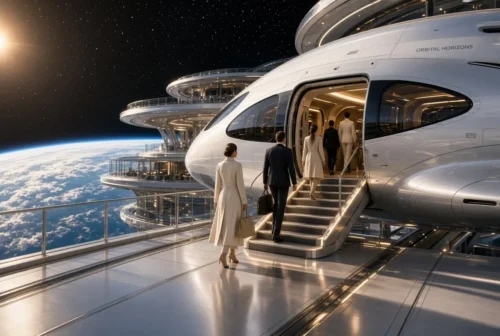
The Message at 2:14 a.m. (Fictional Scene)
At 2:14 a.m., physicist Mira Rao is alone in a quiet lab. Her screen lights up. The AI system she has trained for three years has sent a short warning.
“Power failure at 2:41. Backup failure at 2:43.”
She laughs. At 2:41, the lights die. At 2:43, the backup fails too.
Then a third line appears. “This signal did not come from your data. It arrived from 2031.”
Mira stares at the dark screen. Did her AI find a hidden pattern in the building’s electrical records? Or did it touch something science cannot explain?
This is only a story. But it points to a real question. Can AI help with Future Travel, meaning the power to predict, understand, or even reach other moments in time? Let us separate what is proven, what is possible, and what is fantasy.
Table of Contents
Three Ideas People Often Mix Up
First, forecasting. AI studies past data and estimates what is likely to happen next. In 2023, Google DeepMind showed that its GraphCast model could produce ten day global weather forecasts in under a minute, and it beat a leading traditional system on most measures tested. Still, a forecast is a probability. It is not a memory of tomorrow.
Second, time travel in physics. Moving into the future is real and measured. Moving into the past is speculative and faces deep problems.
Third, fictional AI time travel. Stories imagine a future machine that uses AI to study spacetime, run mathematical models, control delicate instruments, or decode strange signals.
Here is the key point. Intelligence and computing power do not change the laws of nature. A smarter calculator is still a calculator.
What Is Time in Modern Physics?
Newton treated time as a steady clock ticking the same way for everyone. Einstein changed that. In relativity, time joins the three dimensions of space to form one fabric called spacetime.
In this picture, time is not universal. It depends on how you move and where you are. Two clocks can be perfect and still disagree.
Time Dilation: The Proven Side of Future Travel
Time dilation means clocks tick at different rates in different conditions. There are two causes.
- Speed. The faster you move, the slower your clock runs compared with someone standing still.
- Gravity. The stronger the gravity, the slower your clock runs. A clock on a mountain top ticks slightly faster than one at sea level.
This is not theory alone. In 1971, scientists flew atomic clocks around the world on airliners and found small differences that matched Einstein’s predictions. In 2010, researchers at NIST measured the effect with ultra precise clocks separated by only 33 centimetres in height. GPS satellites must correct for both effects every day. Without those corrections, position errors would grow by kilometres daily.
Astronauts are real examples too. Cosmonaut Sergei Krikalev spent about 803 days in orbit and came home roughly 0.02 seconds “ahead” of everyone on Earth.
Now imagine a spacecraft travelling at 99.5 percent of the speed of light. For the crew, one year would pass while about ten years pass on Earth. That is genuine Future Travel in physics.
But there are two catches. The energy needed is enormous, far beyond any present technology. And the trip only goes one way. You cannot return to your own past.
Why Travelling to the Past Is So Hard
Some solutions to Einstein’s equations allow loops in time, called closed timelike curves. Wormholes, which are theoretical shortcuts through spacetime, are one popular idea.
The problems are serious:
- Physicists Morris and Thorne showed in 1988 that a traversable wormhole would need “exotic matter” with negative energy density. Nobody has shown that enough of it can exist or be made.
- Stephen Hawking proposed the chronology protection conjecture, which suggests nature may block time loops.
- Paradoxes appear. If you changed your own past, the cause of your journey could vanish.
- No experiment has ever detected a signal from the future.
A mathematical possibility is not a working machine. Many equations allow things the universe never does.
What AI Can Genuinely Do Today
AI is already a powerful research partner:
- Prediction. It improves weather, climate, and traffic forecasts.
- Pattern finding. It helps scientists search huge datasets, including data from telescopes and gravitational wave detectors.
- Simulation. It speeds up models of complex systems. DeepMind’s AlphaFold, which predicts protein structures, shared in the 2024 Nobel Prize in Chemistry.
Could AI help researchers test theories about time? Yes, by running simulations, spotting odd results, and suggesting new models. But AI cannot prove a theory correct. Only careful experiments can do that.
Prediction vs a Message from the Future
This is the heart of the matter.
A prediction is built from information that already exists. It can be wrong, and it improves with better data. A message from the future would contain information that cannot be worked out from the present at all.
So if an AI ever seemed to receive such a message, how would we judge it? Try the Five Question Time Test:
- Could present data explain it? Hidden patterns are far more likely than time travel.
- Was it recorded before the event? Secure timestamps matter.
- Does it repeat? One lucky hit proves nothing.
- Can independent teams reproduce it? Others must get the same result.
- Does it reveal something unguessable? The fact should be impossible to infer in advance.
If the answers are no, the simplest explanation wins.
Comparison: Three Kinds of Time Travel
| Idea | Scientific status | Evidence | Role of AI |
|---|---|---|---|
| Forecasting the future | Real and useful | Weather, finance, medicine | Central tool |
| Travel to the future (time dilation) | Real but tiny in practice | Atomic clocks, GPS, astronauts | Helps with models and data |
| Travel to the past | Highly speculative | None | Can only test equations |
Common Misconceptions
“AI can see the future.” It estimates probabilities from the past.
“Time dilation is just science fiction.” It is measured every day, though the effects are very small at normal speeds.
“More computing power will build a time machine.” Computing power helps calculation. It does not create new physics.
Ethics and Responsibility
Even forecasting raises hard questions. If people trust predictions too much, a forecast can become a self fulfilling prophecy. Biased data can create biased predictions. Systems that predict human behaviour can threaten privacy and fairness.
So the real challenge may not be whether AI can reach the future. It may be whether we use its predictions wisely.
Back to the Lab (Fictional Ending)
Mira’s team spends a week applying the Five Question Time Test. The answer turns out to be ordinary. Her AI had noticed tiny vibrations in an ageing transformer, a pattern humans had missed. The “2031” line came from a corrupted timestamp in a log file.
The story is less magical, and more useful. The AI did not travel through time. It saw the present more clearly than people could.
Conclusion: A Door Worth Studying
Today, Future Travel exists in two honest forms. Forecasting lets us glimpse likely futures. Time dilation lets matter drift into the future by tiny, measurable amounts. Travel to the past remains an open question, with no evidence and many obstacles.
AI may not be a time machine, but it may become one of our best tools for understanding time. Curiosity, careful testing, and honesty will matter more than any headline.
Frequently Asked Questions
1. Can AI predict the future? It can estimate likely outcomes from past patterns, such as tomorrow’s weather. It cannot know the future with certainty.
2. Is time travel to the future possible? Yes, in a small way. Clocks moving fast or sitting in stronger gravity run slower, and this has been measured many times.
3. Is time travel to the past possible? Nobody knows. Some equations allow it, but it would need exotic conditions that have never been observed.
4. What is time dilation in simple words? It means time does not tick at the same speed for everyone. Speed and gravity change the rate.
5. Could AI help invent a time machine? AI could help test theories and analyse data. It cannot create new physics by itself.
6. Has any AI received information from the future? No. There is no scientific evidence of this. The opening story is fiction.