
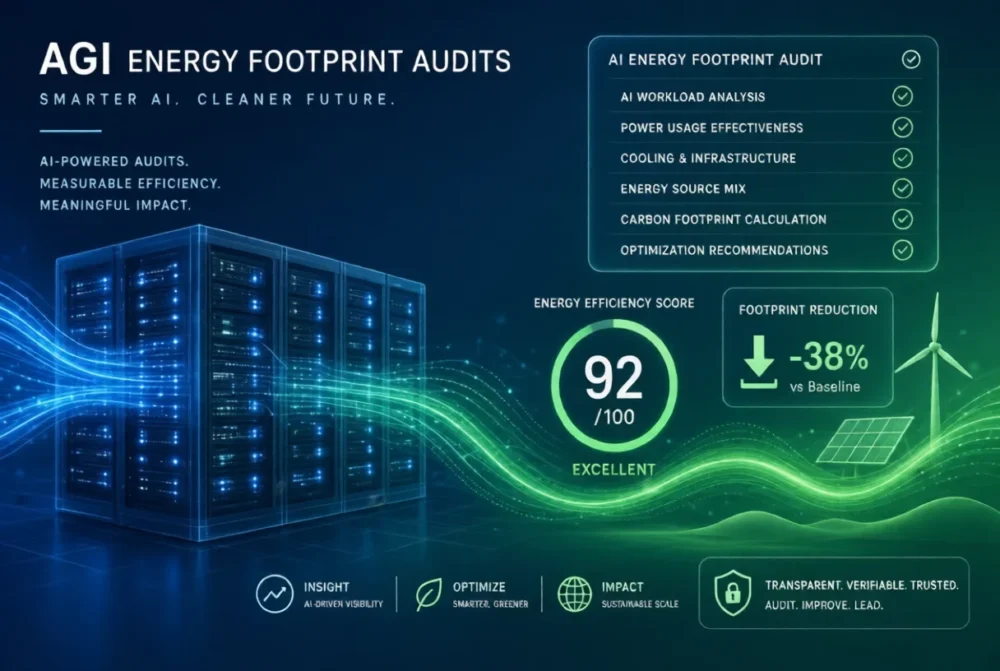
Introduction: The Night the Grid Felt the Machine While the city sleeps, a massive AI computing facility silently pulls an unprecedented, highly concentrated amount of electricity. Cables heat up and local substations strain—not from a nationwide lack of power, but from the physical limits of funneling massive energy to a single location. As artificial intelligence advances faster than our local grids can adapt, understanding this localized strain and conducting comprehensive AGI Energy Footprint Audits are now critical for sustainable technological expansion.
Table of Contents
1. The Hidden Problem Is Location
When we talk about the energy consumption of advanced technology, we usually look at national statistics. We assume that if a country generates enough terawatt hours of electricity, the grid is perfectly fine. This is a dangerous misconception.
Electricity is difficult and expensive to move. A region might possess abundant wind, solar, or nuclear generation capacity. However, if a massive data center is built in a specific town, that particular distribution network faces intense pressure. Total electricity supply is entirely irrelevant if the transmission corridor or local substation lacks the capacity to deliver it.
Localized grid strain occurs when specific nodes in a power network become overloaded. A single town could experience voltage drops or require extreme infrastructure upgrades simply because a facility nearby demands as much power as a small city.
2. Why AI Can Create Localized Grid Strain
To understand why this happens, we must look inside the modern data center. Traditional cloud computing facilities are already energy intensive. Artificial intelligence requires an entirely different level of density.
Training and running large scale models rely on thousands of specialized AI accelerators and powerful servers packed closely together. This equipment draws enormous amounts of electricity to compute complex calculations. Furthermore, these machines generate staggering amounts of heat. Cooling systems, whether advanced liquid cooling or massive air conditioning units, require huge power reserves just to keep the equipment from melting.
Unlike traditional office buildings or residential neighborhoods where power demand drops at night, computing infrastructure runs continuous workloads. The power conditioning equipment, networking gear, and backup systems draw heavy continuous loads. This constant concentration of high density power consumption makes it incredibly difficult for a local grid to find moments of relief.
3. What an AGI Energy Footprint Audit Reveals
As we look toward a future where computing clusters might scale to support Artificial General Intelligence, we cannot rely on guesswork. This is exactly where AGI Energy Footprint Audits become necessary.
An audit of this scale is not merely a corporate environmental exercise. It is a rigorous infrastructure risk assessment. Proper AGI Energy Footprint Audits examine multiple critical factors:
- Total hourly load patterns and peak demand forecasts
- Geographic concentration of computing clusters
- Cooling requirements during extreme weather events
- Substation capacity and transmission constraints
- Local renewable energy availability and battery storage readiness
- Carbon intensity and backup generation dependencies
By conducting AGI Energy Footprint Audits, grid operators and tech companies can identify exactly where a localized failure might occur before a single server is plugged in. These audits expose the vulnerabilities that standard environmental reports completely miss.
4. The Transformer Nobody Notices
Let’s picture a real-world scenario: A tech company builds a massive computing center, and planners verify the main power lines but overlook a crucial bottleneck—the local transformer. While the existing transformer served the area for decades, the new facility’s immense peak demand pushes it past maximum capacity. To prevent catastrophic equipment failure, grid operators must throttle the power, suddenly crippling a billion-dollar investment over a single piece of infrastructure.
5. The Peak Demand Trap
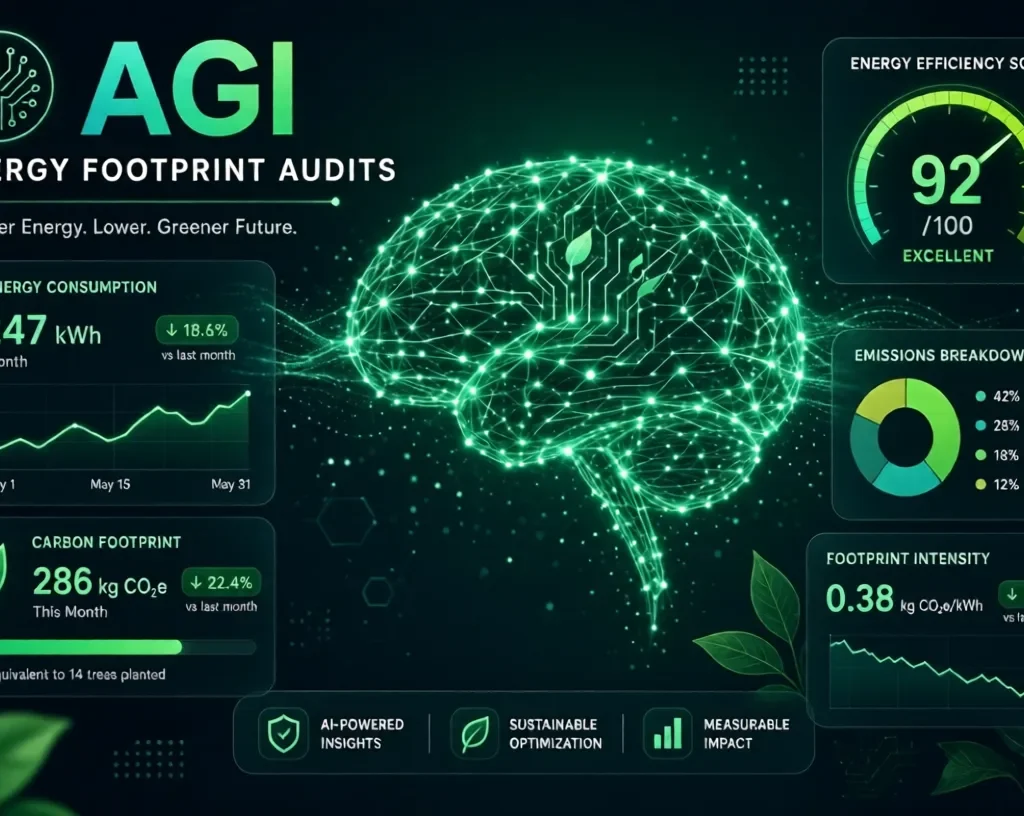
Average electricity consumption is a terrible metric for infrastructure planning. A facility might average a moderate power draw over a whole year, but the grid must be built for the absolute maximum peak demand.
The peak demand trap happens when high density computing workloads coincide with seasonal grid stress. Imagine a brutal summer heatwave. Homes and businesses turn their air conditioners on maximum. Simultaneously, the data center must ramp up its own cooling systems to prevent server failure. The difference between energy consumption over a year and power capacity required in that exact second is immense.
Grid planners must prepare for the worst possible hour of the worst possible day. Without understanding simultaneous demand, planners risk triggering localized blackouts.
6. Can Renewable Energy Solve It?
It is tempting to think we can solve localized grid strain simply by building more solar panels and wind turbines. The International Energy Agency notes that renewable generation is expanding rapidly. However, green energy does not automatically fix local bottlenecks.
Renewable power faces two major hurdles: intermittency and location mismatch. Solar power disappears at night. Wind power drops when the air is still. High density computing requires firm, continuous power twenty four hours a day.
Furthermore, the best places to generate wind and solar energy are often hundreds of miles away from the urban centers where data facilities are built. Pushing remote renewable energy across long distances only exacerbates transmission congestion. While renewable energy is vital for reducing the carbon footprint, it must be paired with massive battery storage and intelligent demand management to truly relieve localized grid strain.
7. The Smart Way Forward
We are not powerless against these infrastructure challenges. Technology companies, regulators, and utilities can cooperate to build a resilient system.
The smart way forward involves proactive grid planning guided by rigorous AGI Energy Footprint Audits. Practical solutions include:
- Deploying grid scale battery storage to absorb renewable energy and discharge it during peak demand
- Implementing flexible computing workloads that pause non critical training tasks when local grid stress is high
- Upgrading transmission corridors and substations before approving facility construction
- Investing in advanced efficient AI hardware and next generation liquid cooling
- Establishing transparent energy reporting standards
Guidance from organizations like the U.S. Department of Energy emphasizes that managing future electricity loads requires an orchestrated effort. We must match clean power procurement with the actual physical realities of the grid.
8. Case Study: When Computing Demand Meets a Bottleneck
To understand how this works in practice, consider a hypothetical case study.
A major technology firm plans to build a sprawling advanced computing facility near a growing metropolitan area. The goal is to lay the groundwork for future advanced models. The regional grid has plenty of total generation capacity from nearby natural gas and wind farms.
Before: The expansion looks technically and financially possible on paper.Investigation: The local utility requests a comprehensive assessment. The resulting AGI Energy Footprint Audits expose a severe localized constraint. Load modeling reveals that the primary substation and the final five miles of transmission lines have zero spare capacity during summer evenings.Action: Instead of abandoning the project, the operator adapts. They fund a substation upgrade. They install on site battery storage to handle evening cooling loads. They write software to shift massive data processing tasks to the middle of the night when the grid is quiet.Result: The expansion proceeds responsibly. By identifying the bottleneck early, they manage the expansion without pretending that infrastructure limitations do not exist. This hypothetical scenario illustrates exactly how preparation prevents crisis.
9. Why AGI Energy Footprint Audits Could Become Essential
Artificial General Intelligence does not exist yet. However, the foundational systems being built today require unprecedented computing clusters. If AI development continues to accelerate, the physical infrastructure will become just as critical as the software itself.
In the near future, energy planning may dictate the pace of technological progress. Securing access to robust, clean, and reliable electricity will be just as difficult as acquiring advanced silicon chips. This reality means AGI Energy Footprint Audits could soon transition from voluntary environmental checks to mandatory regulatory requirements. Communities will demand verified proof that a new massive facility will not destabilize their local power resilience.
To explore more about the intersection of emerging technology and sustainable infrastructure, read our complete guide to AI Infrastructure and Sustainability strategies.
10. The Bigger Question
As we push the boundaries of what machines can achieve, we must pause and ask a fundamental question. Are we building intelligent machines faster than we are building the infrastructure needed to power them responsibly?
The race for advanced computing is thrilling, but it is deeply dependent on the physical world. Steel, copper, transformers, and transmission lines dictate our digital future. By embracing transparency, prioritizing efficiency, and utilizing tools like AGI Energy Footprint Audits, we can build a technological future that respects the physical limits of our world. The grid is the silent foundation of intelligence. We must ensure it is strong enough to carry the weight.
FAQ
What is an AGI Energy Footprint Audit? It is a comprehensive assessment that evaluates the total energy consumption, peak power demands, geographic concentration, and infrastructure impacts of massive computing facilities designed for advanced artificial intelligence workloads.
Why can AI data centers cause localized grid strain? These facilities pack thousands of powerful processors into tight spaces. They require immense, continuous power for computing and cooling. This heavy concentration of demand can overload specific local power lines and substations, even if the national grid has enough power.
How does AI electricity demand affect substations? Substations step down high voltage power for local use. Because AI facilities draw extreme amounts of power continuously, they can push a local substation to its maximum physical capacity, risking equipment failure or forcing power throttling.
Can renewable energy reduce AGI’s energy footprint? Yes, but it requires careful management. Solar and wind power are intermittent. Because computing facilities require constant power, renewable energy must be paired with large scale battery storage and transmission upgrades to be truly effective.
Why is peak demand important for AI infrastructure? A power grid must be built to handle the single moment of highest usage. During hot weather, a data center must maximize its cooling systems at the exact same time nearby homes turn on air conditioners. This simultaneous peak demand creates massive strain.
How can energy audits help future AGI development? Audits identify infrastructure bottlenecks before construction begins. By exposing vulnerabilities in transmission, cooling requirements, and substation capacity, they allow operators to invest in battery storage and grid upgrades proactively.
Can battery storage reduce localized grid pressure? Absolutely. Large battery systems can store excess renewable energy when grid demand is low and discharge that power directly to the computing facility during peak hours. This reduces the immediate strain on the local transmission network.
1 thought on “How 5 AGI Energy Footprint Audits Expose Hidden Grid Strain”