
You are sitting in a room that looks empty. The air feels dry. Nothing drips. Nothing shines.
Yet the air is carrying water right now, as invisible vapor brushing past your hands and face.
The U.S. Geological Survey puts the total at about 12,900 cubic kilometers of water in the atmosphere at any moment. That is only 0.04% of Earth’s freshwater. But it hangs over deserts, islands and dry villages too.
So why don’t we simply take it?
Because catching vapor is the easy half. The hard half has a quiet name: desorption. It decides whether an atmospheric water generator delivers a cup of water or a disappointment.
The water is already there. The real question is how to unlock it.
Table of Contents
The Water You Cannot See
Air holds water as vapor. Warm air holds more than cold air. Relative humidity tells you how full the air is compared with its limit at that temperature.
Even desert air is never truly empty. It is just close to empty at certain hours.
Why care? WHO and UNICEF report that 2.1 billion people, about 1 in 4, still lack safely managed drinking water. A source that does not depend on rivers or wells deserves a fair look.
The idea is not science fiction. On the International Space Station, dehumidifiers capture moisture from the crew’s breath and sweat. NASA says the water recovery system recycles about 98% of the station’s water. A cabin is controlled, and open air is not. But the principle works.
Desorption: The Hidden Release
Two words sound almost alike, and the difference is the whole story.
Adsorption means water vapor sticks to the surface of a material, like lint on a sweater. Desorption is the reverse. The water lets go and returns to the air as vapor.
Materials built for this job are called sorbents. Silica gel, zeolites, salts, hydrogels and metal organic frameworks (MOFs) all qualify. MOFs are so porous that UC Berkeley says one gram has the surface area of a football field.
Think of a sorbent as a parking garage for water molecules. Cool, humid air fills it. Something must empty it again. Three levers can do that:
- Heat, which gives molecules enough energy to break free. This is the most common lever.
- Lower pressure, which helps vapor escape.
- Drier surrounding air, which pulls vapor out.
Once emptied, the sorbent is regenerated and ready for another round.
How an Atmospheric Water Generator Works
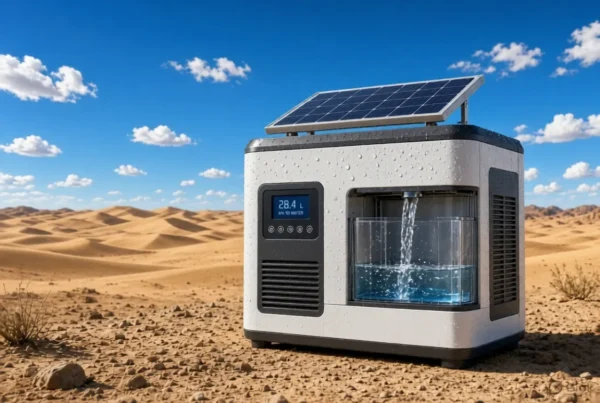
Most machines work like a dehumidifier, cooling air below its dew point until vapor condenses. This route loses efficiency in cool, dry air. A commonly cited rule of thumb puts trouble below about 18°C or 30% humidity.
Sorbent systems take a different route and can work in drier air. The cycle runs like this:
- Capture: at night, humid air passes over the sorbent, and adsorption fills its pores.
- Release: by day, sunlight or other heat triggers desorption. Water vapor leaves the sorbent.
- Condense: the vapor meets a cooler surface and turns into liquid.
- Collect: the water is gathered, and the sorbent resets for the next night.
Skip any step and you get nothing. The middle step is the one people forget.
Case Study: A Backyard in the Arizona Desert
What the record shows. In October 2017, a UC Berkeley team led by Omar Yaghi tested a prototype at a home in the Arizona desert. The results appeared in Science Advances in 2018.
The air was harsh. Humidity fell to 5% at 35 to 40°C by day and reached 40% at night. The dew point sat below freezing, which the authors say made refrigeration based production infeasible.
The sorbent was MOF-801, blended with graphite so sunlight could heat it. The first attempts gave no liquid water. The condenser reached 42°C, too warm to work. The team buried the case in soil for insulation and tilted it 37 degrees toward the sun.
Then water formed. From 0.825 kg of sorbent blend, the device collected 55 grams in one day and night cycle, using only sunlight and natural cooling. The team reported no sorbent contamination in the collected water.
A later Nature Water paper described a passive MOF-303 harvester. It produced 210 grams per kilogram of sorbent per day in Death Valley and 285 in Berkeley.
My reading. Fifty five grams is about a quarter of a glass. It is proof of principle, not a village supply. The best lesson sits in the failed attempts: release and condensation must be matched, or the water never appears.
The Energy Problem
Water clings hard, and freeing it costs heat. Basic physics puts the heat needed to turn one liter of water into vapor near 0.6 kilowatt hours. That is a floor, before any losses. Some sorbents need slightly more, as one 2024 review notes.
Humidity changes the math. A 2021 Nature modeling study of a hypothetical solar device assumed yields from 0.2 liters per kilowatt hour at 30% humidity to 2.5 at 90%. That is a wide gap, and it is a model, not a measurement. A 2026 review reports that commercial cooling based units typically use 0.3 to 1.0 kWh per liter, depending on climate. The systems differ, so the numbers are not a fair race.
Heat reuse helps. In dual stage designs, the heat released by condensation drives desorption in the next stage.
The heat source matters too. Sunlight is free but limited. Fossil electricity adds a climate cost. The energy source decides whether this is truly sustainable water technology.
Why the Material Decides So Much
A good sorbent for an atmospheric water generator must grab water at low humidity, release it with little heat, survive hundreds of cycles, stay safe and cost little.
MOF-801 uses zirconium, which is expensive. The team’s aluminum based MOF-303 is at least 150 times cheaper, according to the researchers, and held more water in lab tests. It showed no measurable damage after 150 adsorption and desorption cycles.
When Air Becomes a Water Source
How does this compare with conventional sources? Conceptually:
| Source | Water comes from | Main challenge |
|---|---|---|
| Rivers and wells | Surface or ground water | Availability, treatment, delivery |
| Desalination | Seawater or brackish water | Energy, brine disposal, coastal access |
| Atmospheric water generator | Water vapor in air | Energy, materials, humidity |
The best fit is not replacing city pipes. It is remote clinics, disaster zones, and island or desert communities, where distance is the enemy. The Nature model suggests such devices could supply safely managed drinking water for about a billion people, but that assumes a hypothetical device and suitable climates.
The limits are real. Yields are modest, cost remains a hurdle, and sorbents need long term testing. Air also carries dust and microbes. Water from any machine still needs treatment and testing against WHO drinking water guidelines.
A Realistic Future
Progress will likely come in small, unglamorous steps: sorbents that release water at lower temperatures, faster cycles, smarter heat reuse, cheaper synthesis, and standard testing so results can be compared honestly.
The 2018 Arizona device gave about 100 grams per kilogram of MOF-801 each day. The 2023 harvester roughly doubled that. Hope is fair. Certainty is not.
FAQ
What is desorption? Desorption is the release of molecules that were stuck to a surface. In water harvesting, heat or lower pressure frees captured water vapor from a sorbent.
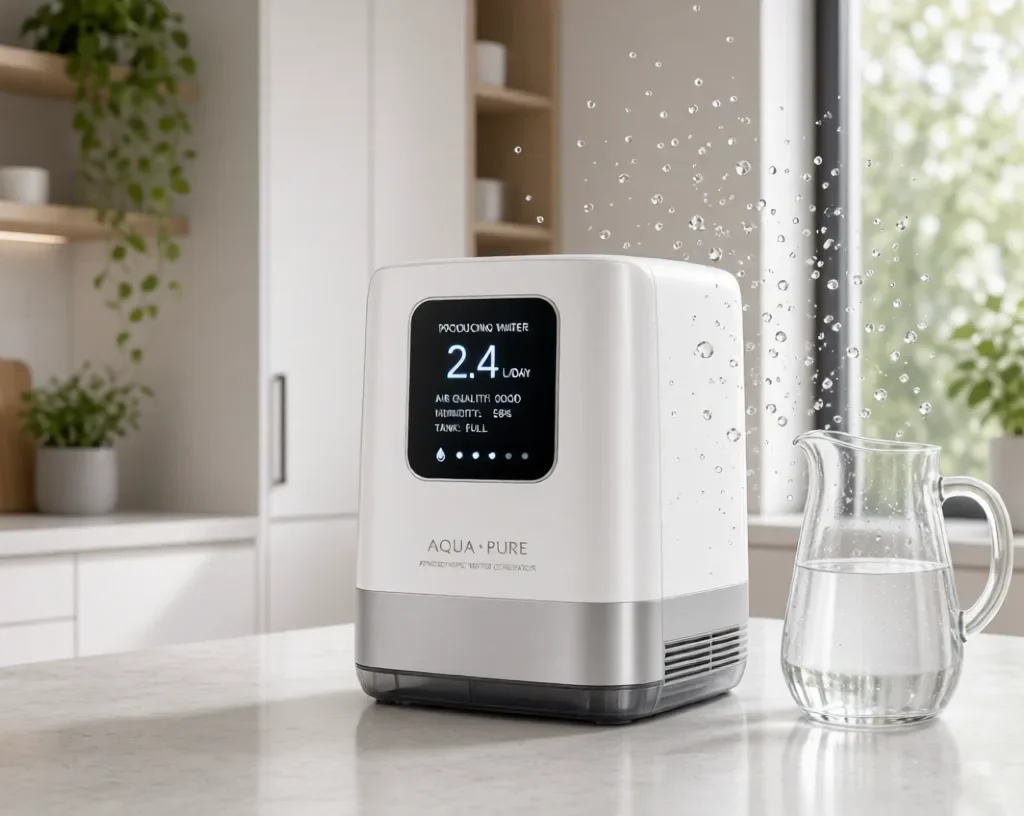
What is an atmospheric water generator? An atmospheric water generator is a device that pulls water from humid air. It either cools the air until vapor condenses, or uses sorbents that capture vapor and later release it.
How does desorption help produce water from air? It turns a loaded sorbent back into water vapor at a chosen moment. That vapor can then be condensed into liquid and collected.
Is atmospheric water generation energy intensive? Often, yes. Releasing or condensing water needs real heat or power. Yields depend heavily on humidity, temperature and design, so compare energy per liter before trusting any claim.
Can an atmospheric water generator work in dry climates? Sorbent based designs can. The Arizona test collected water with daytime humidity as low as 5%. Yields are small, though. Cooling based machines struggle in dry air.
Is water produced from air safe to drink? Not automatically. Air carries dust and microbes, and materials can shed particles. Water should be filtered, treated and tested to local standards and WHO guidance. The Arizona team found no sorbent contamination, but that was a research device.
What is the future of atmospheric water harvesting? Cheaper sorbents, faster cycles, better heat reuse and honest testing. Solar driven systems look most promising for remote areas.
The Last Word
Desorption is the moment the invisible becomes usable. Adsorption catches the vapor. Desorption gives it back, on our terms. An atmospheric water generator succeeds or fails on that step, on the energy behind it, and on the material inside it.
The evidence so far is modest but real: grams in an Arizona backyard, hundreds of grams per kilogram in later tests, and models that hint at much more. No single machine will solve water access. But understanding this hidden step helps you judge every claim about water from air with clear eyes.
So consider this:
What if the next source of clean water is not beneath our feet, but already floating invisibly around us?