
What if the glow you keep searching for in a bottle is quietly being built on your plate?
Picture this familiar scene. It is 11:30 PM. Your bathroom counter looks like an apothecary shop. There is a multi-step routine lined up under harsh fluorescent light: a milky cleanser, an exfoliating acid, two serums claiming clinical miracles, and a heavy barrier cream. You pat them on with precision, check the mirror, and hope that tomorrow morning brings a transformation.
Yet week after week, the dullness lingers. A subtle tightness persists. Occasional breakouts pop up without warning, bringing a quiet sense of worry and frustration.
Here is the central mystery: why does external care often stall, even when you purchase the most expensive formulas?
The answer is not hiding in a higher concentration of topical actives. It lies deep inside your biology, where a 28-day cellular assembly line runs around the clock. Your surface skin consists of cells that formed weeks ago beneath the surface. If you want skin that looks vibrant, resilient, and clear, you must nourish the factory, not just polish the final product.
Welcome to the concept of Glow Fooding. It is not a quick detox or an aesthetic trend. It is an intentional, evidence-based approach to eating that fuels your body’s largest organ from the inside out.
Table of Contents
What Does Glow Fooding Really Mean?
Let us clear away the marketing noise immediately.
Glow Fooding is not a monochrome diet of green juices, nor does it demand exotic berries imported from remote mountaintops. At its core, Glow Fooding means choosing whole, minimally processed foods rich in essential micronutrients, structural proteins, healthy fats, and antioxidants that support normal dermal biology.
Cosmetic marketing often treats skin like an inanimate canvas: polish it, paint it, hydrate it from above. Physiology tells a completely different story. The skin is a dynamic, living shield. It regenerates constantly, manages moisture balance, and protects internal organs from pathogens and UV radiation.
Every single cell, enzyme, and lipid barrier in that shield is constructed from raw materials you swallow. When you practice sensible Glow Fooding habits, you feed that construction process with high-grade building blocks instead of biological scraps.
The Biological Mystery: Why Skin Needs More Than Skincare
Consider how the human body prioritises resources under stress or nutrient scarcity.
Your heart, brain, liver, and kidneys hold top priority. If your daily diet runs low on essential amino acids, trace minerals, or key vitamins, your metabolism makes a calculated triage decision. It diverts those critical nutrients to keep vital organs running.
Your skin sits at the very end of the delivery chain. It is non-essential for immediate survival. When daily meals lack foundational nourishment, your skin shows the deficit first: slow wound recovery, rough texture, increased sensitivity, and loss of tone.
Topical products are valuable. A gentle cleanser, a reliable moisturiser, and daily broad-spectrum sunscreen are non-negotiable fundamentals endorsed by the American Academy of Dermatology. But topicals operate primarily on the stratum corneum, the outermost layer of dead or dying skin cells.
To influence the deeper layers where collagen forms and cell division occurs, you must rely on systemic nutrition. True skin resilience starts where creams cannot reach: in the bloodstream.
7 Nutrients That Form the Backbone of Glow Fooding
If your plate acts as the supply depot for your skin, which raw materials matter most? Decades of clinical nutrition point to seven vital nutrients.
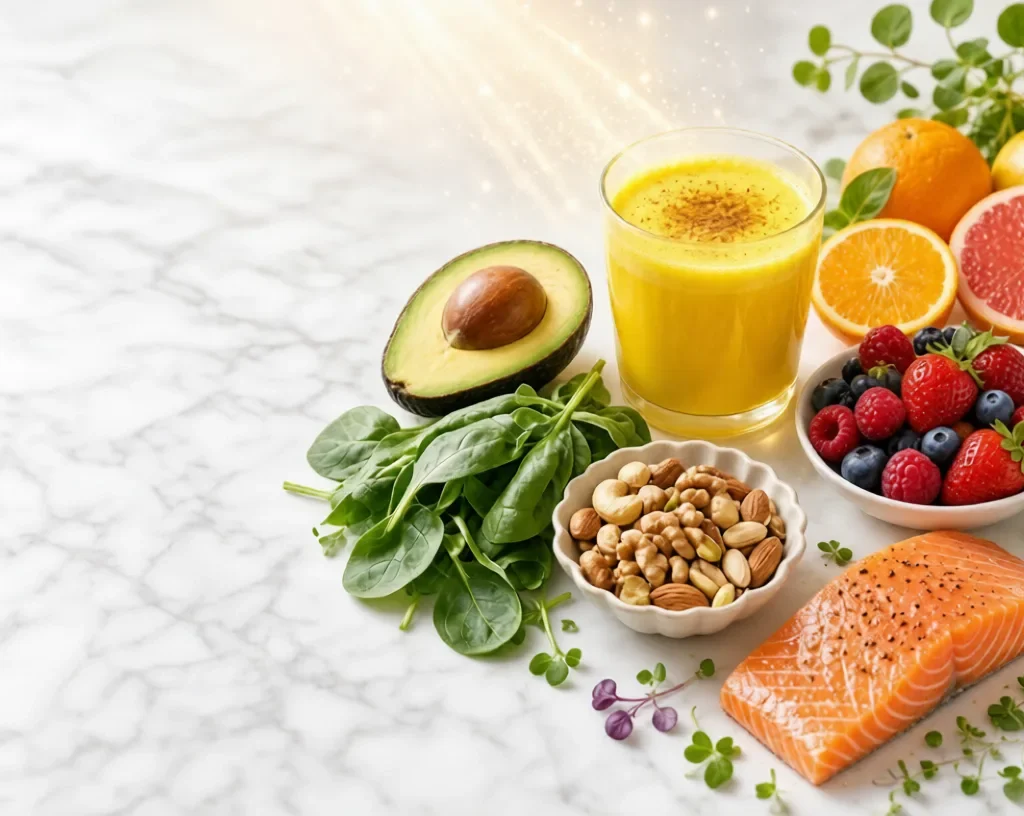
       THE GLOW FOODING NUTRITION MATRIX
┌──────────────────┬─────────────────────────────┬───────────────────────────┐
│ Nutrient Group   │ Primary Cellular Role       │ Whole Food Sources        │
├──────────────────┼─────────────────────────────┼───────────────────────────┤
│ Essential Fats   │ Lipid barrier integrity     │ Walnuts, chia, wild salmon│
│ Vitamin C        │ Collagen synthesis engine   │ Bell peppers, kiwi, citrus│
│ Quality Protein  │ Structural amino acids      │ Eggs, lentils, tofu, fish │
│ Vitamin E        │ Lipid-soluble antioxidant   │ Almonds, sunflower seeds  │
│ Trace Zinc       │ Tissue repair & renewal     │ Pumpkin seeds, chickpeas  │
│ Vitamin A (Beta) │ Normal cell differentiation │ Carrots, spinach, sweet p.│
│ Water & Fluids   │ Cellular volume & transport │ Filtered water, cucumbers │
└──────────────────┴─────────────────────────────┴───────────────────────────┘
1. Essential Omega-3 Fatty Acids
Your skin cells are encased in a protective lipid bilayer. When this membrane stays supple and intact, it locks in moisture and keeps irritants out. Omega-3 fatty acids help maintain this crucial barrier. Incorporating wild-caught fish, chia seeds, flaxseeds, and walnuts provides the parent lipids needed to soothe skin reactivity and prevent systemic dryness.
2. Vitamin C
Vitamin C is an indispensable cofactor for two enzymes: prolyl hydroxylase and lysyl hydroxylase. Without these enzymes, your body cannot cross-link collagen fibres to give skin structural firmness. Because the human body cannot manufacture or store vitamin C, you need fresh sources daily, such as bell peppers, strawberries, broccoli, and citrus fruits.
3. Complete and Balanced Protein
Collagen, elastin, and keratin are structural proteins. Your digestive system breaks dietary protein down into peptides and amino acids, which fibroblasts use to build new tissue. Relying on pasture-raised eggs, lentils, edamame, and poultry guarantees your body never runs short of building blocks for daily tissue repair.
4. Vitamin E
Working in tandem with vitamin C, vitamin E acts as your primary fat-soluble antioxidant. It positions itself directly inside cell membranes, absorbing free-radical attacks caused by sunlight and air pollution. Sunflower seeds, almonds, avocados, and cold-pressed olive oil are fantastic whole-food sources.
5. Zinc
Zinc is a microscopic workhorse. This trace mineral supports more than 300 enzymatic reactions in the human body, playing a documented role in DNA synthesis, cellular turnover, and wound healing. A shortfall in zinc frequently shows up as stubborn breakouts, flaky patches, or delayed healing. Look to pumpkin seeds, hemp hearts, lentils, and shellfish to maintain healthy levels.
6. Carotenoids (Provitamin A)
Beta-carotene, lutein, and lycopene belong to a family of plant pigments that deposit naturally in the skin’s dermal and epidermal layers. Research collated by the Harvard T.H. Chan School of Public Health highlights how vibrant plant foods support cellular defence against environmental stress. Carrots, sweet potatoes, tomatoes, and dark leafy greens act like a mild internal cushion against oxidative damage.
7. Bioavailable Water and Electrolytes
A dehydrated skin cell shrinks, accentuating fine surface creases and slowing down metabolic waste removal. Drinking plain water is essential, but eating fluid-dense plants, such as cucumbers, celery, and melons, delivers water bound with trace minerals, helping your cells retain internal hydration efficiently.
The Colourful Plate Advantage: Phyto-Shielding
Why do clinical dietitians constantly advise us to “eat the rainbow”?
Every distinct hue in a vegetable or fruit signals the presence of a specific plant compound:
- Deep blues and purples in blueberries and blackberries signal anthocyanins, which protect blood vessels that deliver fresh nutrients to facial capillaries.
- Bright reds in cooked tomatoes and watermelon signify lycopene, an antioxidant studied for its ability to temper photocarcinogenesis and oxidative degradation.
- Earthy greens like kale and arugula provide chlorophyll, lutein, and folate, supporting normal DNA replication during cell division.
When you assemble a plate bursting with contrasting colours, you create an internal shield. These compounds neutralise everyday oxidative stress before it degrades delicate structural proteins.
For practical meal ideas that balance colour, macronutrients, and simple prep, explore our guide to easy anti-inflammatory lunches on kritiinfo.com.
Hydration: The Most Misunderstood Skin Habit
Drink two litres of water, and your skin will magically transform overnight, right? Not quite.
Hydration is vital, but the relationship is nuanced. Drinking water does not act like an internal hose that shoots moisture directly into dry cheeks. If your skin’s protective lipid barrier is damaged from harsh astringents, stripping cleansers, or an ultra-low-fat diet, water simply evaporates through the skin via trans-epidermal water loss (TEWL).
Real cellular hydration requires two factors:
- Adequate fluid intake: Consistent sips of water, herbal teas, and mineral broths across your day.
- Lipid retention: Sufficient dietary healthy fats to preserve the protective cellular mortar that locks that moisture inside.
Hydration without healthy fats is a leaky bucket. Balanced Glow Fooding habits tackle both sides of the equation.
Glow Fooding vs Common Beauty Food Myths
The wellness world is saturated with dramatic promises. Let us separate verifiable science from clever marketing folklore.
MYTH: "Drinking pure bone broth erases fine lines in two weeks."
REALITY: Your gut breaks all dietary collagen down into basic amino acids. It distributes them based on systemic need, not cosmetic preference. Consistent, diverse protein intake delivers the exact same building blocks.

MYTH: "Cutting out all dietary fats clears up stubborn acne."
REALITY: Severely restricting healthy fats deprives cell membranes of linoleic acid, which can disrupt the skin barrier, leading to irritation and compensatory sebum production.

MYTH: "Superfood green powders replace a balanced whole-food plate."
REALITY: Isolated powders lack the intact fibre matrix, moisture, and synergistic trace compounds naturally present in whole, fresh vegetables.
Healthy skin is never produced by a singular “miracle food.” It is the natural byproduct of overall metabolic health, balanced blood sugar, and steady nutritional nourishment.
A Realistic One-Day Glow Fooding Plate
You do not need a culinary degree or an unlimited grocery budget to eat for healthy skin. Here is how a balanced, nutrient-rich day looks in practice:
Morning
- Two pasture-raised eggs scrambled with a handful of fresh baby spinach and chopped tomatoes.
- One slice of sourdough or whole-grain toast brushed with cold-pressed olive oil.
- A warm cup of green tea or water with a slice of fresh lemon.
Midday
- A hearty quinoa bowl topped with spiced chickpeas, diced cucumbers, shredded carrots, and pumpkin seeds.
- A light dressing made from tahini, lemon juice, garlic, and water.
Afternoon Reset
- A small handful of raw walnuts alongside a cup of fresh blueberries or a sliced kiwi.
Evening
- Baked wild salmon (or pan-seared firm tofu) served alongside roasted sweet potato wedges and steamed broccoli florets drizzled with sesame oil.
- Plenty of water throughout the afternoon, tapering off before bed to ensure deep, uninterrupted rest.
If you struggle with afternoon energy slumps or irregular schedules, pair these meal ideas with our practical breakdown on managing daily lifestyle stress on kritiinfo.com.
Case Study: From Product Confusion to Nourishing Simplicity
Note: The following scenario is a hypothetical educational example illustrating common lifestyle patterns.
Meet Ananya, a 31-year-old software designer working long, irregular hours.
For nearly two years, Ananya struggled with recurring dullness, dry cheek patches, and sudden forehead flare-ups. Her bathroom shelves held over twelve targeted skincare formulas. She tracked ingredients meticulously: niacinamide, glycolic acids, retinol, and peptide complexes.
Yet her skin remained unpredictable. Every minor breakout sparked worry and prompted her to buy another targeted cream.
When Ananya took a closer look at her daily routine, she noticed a clear pattern:
- She skipped breakfast four days a week, relying on sweet lattes to start the morning.
- Lunches were hurried desk meals, usually consisting of ultra-processed sandwiches or instant noodles.
- She drank less than three glasses of plain water daily, confusing dehydration fatigue with low caffeine.
Ananya decided to test an experiment for eight weeks. Instead of adding new cosmetic products, she simplified her topical routine to three essentials: a mild cleanser, a basic moisturiser, and daily sunscreen.
She redirected her attention toward balanced Glow Fooding choices:
- She added two eggs or a bowl of spiced sprouted lentils to her morning routine.
- She kept a jar of raw pumpkin seeds and walnuts at her desk for afternoon snacks.
- She swapped one sweet coffee for a litre water bottle infused with cucumber and citrus.
- She committed to adding two different coloured vegetables to every dinner plate.
The initial two weeks felt ordinary. There was no overnight revelation. But by week six, Ananya noticed subtle, genuine changes. The chronic tight sensation along her cheeks disappeared. Her skin tolerated dry office air without flaking. Small blemishes healed without leaving stubborn, prolonged dark marks.
Ananya did not “cure” her skin with a miracle cure. By replacing nutritional chaos with steady, reliable building blocks, she simply gave her body what it had been lacking for years.
What the Medical Evidence Actually Shows
Dermatological and nutritional research has matured dramatically over the past two decades.
A comprehensive review published in the journal Dermato-Endocrinology points out that structural skin aging and environmental vulnerability are heavily mediated by systemic nutrition. Clinical studies consistently find that diets rich in antioxidants, healthy mono- and polyunsaturated fatty acids, and clean protein sources correlate with:
- Enhanced skin elasticity.
- Lower rates of trans-epidermal water loss.
- Improved microvascular circulation in the dermis.
Conversely, research consistently warns against excessive consumption of high-glycemic-index foods and refined sugars. Rapid spikes in blood glucose promote glycation, a process where excess sugar molecules bond to collagen and elastin fibres.
This reaction produces Advanced Glycation End-products (aptly abbreviated as AGEs). Over time, AGEs make structural proteins stiff, brittle, and prone to premature breakdown.
Choosing whole grains, legumes, and fibre-rich produce maintains steady glucose curves, protecting your existing collagen architecture from avoidable micro-damage.
5 Daily Habits That Quietly Sabotage Skin Health
Even the best skin nourishing foods struggle to work effectively if other lifestyle habits continuously drain your system. Keep an eye out for these five common mistakes:
- Relying on High-Sugar Convenience SnacksFrequent spikes in insulin elevate systemic inflammation and trigger androgen pathways, which can increase sebum stickiness and encourage clogged pores.
- Fear of Healthy Dietary FatsAdopting an ultra-lean, fat-free regimen deprives your body of building materials for cellular membranes and impedes the absorption of fat-soluble vitamins (A, D, and E).
- Inconsistent Sleep RoutinesYour skin performs the bulk of its cellular repair and collagen rebuilding while you sleep. Chronic sleep deprivation increases cortisol, which actively degrades structural proteins.
- Over-Exfoliating While Under-NourishingAggressively scrubbing away surface skin cells while starving deeper layers of key amino acids leaves your skin thin, reactive, and exposed.
- Ignoring Chronic Low-Grade StressSustained mental strain releases inflammatory neuro-peptides that impair your skin’s natural barrier recovery. For helpful coping strategies, read our overview on practical nervous system resets on kritiinfo.com.
How to Build a Sustainable Skin Nourishing Habit
You do not need to overhaul your entire kitchen by tomorrow morning. Radical diets trigger stress, and stress runs counter to healthy skin.
Instead, build your Glow Fooding routine using small, cumulative upgrades:
- This week: Add one colourful vegetable to your regular dinner. A roasted red pepper, a cup of sautéed spinach, or sliced carrots are simple, reliable additions.
- Next week: Swap a processed midday snack for raw nuts and fresh fruit. A handful of walnuts and an orange delivers instant vitamin E, healthy fats, and vitamin C.
- The following week: Focus on consistent hydration. Keep a full glass of water beside your workspace and finish it before reaching for a second cup of coffee.
Healthy skin is a marathon, not an overnight sprint. Celebrate small, steady improvements in your energy, digestion, and resilience. Over time, your skin will reflect that quiet, consistent care.
Frequently Asked Questions
What is Glow Fooding?
Glow Fooding is an intentional approach to daily eating that prioritises whole, nutrient-dense foods known to support skin health, tissue repair, and barrier function. It emphasizes essential fatty acids, complete proteins, vitamins C and E, zinc, and consistent hydration over beauty fads and restrictive meal plans.
How quickly can Glow Fooding habits improve my skin?
The human skin turnover cycle takes roughly 28 to 40 days in adults, and lengthens as we grow older. While adequate hydration can relieve surface dryness within a few days, meaningful improvements in texture, tone, and skin barrier resilience generally take four to eight weeks of sustained dietary balance.
Can food cure medical conditions like eczema or severe acne?
No. Food is a foundational support system, not an instant medical cure. While balanced nutrition and lower dietary sugar can help manage underlying inflammation, chronic skin conditions such as severe cystic acne, psoriasis, and eczema require clinical diagnosis and comprehensive care from a board-certified dermatologist.
Do I need to buy expensive collagen powders for skin health?
No. Collagen powders are broken down into basic amino acids during digestion, just like proteins from eggs, tofu, lentils, or fish. Consuming balanced, diverse whole proteins alongside sufficient vitamin C gives your body every tool it requires to synthesise its own collagen naturally.
Is drinking extra water enough to fix dry skin?
Not on its own. While adequate fluid intake prevents cellular dehydration, dry skin is often caused by an impaired external lipid barrier. Without sufficient dietary fats (such as omega-3s and monounsaturated oils) to hold water inside your cells, fluid evaporates quickly through the skin surface.
Which single food is best for skin health?
No individual food holds a monopoly on healthy skin. A balanced mix of omega-3 rich seeds or fish, antioxidant-dense berries, colourful root vegetables, and quality proteins will always outperform any single “superfood.”
A Healthier Perspective on Your Glow
It is easy to feel frustrated when a new, beautifully packaged serum fails to deliver the radiant results promised on the label.
The next time you catch yourself scrutinising your reflection, take a breath. Step away from the magnifying mirror. Remind yourself that your skin is not an artificial surface to be endlessly stripped, polished, and perfected. It is a living, breathing protective organ that works around the clock to keep you safe and well.
No single food, pill, or miracle extract creates lasting skin vitality.
True skin health is quietly assembled over time: supported by whole foods, sustained by genuine hydration, anchored by restorative sleep, and guided by realistic, patient expectations.
Take a look at your next plate. Ask yourself what simple, nourishing upgrade you can make today. Then sit back, enjoy your meal, and let your body do the rest.