
You unlock your smartphone dozens of times each day. The screen brightens, notifications cascade down, and banking, messaging, and navigation tools snap into place instantly. Everything feels effortless, intuitive, and deeply personal.
Yet an uncomfortable question quietly lingers beneath that smooth glass: who really controls the software running inside your device?
For billions of people worldwide, the answer is clear. Google provides the digital foundation that dictates which apps install, what personal data travels across background servers, and how the underlying operating system behaves. In an era where a handset holds financial keys, personal memories, and private conversations, reliance on a single foreign tech ecosystem sparks genuine concern.
That friction set the stage for an intriguing technological development: BharOS.
Billed as an indigenous mobile operating system from India, BharOS sparked widespread curiosity and intense debate upon its unveiling. Can an emerging, privacy-oriented platform challenge a global powerhouse?
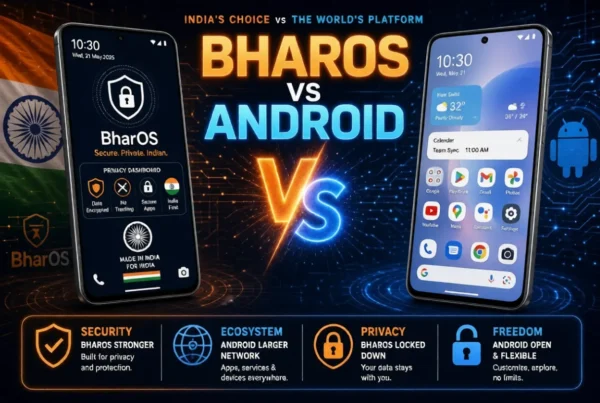
To understand the stakes, we must explore the reality behind BharOS V/S Android, separating documented facts from digital folklore.
Table of Contents Of BharOS V/S Android
1. The Smartphone Battle Nobody Sees
Behind sleek hardware designs and multi-camera arrays sits an invisible contest over digital sovereignty, data telemetry, and system control.
When you purchase a standard commercial smartphone, the hardware manufacturer rarely controls the core software architecture. Google licenses its proprietary Android ecosystem, bundling Google Mobile Services (GMS) directly into daily routines. From location tracking to push notification gateways, everyday convenience relies heavily on automated background synchronization.
This dynamic creates an acute vulnerability. If an operating system controls data flows at the root level, whoever controls the operating system holds unprecedented influence over user privacy and national security. The underlying rivalry between dominant platforms and emerging alternatives is not merely about app icons or battery performance. It represents a fundamental struggle over who sets the rules for modern communication.
2. What Is BharOS?
BharOS is a specialized, privacy focused mobile operating system developed by JandK Operations Private Limited, a non-profit company incubated at the Indian Institute of Technology (IIT) Madras.
Promoted through support from the Department of Science and Technology (DST) under the National Mission on Interdisciplinary Cyber-Physical Systems (NMICPS), BharOS emerged to address domestic data security and technological self-reliance.
To evaluate BharOS objectively, one must understand its foundational architecture:
- Android Open Source Project (AOSP) Roots: BharOS is built on top of the freely available Android Open Source Project. It is not a completely foreign codebase coded from scratch, nor does it run on an entirely separate kernel architecture.
- No Default Apps (NDA): Standard phones arrive cluttered with preinstalled bloatware, tracking utilities, and commercial services. BharOS ships with zero default apps, leaving the device entirely blank out of the box.
- Private App Store Services (PASS): Rather than connecting to public marketplaces, BharOS relies on curated private directories that authenticate apps against strict corporate or institutional security standards.
- Target Audience: The primary purpose of BharOS remains focused on government agencies, defense bodies, and sensitive enterprise organizations requiring private cloud connections rather than retail consumers.
3. What Is Android?
Android, created originally by Android Inc. and acquired by Google in 2005, powers over 70% of the worldwide smartphone market.
Android operates on a unique dual-layer model:
- AOSP (The Base Layer): The open source technology core that anyone can view, download, modify, and build upon for free.
- Google Mobile Services (The Proprietary Layer): The commercial engine containing the Google Play Store, Google Play Services APIs, Maps, Gmail, YouTube, and cloud synchronization tools.
While AOSP offers flexibility, commercial Android smartphones thrive because of Google’s proprietary layer. Millions of software developers rely on Google APIs for in-app billing, maps integration, anti-cheat detection, and push notifications. As a result, commercial Android is not merely software; it is a mature, massive, and interdependent global ecosystem.
4. 7 Key Differences in the BharOS V/S Android Comparison
Examining BharOS V/S Android requires assessing day-to-day usability, privacy protections, and overall infrastructure.
Here are the seven primary practical differences:
1. Architectural Philosophy and Base Packages
Commercial Android pairs AOSP with dozens of preinstalled Google apps and hardware-maker utilities. BharOS relies on a stripped-down AOSP base configured strictly with No Default Apps (NDA). Users must explicitly authorize and configure every single utility they wish to run.
2. Google Mobile Services (GMS) vs. De-Googled Freedom
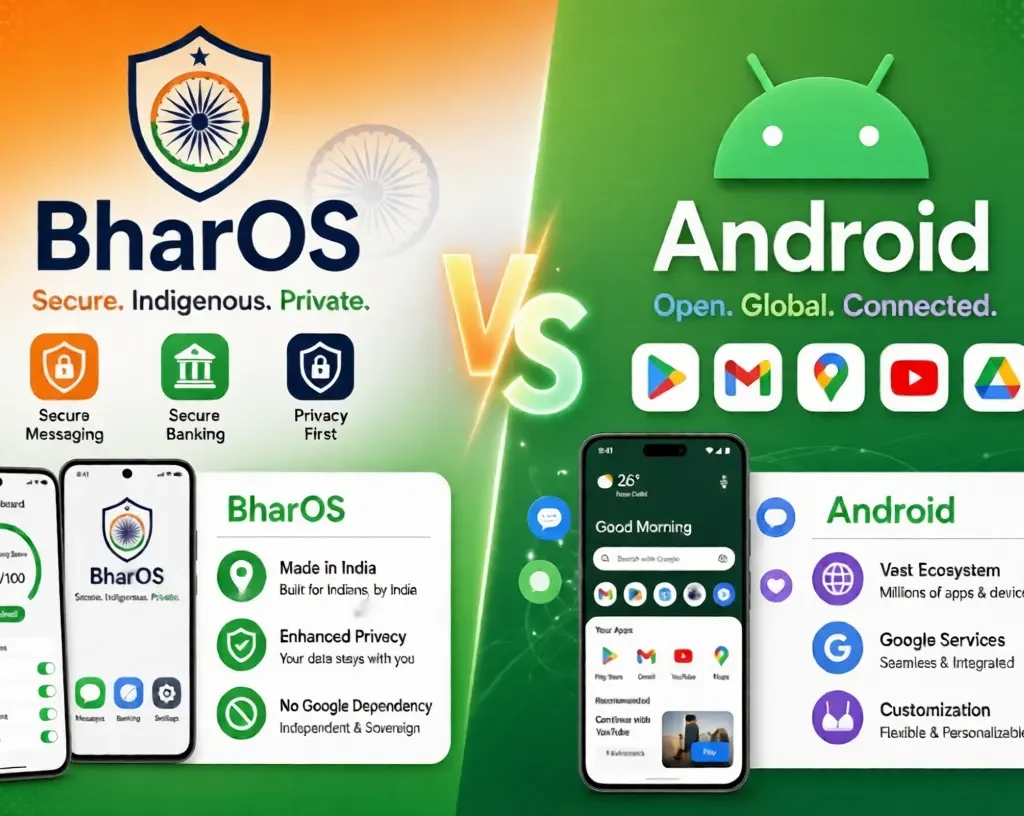
Commercial Android functions around Google Play Services. BharOS eliminates GMS entirely to reduce external data transmission. This choice enhances privacy but disrupts regular applications that rely on Google APIs for notifications, login tokens, or background location fixes.
3. App Distribution Ecosystems
Android users enjoy access to millions of titles through the Google Play Store. BharOS utilizes Private App Store Services (PASS). In a PASS environment, an enterprise organization or administrative authority audits, approves, and serves whitelisted apps, blocking unregulated commercial installations.
4. Privacy and Telemetry Architecture
Because Android links deeply with user profiles, telemetry data continuously flows to cloud servers to optimize personalization and advertising. BharOS blocks this automated telemetry by default, granting users strict, granular control over sensor permissions, storage, and network access.
5. Update Mechanisms (NOTA vs. Carrier Deployments)
Android updates travel through a complex chain: Google releases source code, silicon vendors patch drivers, phone manufacturers overlay custom skins, and telecom carriers approve deployment. BharOS features Native Over The Air (NOTA) updates, pushing verified security patches directly to managed devices without carrier or vendor delays.
6. Hardware Compatibility and Device Availability
Android runs on thousands of commercial smartphone models produced by global manufacturers. In contrast, BharOS has been demonstrated on selected hardware testbeds (such as Google Pixel devices) and remains unavailable as a commercial retail release for everyday consumer handsets.
7. User Experience and Convenience
Android prioritizes effortless, friction-free operation: sign into an account, and your contacts, calendars, photos, and payment methods instantly align. BharOS prioritizes defensive security: setup demands manual intention, administrative onboarding, and patience.
| Feature Dimension | BharOS | Commercial Android |
| Core Foundation | AOSP (De-Googled) | AOSP + Google Mobile Services (GMS) |
| Preinstalled Apps | None (Zero Bloatware) | Extensive (Google suite + OEM apps) |
| App Delivery | Private App Store Services (PASS) | Google Play Store + Third-party stores |
| Primary Telemetry | Restricted / Enterprise-managed | Synced with Google Account infrastructure |
| Update Delivery | Native Over The Air (NOTA) direct | OEM and Carrier-dependent schedules |
| Target Audience | Enterprise, Defense, and Government | General Public and Global Consumers |
| Consumer Availability | Restricted / Non-commercial | Universally available on retail hardware |
5. The App Problem: Why Software Ecosystems Matter
Building an operating system is a manageable engineering challenge; building a vibrant app ecosystem is an immense economic hurdle.
Consider what transpires behind the scenes of an average mobile application. A food delivery app does not merely display food pictures; it queries Google Maps for routing, uses Firebase for push notifications, and calls safety APIs to verify that the device operating system has not been compromised.
When an operating system removes Google Play Services:
- Notification Breakdowns: Messaging and logistics apps relying on Google cloud messaging may fail to alert users unless rewritten with custom background sockets.
- Banking and DRM Hurdles: Mobile banking applications depend heavily on integrity attestation systems (such as Play Integrity API). Without explicit certification, financial software often refuses to boot on modified or custom operating systems.
- Developer Resistance: App developers maintain software where audiences exist. Recompiling, testing, and distributing specialized APKs across isolated private app stores requires developer resources that companies only commit when forced by regulatory mandates or immense market scale.
Operating systems live and die by their network effects. Without seamless application support, even the most secure mobile software ecosystem faces uphill adoption challenges.
6. Privacy and Digital Independence
Why are governments and institutions pouring research funding into projects like BharOS?
The motivation centers on two pillars: institutional data protection and strategic technology independence.
When government officials, infrastructure engineers, or military personnel use commercial smartphones, routine background telemetry poses potential operational risks. Metadata regarding physical movements, network connections, and communication timing can theoretically be intercepted or analyzed abroad. BharOS provides an environment where confidential communications remain isolated from commercial surveillance pipelines.
Digital sovereignty also guards against sudden geopolitical disruption. If access to dominant global operating system services were ever restricted due to trade embargoes or diplomatic conflicts, having an indigenous mobile operating system foundation ensures that critical state communication systems can continue operating without foreign intervention.
7. Case Study: BharOS V/S Android
To visualize how these platform choices function in real life, consider this hypothetical scenario examining three users with distinct digital priorities.
- User A (The University Student):A student needs instant access to social networks, video streaming, university portals, campus food ordering, and ride-hailing apps. For this user, commercial Android is indispensable. The convenience of one-tap Google logins, automatic cloud photo backups, and universal app compatibility outweighs abstract privacy concerns.
- User B (The Privacy Advocate):A tech-savvy enthusiast wants zero tracking, transparent open source technology, and control over hardware sensors. This user avoids Big Tech data mining, prefers sideloading verified software via F-Droid, and embraces de-Googled Android alternatives. For them, the principles behind BharOS are commendable, though they might prefer existing open-source distributions like GrapheneOS that run independently on unlocked consumer phones.
- User C (The Defense Logistics Officer):An officer oversees sensitive transit routes and operational infrastructure. In this environment, consumer convenience is a liability. The priority is verified system integrity, private network routing, and strictly controlled software installation via audited organization directories. Here, BharOS proves exceptionally suited, delivering a hardened, bloatware-free environment tailored to secure internal communications.
8. The Bigger Technology Story Of BharOS V/S Android
The BharOS V/S Android conversation is not an isolated event. It forms part of a worldwide movement toward technological multipolarity.
Across Europe, China, and emerging digital economies, policymakers recognize that relying on a mobile software duopoly (Google Android and Apple iOS) carries profound systemic risk. Regulatory bodies, such as the Competition Commission of India (CCI), have actively investigated bundled licensing agreements that favor proprietary Google services over competitive alternatives.
At the same time, developing independent platforms requires immense transparency. When projects claim indigenous origins, technical communities carefully inspect the source code to determine whether the work represents an original software stack or an AOSP distribution. Transparent collaboration and open source development remain essential for building trust across the broader developer ecosystem.
9. What Could Happen (BharOS V/S Android)Next?
Can BharOS ever become a mainstream consumer operating system capable of replacing Android in everyday electronics stores?
Realistically, that outcome remains improbable in the near term. For BharOS to expand beyond institutional and enterprise deployments into consumer hands, several massive milestones must occur:
- Hardware Partnerships: Original equipment manufacturers (OEMs) must agree to produce, warrant, and distribute retail devices preloaded with the software.
- Robust API Frameworks: JandK Operations or developer consortia must build robust, open-source micro-libraries that replicate mapping, notification, and authentication features without Google.
- Consumer App Store Alliances: Indian tech giants, banking institutions, and utility providers must actively maintain their applications on secure domestic marketplaces.
Meanwhile, commercial Android continues to evolve, steadily incorporating finer privacy dashboards, on-device AI processing, and sandboxed storage permissions. The presence of emerging alternatives encourages dominant tech giants to treat user data responsibly and remain mindful of fair market competition.
10. Frequently Asked Questions
What is BharOS?
BharOS is an Indian mobile operating system incubated at IIT Madras by JandK Operations Private Limited. It is built without default apps or Google services, focusing heavily on enterprise privacy and institutional security.
Is BharOS Android?
Under the hood, yes. BharOS is built on the Android Open Source Project (AOSP). It utilizes Android’s underlying Linux-based core while stripping away proprietary Google Mobile Services.
What is the main difference between BharOS and Android?
Commercial Android includes Google Play Services, preinstalled consumer applications, and cloud data synchronization. BharOS features No Default Apps (NDA), avoids Google tracking by default, and distributes approved software through Private App Store Services (PASS).
Can BharOS run Android apps?
Yes. Because it uses the AOSP framework, BharOS can execute APK files compiled for Android. However, applications that strictly depend on Google Play Services (such as specific mobile banking systems or Google Maps integration) may experience errors.
Is BharOS made in India?
Yes, the customization, integration, and security architecture were designed in India by JandK Operations at IIT Madras under national cyber-physical research initiatives. However, its base foundation originates from the global AOSP codebase.
Which smartphones support BharOS?
BharOS is not currently available as a commercial consumer download for the general public. It has primarily been tested and flashed onto select hardware models (such as Google Pixel devices) for government trials and enterprise pilot programs.
Is BharOS more private than commercial Android?
In terms of telemetry and preinstalled trackers, yes. Because it does not run automated background Google services or commercial bloatware, device data remains confined locally or within approved enterprise networks.
Can BharOS replace Android on everyday phones?
Not for average consumers right now. Without the Google Play Store, developer-wide API support, and retail hardware partnerships, BharOS cannot replicate the everyday convenience that mainstream smartphone owners demand.
The comparison between BharOS and Android touches upon an issue far broader than operating system code. It reflects a growing global reckoning with ecosystem monopolies, user privacy, and technical autonomy. When the smartphone becomes the gateway to almost everything we do, how much should we care about the software controlling that gateway?