
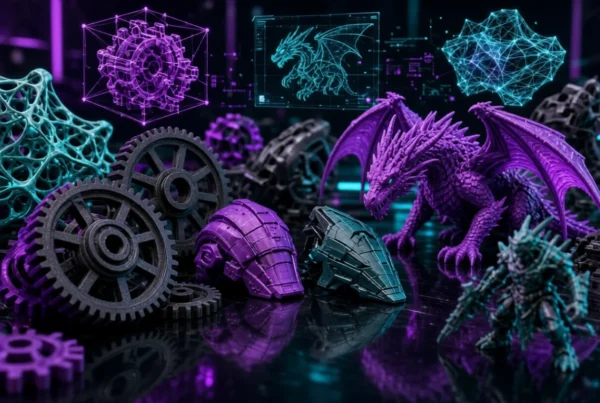
Picture a screen with nothing on it but lines and curves, a digital sketch of something that does not exist yet. Somewhere nearby, a machine hums to life. A nozzle begins to move in tight, patient paths. A laser flicks across a bed of fine powder. Nothing dramatic happens in the first minute. Or the tenth.
Then, slowly, a shape starts to rise off the build plate. Layer sits on layer. An hour passes. Then several more. And what began as pixels on a monitor is now an object you can hold, turn over in your hand and use.
That transformation, digital file to physical thing, without a single cut, drill or mould, is what engineers call additive manufacturing. Most people simply call it 3D printing.
Table of Contents
The Moment a Digital Design Becomes Real
For most of industrial history, making something meant starting with more material than you needed and removing the excess. A block of metal became a gear once a machinist had cut, drilled and ground away everything that was not the gear. That is subtractive manufacturing, and it still runs most of the factories on Earth.
3D printing flips that logic. Instead of removing material, it adds it, one thin layer at a time, building only where the design says something should exist. There is no waste block sitting in a corner. There is no mould that has to be built first and thrown away later. The object grows directly from the file.
This single shift, subtraction versus addition, is why 3D printing has moved from hobbyist curiosity to a serious manufacturing tool used by aerospace giants, hospitals and car makers.
What Is 3D Printing?
At its simplest, 3D printing is a process that builds a physical object from a digital 3D model by depositing or fusing material layer by layer until the full shape exists.
Think of it the way you might think of a loaf of bread rising in thin, stacked rings inside a mould, except here, the machine is both the mould and the hand shaping each ring, and it follows a digital blueprint down to fractions of a millimetre.
The basic workflow looks like this:
Digital model → slicing → material deposition → layer formation → finished object.
A designer or engineer creates a 3D model, usually in CAD software. That file is then run through slicing software, which mathematically cuts the model into hundreds or thousands of thin horizontal layers and generates the exact path the printer’s nozzle, laser or beam needs to follow for each one.
How Does 3D Printing Actually Work?
Strip away the jargon and the process breaks down into a handful of understandable stages.
Digital design. Everything starts with a 3D model, either designed from scratch or created by scanning an existing object.
File format. That model is usually exported as an STL file, a format built specifically to describe the surface geometry of a 3D shape so a printer can understand it. Newer formats like 3MF are gaining ground because they can also carry colour, material and structural information that STL cannot.
Slicing. Software divides the model into layers, often as thin as 0.1 millimetre, and calculates the print head’s movement path, speed and support structures for each one.
Printing. Depending on the technology, this might mean a thermoplastic filament being melted and extruded through a nozzle, a laser fusing metal powder particle by particle, or ultraviolet light curing a liquid resin. This is the part people usually picture when they hear “3D printing,” but it is really the shortest conceptual step in a longer chain.
Post processing. Very few printed parts come off the machine ready to use. Support structures are removed, surfaces are sanded or chemically smoothed, and metal parts are often heat treated to relieve internal stress.
Quality inspection. In industries like aerospace and healthcare, printed parts go through CT scanning, dimensional checks and material testing before they are cleared for use, because a hidden void inside a printed bracket can behave very differently under stress than the same part cast or forged the traditional way.
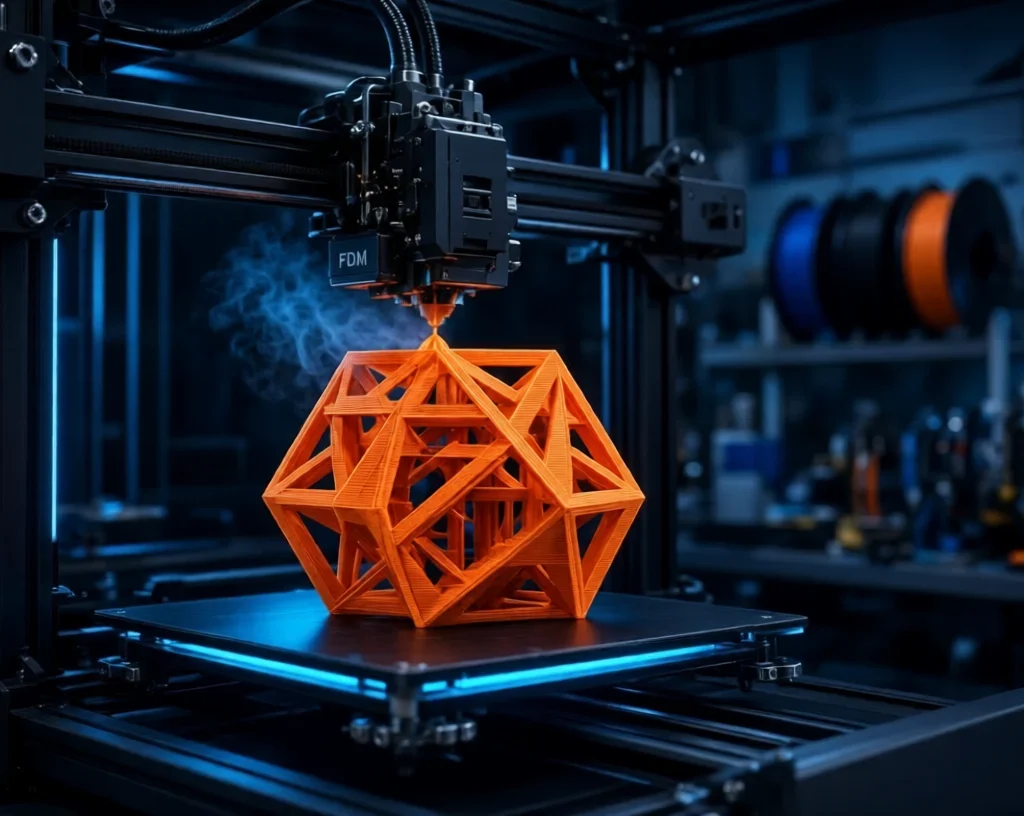
7 Powerful Ways 3D Printing Is Changing Industry
1. Rapid prototyping. Before 3D printing became affordable, a single design revision could mean weeks of waiting for a new tool or mould. Now a designer can print a physical prototype overnight, hold it, test it and print a revised version the next day. This has genuinely compressed product development cycles across consumer goods, electronics and industrial design.
2. Healthcare and medical models. Surgeons increasingly use 3D printed replicas of a patient’s own anatomy, built from their CT or MRI scans, to plan complex operations before ever making an incision. Hospitals and research institutions such as the Mayo Clinic have documented using patient specific printed models for pre surgical planning in complex cardiac and craniofacial cases.
3. Aerospace components. This is where 3D printing has proven itself under the harshest possible scrutiny, and the fuel nozzle case study below explains exactly why.
4. Automotive development. Car makers use 3D printing extensively for tooling, jigs, fixtures and prototype parts, letting engineering teams test fit and function long before a design commits to expensive production tooling.
5. Customized products. From dental aligners built from a scan of an individual patient’s teeth to hearing aid shells shaped to a single ear canal, 3D printing makes mass customization economically realistic in a way traditional moulding never could.
6. Construction experimentation. Companies including ICON in the United States have used large scale concrete 3D printers to build actual habitable homes, printing wall structures in a fraction of the time conventional framing and masonry would take, though the technology remains a small slice of overall construction today.
7. Education and research. Universities and research labs use 3D printing to let students physically test engineering concepts and to rapidly build custom lab equipment, extending research budgets that would otherwise be consumed by outsourced fabrication.
The Materials Behind the Magic
The word “printing” undersells how much material science sits behind this technology.
Plastics, particularly PLA, ABS and nylon, dominate consumer and prototyping applications because they are cheap, easy to print and forgiving of small errors.
Resins, cured layer by layer with ultraviolet light, produce far finer detail and smoother surfaces, which is why dental and jewellery applications rely heavily on them.
Metals, including titanium, cobalt chrome and aluminium alloys, are fused using high powered lasers or electron beams, and are the material of choice wherever strength to weight ratio genuinely matters, aerospace being the clearest example.
Ceramics offer heat resistance that plastics and even many metals cannot match, useful for specialised industrial and medical applications.
Composite materials, often plastics reinforced with carbon fibre, split the difference, offering strength closer to metal at a fraction of the weight.
Material choice is not a cosmetic decision. It determines whether a printed part can survive engine heat, flex without cracking, or simply hold its shape on a shelf for ten years.
A Real World Case Study: The LEAP Engine Fuel Nozzle
For a technology often accused of being more novelty than necessity, GE Aviation’s fuel nozzle tells a different story.
The problem. The fuel nozzle tip inside the LEAP jet engine, used on some of the world’s most widely flown commercial aircraft, traditionally required around twenty separate small components, cast individually and then welded and brazed together by hand. Every joint was a potential point of failure under extreme heat and vibration.
The 3D printing approach. GE Aviation redesigned the nozzle as a single, continuous shape optimised for additive manufacturing rather than simply copying the old design. Engineers could route internal fuel channels in complex curved paths that a casting mould could never have produced.
The process. The redesigned part is grown from fine metal powder, fused layer by layer with a laser inside GE’s production facility in Auburn, Alabama, which opened in 2015 as one of the industry’s first sites built specifically for mass producing additive parts.
The result. The part count dropped from roughly twenty pieces to one. The nozzle became about 25 percent lighter and, according to GE, roughly five times more durable than its predecessor. By 2018, the Auburn facility had produced its 30,000th printed nozzle tip, running more than 40 printers in continuous production, evidence that additive manufacturing could scale well beyond a lab demonstration.
The lesson. 3D printing delivered its biggest win here not by copying an existing part faster, but by allowing engineers to design something that traditional manufacturing physically could not have made in the first place.
What Makes 3D Printing So Powerful?
The genuine strengths are worth stating plainly, without overselling them.
It compresses design iteration time dramatically. It allows geometries, internal lattices, curved channels, organic shapes, that subtractive machining simply cannot cut. It makes small batch and highly customised production economically viable. In suitable applications, it reduces material waste because material is placed only where needed. It opens the door to more localised, on demand production, as NASA demonstrated when astronauts aboard the International Space Station printed a replacement tool rather than waiting months for a resupply mission to deliver one from Earth.
None of this means 3D printing is automatically cheaper, faster or greener than conventional manufacturing in every case. For high volume, simple parts, traditional moulding and machining usually remain more economical. The honest answer is that 3D printing wins where design complexity, customisation or speed of iteration matter more than raw unit cost.
The Hidden Challenges
A responsible look at this technology has to include what it still struggles with.
Printing speed remains a real constraint for large or high volume parts, since layers can only be added so fast without compromising quality. Material options, while growing, are still narrower than the full catalogue available to traditional manufacturing. Surface finish often needs additional post processing to meet the smoothness or tolerance industrial applications demand. Equipment costs for industrial grade metal printers remain high, often keeping the technology out of reach for smaller manufacturers. Quality control is unusually demanding, since internal defects are not always visible from the outside, which is why aerospace and medical parts undergo extensive scanning. Scalability for true mass production still lags far behind injection moulding for simple, high volume components. Intellectual property protection becomes trickier when a design file itself, not a physical mould, is the thing that needs safeguarding. And running these systems well still requires genuinely skilled operators who understand both the software and the physics of how different materials behave as they cool.
The Future: Where Could 3D Printing Go Next?
Some directions are already visible today. Larger scale additive manufacturing systems are being tested for building sized concrete structures. Metal 3D printing continues to mature for aerospace, defence and medical implants. Distributed manufacturing, printing spare parts near where they are needed instead of shipping them across the world, is gaining real traction in industries like shipping and defence logistics.
Other directions remain firmly in research territory rather than commercial reality. Bioprinting, the layer by layer construction of living tissue structures, is an active area of study at research centres including the Wake Forest Institute for Regenerative Medicine, but printing functional, transplantable human organs remains a research goal, not an available treatment. AI assisted design tools that automatically optimise a part’s shape for additive manufacturing are becoming more common in engineering software, and mass customisation at genuinely low cost is edging closer as printers get faster and materials get cheaper.
It is worth being precise about that line between what works today and what is still being researched. Confusing the two is how a genuinely exciting technology ends up sounding like science fiction.
What Should Readers Remember?
3D printing was never really about printing odd shaped trinkets. It represents something bigger: a shift from manufacturing being limited to what a machine could physically cut or mould, toward manufacturing being limited only by what can be designed.
That shift is already reshaping how a jet engine nozzle is built, how a surgeon rehearses a difficult operation and how an astronaut replaces a broken tool without waiting for a rocket. It has not replaced traditional manufacturing, and for a long time it will not. But it has permanently expanded what is possible.
The object that did not exist an hour ago now sits on the table. That is not magic. That is engineering, one careful layer at a time.
Frequently Asked Questions
What is 3D printing? 3D printing, also called additive manufacturing, is a process that builds a physical object by adding material layer by layer based on a digital 3D model, rather than cutting or moulding material away from a larger block.
How does 3D printing work? A digital 3D model is sliced into thin layers by software, which then guides a printer to deposit, fuse or cure material one layer at a time until the full object is complete, followed by post processing steps like support removal and surface finishing.
What can be made with 3D printing? Applications range from prototypes, medical models and dental devices to aerospace components, automotive parts, customised consumer products and, experimentally, building structures.
Is 3D printing expensive? It depends heavily on the material and scale. Desktop plastic printers are now inexpensive, while industrial metal printing systems used in aerospace and healthcare remain a significant capital investment.
What materials are used in 3D printing? Common materials include plastics such as PLA and nylon, photopolymer resins, metals like titanium and cobalt chrome, ceramics and fibre reinforced composites, each chosen for the strength, flexibility or heat resistance a part requires.
What are the limitations of 3D printing? Key limitations include slower production speed for large volumes, a narrower material range than traditional manufacturing, surface finish that often needs extra processing, high equipment costs for industrial systems and the need for skilled operators.
Will 3D printing replace traditional manufacturing? Not entirely. For simple, high volume parts, traditional methods like injection moulding remain more economical. 3D printing tends to win where design complexity, customisation or rapid iteration matter more than unit cost.