
The departure board at Frankfurt Central Station flickered, completely scrambled by an electrical malfunction. Elena had exactly four minutes to catch her connecting train to Zurich. Surrounding passengers bumped past in sheer panic, wrestling luggage, squinting at static screens, and clamouring around two overwhelmed station attendants.
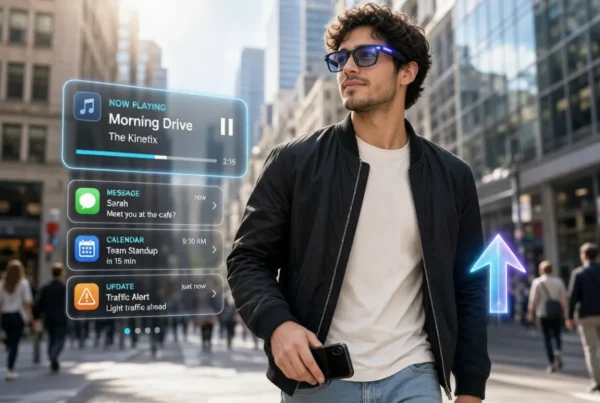
Elena did not break her stride. She touched the discreet composite frame resting quietly on the bridge of her nose.
“Find platform for ICE 73,” she whispered.
A directional arrow glowed faintly in the upper periphery of her right lens. A soft voice delivered clear audio straight into her temporal bone without blocking the ambient noise of the crowd: Platform four, track clear, boarding closes in two minutes. As a platform guard yelled rapid German instructions through a megaphone, the glasses translated his voice into English almost instantly. Elena sprinted down the stairwell, cleared the gate, and slipped through the carriage doors seconds before the pneumatic seal hissed shut.
She did not pull out a heavy glass slab. She did not scroll frantically through a messy navigation app.
The transaction with technology happened at the speed of thought. That quiet, frictionless interaction captures why smart glasses represent the most significant shift in personal computing since the smartphone.
Table of Contents
The New Technology Arrives
Every transformative technology begins with a physical shift. In the 1980s, computers occupied entire desks. By the 2000s, they fit neatly into bags. By 2010, smartphones placed the internet directly into our pockets.
Yet carrying a handheld screen introduces an unnatural physical tax. We walk through busy streets with heads tilted downward, necks craned at sixty-degree angles, ignoring the physical world in order to inspect a miniature digital rectangle.
Smart glasses change this dynamic completely. By moving computation, cameras, microphones, and displays directly to eye level, connected eyewear removes the barrier between physical space and digital information. According to wearable device research tracked by the IEEE Computer Society, ambient head-mounted interfaces allow users to retrieve critical data with less than one-third of the cognitive load required to unlock and navigate a conventional smartphone.
This is not a modest product refresh. It represents a clean break from screen-based interaction toward perceptual computing.
What Smart Glasses Really Do
Strip away the marketing buzzwords, and intelligent glasses serve one practical function: they give your senses an intelligent, ambient layer.
Modern intelligent eyewear integrates several miniature technologies into an everyday frame:
- Micro-optical projection: Tiny microLED or waveguide displays project high-contrast graphics directly onto the lens, floating information naturally across your normal field of view.
- Spatial microphone arrays: Multi-mic systems isolate your voice from wind and street noise, allowing you to whisper commands in public without shouting.
- Open-ear acoustic speakers: Miniature directional speakers direct crisp audio into your ear canal without plugging your ears, keeping you completely aware of approaching vehicles or nearby conversations.
- Ultra-compact camera sensors: Subtle outward-facing lenses capture photos, video, and visual data exactly as your eyes perceive them.
- Spatial sensors: Accelerometers and gyroscopes track head orientation, pinning digital information to specific spots in your physical room.
You can learn more about how sensory computing hardware develops across our deep dive on emerging wearable display technologies on kritiinfo.com.
Why They Feel Different
The fundamental difference between a handheld phone and augmented reality glasses comes down to attention.
When your phone vibrates, it demands a context switch. You stop your conversation, pull the device from your pocket, unlock the screen, decipher the badge, and glance away from what you were doing. Once there, notifications lure you into apps you never planned to open.
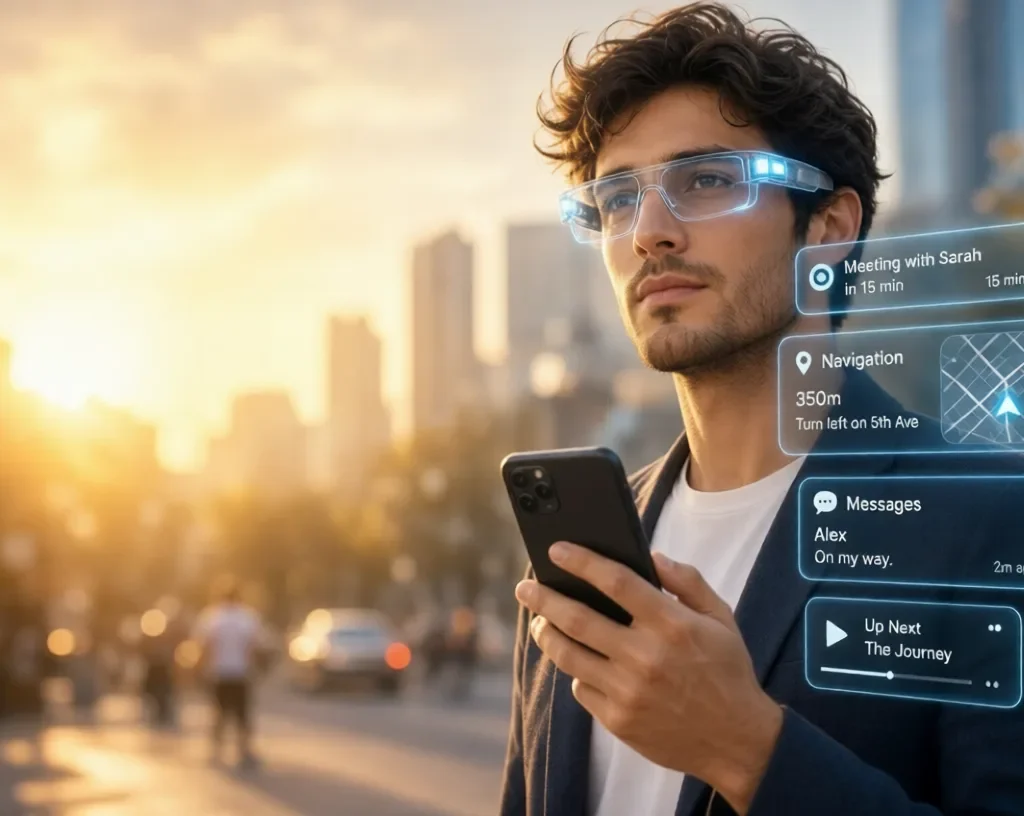
Smart glasses preserve your presence. Information appears in your line of sight only when necessary and vanishes the moment it loses relevance. If an alert arrives, you absorb it in a split second without looking down. If you need navigation, an arrow overlays your actual street lane.
The machine adapts to human context rather than forcing the human to enter the machine.
The AI Advantage
Early head-mounted displays stumbled because they were passive screens strapped to faces. They were cumbersome, computationally slow, and visually distracting.
The catalyst turning wearable displays into a mass-market reality is multimodal artificial intelligence.
Leading AI laboratories like Meta AI and foundational research institutions like the MIT Computer Science and Artificial Intelligence Laboratory (CSAIL) have created models capable of processing visual images, spoken words, and spatial signals simultaneously.
When smart glasses possess eyes and ears, the device ceases to be a display monitor. It becomes an active personal companion. You can look at an obscure engine belt while fixing your car and ask, “Is this tension correct?” The AI inspects the live video feed, measures the slack, and speaks the answer into your ear.
Language barriers collapse in the exact same manner. When you travel overseas, built-in translation models process foreign signage or spoken dialogue, relaying translated speech in seconds. You stay anchored in the moment, making eye contact with the person across the table.
Real World Applications
The practical value of intelligent glasses extends far beyond gadget enthusiasts. Useful applications are already solving concrete problems across everyday life:
Hands-Free Navigation and Mobility
Walking or cycling through an unfamiliar metropolis normally requires juggling a handset and glancing away from traffic. Smart glasses project subtle turn-by-turn prompts directly over the roadway, significantly improving commuter safety.
Accessibility for the Visually Impaired
Wearable displays equipped with computer vision are life-changing tools for people with low vision. Non-profit initiatives and research groups frequently partner with institutions like the National Institute of Standards and Technology (NIST) to validate visual accessibility systems. The glasses identify approaching crosswalks, read restaurant menus aloud, and describe physical obstacles in real time.
Streamlined Hands-Free Workspaces
Technicians, field engineers, and medical practitioners work with their hands. Connected eyewear allows surgeons to monitor vital signs without turning away from a patient, while field mechanics review electrical wiring schematics directly in their field of view.
For practical insights on how automated tools reshape industrial productivity, check our analysis on workplace technology and smart workflows on kritiinfo.com.
The Hidden Challenges
Every radical technological leap arrives with sharp engineering trade-offs. Building smart glasses requires solving the most unforgiving physics problems in consumer electronics.
The human head is exceptionally sensitive to weight. A standard pair of optical glasses weighs between 25 and 35 grams. If a device exceeds 50 grams, wearers experience nose bridge soreness and ear fatigue within an hour.
Engineers must pack a multi-core processor, radios, cameras, spatial sensors, waveguides, and batteries into that minute footprint. Run the processor too hard, and the temples grow uncomfortably warm against the wearer’s skull. Shrink the battery to shed weight, and runtime drops to ninety minutes.
Optical physics poses an equally stubborn hurdle. Waveguides struggle to produce sufficient brightness against direct midday sunlight while maintaining crisp resolution in dim rooms. Until display efficiency improves, industrial designers must balance battery endurance against visual fidelity.
Privacy and Trust
The single largest barrier to universal smart glasses adoption is social acceptance and privacy.
When an individual raises a smartphone to record video, everyone nearby recognizes the social cue. The subject can step aside, turn away, or ask the person to stop. Smart glasses alter that social compact. A tiny camera lens mounted on a frame can record video or snap a photograph with a tap or a discreet voice prompt.
Hardware makers have introduced bright LED privacy indicators that glow when sensors operate. However, security researchers have already proven that unprincipled actors can paint over or tamper with physical indicator lights.
Beyond public recording, data governance raises deeper questions. Who owns the visual feed of your living room, your workplace whiteboard, or your financial documents when your AI glasses continuously scan your environment? Regulatory watchdogs and groups like the Center for Democracy & Technology advocate for strict on-device data processing standards, ensuring that visual telemetry never leaves the physical gadget without explicit user consent.
Without transparent privacy protections and verifiable safeguards, public backlash will remain a persistent friction point.
A Practical Case Study
To understand how smart glasses transition from experimental gadgets into essential tools, consider this documented real-world manufacturing transformation.
       CONVENTIONAL METHOD                    SMART GLASSES INTEGRATION
┌─────────────────────────────────┐      ┌─────────────────────────────────┐
│  Aircraft Wire Harness Assembly │      │ Line-of-Sight Waveguide Display │
├─────────────────────────────────┤      ├─────────────────────────────────┤
│ • Printed multi-page schematics │      │ • Hands-free visual overlay     │
│ • Constant head/arm turning     │  →   │ • Voice-prompted wire tracking  │
│ • Periodic manual inspection    │      │ • Automated error check         │
├─────────────────────────────────┤      ├─────────────────────────────────┤
│ Base Efficiency: 100% time      │      │ Result: 25% Time Reduction      │
│ Base Error Rate: Standard       │      │ Result: Near-Zero Splice Errors │
└─────────────────────────────────┘      └─────────────────────────────────┘
The Scenario: Aerospace Assembly Lines
Commercial jetliners contain miles of intricate wiring harnesses. For decades, aerospace technicians at manufacturing plants, including documented initiatives at Boeing, navigated massive paper manuals and complex PDF binders while standing inside cramped fuselage frames.
Technicians spent half their working shift looking away from their hands: reading a complex wiring diagram on a distant work cart, memorizing the pin number, twisting back toward the wire loom, and threading the harness. Every glance away introduced cognitive fatigue and the potential for a misplaced wire splice.
The Intervention
Assembly engineers equipped technicians with industrial smart glasses running specialized enterprise software. The wearable display projected the precise wiring schematic directly over the technician’s line of sight.
Using basic voice commands, the technician called up the next connector sequence without moving their hands. Built-in optical sensors recognized specific wire colours and confirmed correct pin insertions on the fly.
The Documented Result
Assembly times dropped by approximately 25 percent, while wiring error rates plunged to near zero. Technicians reported far less physical fatigue, as they no longer turned back and forth hundreds of times per shift between paper binders and wire harnesses.
This case study demonstrates a crucial rule: smart glasses deliver maximum value whenever humans require hands-free visual information to complete a complex physical task.
What Comes Next
Where is this technology heading over the next decade? It helps to divide expectations into clear stages:
| Technology Stage | Capabilities | Current Timeline |
| What Exists Today | Audio-only assistants, basic monochrome micro-displays, still photo and video capture, real-time voice translation. | Readily available commercially. |
| What Is Developing | Full-colour binocular waveguides, continuous contextual AI, and seamless gesture control rings. | Active developer prototypes. |
| What Is Experimental | All-day microLED holographic projectors, eye-tracking foveated rendering, and neural motor-signal bands. | Leading research laboratories. |
| What Is Future Possibility | True contact-lens displays, direct retinal projection, and universal ambient spatial operating systems. | Speculative exploratory research. |
The short-term path belongs to audio-first and discreet micro-display frames. Bulky headsets will remain confined to gaming dens and specialized enterprise depots. Sleek, indistinguishable smart eyewear will capture the broader public.
The Human Question
Technology always extracts a cultural price for the convenience it provides.
If smart glasses eventually replace the smartphone, will we become more connected to our environment, or will we permanently retreat into a bespoke digital hallucination? If every stranger’s face on the subway can be matched with a social profile via visual lookup, spontaneous anonymity disappears.
Technology works best when it amplifies human agency instead of replacing human intuition. Elena made her train in Frankfurt not because the glasses replaced her judgment, but because they cleared the friction of static infrastructure out of her way.
Smart glasses are not merely another electronic accessory to toss onto your bedside charger. They represent a fundamental rethinking of how human beings view, interpret, and inhabit reality. As the lines blur between physical vision and digital perception, the critical choice will not be what the glasses show us, but knowing when to take them off.
Frequently Asked Questions
What are smart glasses?
Smart glasses are wearable electronic spectacles that integrate computational components, such as cameras, speakers, microphones, and transparent optical displays, directly into an everyday eyewear frame.
How do smart glasses work?
Smart glasses communicate wirelessly with your smartphone or a cloud server via Bluetooth and Wi-Fi. Built-in sensors gather environmental data, while miniature microLED or waveguide optics project digital images onto the lens, and directional speakers deliver private audio directly to your ears.
What can smart glasses do today?
Modern commercial smart glasses capture high-definition photos and videos, play music, manage phone calls, translate foreign languages in real time, and query AI assistants about visual objects directly in front of you.
Are smart glasses useful without augmented reality displays?
Yes. Audio-focused smart glasses are among the most popular models today. They allow hands-free communication, voice notes, audio navigation, and direct access to conversational AI assistants without any visual distractions on your lenses.
What are the main privacy concerns surrounding smart glasses?
The primary concerns involve unauthorized photography or video recording in public spaces, covert facial recognition, and how device manufacturers store and process continuous video feeds gathered from inside homes and workplaces.
Are smart glasses safe for everyday vision?
Certified smart glasses use low-intensity optical displays and lenses that adhere to international optical safety standards. However, users should take periodic breaks to prevent digital eye strain, similar to viewing any traditional electronic screen.
What could smart glasses become in the future?
Over the coming decade, smart glasses could evolve into lightweight, all-day spatial computing platforms, rendering realistic holographic interfaces that replace smartphones, computer monitors, and physical television screens entirely.