

You can feel dangerously close to burnout even when your calendar, to‑do list, and productivity system look “perfect” from the outside.
Maybe this sounds familiar: you crush deadlines, help your family, stay active in a few WhatsApp groups or Slack channels… and yet you wake up already tired, your brain buzzing like 30 tabs are open at once. That’s Triple Peaks Overload in action – and if you don’t catch it early, it pushes you straight toward burnout.
In this kritiinfo.com guide, I’ll walk you through what Triple Peaks Overload really is, the subtle warning signs of burnout, and seven proven, practical ways to reset before things crash.
What is Triple Peaks Overload?
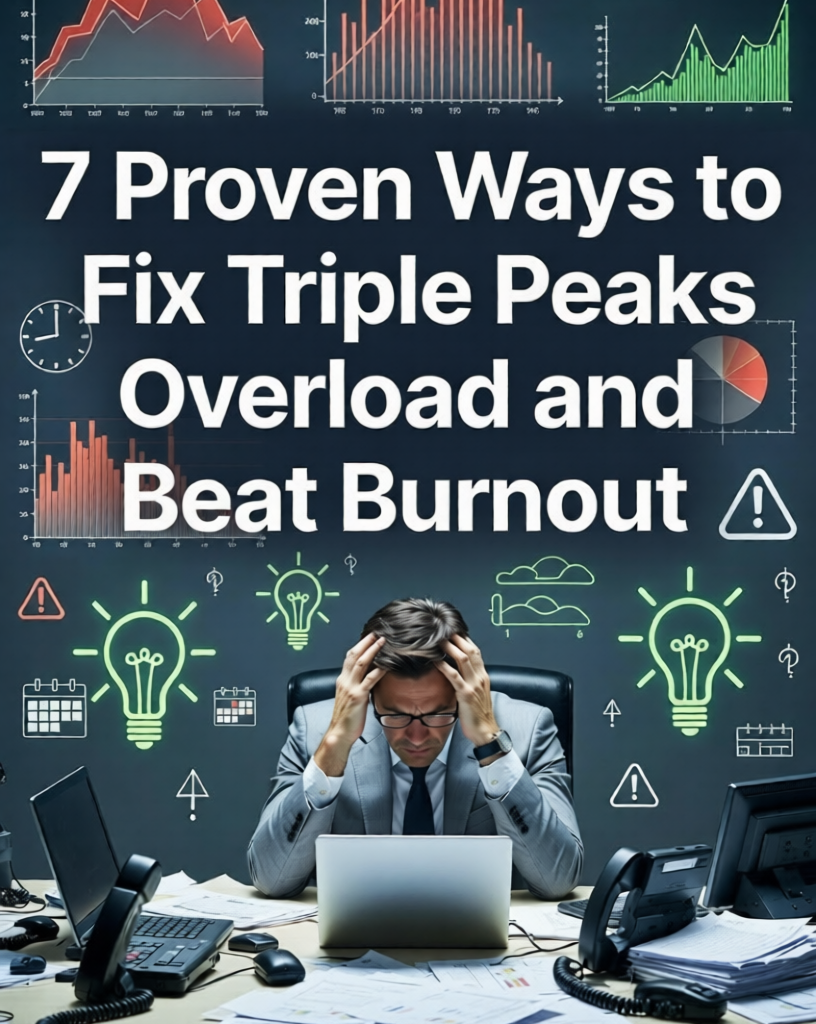
Triple Peaks Overload is what happens when three different “stress peaks” in your life keep overlapping instead of taking turns:
- Personal peak: family responsibilities, health worries, money pressure.
- Professional peak: deadlines, performance reviews, big projects, client expectations.
- Digital peak: notifications, messages, endless updates, and the constant pressure to “stay online”.
Individually, each peak is manageable. Together, they stack into chronic stress overload that your body and brain never fully recover from. Over time, this can show up as mental fatigue, irritability, energy depletion, and a slow but steady productivity crash.
Researchers have started to show how digital overload specifically adds a new layer of stress on top of traditional work pressure, increasing exhaustion and harming mental health. Mental Health America’s 2025 report also highlights how always‑on technology drains emotional energy, especially for younger, highly connected workers.
Triple Peaks Overload is basically your nervous system saying, “You’ve removed all the off‑ramps.”
Signs You’re Heading Toward Burnout
The World Health Organisation now classifies burnout as an occupational phenomenon caused by chronic workplace stress that hasn’t been successfully managed. It highlights three core dimensions: energy depletion, mental distance or cynicism about work, and reduced professional effectiveness.
Realistically, here’s how that looks when Triple Peaks Overload is pushing you toward burnout:
- You wake up tired, even after a “full” night’s sleep (energy depletion).
- You feel numb or cynical about work you once cared about.
- You keep rereading the same email because you can’t focus.
- Small asks – another meeting, another message – feel strangely heavy.
- You’re more impatient with family, colleagues, or customers.
- Your body starts talking: headaches, stomach issues, sleep disruption.
Mayo Clinic and other medical sources warn that these patterns, if ignored, can lead to more serious mental health issues, physical problems, and long‑term work‑life imbalance. This is why catching Triple Peaks Overload early is essential, not optional.
For a deeper clinical overview, see the WHO’s official ICD‑11 description of burnout.
Link: WHO – Burn-out as an occupational phenomenon
Why Traditional Productivity Advice Fails Now
Most productivity advice was built for a world with:
- One main role (usually work).
- Clear boundaries (office vs home).
- Limited digital noise.
That world is gone.
Today, you can be in a serious work chat, a family crisis group, and a meme reel – all in the same 5‑minute window. Information overload and the fear of missing out on updates are now proven drivers of stress and exhaustion in digital workplaces. A systematic review has linked intensive workplace technology use with higher levels of stress and burnout.
The result?
- “Work harder” turns into work‑life imbalance.
- “Just focus” is impossible when your brain is in ten places.
- “Hustle more” quietly normalises chronic stress overload.
You don’t need more hacks. You need a system that respects your three overlapping peaks.
The 3-Peak Reset System (Simple Framework)
Here’s a simple, practical framework I use with overwhelmed knowledge workers:
- Map the three peaks
- Personal: caregiving, health, relationships.
- Professional: deadlines, launches, reviews.
- Digital: devices, platforms, notification-heavy tasks.
- Spot the collision zones
- Monday mornings where work meetings, school runs, and notification storms collide.
- Late nights where you’re still replying to emails while handling family or personal tasks.
- Engineer recovery windows between peaks
- Instead of allowing all three to spike at once, you deliberately create gaps where at least one peak is low (no digital noise, lighter work, or protected personal downtime).
Think of it as running your life like an athlete: you don’t schedule three intense workouts back‑to‑back and then wonder why you’re injured. Triple Peaks Overload is exactly that – three “workouts” with zero recovery.
7 Proven Strategies to Fix Triple Peaks Overload
1. Run a Brutally Honest Energy Audit
Before you “optimise”, you need to see the truth.
- For one week, note your energy levels (1–10) three times a day.
- Mark when each peak (personal, professional, digital) feels highest.
- Highlight the hours where all three feel “on”.
You’ll usually find 2–3 pockets where your mental fatigue is consistently high, and your patience is consistently low. That’s your Triple Peaks danger zone – prime territory for burnout if left unaddressed.
Once you see this on paper, it’s easier to say, “I can’t schedule back‑to‑back calls here and handle home responsibilities and scroll through every notification.”
2. Create Non-Negotiable Buffer Zones
Buffer zones are small, intentional gaps that prevent peak collisions.
Examples:
- 15 minutes of no-screen time between your last work task and family time.
- A short walk or stretch between major meetings.
- A “zero-input” morning routine (no email or social apps for the first 30–45 minutes).
These tiny buffers break the chain of constant stimulation, reducing stress overload on your nervous system. Over time, this lowers your risk of burnout because your body gets micro-opportunities to reset instead of living in permanent fight-or-flight mode.
3. Shift from Time Management to Attention Management
Triple Peaks Overload isn’t just a time problem; it’s an attention problem.
Try this:
- Give each hour a “primary role”: maker (deep work), manager (meetings), or human (personal).
- Match your tasks to that role and avoid mixing modes.
When you stop forcing your brain to jump from strategy to crisis to social media in the same 10 minutes, the mental fatigue reduces dramatically. That’s when you start pulling away from full burnout and regaining real productivity instead of a constant productivity crash.
4. Put Your Digital Peak on a Leash
Your digital peak is usually the most ignored – and the most dangerous.
Practical moves that work in real life:
- Turn off non-essential push notifications (especially social and promo).
- Batch messages: check chats and email at fixed times instead of constantly.
- Keep one “low-stimulation device zone” in your home (no phones in bed, for example).
Research on digital overload shows that constant connectivity is linked to anxiety, stress, and exhaustion, especially when people feel pressure to respond quickly. Reducing that pressure is one of the most effective, hidden burnout prevention levers you control.
For more, you can explore Mayo Clinic’s guidance on how job-related stress contributes to burnout and health issues.
Link: Mayo Clinic – Job burnout: How to spot it and take action
5. Use Micro-Recovery Rituals During the Day
You don’t need a 10-day retreat to heal from overload. You need repeatable micro-recoveries.
Examples:
- 60–90 seconds of slow breathing after intense calls.
- Five-minute sun breaks between deep work blocks.
- One “tech-free” lunch per day.
- Short body scans to notice tension and relax your shoulders, jaw, and hands.
These small resets improve focus and reduce energy depletion. They also help prevent the kind of all-day stress build-up that leads to evening collapses, emotional outbursts, and long-term burnout.
6. Renegotiate Expectations Before You Hit the Wall
Burnout often spikes when expectations stay sky-high while your capacity quietly drops.
Courageous but practical steps:
- With your manager:
- Share data (your workload, hours, and key projects).
- Ask: “If everything can’t be top priority, what actually comes first this month?”
- With family:
- Explain your peak times (e.g., “6–8 pm is my most overloaded personal peak; I need help or simpler routines here.”).
Many people wait until a meltdown before having these conversations. By then, you’re already in deep burnout. Renegotiating early maintains your effectiveness and protects your mental health.
7. Run a Weekly Triple Peaks Review
Once a week, give yourself a 20–30 minute “CEO moment” for your life:
- Where did the three peaks collide this week?
- What triggered the worst stress overload or productivity crash?
- Which boundary or buffer worked surprisingly well?
- What will you change next week (one personal, one professional, one digital)?
This review turns burnout prevention into an ongoing system, not a one‑time fix. Over time, your work-life imbalance shifts toward a more sustainable rhythm that supports high performance and health.
For a broader context on how digital work environments contribute to stress and burnout, this open-access study is worth reading.
Link: SAGE Open – Information overload, stress, burnout in the digital workplace
A Real-Life Mini Case: Riya’s Triple Peaks Reset
Riya (name changed) was a mid-level manager who felt like she was “failing everywhere”:
- At work: nonstop meetings and last-minute requests.
- At home: caring for ageing parents and a young child.
- Digitally: active in multiple family groups, community forums, and work chats.
She wasn’t lazy or unorganised. She was in full Triple Peaks Overload.
Here’s what changed things:
- She mapped her three peaks and saw her worst collision: 6–9 pm (urgent emails, homework time, parent calls).
- She created a 30-minute no-notification buffer before 6 pm to close work properly.
- She moved one recurring meeting out of her overloaded window and delegated one community group to a co-admin.
- She added two five-minute breathing breaks – one after lunch, one before bed.
Within three weeks, her mental fatigue dropped, she reported fewer late-night breakdowns, and her work performance actually improved. The external pressures were still there, but her system was no longer pushing her straight into burnout territory.
Mistakes to Avoid When Fixing Triple Peaks Overload
- Trying to fix everything in one weekend. Go for one meaningful change per week.
- Ignoring your digital life. If you only tweak calendars and to‑do lists but leave your phone wild, stress overload will stay.
- Assuming burnout means you’re weak. Clinical bodies clearly frame burnout as a response to chronic stress and systemic pressure, not a personal flaw.
- Copy‑pasting someone else’s routine. Your peaks and life roles are unique; your reset system should be too.
Long-Term Sustainable Habits
To keep burnout away, build habits that automatically protect your energy:
- Clear “on” and “off” hours for work, and stick to them most days.
- Regular device-free micro-breaks (especially between role switches).
- Weekly reviews of commitments so you don’t silently accumulate obligations.
- Periodic “digital declutter” – unsubscribing, muting, and pruning channels.
- Guarding sleep like a strategic advantage, not a luxury.
These habits gradually turn your life from reactive firefighting into intentional, sustainable performance.
FAQs: Burnout, Overload and Triple Peaks
1. What causes burnout in modern work life?
Burnout today is usually caused by a mix of chronic workplace stress, high digital demands, and weak boundaries between roles. Heavy workloads, constant connectivity, and unclear expectations are common triggers that slowly erode your mental health and productivity.
2. How do you recover from overload quickly?
You won’t reverse deep burnout in a weekend, but you can reduce overload quickly by removing peak collisions: cancel or postpone non-essential tasks, drastically cut notifications, and protect sleep and basic recovery for a few days. Think “emergency decompression” first, optimisation second.
3. Can Triple Peaks Overload affect mental health?
Yes. When personal, professional, and digital stress peaks overlap for too long, they significantly increase the risk of anxiety, low mood, and cognitive problems like poor focus and memory. Studies link digital and information overload with greater exhaustion and poorer mental health outcomes in workers.
4. How do I prevent burnout long-term?
Long-term burnout prevention means designing a life where your peaks don’t constantly collide: realistic workload, clear boundaries, manageable digital input, and regular recovery practices. A weekly Triple Peaks review helps you catch problems early, rather than waiting for a full productivity crash.
5. Is burnout a medical diagnosis?
The World Health Organisation classifies burnout as an occupational phenomenon related to chronic job stress, not as a medical disease in itself. However, it can be associated with serious mental and physical health issues, so talking to a qualified health professional is wise if you suspect burnout.
6. Does using technology always cause burnout?
No. Technology can support productivity and mental health, but high, unstructured use – especially with constant notifications and pressure to respond – raises stress and exhaustion levels. The key is intentional, boundary-based use, not complete avoidance.
Table of Contents
You may look out for kritiinfo.com(Idea not to burnout)
- A guide on “energy management vs time management” (anchor text idea: energy management for high performers).
- An article on “digital minimalism for knowledge workers” (anchor text idea: reduce digital noise without hurting your career).
2 thoughts on “7 Proven Ways to Fix Triple Peaks Overload and Beat Burnout”