
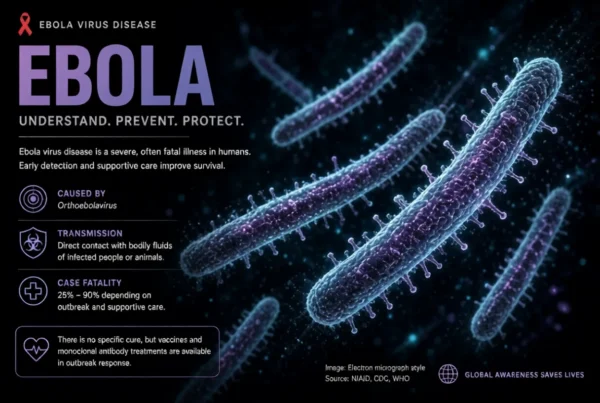
Your phone buzzes at the gate. Boarding starts in eleven minutes. The push notification is short and cold: a new health alert, a country on your itinerary, and one word that makes your stomach drop, Ebola.
Do you keep walking toward the jet bridge? Do you pull up the airline app and check your connection? Do you call someone? For a few seconds, you have more questions than answers, and the flight is not waiting.
This scenario plays out for real travelers more often than most people realize, because global health information now moves faster than travel plans do. A notice can appear on a government website, a news app, or an airline alert system hours before a flight, sometimes while a traveler is already at the airport. That immediacy is exactly why understanding what an Ebola travel notice actually means, and what it does not mean, matters long before you ever see one.
So what does a global travel notice really mean when Ebola is involved? Let’s break it down.
Table of Contents
What Is an Ebola Travel Notice?
A travel health notice is a public communication issued by a health authority, most often a national agency like the CDC or a global body like the WHO, when a disease event could affect people crossing borders. It is not a legal order. It is guidance, built from evolving evidence, meant to help travelers, airlines, and clinicians make informed decisions.
Notices exist on a scale. A low level notice might simply ask travelers to practice routine precautions. A higher level notice might recommend postponing nonessential travel to a specific province or region. The CDC’s Travel Health Notices page publishes current notices by country and disease, updated as situations change.
A notice covering Ebola does not mean every traveler to that country faces equal danger. Risk depends heavily on where you are going within a country, what you plan to do there, and how close that location is to confirmed transmission. A notice about eastern provinces of a country does not automatically apply to its capital city or its coastline, though many travelers assume it does.
Why Ebola Notices Can Change Quickly
Outbreak information is a moving target. Contact tracing teams identify new exposures. Laboratories confirm or rule out suspected cases. Health workers map how far a virus has spread across districts and provinces. Every one of those steps can shift the guidance within days.
The 2026 Ebola disease outbreak caused by the Bundibugyo virus in the Democratic Republic of the Congo illustrates this well. The World Health Organization declared it a public health emergency of international concern in May 2026, and by early September the DRC had reported more than 6,700 confirmed cases, according to WHO outbreak reporting. Uganda’s linked outbreak, by contrast, was declared over by WHO in late August after 42 days passed without a new confirmed case. Two very different outcomes, in two neighboring countries, tracked under the same event.
This is exactly why a notice issued in May can look different from one issued in August, even for the same outbreak. Guidance is not static, and travelers who check a notice once and never look again are working from outdated information.
The Difference Between an Alert and a Travel Ban
These terms get blurred constantly, so it helps to separate them clearly.
A travel health notice or alert is informational. It flags a risk and often recommends precautions, but it does not stop you from boarding a plane.
Enhanced monitoring means health authorities are watching travelers from a specific region more closely, sometimes through symptom questionnaires or temperature checks at arrival.
Screening refers to physical checks at airports or borders, such as health questionnaires or observation for symptoms, applied to travelers coming from an affected area.
Entry requirements are conditions a destination country sets, like proof of a health screening or a declaration of recent travel history.
An actual travel restriction or entry suspension is a binding measure. It can bar entry for certain travelers or require a waiting period outside an affected country before entry is allowed. During the 2026 outbreak, the United States implemented exactly this kind of measure, restricting entry for certain non-citizen travelers who had recently been in the DRC, Uganda, or South Sudan, an order that has been repeatedly reviewed and extended as the CDC’s Health Alert Network advisory describes.
Confusing an informational alert with a hard ban leads to two bad outcomes: unnecessary trip cancellations, or dangerous overconfidence when a real restriction does apply.
7 Signals Travelers Should Watch
Rather than reacting to a single headline, build a habit of checking these seven signals whenever a destination is linked to an Ebola notice.
- Official outbreak confirmation. Has a recognized health authority confirmed cases, or is this still an unverified report circulating online?
- Destination specific guidance. Does the notice apply to the entire country, or to particular provinces, districts, or health zones?
- Exposure recommendations. Is the advice to avoid all travel, avoid nonessential travel, or simply practice enhanced precautions?
- Symptom guidance. What symptoms are travelers being told to watch for, and over what time window after possible exposure?
- Airport or border measures. Are there screening stations, temperature checks, or health declarations at points of entry or exit?
- Entry requirement changes. Has the destination or your return country added new documentation or waiting period rules?
- Instructions for recent travelers. If you have already been in an affected area, are there self monitoring or reporting steps you are expected to follow?
Working through this list takes a few minutes and replaces guesswork with a clear picture of your actual exposure risk.
A Traveler’s 24 Hour Decision
The following case study is fictional and illustrative. It does not describe a real person or a documented event.
Picture a traveler, we’ll call her Meera, a marketing consultant with a flight booked to a country bordering an outbreak zone. Twelve hours before departure, she sees a headline claiming Ebola has been detected near her destination city.
Her first instinct is to cancel everything. Instead, she pauses and works through it methodically. She checks her destination country’s actual travel health notice rather than relying on the headline alone. She confirms which province the cases are linked to, and realizes her business meetings are in a different region entirely, hundreds of kilometers from the affected zone.
She calls her travel insurance provider to confirm her coverage still applies. She reviews her itinerary for any side trips that might cross into a higher risk area, and cancels one optional excursion out of caution. She emails a travel medicine clinic to ask whether any additional precautions make sense for her specific route.
By the next morning, she has a decision grounded in verified information rather than fear: she travels, with a clearer understanding of what to watch for and who to contact if anything changes. Her case shows the difference between reacting to a headline and responsibly assessing a real notice.
The Hidden Danger of Misinformation
Outbreaks attract misinformation the way storms attract debris. A forwarded voice message claims a city is “locked down.” A screenshot with no source claims a country has been sealed off entirely. An old article from a previous outbreak resurfaces and gets shared as if it were current news.
This matters because travelers who act on unverified claims can make decisions that hurt them either way, canceling trips that were never actually at risk, or ignoring a real restriction because it was buried under noise from fake ones.
Verification is simple in practice. Check the date on anything you read. Compare it against the official notice from a national health authority or the WHO’s Ebola outbreak page. If a claim cannot be traced to an identifiable, current, official source, treat it as unconfirmed until you find one that can.
What Smart Travelers Should Do
Before departure: Check the travel health notice for every country and connection on your itinerary, not just your final destination. Review your travel insurance for outbreak related coverage. Note the contact information for the nearest embassy or consulate at your destination.
During travel: Follow any posted screening or declaration procedures at airports without skipping steps. Keep a record of the regions you actually visit, not just the country name, in case you need to report travel history later. Avoid contact with anyone showing symptoms consistent with viral hemorrhagic fever.
After returning: Monitor your health for the incubation period specified by health authorities, generally up to 21 days for Ebola virus disease. Keep your travel history accessible in case a clinician asks.
If symptoms develop: Call ahead to a healthcare provider or emergency department before showing up in person, mention your recent travel history clearly, and follow their instructions for safe evaluation. This protects both you and the people around you.
Why Calm Decisions Matter
Panic and denial cause similar amounts of harm, just in opposite directions. A traveler who cancels every trip near any health notice misses opportunities based on fear rather than evidence. A traveler who ignores every notice because “it’s probably nothing” can walk into a genuinely elevated risk unprepared.
Responsible travel sits between those extremes. It means checking sources, understanding what a notice actually recommends, and adjusting behavior proportionally to the real risk in front of you. That is not overcaution or recklessness. It is informed decision making, and it is a skill every international traveler benefits from building.
Conclusion
Health notices will keep appearing, because outbreaks are a permanent feature of a connected world, not a rare exception. What separates a stressful trip from a manageable one is not luck. It is the habit of verifying before reacting, understanding the difference between an alert and a restriction, and making decisions based on facts rather than fear.
Good travel decisions come from verified information, not fear. That single idea, applied consistently, will serve you through every future notice you encounter, Ebola related or otherwise.
Because outbreak conditions and travel restrictions can change within days, always confirm current guidance directly through the WHO, the CDC, or your destination’s official government health agency before finalizing travel plans.
Frequently Asked Questions
What is an Ebola travel notice? It is guidance issued by a health authority, such as the CDC or WHO, informing travelers about a confirmed or suspected Ebola outbreak in a specific area and recommending precautions appropriate to the level of risk.
Does an Ebola travel notice mean I should cancel my trip? Not automatically. Read the specific notice to see which regions are affected and what level of precaution is recommended, then assess whether your actual itinerary intersects with that risk.
Can I travel to a country where Ebola has been reported? Often yes, particularly if your destination is far from the affected provinces and no formal travel restriction is in place. Always check the current notice for that specific country before deciding.
How can travelers verify an Ebola alert? Check official sources directly, including national health agencies, the WHO’s outbreak pages, and your government’s travel advisory site. Avoid relying on social media posts or forwarded messages alone.
What symptoms should travelers watch for after possible exposure? Fever, severe headache, muscle pain, vomiting, diarrhea, stomach pain, or unexplained bleeding or bruising are key symptoms. Anyone with these symptoms after travel to an affected area should seek medical evaluation promptly and mention their travel history.
What should I do if I become ill after international travel? Call a healthcare provider or emergency department before arriving in person, clearly state your recent travel history, and follow their guidance for safe evaluation and possible isolation.
Can Ebola travel notices change quickly? Yes. Notices are updated as new cases are confirmed, as outbreaks are contained, or as health authorities reassess risk. A notice from several weeks ago may no longer reflect the current situation.
Are entry restrictions the same as travel notices? No. A notice is informational guidance. An entry restriction is a binding measure that can limit or delay entry for certain travelers, and it is issued separately by the relevant government agency.