
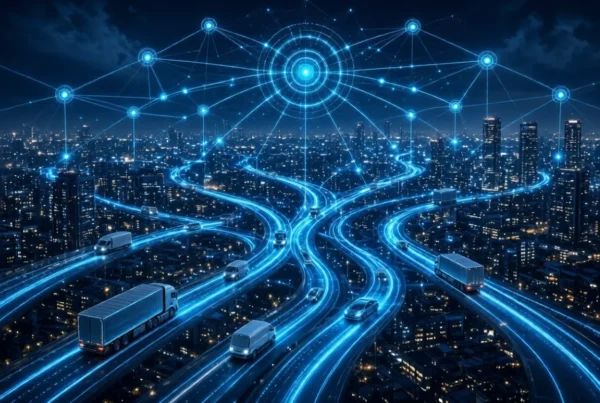
Midnight at the Fulfilment Center
The dispatch clock reads 11:42 PM. Inside a four hundred thousand square foot distribution hub, the environment looks less like a traditional storage depot and more like a high stakes physical computational engine. Over twelve hundred autonomous mobile robots glide across concrete floors polished to a mirror shine. Overhead conveyors churn. Articulated robotic arms pivot with micro millimeter accuracy.
Then comes the surge.
An unexpected batch of thirty thousand priority orders floods the system at once. Simultaneously, an automated tugger carrying heavy battery cells detects an oil slick in Aisle 14 and halts abruptly. A downstream picking cell suddenly screams for immediate replenishment, while three autonomous forklifts converge on the same narrow transfer corridor with only seconds to spare.
In an uncoordinated facility, this is where catastrophe begins. One stalled cart creates a queue. A single queue blocks an intersection. Within ninety seconds, hundreds of machines freeze into deadlocks, human technicians sprint onto the floor, and shipping guarantees collapse under immense operational pressure.
Yet none of that happens.
Instead, the inbound forklifts decelerate smoothly, rerouting through secondary paths without stopping. The replenishment task transfers dynamically to a secondary unit already positioned thirty meters away. The halted tugger flags its exact spatial coordinates, drops into safe diagnostic mode, and signals an autonomous floor scrubber to clean the spill. The entire choreography shifts seamlessly.
The machines never collided. Nobody shouted. Throughput never dipped.
What prevents thousands of independent steel and silicon workers from descending into total gridlock? The answer is not simply faster sensors or better mechanical engineering. It is the intelligence managing the collective: Fleet Orchestration.
Table of Contents
What Is Fleet Orchestration?
At its core, fleet orchestration is the centralized and distributed software intelligence that directs, synchronizes, and optimizes massive groups of heterogeneous mobile robots and fixed industrial automation in real time.
Think of it as the air traffic controller, logistics dispatcher, and master strategist rolled into a single real time computing framework.
Many operations managers mistakenly confuse basic robot management with true orchestration. Basic fleet management monitors whether individual machines are online, displays battery percentages, and allows an operator to manually send a robot from point A to point B. That works well enough if you run twelve identical cleaning bots.
It breaks down entirely when you deploy four hundred units across five different hardware vendors, integrating autonomous mobile robots, automated guided vehicles, sorting arms, automated storage and retrieval systems, and human workers.
True orchestration connects to the broader enterprise nervous system. It pulls live operational data from the Warehouse Management System, syncs directly with the Manufacturing Execution System, and translates high level commercial demands into immediate physical trajectories. It answers three fundamental questions for every robot every millisecond: Where should you go, what task should you execute, and how do you complete it without disrupting the surrounding ecosystem?
For technology architects building next generation facilities, our deep dive into Enterprise Architecture illustrates how these distributed data layers interface cleanly with legacy operational backbones.
Why Thousands of Robots Need a Shared Brain
Put five autonomous vehicles on an open highway, and their onboard sensors can prevent them from crashing into each other. Put five hundred autonomous machines inside a tightly constrained warehouse or assembly plant, and local sensor navigation alone creates paralysis.
Robots navigating solely by their own onboard light detection and ranging systems suffer from local minima problems. When two machines meet head on in an aisle, both stop. Both attempt to nudge around the other. Both register an obstacle and freeze. Multiply that dynamic across a labyrinth of storage racks, and localized collision avoidance creates systemic operational gridlock.
To maintain real time flow, modern operations demand systemic spatial intelligence. According to research published by the IEEE on multi robot systems, coordinating high density fleets requires global path planning coupled with localized collision avoidance algorithms.
Without an orchestrator calculating mutual clearances across the entire operational footprint, individual machines operate in algorithmic silos. The most severe threat to warehouse productivity is rarely a mechanical failure. It is a failure of coordination.
How the Coordination Actually Works
Dynamic fleet coordination relies on six technological breakthroughs that bridge the physical and digital divide:
[ WMS / MES Layer ]
         │
         ▼
[ Orchestration Engine ]
   ├─ Dynamic Task Allocation
   ├─ Global Path Planning & Graph Networks
   └─ Digital Twin State Engine
         │
         ▼
[ Heterogeneous Fleet: AMRs, AGVs, Arms, Conveyors ]
1. Dynamic Task Allocation
The orchestration engine evaluates open work orders, physical machine locations, current battery states, payload capacities, and destination deadlines. It does not merely assign the closest machine to a task; it models the opportunity cost of dispatching that specific asset versus holding it for an imminent, higher priority workload.
2. Time Space Routing Networks
Instead of mapping paths purely in two dimensional floor space, advanced platforms treat navigation as a time space graph. The path computation reserves not just a physical lane on the grid, but a specific time window for that lane. If Robot A needs to pass through an intersection at precisely 10:14:02 AM, the engine schedules Robot B to cross at 10:14:06 AM, eliminating unnecessary stops and energy intensive deceleration cycles.
3. Standardized Interoperability and APIs
Historically, buying robots meant signing an exclusive contract with a single manufacturer because their proprietary software refused to communicate with rival hardware. The industry is shedding these walled gardens. Modern platforms leverage vendor agnostic standards, such as the VDA 5050 communication interface, allowing machines from different manufacturers to exchange dispatch commands, status signals, and coordinate trajectories via standardized APIs.
4. Sensor Fusion and Digital Twins
Edge gateways collect real time telemetry across the building, feeding continuous updates into a live digital twin of the facility. By combining onboard lidar, camera feeds, and environmental facility sensors, the orchestrator maintains complete operational transparency, predicting choke points before they manifest on the physical floor.
5. Edge and Cloud Collaboration
Heavy path routing and global optimizations run across high performance cloud or on premise servers. Meanwhile, time critical safety reactions, motor actuation, and micro obstacle detours execute instantly on edge computing modules embedded directly inside the robot chassis. This ensures safety systems remain functional even during momentary network dropouts.
6. Predictive Maintenance Integration
Orchestration engines track machine telemetry over time, noting motor vibration variations, battery degradation, and wheel slippage. When an anomaly surfaces, the system autonomously routes the affected robot off the main floor and into a maintenance bay before an unexpected mechanical breakdown blocks a critical path.
Inside a Smart Warehouse
Consider what happens when an unexpected wave of priority freight arrives at an automated logistics terminal.
At the loading docks, autonomous mobile robots retrieve mixed pallets straight from container beds. The orchestrator cross references shipping manifests against customer delivery windows, prioritizing units carrying high margin, time critical parts.
As an autonomous cart moves toward an automated storage rack, the orchestrator coordinates with high speed vertical lift modules to pre stage empty storage bays. If human staff step into a shared picking zone, the system calculates a dynamic safety zone, signaling incoming machinery to drop speeds or route around the human workspace entirely.
The system treats human workers not as unpredictable obstacles, but as critical, value adding participants in the operational loop. For leaders exploring practical ways to integrate human talent with robotic fleets, our analysis of Intelligent Operations outlines practical workflows that preserve physical safety while boosting picker productivity.
When Production Lines Join the Fleet
Moving packaged goods inside a distribution center is difficult; moving raw components through an active automotive or aerospace assembly plant is considerably more unforgiving.
In manufacturing environments, robotic fleets must interface directly with industrial robotic arms, Computer Numerical Control stations, and stamping presses governed by strict cycle times. If an autonomous tugger carrying engine blocks arrives sixty seconds late, an entire automotive assembly line halts, costing thousands of dollars per minute.
Advanced fleet orchestration links directly into the plant Manufacturing Execution System. If an automated torque station on the assembly line encounters a mechanical fault and slows down, the orchestrator recognizes the lag instantly. It automatically holds upstream delivery robots in temporary staging buffers and speeds up parts delivery to alternate assembly cells.
This tight alignment between stationary production robotics and autonomous logistics creates a flexible, highly resilient manufacturing ecosystem capable of continuous self correction.

The Measurable Business Dividends
Organizations transitioning from fragmented automation setups to comprehensive orchestration platforms unlock substantial operational advantages:
| Operational Metric | Fragmented Automation Setup | Advanced Fleet Orchestration |
| Fleet Scalability | Hits coordination ceilings at 30 to 50 machines | Seamlessly scales to hundreds or thousands of units |
| Asset Utilization | 45% to 60% (frequent waiting and idle time) | 80% to 90% (active, balanced task execution) |
| Vendor Diversity | Single vendor lock in across hardware lines | Mixed vendor fleets operating across shared floor space |
| Response to Floor Disruptions | Manual human intervention; systemic deadlocks | Dynamic real time rerouting; automatic task reassignment |
| Operational Visibility | Disconnected vendor portals and local dashboards | Unified facility wide digital twin and telemetry |
Beyond higher asset utilization, efficient coordination minimizes wear and tear on mechanical drive units, smooths electrical demand curves by staggering battery charging cycles, and drastically reduces physical congestion in shared aisles.
The Operational Constraints and Real World Challenges
Building an enterprise grade orchestration architecture is not without friction. Organizations frequently face structural, technological, and procedural barriers that demand sober leadership evaluation.
                  ┌──────────────────────────────┐
                  │ Core Implementation Hurdles  │
                  └──────────────┬───────────────┘
         ┌───────────────────────┼───────────────────────┐
         ▼                       ▼                       ▼
  [ Interoperability ]    [ Network Latency ]    [ Safety & Cyber ]
  Proprietary silos       Industrial Wi-Fi       OT network exposure
  VDA 5050 gaps           Packet dropouts        OSHA / ISO 3691-4
- Vendor Reluctance and Interoperability Gaps: While standards like VDA 5050 have gained traction across Europe and North America, several established robotics manufacturers continue to protect proprietary software ecosystems. Integrating diverse machinery often requires custom middleware, complex API connectors, and careful data normalization.
- Facility Network Latency: Orchestrating hundreds of high speed machines demands deterministic wireless communication. Weak industrial Wi-Fi coverage, physical signal shadows created by dense metal racking, and unexpected packet loss can cause robots to stop abruptly as fail safe protocols engage. Many facilities must deploy private 5G networks to guarantee reliable low latency communication.
- Workplace Safety Regulations: Integrating heavy autonomous transport into shared human spaces requires strict adherence to workplace safety regulations. Frameworks like OSHA standards and international safety guidelines, including ISO 3691-4, govern minimum stopping distances, optical clearance zones, and physical emergency stops. Software orchestration can optimize workflows, but hardware level safety circuits must always retain absolute override authority.
- Cybersecurity Vulnerabilities: Every connected robot represents an active network endpoint navigating physical space. Operational technology networks require rigorous protection, end to end encryption, zero trust architectures, and isolated control layers to protect industrial fleets from malicious tampering, operational sabotage, or unauthorized surveillance.
Real World Case Study: Solving the E-Commerce Peak Surge
To understand the practical impact of advanced coordination, evaluate this operational scenario based on common high volume retail distribution challenges.
Situation
A nationwide distribution facility operating four hundred autonomous mobile robots across three distinct hardware vendors faced an unprecedented promotional peak season. Order intake spiked three hundred percent above standard baseline volumes.
Problem
The facility relied on three isolated fleet dispatch systems provided by the respective robot manufacturers. The mobile units shared the same physical transfer corridors, but their navigation brains were completely blind to one another.
Escalation
During the second day of the surge, an automated tote delivery bot stalled at a primary cross aisle intersection. Because the systems lacked a unified navigation brain, inbound carts from the other two vendors detected the stopped unit as an unclassified physical obstacle.
Rather than selecting coordinated alternate routes, seventy machines stopped in rapid succession, creating a physical gridlock that spread through the picking aisles. Within twenty minutes, order processing fell forty percent, and outbound dispatch schedules faced severe operational delays.
Orchestration Response
The engineering team integrated an enterprise fleet orchestration layer running over a private wireless network. The unified platform ingested real time spatial coordinates from all four hundred units using open API protocols, establishing a single real time dynamic map of the facility floor.
When obstacles occurred, the centralized time space planner instantly rerouted trailing units through secondary corridors before queues formed, balancing traffic densities across all operational zones.
Result
System deadlocks dropped to zero. Fleet wide asset utilization rose from fifty two percent to eighty seven percent, while overall order cycle times fell twenty four percent. Crucially, the facility handled the remainder of the peak season volume without adding temporary rental machinery or running emergency shifts.
Lesson
Scaling autonomous automation is rarely a hardware problem. High capacity operations require a unified orchestration layer capable of treating every machine, regardless of manufacturer, as a synchronized component of a single, coherent system.
Strategic Guidance for Technology Leaders
If your enterprise plans to deploy or expand industrial robotics, execute a disciplined implementation strategy:
- Audit Your Wireless Infrastructure: Before ordering additional machines, verify your facility network architecture. Low latency, seamless roaming, and resilient coverage are non negotiable requirements for real time fleet management.
- Mandate Vendor Agnostic Standards: Reject proprietary, closed software platforms. Insist on open APIs, standard integration interfaces like VDA 5050, and clean data exchange formats in your procurement contracts.
- Integrate Early with Core Systems: Orchestration software delivers peak value when deeply coupled with your Enterprise Resource Planning, Warehouse Management, and Manufacturing Execution systems. Treat fleet intelligence as an enterprise operational layer, not an isolated shop floor utility.
- Prioritize the Human Machine Interface: Train floor managers, pickers, and maintenance technicians to read systemic status displays with ease. Automation thrives when floor operators trust algorithmic recommendations rather than fighting them.
- Start with Small Dynamic Scenarios: Validate multi robot path planning in high traffic choke points before deploying facility wide synchronization. Measure latency, verify stopping distances, and test unexpected obstacle interventions under realistic production pressures.
For organizations refining long term deployment roadmaps, our practical guides on AI and Automation and modern Management methods offer valuable operational blueprints.
Frequently Asked Questions
What is Fleet Orchestration?
Fleet orchestration is the software intelligence that coordinates, routes, and schedules large, diverse groups of mobile robots and automated industrial machines in real time. It unifies operations across different hardware brands, synchronizing machine tasks with enterprise warehouse and production demands.
How does Fleet Orchestration coordinate thousands of robots?
Advanced orchestration platforms build a continuous time space digital model of the entire facility. Centralized algorithms plan collision free travel routes, allocate workloads based on priority and battery states, and communicate dynamic paths to machines via edge computing gateways and low latency wireless networks.
Why is Fleet Orchestration important for modern warehouses?
Without unified coordination, dense robotic fleets encounter local navigation deadlocks, block busy intersections, and leave costly machinery idling. Orchestration balances traffic flow, raises asset utilization, and maintains high throughput even during unexpected peak volume surges.
Can Fleet Orchestration platforms manage different robot brands simultaneously?
Yes. Modern orchestration engines leverage open communication protocols like VDA 5050 and standardized APIs. This enables facilities to manage autonomous mobile robots, automated forklifts, sorting arms, and specialized machinery from multiple vendors within a single operating interface.
What are the primary risks associated with robotic fleet coordination?
Key risks include industrial network latency dropouts, cybersecurity vulnerabilities across exposed operational endpoints, proprietary vendor lock in, and software interoperability issues. Ensuring compliance with rigorous workplace safety regulations like ISO 3691-4 is also essential.
How does artificial intelligence improve Fleet Orchestration?
Artificial intelligence enhances orchestration through predictive traffic modeling, intelligent task assignment, dynamic path optimization, and predictive maintenance. AI systems analyze historical operational telemetry to forecast choke points and dispatch maintenance routines before physical machinery breaks down.
What should a company evaluate before investing in an orchestration platform?
Companies should evaluate their existing industrial Wi-Fi or private cellular network, audit the open API capabilities of their current and planned robot assets, examine integration paths into their existing Warehouse Management Systems, and calculate expected asset utilization gains.
The New Standard for Industrial Autonomy
The true revolution unfolding across modern supply chains is not found in the mechanical joints of an articulated arm or the silent lithium batteries driving an autonomous cart.
The breakthrough is coordination.
True competitive advantage belongs to operations that turn hundreds of isolated machines into a single, cohesive, self directing workforce. When production demands spike, paths shift instantly, priorities rebalance, and the floor keeps moving.
Investing in robust fleet orchestration is not simply a technical upgrade. It is the definitive foundation for building an agile, scalable, and genuinely resilient industrial future.