
It begins on a Tuesday morning with something entirely ordinary.
You grab a caramel latte and a flaky, chocolate filled pastry on the way to your desk. By mid afternoon, sluggish energy prompts a quick visit to the breakroom for a soda and a bag of salted chips. Dinner is takeout pizza ordered late because work ran long.
Nothing about this day feels dramatic. You feel fine, aside from standard fatigue. You brush your teeth before bed, spit into the sink, and see a faint pink tint in the foam. Just a slight sign of brushing too hard, you assume. You rinse, turn off the light, and go to sleep.
Yet under the surface, an invisible biological drama has already started. The food on your plate did not merely deliver calories. It selectively fed trillions of microbial organisms lining your tongue, your gums, and your digestive tract.
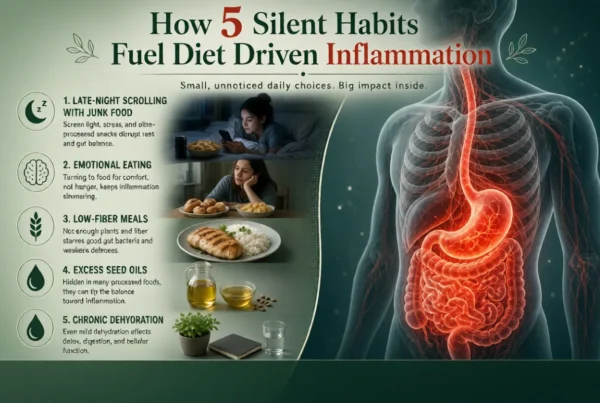
What felt like a routine meal was actually an environmental shift. When repeated day after day, this common pattern sets the stage for diet driven inflammation, an underlying process that links what happens in your mouth to the deeper metabolic circuits of your body.
Dietary Pattern (High Sugar, Low Fiber)
               │
               ▼
   Microbial Environment Shifts
               │
       ┌───────┴───────┐
       ▼               ▼
Oral Dysbiosis    Gut Dysbiosis
       │               │
       ▼               ▼
Gingival Barrier   Intestinal Barrier
  Permeability      Permeability
       │               │
       └───────┬───────┘
               ▼
   Systemic Immune Response
               │
               ▼
     Diet Driven Inflammation
               │
       ┌───────┴───────┐
       ▼               ▼
Periodontal Risk   Metabolic Burden
Table of Contents
The Hidden Warning Sign
Most people treat the human body like an apartment complex where the tenants never speak to one another. The mouth belongs to the dentist. The stomach belongs to the gastroenterologist. Blood sugar belongs to the primary care physician.
Biology does not respect these clinical boundaries.
That faint trace of pink in the sink is often an overlooked clue. The American Dental Association notes that bleeding gums represent an early stage of gingival inflammation, typically sparked by microbial biofilm accumulating along the gumline.
Could the problem begin before you ever notice a visible symptom?
Research suggests it often does. Your mouth is the main gateway to your gastrointestinal tract. Every meal passes through this entryway before entering the stomach and intestines. When your daily menu consistently favors refined carbohydrates, saturated fats, and minimal roughage, you alter the biological terrain in both locations at once.
The result is not an isolated problem. It is a slow, systemic conversation mediated by bacteria, cellular barriers, and immune signaling molecules.
Why the Microbiomes Matter
You host two of the most densely populated microbial ecosystems on the planet: the oral microbiome and the gut microbiome.
Under balanced conditions, these diverse communities are protective allies. In the mouth, commensal bacteria help maintain a stable pH, limit pathogens, and even assist in converting dietary nitrates into nitric oxide, an essential compound for vascular health. In the lower digestive tract, beneficial microbes break down complex plant fibers into short chain fatty acids that nourish colon cells and help regulate immune tolerance.
When your diet changes drastically, their food supply changes too.
Beneficial species thrive on structural diversity, mainly complex carbohydrates and plant fibers that human enzymes cannot digest alone. Pathogenic and inflammatory microbes, by contrast, thrive on simple sugars and refined fats.
When you consistently starve the protective species and overfeed the opportunistic ones, the ecosystem shifts into microbial imbalance, or dysbiosis. This shift forms the primary foundation for diet driven inflammation.
The Sugar Connection
Refined sugars do not just sit in the mouth; they actively fuel acid producing bacterial strains such as Streptococcus mutans.
As these bacteria consume sucrose, they generate acidic byproducts that lower the pH of your saliva. This acidic microenvironment dissolves enamel over time, but it also does something worse: it creates an ecological pressure that selects for acid tolerant, pro inflammatory bacteria.
Excess Added Sugars
       │
       ▼
Rapid Bacterial Fermentation
       │
       ▼
Salivary pH Drops (< 5.5)
       │
       ▼
Acid-Tolerant Microbes Dominate
       │
       ▼
Gingival Margin Irritation
Meanwhile, in the bloodstream, rapid absorption of high glycemic carbohydrates causes repeated glucose surges. According to research synthesized by the Harvard T.H. Chan School of Public Health, repetitive glucose spikes stimulate the release of inflammatory cytokines like interleukin 6 and tumor necrosis factor alpha.
These circulating signals put the body’s innate immune system on high alert. Tissues in the gums, already coping with local microbial shifts, become far more vulnerable to inflammatory breakdown.
When Fat Changes the Picture
Fat is an essential macronutrient, but the quality and quantity matter immensely.
Diets loaded with industrial trans fats and excessive saturated fats change how gut microbes interact with the intestinal lining. A high fat, ultra processed meal stimulates the production of bile acids that can alter gut bacterial composition, reducing protective species like Bifidobacterium.
Even more alarming is what happens to bacterial outer membranes. Gram negative bacteria naturally contain lipopolysaccharides, also known as endotoxins.
When you consume excessive unhealthy fats alongside refined sugars, the intestinal wall can become more permeable. Small amounts of these endotoxins leak across the gut lining into portal circulation, a biological event termed metabolic endotoxemia.
The immune system treats these bacterial fragments as an active infection. It mounts a low grade, continuous defense. This baseline activation is a classic hallmark of diet driven inflammation, silently stressing blood vessels, adipose tissue, and liver cells.

The Fiber Gap
If sugar and excess fat act as fuel for this internal fire, dietary fiber is the cooling rain that prevents it from spreading.
Yet modern eating patterns frequently leave a massive fiber gap. The Centers for Disease Control and Prevention highlights that the vast majority of adults fall well short of the recommended daily fiber intake, which typically ranges between 25 and 38 grams per day.
What happens when you do not eat enough fiber?
- Starved microbes switch fuels: Without plant polysaccharides to consume, certain gut bacteria begin feeding on the protective mucus layer that coats your intestinal wall.
- Loss of short chain fatty acids: Less fiber means lower production of acetate, propionate, and butyrate, vital compounds that maintain gut barrier integrity and signal immune cells to stand down.
- Rapid transit of simple carbs: Without soluble fiber to slow digestion, sugars rush into the bloodstream, worsening insulin spikes and systemic oxidative stress.
By neglecting fiber, you unwittingly dismantle the body’s primary internal buffer against inflammation.
The Mouth Gut Connection
For decades, oral biology and gastrointestinal medicine were treated as separate specialties. Today, researchers know that millions of oral bacteria are swallowed every day in saliva.
In a resilient digestive tract with robust stomach acid, most oral bacteria do not colonize the lower intestines. But when diet driven inflammation weakens gut barrier function and alters the intestinal microbiome, oral opportunistic bacteria can establish footholds downstream.
Certain species commonly found in inflamed periodontal pockets, such as Porphyromonas gingivalis, have been detected in the gut microbiomes of individuals with systemic metabolic disturbances. Their presence can disrupt gut microbial ecology, further worsening intestinal permeability.
The highway runs both ways: gut derived systemic inflammation degrades oral immune defenses, while oral dysbiosis continually seeds inflammatory mediators into the body. The mouth and gut are connected parts of a single continuous tube.
The Periodontal and Metabolic Consequences
Is your daily menu quietly changing your microbial environment?
When these disruptions persist over years, the consequences branch into two distinct but deeply intertwined health challenges: periodontal disease and metabolic dysfunction.
       Persistent Diet Driven Inflammation
                        │
       ┌────────────────┴────────────────┐
       ▼                                 ▼
Periodontal Vulnerability       Metabolic Burden
(Tissue breakdown, bone loss)   (Insulin resistance, lipid drift)
       │                                 │
       └────────────────┬────────────────┘
                        ▼
           Compounded Systemic Risk
1. Periodontal Vulnerability
Periodontal disease is not simply bad hygiene; it is an inflammatory condition driven by host response to bacterial plaque.
The National Institute of Dental and Craniofacial Research points out that while bacterial plaque initiates the process, it is the host’s own exaggerated immune response that breaks down the periodontal ligament and supporting alveolar bone.
When your systemic baseline is already primed by diet driven inflammation, periodontal tissues react with excessive swelling, matrix metalloproteinase release, and accelerated tissue destruction.
2. Metabolic Burden
At the same time, continuous low grade immune activation interferes with normal metabolic signaling. The National Institute of Diabetes and Digestive and Kidney Diseases explains that chronic inflammation is intimately tied to insulin resistance.
When immune cells infiltrate fat deposits and liver tissue, cellular receptors struggle to respond properly to insulin. Glucose stays in the bloodstream longer, compelling the pancreas to pump out more insulin, which further locks the body into an inflammatory cycle.
| Health Factor | Balanced Diet (High Fiber, Low Sugar) | Disruptive Diet (High Sugar, High Fat, Low Fiber) |
| Oral Microbiome | Diverse, balanced, stable saliva pH | Acidic shift, enriched in pathogenic anaerobes |
| Gut Lining | Intact mucosal barrier, high butyrate | Thin mucus layer, elevated endotoxin leakage |
| Immune Status | Regulated, targeted, resolving | Chronic low grade, systemic activation |
| Periodontal Risk | Stable gums, minimal tissue breakdown | Heightened bleeding, accelerated bone loss |
| Metabolic Health | Predictable insulin response, balanced lipids | Insulin resistance, elevated resting inflammation |
A Practical Turnaround
Solving this problem does not require extreme cleanses, unverified supplements, or unrealistic meal plans. Biology responds remarkably well to consistent, measured adjustments.
To break the chain of diet driven inflammation, focus on practical dietary shifts that reintroduce protective inputs while scaling back disruptive ones:
- Build around diverse fibers: Prioritize lentils, chickpeas, black beans, chia seeds, oats, and leafy greens. Aim to include at least two distinct plant foods in every major meal.
- Moderate refined sugars: Swap carbonated sodas, sweetened teas, and processed morning pastries for whole fruits like berries and apples, which package natural sugars alongside protective polyphenols and fiber.
- Select balanced fats: Reduce consumption of fried fast foods and shelf stable commercial baked goods rich in modified oils. Choose extra virgin olive oil, avocados, walnuts, and wild caught fish.
- Hydrate with plain water: Water supports adequate salivary flow, which naturally buffers oral acids and rinses away residual food particles before bacteria can ferment them.
- Coordinate your daily habits: Pair your nutrition with thorough twice daily brushing, daily interdental cleaning with floss or interdental brushes, sound sleep hygiene, and routine checkups.
Illustrative Case: The Invisible Shift
To understand how these biological concepts play out in day to day living, consider this hypothetical scenario.
Marcus, a 42 year old software architect, noticed that his gums bled slightly whenever he flossed. His routine blood work also showed fasting blood glucose creeping into the prediabetes range, alongside elevated high sensitivity C reactive protein, a measurable biological marker of systemic inflammation.
His dentist noted localized gum inflammation, while his physician recommended lifestyle modifications to address his emerging metabolic markers.
Rather than adopting an extreme elimination diet, Marcus worked with his healthcare providers to make three sustainable adjustments:
- He replaced his refined breakfast pastries with steel cut oats topped with crushed walnuts and ground flaxseed.
- He traded afternoon sodas for seltzer water with lemon and kept sliced carrots and hummus near his workstation.
- He committed to flossing nightly before brushing and scheduled a comprehensive professional dental cleaning.
Over six months, these modest habits dramatically increased his daily fiber from 12 grams to 34 grams while slashing his added sugar intake. Marcus did not experience a miraculous transformation overnight, but his gums stopped bleeding, his resting energy stabilized, and his follow up laboratory tests showed a measurable decline in inflammatory markers.
This illustrative case highlights a fundamental biological truth: supportive inputs allow both the oral and gut microbiomes to gradually regain equilibrium.
When to Seek Professional Guidance
Diet is a powerful foundational tool, but it is not a replacement for medical or dental diagnostics. You cannot resolve an established deep periodontal pocket or an advanced metabolic issue with dietary fiber alone.
Schedule an appointment with a qualified professional if you notice any of the following signs:
- Gums that bleed consistently during brushing, flossing, or eating
- Persistent redness, swelling, or tenderness in the gum tissue
- Chronic bad breath or an unpleasant taste that does not resolve after brushing
- Gums pulling away from your teeth, making teeth look longer
- Changes in how your teeth fit together when you bite, or teeth feeling loose
- Unexplained weight fluctuations, persistent extreme thirst, or chronic fatigue
Always discuss metabolic concerns with your physician and keep regular preventive dental appointments. Early, expert intervention prevents minor reversible inflammation from becoming permanent structural damage.
Frequently Asked Questions
Can diet alone reverse advanced periodontal disease?
No. While reducing diet driven inflammation creates an internal environment that supports healing, established periodontal disease involves subgingival bacterial biofilm and calculus that require professional scaling and root planing by a dental provider. Nutrition works alongside clinical care, not in place of it.
How quickly does the gut microbiome respond to dietary changes?
Microbial populations can begin shifting within 24 to 72 hours after you significantly change your fiber and sugar intake. However, stabilizing that microbial ecosystem and translating those shifts into measurable drops in systemic inflammation typically requires several weeks to months of sustained dietary consistency.
Why do simple sugars harm gums if you brush your teeth regularly?
Brushing removes surface plaque, but simple sugars cause rapid salivary pH drops and blood glucose spikes. These systemic surges provoke transient inflammatory signaling throughout the body, meaning sugar influences oral tissue health via systemic immune pathways as well as local bacterial fermentation.
Is saturated fat entirely bad for metabolic and oral health?
Saturated fat is not inherently toxic, but consuming it in excessive amounts, particularly from ultra processed meats and packaged foods devoid of fiber, promotes higher systemic endotoxin absorption. Balancing fat intake with mono- and polyunsaturated sources alongside ample fiber significantly mitigates this response.
What is the most reliable marker of diet driven inflammation?
Clinical providers often evaluate high sensitivity C reactive protein (hs-CRP) in blood tests to gauge baseline systemic inflammation. In the dental clinic, bleeding on gentle probing remains the most reliable, direct marker of active localized periodontal inflammation.
Do I need commercial probiotic supplements to fix dysbiosis?
In most cases, no. Commercial probiotic supplements often contain only a few bacterial strains that may not colonize long term. Providing dietary prebiotics through fiber rich whole foods, legumes, seeds, and vegetables is generally a more proven, sustainable way to nurture diverse native species.
A Healthier Internal Landscape
Health challenges rarely arrive without warning; they build quietly through the interconnected systems of the body. Your mouth and your gut are not passive biological compartments, but dynamic environments constantly listening to your daily habits.
When you choose a meal, you are casting a direct vote for the types of microbes that populate your tissues, the strength of your cellular barriers, and the baseline activity of your immune system. You do not need radical regimens to protect yourself.
By increasing fiber rich whole foods, moderating excess sugars and heavily processed fats, keeping up with daily oral care, and partnering with your doctors and dentists, you can quiet diet driven inflammation at its roots.
A small change in what you eat today could influence much more than you expected.
For more evidence aware guides on nutrition, gut biology, and sustainable preventive habits, explore our complete library at kritiinfo.com.