
It is 2:14 on a Tuesday afternoon, and the dashboard looks calm. Then it isn’t.
Intelligent Ops:A retail checkout service starts answering a few hundred milliseconds slower than usual. Ninety seconds later, the delay has doubled. A payment gateway that normally clears transactions instantly begins queuing them instead. Shoppers start refreshing their carts, wondering why the page has frozen. Somewhere in a cloud region, a database connection pool is quietly running out of headroom, and no human has looked at it yet.
This is the gap every operations team fears: the space between a small signal and a large outage, measured in minutes that feel much longer. A decade ago, a person would have had to notice the alert, open several dashboards, cross reference logs, guess at a cause, and escalate to someone with authority to act. On a good day, that took twenty minutes. During a flash sale or a market open, twenty minutes is not an inconvenience. It is a crisis.
This scenario is illustrative rather than a report on any single organization, but it is a fair composite of what plays out across enterprise environments every week. What is changing is what happens next. Instead of waiting for a human to notice, an AI agent watching the monitoring stack flags the anomaly, pulls related metrics and logs, checks recent deployments, forms a hypothesis, and either recommends a fix or, inside pre-approved boundaries, applies one. A human reviews the outcome and either confirms it or steps in. This shift, from infrastructure that waits for instructions to a system that senses, reasons, and responds, is what a growing number of technologists now call Intelligent Ops.
Traditional backend systems were built to run predictably, not to think. Intelligent Ops describes the next stage: enterprise infrastructure wired with AI agents that observe operating conditions, reason about likely causes, take or recommend action, verify the result, and escalate when the decision exceeds their authority. It is not about removing engineers from the loop. It is about giving backend systems some of the reflexes that used to live only in the people watching them.
Table of Contents
What Intelligent Ops Really Means
It helps to see Intelligent Ops as the latest point on a longer curve.
Traditional automation runs a fixed script when a fixed condition is met. It is reliable but literal, and it breaks the moment reality drifts from the assumptions baked into the script.
Rule based operations add branching logic, alert thresholds, and runbooks. This is where most enterprise IT operations, or ITOps, still lives today: dependable, but slow to adapt and heavy on human toil.
AI assisted operations bring in machine learning to detect anomalies, cluster related alerts, and suggest a likely root cause. A human still decides and acts.
Agentic operations, the layer Intelligent Ops sits on, hand an AI agent enough context and enough scoped permission to investigate on its own, propose or execute a bounded response, and confirm whether it worked. The agent does not replace governance. It operates inside it.
What happens when software can respond before a human operator even opens the dashboard? That question is exactly what is pulling enterprise architecture in this direction.
Why Enterprise Backends Are Changing
Static infrastructure made sense when applications were monolithic and traffic patterns were predictable. Neither is true anymore.
Modern enterprises run distributed applications across multiple clouds, stitched together through hundreds of APIs, generating telemetry at a volume no team can watch manually. IBM’s consulting practice describes this pressure plainly: IT environments have grown too complex, too fast moving, and too interdependent for reactive, human-paced monitoring to keep up.
Enterprises increasingly need backend systems that can observe conditions continuously, understand what the signals mean together rather than in isolation, decide on a course of action, act within safe limits, verify the result, and learn from what happened. That six-step loop, not any single algorithm, is the practical core of Intelligent Ops.
How AI Agents Transform Operations
The operational loop inside Intelligent Ops is usually described as sense, reason, act, verify, escalate.
An agent senses by pulling data from monitoring platforms, logs, and application telemetry, often standardized through open frameworks like OpenTelemetry, the CNCF project that has become a de facto standard for collecting metrics, logs, and traces. It reasons by comparing current behavior against learned baselines and correlating events across systems that a human would otherwise check one at a time. It acts through API calls into ticketing systems, orchestration tools, cloud consoles, or database administration interfaces, restarting a service, scaling a resource, or rolling back a deployment. It verifies by checking whether the metric actually recovered. And it escalates the moment confidence drops or the action would cross a policy boundary a human has set.
It is worth being honest about the limits here. Today’s agents are strong at narrow, well-instrumented, repeatable problems. They are not reliable judges of ambiguous business tradeoffs, and claims that AI agents can independently run an entire enterprise are not supported by documented evidence. The realistic promise is narrower and still valuable: faster detection, faster triage, and fewer humans woken up at 2 a.m. for problems a machine could have already resolved.
The Adaptive Backend
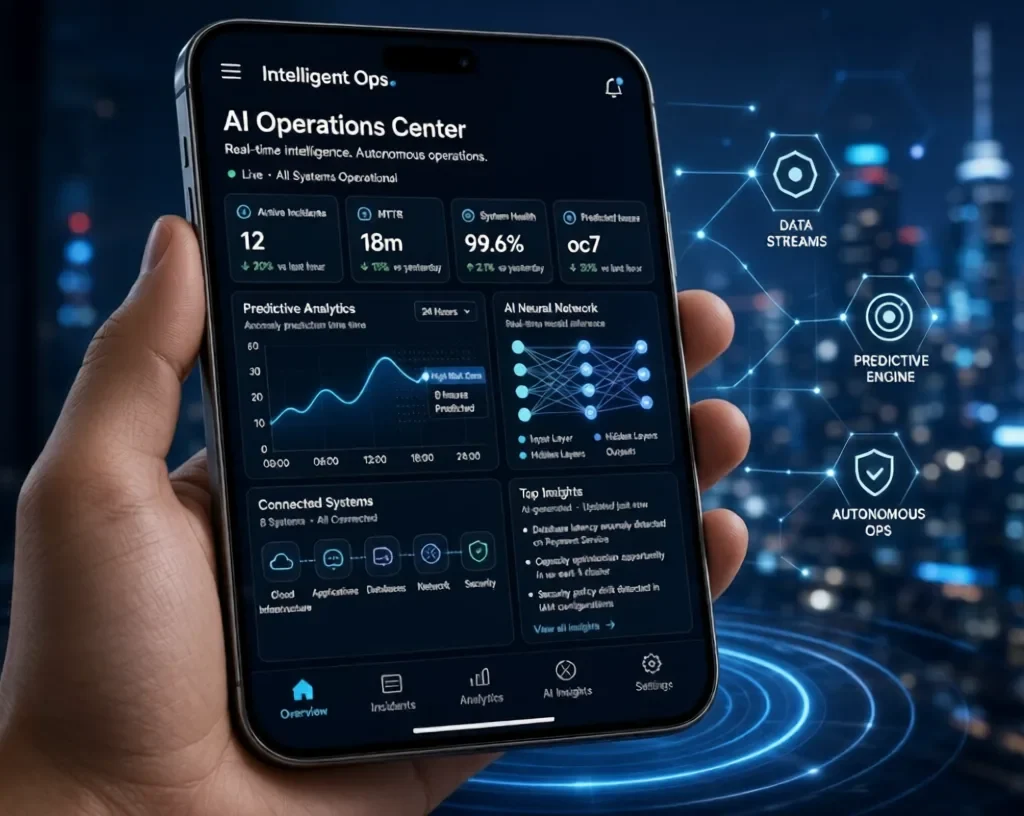
An adaptive backend is not one product. It is several pieces working together: event driven architecture that reacts to changes as they happen instead of on a fixed schedule, real time telemetry and observability that make system behavior visible, AI agents that interpret that telemetry, workflow orchestration tools that let agents actually do something, policy engines that define what an agent is and is not allowed to touch, and human approval gates for anything consequential. None of these pieces is new by itself; what makes the combination Intelligent Ops is that they are wired together in a closed loop instead of sitting as separate tools.
Microsoft’s Azure infrastructure team calls its version of this “agentic cloud ops,” where specialized agents plan and execute multi-step tasks across the cloud management lifecycle while staying inside existing access controls and compliance policies. Amazon’s DevOps Guru takes a narrower but well documented slice of the same idea, using machine learning baselines built from operational history to flag anomalous application behavior before it becomes an outage. Digital twins, virtual models of physical or logical systems, are starting to appear in manufacturing and supply chain settings for the same reason: you cannot reason well about a system you cannot see.
What if the backend is no longer waiting for instructions? That is the practical shift these pieces add up to.
Where Intelligent Ops Creates Real Value
The value shows up differently depending on where you look.
In enterprise IT operations and cloud infrastructure, agents shorten mean time to resolution by correlating alerts instead of forwarding all of them. In cybersecurity operations, agents triage suspicious logins and unusual traffic, isolating a compromised account faster than a human analyst working through a queue. In supply chains and warehouses, agents reconcile inventory signals with shipment data and flag mismatches before a stockout happens. In customer service, agents route and partially resolve tickets, escalating anything emotionally sensitive or contractually complex to a person. In finance operations, agents reconcile transactions and flag anomalies for review rather than approving them outright. In manufacturing, sensor driven agents predict equipment degradation before a line stops. In DevOps and database administration, agents watch deployments and query performance, catching regressions early. In incident management and business process automation, agents keep the paper trail current so postmortems are based on evidence instead of memory.
The common thread across every one of these is speed of detection paired with a documented, reviewable action, not silent autonomy.
Case Study: A Documented ITSM Deployment
For a concrete, sourced example of Intelligent Ops in production rather than a hypothetical, consider the publicly documented engagement between OneReach.ai and Getronics, a European ICT services provider.
The challenge: Getronics needed to manage IT service management ticketing, requests and incidents, at large scale across multiple channels and languages.
The approach: AI agents were deployed on OneReach.ai’s orchestration platform to log tickets directly into ServiceNow, guide users through resolution steps across web chat, Microsoft Teams, and email, and hand off to a human agent when a case needed judgment, a human-in-the-loop design rather than a fully autonomous one.
The reported outcome: according to the vendor’s published account, the deployment went live in four to eight weeks, automated resolution for roughly 85 percent of tickets, and now handles more than one million tickets annually.
The practical lesson: these are vendor-reported figures from a single documented deployment, not an independently audited study, and results will vary by organization. What is verifiable is the pattern: narrow scope, existing systems of record left in place, and a human-in-the-loop step retained for anything the agent could not confidently resolve. That combination, not blanket autonomy, is what made the rollout measurable.
The Hidden Risks
None of this is free of danger, and pretending otherwise would be irresponsible. Every benefit described above assumes Intelligent Ops is implemented with real governance behind it, not just enthusiasm.
An agent can take an incorrect autonomous action based on a plausible sounding but wrong conclusion, the operational version of a hallucination. Overly broad permissions turn a useful agent into a dangerous one; an agent that can restart a service can, misconfigured, also delete data. Security vulnerabilities in agent tooling create a new and largely invisible attack surface. Model drift means an agent tuned on last year’s traffic patterns can misjudge this year’s. Poor observability into what an agent actually did makes postmortems and compliance audits nearly impossible. Vendor lock-in and cost escalation are real commercial risks once an enterprise depends on a specific orchestration platform. And cascading failures are a genuine concern: an agent that reacts to a bad signal by taking a bad action can spread a small problem into a large one faster than a human ever could.
This is why frameworks like the NIST AI Risk Management Framework exist, giving organizations a structured, voluntary way to govern AI systems for trustworthiness, accountability, and safety. Human oversight is not a temporary crutch on the way to full autonomy. For anything involving financial commitments, customer-facing decisions, legal exposure, or irreversible actions, keeping a human in the approval path is a permanent, responsible design choice, not a limitation to be engineered away.
How Companies Should Start
Nobody needs to rebuild their entire backend to benefit from Intelligent Ops. The organizations getting this right tend to follow a similar path.
- Start with one narrow, well-understood workflow, such as ticket triage or a single class of infrastructure alert.
- Choose a use case with a measurable baseline, so improvement is provable rather than assumed.
- Connect the agent to reliable, already-trusted data sources before expanding its reach.
- Define explicit permission boundaries in writing before deployment, not after an incident.
- Keep human approval gates on anything irreversible or customer-facing.
- Log and monitor every agent action so it can be reviewed and explained.
- Deliberately test failure scenarios, including what happens if the agent is wrong.
- Measure return on investment against the original baseline before expanding scope.
- Expand gradually, one workflow at a time, rather than all at once.
The Future
Where does Intelligent Ops go from here? The realistic trajectory is not full autonomy; it is more coordination inside firmer boundaries. Enterprises are likely to see multiple specialized agents working across connected applications, an inventory agent talking to a logistics agent, a security agent talking to an access management agent, while humans retain strategic control over policy, budget, and anything with real consequences. Analysts including Gartner have pointed toward consolidated platforms that unify this kind of orchestration for both business and IT users over the next several years. That is a measured, evidence-based direction, not a prediction of machines running enterprises unsupervised.
Bringing It Back to the Incident
Go back to that Tuesday afternoon. In a backend built around Intelligent Ops, the slowdown gets sensed within seconds, correlated with a recent deployment, and either fixed automatically inside a pre-approved boundary or escalated to a human with the diagnosis already attached. The customer experience barely changes. The engineer’s afternoon does.
The deeper change enterprise leaders should take from this is not that they are “adding AI” to their backend. It is that their systems are moving from waiting for instructions toward observing, reasoning, responding, and verifying within limits they define and can audit. That is a meaningful shift in how operational risk gets managed, and it deserves the same discipline enterprises apply to any other critical system: test it, measure it, and expand it only as fast as the evidence supports.
Frequently Asked Questions
What is Intelligent Ops? Intelligent Ops describes enterprise backend systems that use AI agents to observe operational conditions, reason about causes, take or recommend action, verify results, and escalate to humans when needed, rather than relying only on static rules and manual monitoring.
How are AI agents changing enterprise backend systems? AI agents connect to monitoring, ticketing, and orchestration tools so they can detect anomalies, correlate signals across systems, and execute or propose a bounded response, shrinking the time between a problem appearing and a fix being applied.
What is the difference between Intelligent Ops and traditional automation? Traditional automation runs a fixed action for a fixed trigger. Intelligent Ops involves agents that interpret context, reason about the most likely cause among several possibilities, and adapt their response, while still operating inside defined permission boundaries.
Can AI agents safely manage enterprise operations? They can safely manage narrow, well-scoped, well-monitored tasks with human approval gates on anything consequential. Full unsupervised control of enterprise operations is not something current evidence supports, and most credible implementations keep a human in the loop.
What are the biggest risks of AI driven operations? Incorrect autonomous actions, excessive permissions, security vulnerabilities in agent tooling, model drift, poor observability into agent decisions, and cascading failures if a bad signal triggers a bad response are the most consistently cited risks.
How can a company begin implementing Intelligent Ops? Start with one narrow, measurable workflow, connect it to reliable data, set explicit permission boundaries, keep approval gates on irreversible actions, monitor every agent decision, and expand only after the results are measured.
Will Intelligent Ops replace IT operations teams? Evidence so far points to a change in the work rather than its disappearance. Agents absorb repetitive triage and detection tasks, while human teams spend more time on judgment calls, policy design, and reviewing what the agents did.