
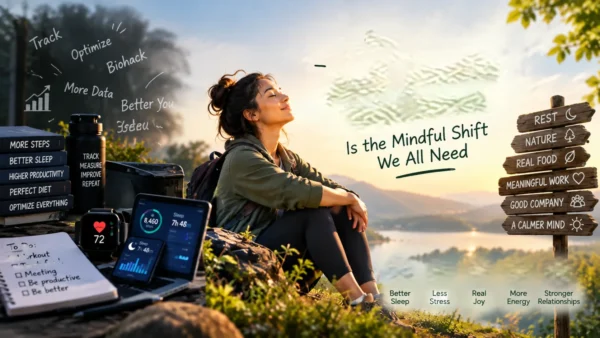
At 5:45 AM, the screen flashes amber before your feet even touch the hardwood floor.
Sleep performance score: 62%. Heart rate variability: suppressed. Recovery index: low. Readiness rating: poor.
You woke up feeling rested, but the little black silicone band around your wrist insists you are broken. Within ninety seconds, your morning transforms into an audit. You check your resting pulse, calculate your calorie baseline, review your overnight respiration, and queue up a thirty minute cold plunge followed by a stack of fourteen nootropics. Before you take your first sip of water, your day has acquired a performance quota.
What happens when the pursuit of better vitality becomes another relentless source of anxiety?
This is the hidden crisis of contemporary self care. Over the past decade, our quest for health quietly turned into an unpaid second shift. We adopted the ruthless metrics of corporate enterprise, key performance indicators, continuous optimization, daily auditing, and applied them to our biology.
Now, a quiet revolution is taking root. People are taking off the rings, turning off the notifications, and refusing to treat their bodies like servers that require around the clock maintenance.
It is called Anti Hustle Wellness, and it may be the most restorative cultural reset of our generation.
Table of Contents Of Anti Hustle Wellness
What Is Anti Hustle Wellness?
Anti Hustle Wellness is a deliberate movement away from obsessive self tracking, extreme biohacking, and the anxious belief that health must be earned through ceaseless self surveillance.
The philosophy treats wellbeing as an ongoing state of balance rather than a competitive project. In conventional wellness culture, you are permanently inadequate until you purchase the next supplement stack, log your macronutrients down to the gram, and hit your target metrics. Anti Hustle Wellness flips that assumption on its head. It insists that genuine health already belongs to you, rooted in rest, simplicity, community, nourishing food, restorative sleep, and the quiet wisdom of knowing when to stop.
The movement does not romanticize negligence. It does not demand that you throw your fitness trackers in the trash or discard medicine. Instead, it questions the exhausting premise that every hour of your existence requires engineering.
Your health is not a spreadsheet.
Why Wellness Started Feeling Like Work
The roots of this exhaustion run deep. During the 2010s, the Quantified Self movement promised liberation through numbers. Silicon Valley founders convinced us that if we could measure our biological markers, we could eliminate human vulnerability. We welcomed fitness bands, smart rings, continuous glucose monitors for nondiabetics, and infrared gadgets directly into our bedrooms.
Gradually, corporate hustle culture cannibalized healthy living. The same hustle mindset that urged young professionals to work eighty hour weeks crept into our private downtime.
A simple walk outdoors transformed into a zone 2 cardiovascular task. A quiet evening reading on the sofa became a failed opportunity to hit twenty thousand steps. Even restorative sleep became a high stakes competition where poor statistics yielded genuine dread.
When every breath, calorie, and heart contraction is tracked, evaluated, and scored, the nervous system never actually rests. You are constantly on the clock, performing for an algorithm that lives in your pocket.
The Hidden Stress of Constant Tracking
The medical community is beginning to sound the alarm on this digital obsession.
Researchers at institutions such as Rush University and Northwestern Medicine identified a formal clinical pattern known as orthosomnia. It describes individuals who develop severe sleep disturbances driven directly by the anxiety of trying to achieve perfect sleep tracker ratings. In striving for the ideal recovery score, people generate enough adrenaline to keep themselves awake for hours.
Similarly, an obsession with nutritional algorithms often bleeds into disordered eating patterns. Research published through the National Institutes of Health shows that while dietary logs can offer initial awareness, compulsive calorie counting frequently correlates with heightened eating anxiety and distorted body image.
There is also the phenomenon of technological alienation. When you rely exclusively on a sensor to tell you if you have energy, you gradually lose the capacity to feel your own body.
Can a healthier life actually require fewer numbers? Absolutely. Intuitive self awareness is a muscle. When you outsource it to an operating system, that muscle atrophies.
When Biohacking Goes Too Far
Optimization has real biological boundaries. While targeted biohacking practices can yield short term adaptations, the relentless pursuit of extreme interventions often triggers the exact breakdown it seeks to prevent.
The human body operates through homeostatic equilibrium. It thrives on manageable fluctuations of stress and recovery, a biological principle known as hormesis. Brief bouts of intense exercise or sauna exposure can be beneficial. But stacking extreme cold exposure, aggressive fasting protocols, intense exercise, and dozens of unregulated supplements creates chronic physiological overload.
The World Health Organization identifies chronic stress as a primary contributor to global disease burden. When your biohacking routine leaves you hypervigilant, exhausted, and socially isolated, it is no longer health care. It is chronic stress disguised as self improvement.
Technology should serve human life, not govern it. Continuous tracking is undeniably valuable for managing chronic cardiovascular illness or monitoring diabetes. However, applying clinical pathology tools to ordinary everyday living turns wellness into a perpetual medical emergency.
What Science Says About Rest and Recovery
The human nervous system possesses two primary operational gears: the sympathetic system, which mobilizes us for action, and the parasympathetic system, which governs digestion, cellular repair, and quiet recovery.
Hustle wellness keeps the sympathetic nervous system continuously active. Every notification and missed health goal registers as an urgent demand.
True physiological repair happens only when the parasympathetic system takes over. According to research from the Centers for Disease Control and Prevention, chronic sleep debt and sustained psychological tension degrade immune function, impair metabolic regulation, and elevate systemic inflammation.
Real recovery cannot be bought in a packet of powdered adaptogens. It demands genuine, unstructured downtime. It requires moments where nothing is being tracked, logged, or optimized.
A Real World Case Study: From Overwhelmed to Grounded
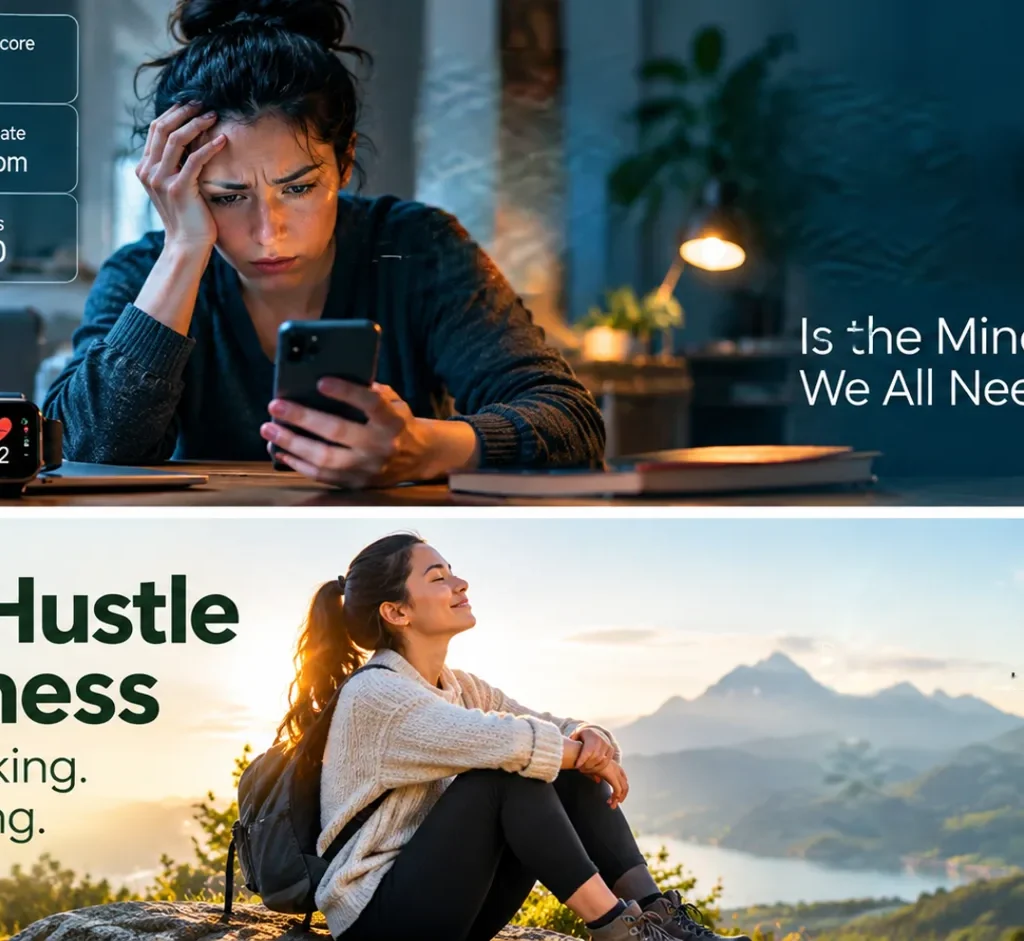
Consider the experience of Elena, a 34 year old digital product designer who spent three years immersed in high performance wellness tracking.
The Problem: Elena woke up every morning to a cascade of biometric alerts. She wore a continuous glucose monitor despite having no metabolic disease, measured her ketone levels twice daily, and scheduled every weekend around infrared saunas, cryotherapy sessions, and rigid zone training intervals.
The Pressure: Over time, Elena felt increasingly depleted. If her recovery score dipped, she felt anxious all day. Dinners with friends became agonizing logistical puzzles because restaurant meals did not fit her calculated macronutrient brackets. Her wellness routine had become a second job that paid zero dividends in joy.
The Turning Point: During an annual wellness checkup, Elena discovered that her resting cortisol levels were elevated, and her sleep quality had reached a three year low. Her physician asked a disarming question: When was the last time you took a walk without checking your heart rate? She could not remember.
The Change: Elena adopted an Anti Hustle Wellness mindset. She placed her tracking bands inside a bedside drawer, deleted her diet tracking apps, and stopped logging her runs. She replaced her rigid supplement regimen with home cooked whole foods and traded her scheduled cryotherapy appointments for long Sunday afternoons reading in the garden.
The Lesson: Within two months, Elena reported that her digestive issues resolved, her daytime focus returned, and her spontaneous energy climbed significantly. By removing the pressure to constantly measure her vitality, her body finally found the peace it needed to heal.
7 Simple Anti Hustle Wellness Practices
Transitioning to a calm, sustainable lifestyle does not mean abandoning healthy routines. It means removing the guilt and digital friction.
Here are seven grounded practices you can begin using today:
1. Institute Screen Free Awakening
Do not let an algorithm tell you how you slept. Keep your phone out of the bedroom overnight. When you wake, take three deep breaths, notice how your limbs feel, stretch gently, and assess your energy using your own body intuition.
2. Practice Aimless Walking
Take a walk without setting a step goal or monitoring your pace. Leave your tracking watch on the charger. Walk through a park or down your neighborhood street, letting curiosity rather than a distance counter guide your path.
3. Enjoy Social Eating Without Guilt
Nutrition is fundamentally about nourishment, pleasure, and connection. Share a rich, unmeasured meal with family or close friends. Savoring good food in community supports mental wellbeing in ways a precision nutrient shake never will.
4. Schedule White Space on Your Calendar
Block out two hours each week dedicated to absolutely nothing. No reading self help literature, no meal preparation, no home workouts. Allow your brain the luxury of boredom and spontaneous daydreams.
5. Choose Gentle Movement Over Punishment
If your body feels fatigued, trade high intensity interval training for a slow yoga sequence or a casual bike ride. Exercise should restore your vitality, not drain the last drop of reserve energy you possess.
6. Curate Your Digital Wellness Feed
Unfollow influencers who suggest that you are failing if you do not wake up at 4:30 AM to plunge into an ice tub. Surround your visual feed with realistic voices that champion balance, rest, and real food.
7. Reconnect With Deep Social Ties
Human connection is one of the most reliable predictors of long term longevity. An afternoon laughing with a trusted friend provides more genuine biological restoration than an expensive infrared blanket.
Who Should Be Careful With Wellness Trends?
Certain groups are especially susceptible to the harms of aggressive optimization culture:
- People with histories of disordered eating: Calorie tracking apps and continuous glucose monitoring can quickly retrigger harmful obsessive behaviors.
- Chronic insomniacs: Tracking every sleep cycle frequently deepens performance anxiety around bedtime, intensifying orthosomnia.
- Perfectionists and high achievers: Ambitious personalities often turn self care into another competitive arena, driving themselves toward burnout.
- Anyone experiencing financial vulnerability: Expensive wellness gadgets, unvetted proprietary supplements, and specialized clinics consume financial resources that would be far better spent on fresh groceries and professional medical care.
How to Build a Calmer Routine
Building a calmer personal routine begins with a willingness to experiment.
Start by taking a 48 hour technology sabbatical from all wearable tracking devices. Notice the emotions that emerge. Do you feel uneasy without validation from a wearable dashboard? That unease is valuable data. It marks the precise boundary where convenience ended and dependence began.
Next, simplify your daily health tasks down to three non negotiable pillars: consistent sleep hours, clean hydration, and simple whole foods. Everything else is secondary decoration.
When you strip away the digital noise, taking care of yourself stops feeling like a chore. It becomes a sanctuary of quiet comfort.
Frequently Asked Questions
What is Anti Hustle Wellness?
Anti Hustle Wellness is a conscious movement that prioritizes gentle, sustainable health habits over extreme biohacking, continuous metric logging, and corporate productivity culture. It focuses on nervous system recovery, joyful living, and intuitive self care.
Why are people moving away from extreme health tracking?
Many individuals discover that constant monitoring generates more anxiety than insight. The pressure to achieve perfect sleep scores, ideal macronutrient splits, and step goals turns daily living into an ongoing performance audit.
Is health tracking always harmful?
Not at all. Digital tools and wearable trackers provide life saving data for individuals managing chronic conditions like cardiovascular disease or diabetes. They become harmful only when healthy individuals use them compulsively, replacing natural body awareness with anxiety.
What is wrong with biohacking?
Biohacking is not inherently dangerous, but its extreme expressions often overlook basic biological realities. Chronic cold exposure, rigid fasting, and massive supplement routines can overwhelm the nervous system if pursued without adequate rest and recovery.
How can I practice Anti Hustle Wellness starting today?
Begin by taking off your fitness monitor for a weekend. Eat a meal without logging its calories, go for a walk without measuring your pace, and go to bed when you feel sleepy rather than when an application commands you to do so.
Can doing less actually improve health?
Yes. Reducing baseline psychological stress lowers chronic cortisol and systemic inflammation, which supports immune balance, optimizes digestion, and encourages deeper, more natural sleep.
The Freedom of Sustainable Health
Tomorrow morning, the sun will rise through your curtains at its usual hour.
Your smartphone will sit silently on its charger in the other room. There will be no morning sleep grades waiting for you, no urgent readiness scores, and no digital reminders that you fell short of an imaginary ideal.
You will open your eyes, feel the warmth of the blankets, and stretch your legs. You will listen to the quiet murmur of your own breath, pause, and decide for yourself how you feel.
Health was never meant to be a test you could fail. It is the steady, quiet rhythm that allows you to enjoy your life. Let go of the metrics, step off the optimization treadmill, and claim the peace of simply being alive.