
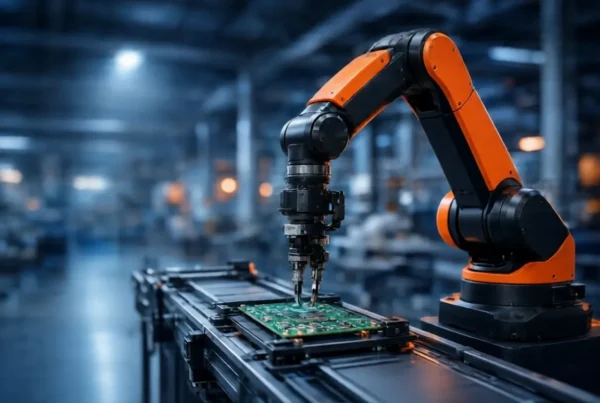
The warehouse floor is dark, silent, and chaotic. At 2:14 AM, an unsecured metal crate slides off a forklift path, landing squarely across a narrow corridor. A shadow glides forward on rubber tracks.
It is not a human guard. It is a machine.
Its dual optical cameras sweep the room. Photons bounce off the fallen metal, striking solid-state sensors. Invisible LiDAR pulses map thirty thousand spatial points every second. In a fraction of a heartbeat, the machine realizes the path is blocked. No pre-programmed script covers this exact mess. No human operator sits behind a joystick.
Instead, its onboard processors fire. Actuators hum inside its mechanical joints. It calculates the mass of the crate, measures grip surface friction, adjusts its hydraulic wrist, and slides the obstruction out of the way. Then, it rolls forward on its original route.
You are not looking at a repetitive factory arm or a chatbot locked behind glass. You are looking at the frontier of physical robotics.
The boundary between digital code and tangible matter is collapsing. For decades, computers observed our world or generated text about it. Today, intelligent machines are stepping into our hallways, fields, and hospitals to physically shape reality.
Table of Contents
What Is Physical Robotics?
At its core, physical robotics represents the merger of advanced artificial intelligence with physical embodiment. Engineers often call this embodied artificial intelligence or physical AI.
To understand it, consider the difference between a mind without limbs and a body without awareness.
Traditional automation involves rigid, blind machines. Think of an automotive welding arm bolted to an assembly line. It repeats the exact same weld sixteen thousand times a day with sub-millimeter precision. Move that car chassis two inches to the left, however, and the arm welds empty air or damages the vehicle. It cannot see. It cannot adapt.
Software AI represents the opposite extreme. Large language models and virtual agents can write computer code, summarize legal briefs, or produce artwork. Yet they cannot pick up a glass of water, open a stuck door, or tie a shoelace. They exist solely in silicon and cyberspace.
Physical robotics unites these two worlds. It gives intelligence a physical presence. These machines observe an unpredictable environment, reason through changing circumstances, make autonomous choices, and exert physical force to achieve real-world goals.
The AI Brain Meets the Physical World
How does a collection of circuits and metal limbs actually navigate human spaces? It relies on a continuous feedback loop: sense, decide, act, and learn.
Here is the anatomy of an embodied machine:
- Perception Systems and Sensors: High-resolution optical cameras provide visual context, while LiDAR sensors cast laser pulses to generate real-time 3D depth maps. Force-torque sensors in the fingertips measure contact resistance down to fractions of a gram, ensuring the robot does not crush fragile items.
- Autonomous Decision-Making: Massive neural networks process sensory feeds simultaneously. Instead of following brittle “if-then” code, the robot interprets spatial context and plans actions probabilistically.
- Edge Computing: When a robot balances on uneven terrain, sending sensory data to a distant cloud server introduces fatal latency. Milliseconds matter. Edge AI processors mounted directly on the chassis run complex inference models locally, ensuring split-second balance and obstacle avoidance.
- Motors and Actuators: High-torque brushless electric motors and compact harmonic drives act as mechanical muscles. They translate digital commands into physical acceleration, rotational torque, and subtle grip pressure.
- Navigation and Mapping: Using spatial algorithms like Simultaneous Localization and Mapping (SLAM), the robot continuously tracks where it stands in relation to dynamic obstacles.
- Manipulation and Grasping: Coordinated tactile control allows robotic fingers to lift a steel bolt, grasp a slick piece of fruit, or fold a cotton cloth without dropping or tearing the material.
When these systems synchronize, the machine ceases to be a passive computer. It becomes an active agent in our everyday physical space.
Why Physical Robotics Matters
Software alone cannot harvest ripe crops, transport patients between hospital beds, or repair severed underwater power cables. The modern world is physical, messy, and heavy.
Our global infrastructure faces structural pressures:
- Labor Shortages: Critical sectors like logistics, eldercare, agriculture, and construction face chronic personnel deficits.
- Human Safety: Demanding jobs involving toxic chemicals, heavy structural loads, and deep underground extraction carry severe physical risks.
- Productivity Limits: Human endurance has biological limits, whereas autonomous systems can operate continuously through monotonous or dangerous tasks.
Moving from screen-bound intelligence to physical action is the single most transformative shift in modern computing. It bridges digital abundance with physical scarcity.
Where Robots Are Already Moving
Physical robotics is already moving past laboratory prototypes and into everyday enterprise settings.
+---------------------+-------------------------------+--------------------------------+
| Sector              | Robotic Application           | Primary Real-World Value       |
+---------------------+-------------------------------+--------------------------------+
| Logistics & Retail  | Autonomous mobile sorters     | Continuous pallet movement     |
| Healthcare          | Precision surgical systems    | Sub-millimeter incision control|
| Agriculture         | Autonomous weeding & harvest  | Targeted chemical reduction    |
| Energy & Utilities  | Structural inspection quadrupeds| Confined-space hazard removal |
+---------------------+-------------------------------+--------------------------------+
Logistics and Fulfillment
Fulfillment centers operate as giant living organisms. Fleets of autonomous mobile robots navigate busy floor plans, ducking under shelves to transport inventory to human packing stations without colliding with personnel.
Agriculture and Food Production
Tractors equipped with computer vision run across vast fields, distinguishing between cash crops and intrusive weeds in milliseconds. Micro-actuators spray concentrated drops of herbicide directly onto weed leaves, cutting chemical runoff by up to eighty percent.
Healthcare and Clinical Support
Robotic surgical platforms translate a surgeon’s hand movements into micro-movements inside the human body, filtering out natural hand tremors. Down the hall, autonomous delivery carts ferry sterile tools, meals, and medications through crowded corridors.
A Real-World Case Study: Boston Dynamics’ Stretch in Modern Warehousing
To witness physical robotics operating under genuine commercial pressure, look inside modern supply chain logistics.
The Original Problem
Unloading corrugated cardboard boxes from shipping containers is one of the most physically punishing jobs on Earth. Workers spend hours inside unconditioned steel containers lifting heavy, shifting packages in extreme temperatures. Musculoskeletal injuries are common, turnover is exceptionally high, and container processing creates severe bottleneck delays at freight docks.
The Robotic System
Robotics firm Boston Dynamics developed Stretch, an autonomous robot designed specifically for case handling in logistics hubs. Unlike stationary industrial arms, Stretch is built upon an omnidirectional mobile base capable of maneuvering through tight container doorways.
Sensing and AI Integration
Stretch uses custom computer vision and optical sensors mounted near its gripper. As it approaches a wall of stacked boxes, its onboard vision models analyze the wall in real time. It detects box orientations, assesses package damage, recognizes variable dimensions, and calculates the optimal pick angle without needing prior information about the container’s contents.
Physical Interaction
The machine uses an ultra-lightweight carbon fiber arm with an array of smart vacuum cups. Force-sensing feedback constantly monitors vacuum pressure. If a cardboard box bends, tears, or shifts mid-air, the actuators immediately compensate to retain suction without crushing the contents.
Documented Outcomes and Industry Impact
Commercial trials and deployments across global logistics firms confirmed that Stretch can reliably handle packages weighing up to fifty pounds at sustained speeds of several hundred cases per hour. By taking on the physical burden of unloading shifting freight, the system reduces severe ergonomic strain on warehouse teams while stabilizing shipping throughput.
This verified deployment demonstrates that modern physical robotics can transition from carefully controlled laboratory demonstrations to gritty industrial environments with measurable success.
The Hardest Problem: Reality
Despite exciting progress, deploying embodied AI in unpredictable spaces remains remarkably difficult. Roboticists call this the challenge of unconstrained environments.
Software programs live in clean, predictable environments where rules are absolute. The physical world, by contrast, is unforgiving:
- Moravec’s Paradox: What is hard for humans is easy for machines, and what is easy for humans is hard for machines. A computer can master complex chess or pass legal exams in seconds. Yet teaching a robotic arm to pick up an egg without cracking it, or to walk across a wet grass slope, demands massive computational effort.
- Sensor Noise and Dirt: Rain, dust, grease, and glare blind optical cameras and distort LiDAR reflections. A robot must remain dependable even when its eyes are smudged with oil.
- Mechanical Wear and Power: Software code does not suffer from joint fatigue, frayed wiring, or thermal degradation. Physical robots face friction, mechanical wear, and the strict limits of onboard battery chemistry.
- Infinite Edge Cases: A child running into a hallway, an unusual shadow across a loading dock, or a wet paper bag behaving differently than a dry one are edge cases that challenge algorithmic certainty.
Engineers are addressing these barriers through advances in synthetic training data, self-supervised learning, and high-fidelity physics simulations like NVIDIA Isaac Sim, allowing robots to experience thousands of virtual years of physical trial and error before taking their first step on real concrete.
Safety, Governance, and Responsible Deployment
When a machine possesses mass, speed, and autonomous agency, safety cannot be an afterthought. A software bug in an accounting app causes an error code. A control loop failure in a two-hundred-pound metal machine can damage property or injure a person.
International bodies like the National Institute of Standards and Technology (NIST) and the International Organization for Standardization (ISO) have established rigorous physical safety standards, such as ISO 13482 for personal care robots and ISO 10218 for industrial robotic safety.
Physical Safety Protocols
│
├── Mechanical Level: Force-limiting joints & soft-stop compliant actuators
├── Sensor Level: Redundant, multi-modal proximity detection rings
└── Architecture Level: Hardware-isolated emergency override systems
Modern collaborative robots, or cobots, feature force-limiting joints and padded shells. If a human unexpectedly steps into their path, sensors register the change in resistance within milliseconds, immediately cutting motor power to prevent injury. Transparent verification and hardware-level safety switches remain mandatory requirements for any deployment near people.
What Should Businesses Prepare For?
The rapid acceleration of physical robotics will change how operational businesses plan their investments. Enterprise leaders should look past hype and adopt practical, measured steps:
- Audit Repetitive Physical Bottlenecks: Identify operational workflows that are hazardous, dull, or plagued by high labor turnover. Those are prime candidates for autonomous mobile manipulation.
- Prioritize Data Infrastructure: Autonomous machines rely on accurate site maps, robust local networks, and clean digital inventory tracking. Prepare your physical facilities with reliable connectivity and clear floor planning.
- Focus on Collaborative Augmentation: The most successful early implementations do not eliminate people. They remove heavy lifting from workers, allowing teams to supervise multiple robotic units and handle complex exceptions.
- Evaluate Total Cost of Ownership: Look beyond the initial purchase price. Factor in software integration, maintenance contracts, sensor calibration, worker retraining, and safety certification.
Frequently Asked Questions
What is Physical Robotics?
Physical robotics refers to machines that combine artificial intelligence with physical bodies, sensors, and actuators. Unlike pure software AI, these systems can observe physical environments, make autonomous decisions, and manipulate physical objects in the real world.
How is Physical Robotics different from traditional industrial robotics?
Traditional industrial robots follow fixed, pre-programmed code inside caged zones and cannot adapt if their environment changes. Physical robotics systems use machine vision, tactile sensing, and adaptive AI to operate safely in dynamic, unstructured spaces alongside humans.
How does AI improve Physical Robotics?
AI provides perception, spatial reasoning, and real-time planning. Machine learning allows robots to recognize unfamiliar items, calculate safe movement trajectories, adapt to changing floor conditions, and improve their physical grasping techniques through experience.
Where is Physical Robotics being used today?
Major real-world uses include autonomous logistics and pallet moving in warehouses, precision robotic surgery in healthcare, automated weed control and crop harvesting in agriculture, and autonomous structural inspections in hazardous energy facilities.
What are the biggest challenges facing Physical Robotics?
Key hurdles include handling unexpected environmental changes, overcoming battery and power density limitations, managing physical mechanical wear, and training machines to grasp soft or irregular objects with human-like dexterity.
Will Physical Robotics replace human workers?
While physical robotics will automate specific high-risk and highly repetitive manual tasks, the primary industry trend focuses on collaboration. Robots handle heavy, hazardous, or ergonomic loads, while human workers step into oversight, maintenance, exception handling, and technical operations.
The Next Physical Horizon
We are leaving behind the era when artificial intelligence was confined to glowing computer monitors, smartphone screens, and distant server farms.
The rise of physical robotics marks a fundamental shift in technology. Matter and computation are learning to speak the same language. As machines learn to perceive our physical environments, navigate our halls, and safely assist our efforts, they present immense opportunities alongside genuine design challenges.
The goal is not to hand our world over to automated systems, but to build dependable, well-engineered physical partners that lift burdens, improve workplace safety, and expand human capability across the physical world.