
Can AI in Indigenous Languages serve without taking away the rights of the people who speak it?
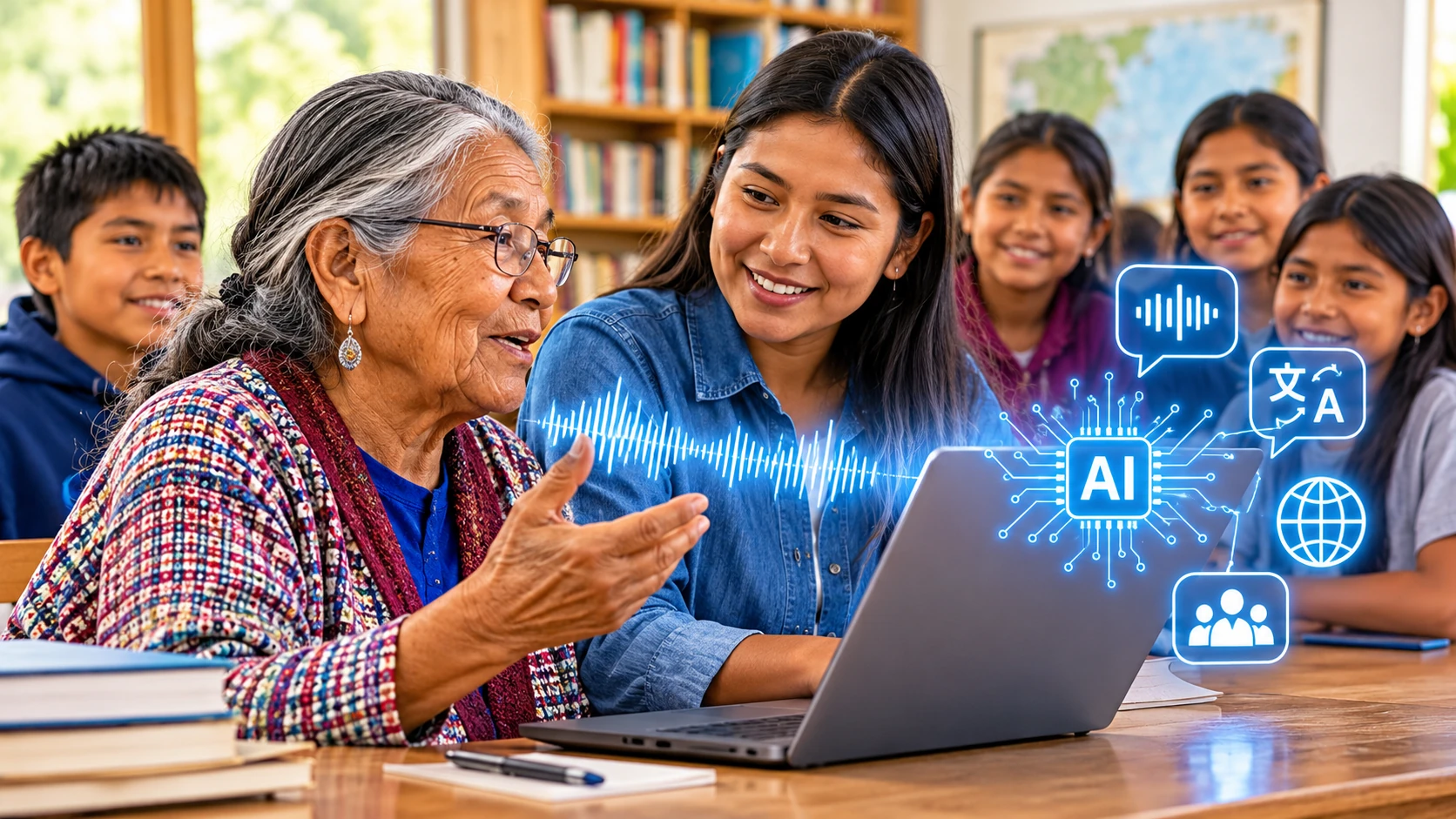
Imagine an elder telling a story in her mother tongue. Her words carry lessons about nature, family and the history of her people.
A technology company records her voice. Its AI system learns the language and begins translating it into English.
But there is a problem.
The machine changes an important expression. A lesson about respecting nature becomes a simple instruction. A private cultural story is added to a public database.
The language is now available online, but the community has lost control over how its knowledge is used.
This is an illustrative fictional example, not a reported incident. However, it raises a real question: What happens when AI can speak your language but cannot understand your culture?
Indigenous languages carry more than words. They carry memories, knowledge, identity and ways of seeing the world. AI can help keep these languages alive, but only when the people who speak them remain in control.
Table of Contents For AI in Indigenous Languages
The hidden cost of teaching AI a language
AI learns from examples. These examples may include recorded voices, written stories, conversations and translations.
Three important technologies are involved:
- Speech recognition: Changes spoken words into written text.
- Machine translation: Changes text from one language into another.
- Language models: Learn patterns in language and use them to answer questions or create text.
These tools can help children learn their mother tongue, allow teachers to prepare lessons and make public information easier to understand.
But there is a hidden problem.
A computer may learn the words without learning their full meaning.
For example, a word may describe a plant, but it may also carry knowledge about when the plant grows, how it is used and why it matters to the community.
A simple translation may miss all these details.
The problem becomes more serious when recordings include family stories, sacred songs or knowledge that should only be shared with certain people.
The important question is not only how much data AI can collect. It is who has the right to share it and decide how it is used.
Building speech and translation systems without extracting or misrepresenting community knowledge
This is the real challenge.
Building speech and translation systems without extracting or misrepresenting community knowledge means creating technology with people, not simply collecting information from them.
Consider two approaches.
| Traditional data collection | Community-led AI |
|---|---|
| Outside teams collect recordings | Communities help decide what to record |
| Companies set most data rules | Communities help set the rules |
| Cultural meaning may be overlooked | Local experts check meaning |
| Benefits may go mainly to companies | Benefits are shared fairly |
| Future use may be unclear | Future use is agreed in advance |
This difference matters because a recording is not just a computer file. It may contain a person’s voice, family history and cultural knowledge.
Who owns the language data?
There is no single ownership answer for every community or recording. Individual speakers, families, cultural groups and recognised community institutions may have different rights and responsibilities.
A responsible project must discuss these rights before collecting data.
It should explain:
- Why the information is needed.
- Who will store it.
- Who can access it.
- Whether it will be used for commercial AI.
- Whether it can be shared with other organisations.
- How people can request restrictions or removal.
Permission should be clear, informed and freely given.
A public recording should not automatically be treated as permission for every possible commercial use.
What is indigenous data sovereignty?
Indigenous data sovereignty means that Indigenous peoples should have authority over data concerning their communities, knowledge, lands and identities.
The CARE Principles provide a useful guide:
- C: Collective Benefit. The community should gain something meaningful.
- A: Authority to Control. People should have a say in how their data is used.
- R: Responsibility. Researchers and companies must explain and answer for their actions.
- E: Ethics. Community rights and wellbeing must come first.
These principles were developed by the Global Indigenous Data Alliance. They remind technology developers that making data available is not the same as making its use fair.
Translation is not the same as cultural understanding
Consider these three situations.
1. Word-for-word translation
A machine translates every word correctly but misses the meaning of a local expression.
2. Cultural understanding
A local language expert explains why the expression matters, when it is used and what it means to the community.
3. Community-approved translation
The AI produces a translation, but local speakers review it before it is used in schools, hospitals or public services.
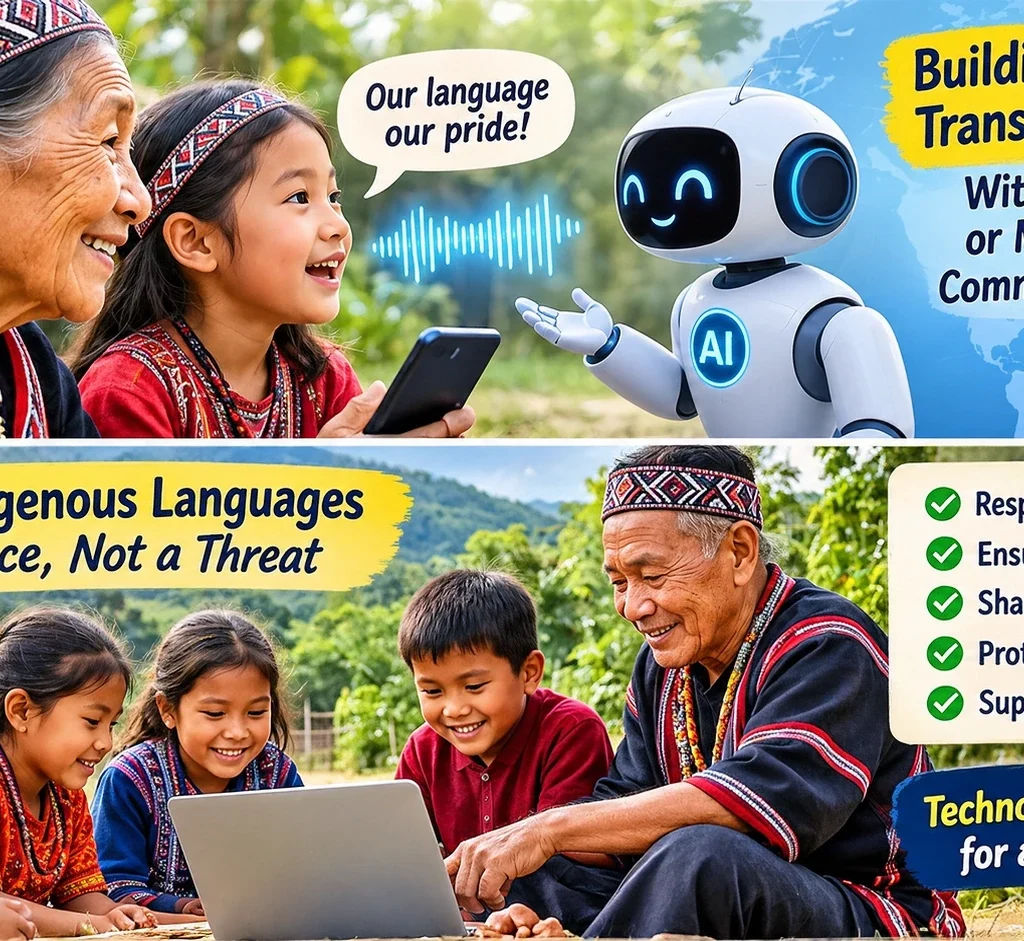
The third approach is stronger because it combines technology with human knowledge.
AI can suggest an answer. It should not automatically become the final judge of cultural meaning.
A better model: Communities as technology partners
How can developers build responsible AI?
Here is a practical ten-step framework.
The 10-step community-led AI framework
- Consult the community firstSpeak with elders, teachers, young people and language groups before collecting recordings.
- Obtain informed consentExplain the project in a language people understand. Never assume that silence means permission.
- Set data access rulesDecide who can see, download, share and reuse the recordings.
- Include local language expertsLet native speakers check words, pronunciation, dialects and cultural meaning.
- Protect sacred knowledgeKeep restricted songs, ceremonies, private stories and sensitive information out of public datasets unless the proper authorities approve their use.
- Agree on ownership and licencesPut data rights, permitted uses and commercial conditions in clear written agreements.
- Share benefits fairlyPay contributors where appropriate and invest in local education, training and technology.
- Test with community membersAsk local speakers to test translations and report mistakes before public release.
- Monitor the systemCorrect errors, review new uses and check whether the technology is causing harm.
- Allow restrictions and withdrawalCreate a clear process for withdrawing consent or restricting future use. Explain honestly that removing data from an already trained model may not always be technically possible.
This framework turns communities from data suppliers into decision-makers.
A practical example: A village builds its own language tool
Consider a hypothetical village in India where only a small number of older people speak a local indigenous language fluently.
A technology team approaches the village with a proposal to build an AI translation tool.
Instead of immediately recording everyone, the team holds meetings with elders, teachers and young people.
The elders identify which stories can be shared and which must remain private. Teachers prepare simple learning sentences. Young speakers help test the mobile application.
The community also agrees that:
- No sacred recordings will enter the public dataset.
- The village language committee will review translations.
- Children will use the tool for learning, not as a replacement for elders.
- The project will provide training to local people.
- Commercial use will require separate permission and agreed benefits.
After several months, the application helps children practise their language and allows teachers to prepare learning materials.
The most important achievement is not the software.
It is that the community has gained a useful tool without surrendering control over its knowledge.
This is the kind of partnership responsible AI should encourage.
Real-world lessons from language technology
Some existing initiatives offer useful lessons.
How Rwanda is Making Voice Tech More Open – Mozilla Foundation
1. Mozilla Common Voice
It allows people to contribute spoken language recordings and text to community-created datasets. Its platform supports hundreds of languages and includes community participation in speech-data creation. However, contributors must still understand the dataset’s license and the limits of its governance model.
A Fight to Save Indigenous Language, Culture | InformationWeek
2. First Peoples’ Cultural Council
In Canada, the organisation provides guidance and technology resources for Indigenous language revitalisation, including language keyboards and digital tools. It demonstrates that useful language technology includes basic digital access, not only advanced AI.
India Launches Adi Vaani, AI Tool for Tribal Languages
3. Adi Vaani in India
A Government of India publication describes Adi-Vaani as an AI-based platform supporting tribal languages, including Santali, Bhili, Mundari and Gondi, through translation, speech-to-text and language learning. This is a promising example of applying AI to India’s linguistic diversity. Its description alone, however, does not establish that every community has full control over its data.
Read the government publication
A lesson from Māori data sovereignty
New Zealand’s Māori Data Sovereignty movement has helped shape wider discussions about Indigenous control over data. The University of Auckland explains how the CARE Principles were developed with the involvement of Te Mana Raraunga, the Māori Data Sovereignty Network. University of Auckland
These examples have different goals and governance arrangements. They should not be treated as proof that every project already follows the same ethical standards.
What the numbers tell us
The language gap is bigger than many people realise.
8,324
Languages documentedIn UNESCO’s World Atlas of Languages.
~7,000
Still in useSpoken or signed languages.
~1,000
Represented onlineAccording to UNESCO’s multilingualism facts.
~1,500
At risk of losing users UNESCO’s estimate of languages at risk in the near future.
What does this mean?
Thousands of languages are still used, but their digital presence is much smaller. If technology supports only a limited number of languages, many people may find it difficult to use digital services in their mother tongue.
UNESCO also reports that more than a quarter of a billion learners lack education in the language they understand best.
For India, the challenge is especially important. UNESCO’s 2025 education report describes 1,369 mother tongues and highlights the unequal digital and educational support available to smaller languages.
These numbers show why language technology matters. But they also show why communities must help decide how that technology is built.
Benefits and risks of AI for indigenous languages
| Benefits | Risks |
|---|---|
| Children can learn their mother tongue | Incorrect translations |
| Teachers can prepare learning material | Loss of cultural meaning |
| Public information becomes accessible | Privacy violations |
| Speech can be converted into text | Misuse of recorded voices |
| Digital archives can support research | Commercial exploitation |
| Younger people can practise language | Dialects may be ignored |
One important limitation deserves attention: AI cannot replace daily human communication.
A language remains strong when families speak it, children learn it and communities use it in everyday life. A digital archive alone cannot achieve that.
Five myths about AI and indigenous languages
Myth 1: More data always makes AI better.
Reality: Poor-quality or culturally unsuitable data can make a system less reliable.
Myth 2: Correct words mean correct meaning.
Reality: Local expressions may have deeper meanings that machines cannot recognise.
Myth 3: Public recordings are free for every use.
Reality: Public availability does not automatically grant unlimited commercial or cultural permission.
Myth 4: Digital storage saves a language.
Reality: Languages survive through speakers, families, education and everyday use.
Myth 5: Big technology companies are always the best solution.
Reality: Local institutions and community-led teams may understand cultural needs better.
What should happen next?
Different groups have different responsibilities.
- AI developers: Build systems with local speakers and publish clear information about data use.
- Community leaders: Establish language committees and decide which knowledge can be shared.
- Universities: Train local researchers and support community-controlled research.
- Governments: Fund mother-tongue education and responsible language technology.
- Teachers and parents: Encourage children to speak, read and record their languages with appropriate permission.
A useful starting point is the UNESCO International Decade of Indigenous Languages (2022–2032), which encourages action to preserve and promote these languages.
Conclusion: Let technology serve the language
AI offers an important opportunity to protect indigenous languages. It can help children learn, teachers prepare lessons and communities create digital resources.
But technology must follow an important rule: the people who carry a language should have a meaningful say in how it enters the digital world.
Building speech and translation systems without extracting or misrepresenting community knowledge is not just good technology practice. It is about respect, fairness and human dignity.
A language does not belong to a machine simply because a machine has learned its words.
The future of indigenous languages should not be decided by algorithms alone. It should be shaped by the people whose voices give those languages life.
Frequently asked questions
1. How can AI help preserve indigenous languages?
AI can convert speech into text, translate simple sentences, create learning tools and help communities organise digital language resources.
2. Who should own indigenous language datasets?
There is no universal ownership arrangement. Rights should be agreed with speakers, families and legitimate community authorities, with clear rules for access and reuse.
3. What is indigenous data sovereignty?
It is the right of Indigenous peoples to exercise authority over data concerning their communities, knowledge, identities and resources.
4. Can AI translation systems misrepresent cultural meaning?
Yes. AI may translate words correctly but miss local expressions, traditional meanings, humour and cultural context.
5. How can communities protect sacred knowledge?
They can restrict access, exclude sensitive recordings, establish permission rules and require separate approval for different uses.
6. What are the CARE Principles?
CARE stands for Collective Benefit, Authority to Control, Responsibility and Ethics. These principles guide responsible use of Indigenous data.
7. Can AI support endangered languages in India?
Yes. Platforms such as Adi-Vaani demonstrate the potential of AI for tribal language translation, speech recognition and learning. Community involvement remains essential.
8. How can developers build ethical speech recognition systems?
They should obtain informed consent, work with native speakers, protect private recordings, test different dialects and establish community-approved data governance.