
She did everything exactly right. She slept eight solid hours. She drank her morning water. She opened her meticulously organized planner. Yet staring at her computer screen felt like staring at a blank wall. Her brain felt heavy. Every task required monumental effort. The mystery was profound because just three days earlier she had conquered a massive project with terrifying speed and crystal clear focus.
She had not changed her routine. She had not changed her diet. She had not lost her discipline. So what hijacked her energy?
Millions of women experience this exact scenario every month. They blame themselves. They assume they lack willpower. They drink more coffee and push harder against an invisible wall. But the problem might not be discipline at all. Instead the hidden culprit often involves female infradian rhythms and hormonal cycles interacting silently with daily demands.
Could the secret to consistent focus be learning to read a biological clock you were never taught to recognize?
Table of Contents
The Productivity Mystery Many Women Ignore
Modern workplace culture operates on a strict twenty four hour schedule. You wake up, work, sleep, and repeat. This assumes your energy remains identical every single day. When a sudden drop in motivation occurs, the immediate reaction is usually frustration or guilt. You wonder why you feel exhausted when you have done nothing differently.
But human biology is incredibly complex. For many women, energy levels are not a straight line. They fluctuate. Recognizing this fluctuation is often the first step toward true workplace freedom. The goal is not to blame every bad day on biology but to recognize that powerful internal shifts genuinely influence how you experience stress, focus, and fatigue.
What Are Female Infradian Rhythms?
Most people understand the circadian rhythm. This is the internal clock that regulates sleep and wakefulness over a single day. However female infradian rhythms and hormonal cycles operate on a much longer timeline. An infradian rhythm is any biological cycle that lasts longer than twenty four hours.
For women in their reproductive years, the most prominent infradian rhythm is the menstrual cycle. This cycle typically spans roughly twenty eight days, though individual variation is completely normal and expected. During this time, the body orchestrates a complex symphony of chemical messengers. These messengers do not just prepare the body for potential pregnancy. They interact directly with the brain, the nervous system, and the metabolism.
Hormonal Cycles and Daily Performance Of Female Infradian Rhythms
Understanding how female infradian rhythms and hormonal cycles impact daily performance requires looking at the main chemical players. Estrogen and progesterone are the two primary actors.
When estrogen rises, research indicates it can influence brain regions responsible for memory and executive function. Many women report feeling more articulate, energetic, and mentally sharp during these peaks. Progesterone, on the other hand, acts somewhat like a natural sedative. When it rises, it can promote calmness but also bring about lethargy or a slight brain fog.
According to available evidence, these chemical shifts can influence neurotransmitters like serotonin and dopamine. This explains why your mood, appetite, and capacity for deep concentration might feel entirely different from one week to the next.
The 4 Phase Productivity Puzzle
While science provides a framework, it is crucial to remember that every woman experiences these shifts differently. There is no universal rulebook, but identifying the four general phases can help solve the productivity puzzle.
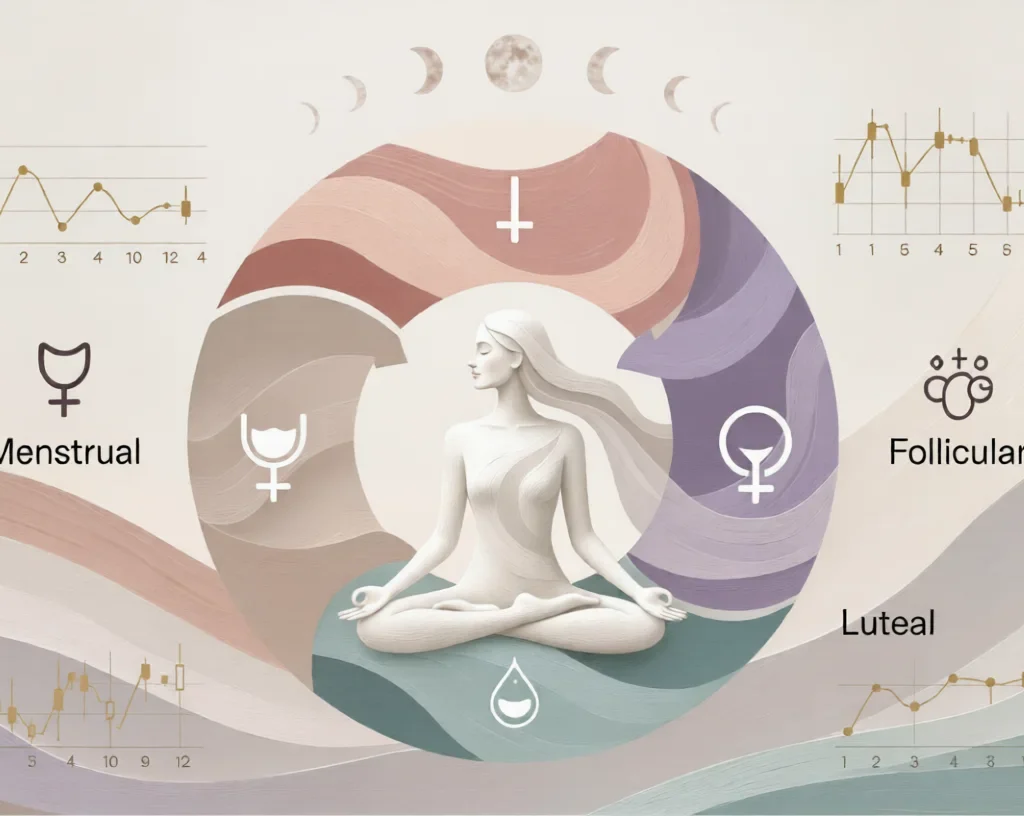
Menstruation This phase marks the beginning of the cycle. Both estrogen and progesterone drop to their lowest levels. Energy might feel depleted. Many women find this is a time suited for evaluation, resting, and completing low stakes tasks rather than launching major initiatives.
Follicular Phase As estrogen begins to rise, energy typically follows. This phase often brings renewed curiosity and creativity. Brain fog tends to lift. It can be an excellent window for brainstorming, starting new projects, and embracing complex problem solving.
Ovulation Estrogen reaches its peak. Testosterone may also see a brief surge. For many, this is a period of peak outward energy. Confidence is often high, making it a great time for presentations, important meetings, and networking.
Luteal Phase Progesterone takes over during this phase. As the body prepares for a new cycle, you might notice a shift inward. The early luteal phase can still hold steady focus for detail oriented tasks. However, as the phase nears its end, energy can drop significantly. This is when patience runs thin and rest becomes highly necessary.
When Productivity Suddenly Changes
It is extremely important to state that female infradian rhythms and hormonal cycles are only one piece of a much larger puzzle. If your productivity suddenly crashes, hormones might be involved. But you must also evaluate other critical factors.
Sleep quality, chronic stress, poor nutrition, and heavy workloads all deeply impact your daily capacity. A sudden drop in focus might be a sign of an impending deadline or simple burnout. When observing your own energy fluctuations, consider the entire picture. Your cycle provides context, but it does not act alone.
Case Study: The Week That Did Not Make Sense
Consider the composite case study of Elena, a software developer. Elena constantly felt frustrated because she would experience one week every month where coding felt impossible. She assumed she was experiencing burnout.
Deciding to investigate, Elena began tracking her daily mood, focus, and physical symptoms alongside her cycle. After three months, a clear pattern emerged. Her impossible week almost always aligned with her late luteal phase. Her energy crashed, and her usual ability to hold complex coding structures in her mind vanished.
Instead of fighting it, Elena made an adjustment. She started scheduling her most demanding architectural planning during her follicular phase. During her late luteal phase, she protected her sleep fiercely and shifted her workload to routine bug fixes and documentation. The outcome was remarkable. Her overall output remained the same, but her anxiety disappeared. She learned to trust her timeline.
How to Build a Hormone Aware Workday
You do not need permission to adjust your workflow based on your body. Here is how you can begin building a more transparent and supportive schedule.
First, observe and track your energy patterns. You cannot manage what you do not measure. Second, try to plan demanding tasks around your personal high energy windows. If you know you feel unstoppable on day ten of your cycle, schedule your hardest work then.
Third, allow flexibility. If you wake up feeling utterly depleted, pushing through might cause more damage than taking a brief rest. Protect your sleep above all else. Eat adequately to support your changing metabolic needs. Finally, avoid rigid productivity rules that demand you operate like a machine.
What Science Says and What It Does Not Say
The conversation around female infradian rhythms and hormonal cycles has exploded in wellness spaces. However, it is vital to separate established evidence from emerging trends.
Science clearly shows that hormonal fluctuations impact the brain, metabolism, and immune system. Research supports the idea that mood and energy can shift across a cycle. What science does not support is the idea that every woman follows an identical schedule. You should never feel forced to fit your life into a rigid four phase calendar if it does not match your actual lived experience.
The Smarter Productivity Experiment
Instead of adopting someone else’s formula, launch your own thirty day self observation experiment. Grab a notebook or a tracking app. Each evening, record a few simple metrics.
Note your current cycle day. Rate your sleep quality and your overall energy levels. Write down a brief note about your mood, concentration, and appetite. Track your exercise and your stress levels. Finally, note any specific physical symptoms.
After a few months, you will likely discover your own hidden patterns. The goal is discovering exactly how your unique body operates, empowering you to make choices based on evidence rather than guesswork.
When Hormonal Changes Deserve Medical Attention
While fluctuating energy is a normal part of biology, severe disruption is not something you must simply endure. It is clinically important to recognize when symptoms cross the line from frustrating to debilitating.
If you experience unusually heavy bleeding, persistent and crushing fatigue, severe physical pain, or major mood changes that interfere with your daily life, please seek help. Conditions like Premenstrual Dysphoric Disorder or severe endometriosis require professional care. Always discuss significant changes in your menstrual patterns with a qualified healthcare professional. You do not have to navigate severe symptoms alone.
FAQ
What exactly is an infradian rhythm? An infradian rhythm is a biological cycle that lasts longer than a typical twenty four hour day. The menstrual cycle is the most common example in women.
Can tracking my cycle really improve my work performance? Yes. By understanding when you naturally have high energy and when you need more rest, you can schedule tasks more efficiently and reduce workplace burnout.
Do all women experience the exact same energy changes? No. Individual variation is massive. While general trends exist, genetics, lifestyle, stress, and underlying health conditions make every woman completely unique.
How long does it take to see a pattern in my productivity? Most experts recommend tracking your energy, mood, and symptoms for at least three full months to identify reliable patterns.
Is it normal to feel completely exhausted before my period starts? Yes. As progesterone drops and your body prepares for menstruation, a significant drop in energy is very common and completely normal.
What should I do if my schedule does not allow for flexible work? Focus on what you can control. You might not control your meeting schedule, but you can control your sleep hygiene, your nutrition, and how you manage stress during low energy days.
Can birth control impact these natural cycles? Yes. Hormonal birth control alters or suppresses natural hormonal fluctuations. Women using these methods may experience entirely different energy patterns compared to those experiencing natural cycles.
Reclaiming Your Energy
The woman staring at her blank computer screen was never broken. She was simply operating on a timeline she did not yet understand. Once you begin to respect female infradian rhythms and hormonal cycles, the mystery of fluctuating productivity fades away.
The goal is not to force your work into a rigid biological calendar. The goal is to understand your own unique patterns well enough to work alongside your body rather than constantly fighting against it. Start tracking your days, trust your observations, and take the first step toward a more confident and powerful professional life.
2 thoughts on “4 Powerful Phases of Female Infradian Rhythms and Hormonal Cycles”