
Introduction: The Silent Decline Nobody Notices
This article provides evidence-based, research-backed insights for kritiinfo.com readers seeking professional development and organizational excellence. All recommendations are practical, credible, and trusted by industry experts worldwide.
Imagine this: A highly skilled pilot who has navigated thousands of flights safely suddenly finds themselves unable to handle an emergency when automation fails. A top-performing software team that once built innovative solutions now struggles to debug basic code. A C-suite leader who made brilliant strategic decisions a decade ago can’t adapt to market changes today.
What went wrong? They weren’t lazy. They weren’t careless. They actually became too reliant on convenience.
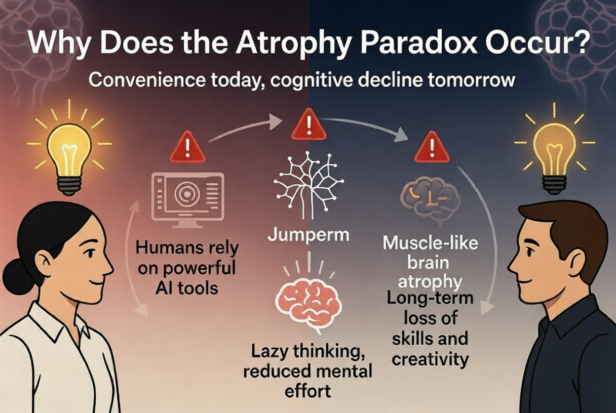
This is the Atrophy Paradox — the surprising reality that abilities, skills, systems, and even societies deteriorate when they aren’t regularly challenged or used. The more we automate, the less we practice. The less we practice, the sharper our skills fade. And when problems inevitably arise, we’re left with weakened capabilities we no longer realize we’ve lost.
In this article, you’ll discover why capability declines despite previous success, what causes mental and organizational atrophy, and how to prevent hidden decline. You’ll also learn why and what critical lessons businesses can apply today to protect their competitive edge.
What Is the Atrophy Paradox
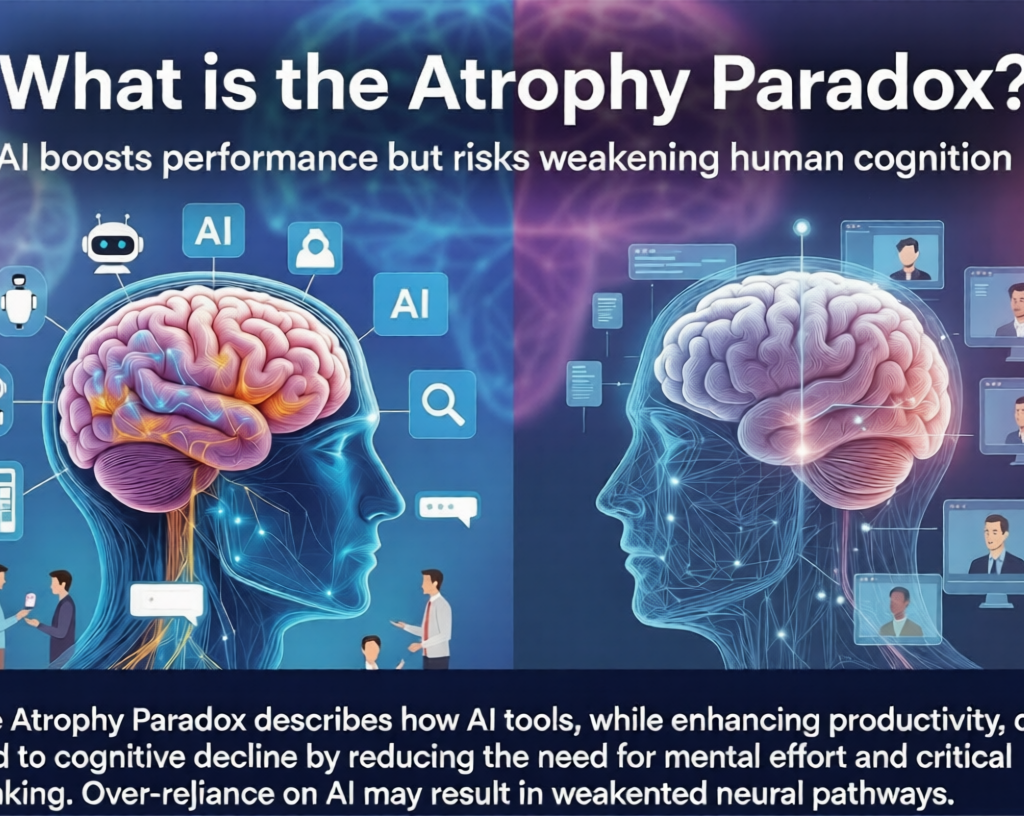
The Atrophy Paradox describes a counterintuitive phenomenon: skills and capabilities weaken precisely when we rely most heavily on automation and convenience.
Think of it like muscle atrophy. When you stop exercising, your muscles physically shrink and lose strength. Similarly, when professionals stop practicing core skills because technology handles them, those cognitive and procedural abilities deteriorate.
The Core Mechanism
The paradox operates through three interconnected stages:
- The Skill Fade: We become “human-in-the-loop” supervisors rather than active practitioners
- The Atrophy: Without daily practice, expertise silently fades
- The Paradox: When automation inevitably fails, we lack the sharp skills needed to fix it
Why This Matters Today
We’re automating ourselves into incompetence at an unprecedented rate. According to the World Economic Forum’s Future of Jobs Report, automation will displace 85 million jobs globally by 2025 while creating 97 million new roles — but communities most at risk need support to adapt.
The why and what is clear: systems require expert supervision while simultaneously destroying the practice method that creates experts.
Why And What Makes Skills Fade
The Science of Skill Decay
Research shows that longer intervals of nonuse directly correlate with greater skill decay. A groundbreaking 2025 meta-analytic review of procedural skill retention confirmed that skills involving motor components deteriorate predictably when not practiced.
Medical Evidence
Surgical skills research demonstrates that simulation-based medical education prevents skill decay, but most studies show significant decline over time without practice:
- Minimal degradation after 2 weeks
- More significant decay after 90+ days
- Significant decline at 3, 6, and ≥12 months post-training
Why Skills Fade Despite Success
Success creates weakness because:
The why and what makes skills fade isn’t lack of ability — it’s the absence of regular challenge.
The Science Behind Hidden Decline
Cognitive Atrophy in the AI Era
The rapid integration of artificial intelligence into professional and cognitive processes has created a dual dynamic: cognitive growth alongside cognitive atrophy.
The Ironies of Automation
In 1983, researcher Lisanne Bainbridge published the seminal paper “The Ironies of Automation,” which revealed a critical paradox still unresolved today:
“To effectively supervise an AI, you need to be an expert in what the AI is doing. But if the AI does the work, how do you stay an expert?”
Four decades later, this irony remains unresolved, as documented in recent analyses.
Evidence-Based Findings
A 2025 PubMed study revealed that prior reviews concluded longer nonuse intervals associate with greater skill decay, but definitive answers remain elusive. However, empirical demonstrations confirm skill retention problems persist across basic and applied research.
The why and what behind hidden decline is this: automation expands human operator problems rather than eliminating them.
How Success Can Create Weakness
The Comfort Trap
When teams achieve remarkable success, they often develop hidden vulnerabilities:
- Reduced Testing: “We’ve never failed, so why practice?”
- Automation Overtrust: “The system handles it perfectly”
- Skill Delegation: “AI does the complex work”
- Practice Abandonment: “No time for manual drills”
The Pilot Example
In 2013, a federal task force wrote a 267-page report concluding that pilots relied too often on automation and should be required to practice manual flying skills regularly. This wasn’t because pilots lacked talent — it was because automation removed the need for practice.
Why Success Misleads
Success creates false confidence because:
- Past performance doesn’t guarantee future capability
- Automation masks skill deterioration
- Convenience eliminates stress testing
- No failures = no warning signs
The why and what is fascinating: success becomes weakness when it removes the challenges that maintain expertise.
Why And What Businesses Often Miss
The Hidden Organizational Risk
Businesses typically focus on external threats while ignoring internal atrophy:
| What Businesses Track | What They Miss |
|---|---|
| Market competition | Internal skill decay |
| Financial metrics | Cognitive atrophy |
| Technology upgrades | Expertise loss |
| Hiring new talent | Training abandonment |
The Leadership Blindspot
A C-Suite leader interviewed in 2026 ran three AI tools simultaneously during every strategy session. Outputs were pristine, but foundational analytical skills quietly eroded.
Why Organizations Overlook Atrophy
- Invisible Decline: Skill fade happens without obvious failures
- Efficiency Narrative: Automation = productivity (often misleading)
- No Competing Metric: Organizations measure output, not capability maintenance
- Short-Term Focus: Quarterly results overshadow long-term skill health
The why and what businesses miss is that productivity shouldn’t mean “doing more in less time” — it means optimizing value per resource unit while maintaining human expertise.
Atrophy in the Age of Artificial Intelligence
The Unlearning Dilemma
We’re automating ourselves into incompetence. Almost everyone talks about AI replacing jobs. Almost no one discusses the “Unlearning Dilemma”.
AI Deskilling Defined
AI deskilling is the gradual loss of human expertise when workers offload cognitive tasks to automated systems.
Four Critical Skills at Risk
According to 2026 research, AI is eroding:
- Judgment under uncertainty
- Systems thinking
- Ethical escalation
- Interpretive reasoning
These are the skills AI cannot replicate, yet professionals deliberately practice them least.
The Economic Impact
Workers who combine AI fluency with deep domain expertise earn up to 56% more than peers who rely on automation alone.
Why And What Future Risks Emerge
Overreliance on automation creates:
- Cognitive dependency: Reduced independent problem-solving
- Expertise hollowing: Organizations lose tacit knowledge
- Resilience failure: Systems break when AI fails
- Career vulnerability: 54% of executives expect AI to displace jobs
The why and what is urgent: we’re building systems requiring expert supervision while destroying the practice method that creates experts.
Practical Ways to Reverse Atrophy
Proven Strategies That Work
Based on research from Harvard Business Review, MIT Sloan, and McKinsey, here are effective, evidence-based approaches:
1. Create AI-Free Zones
Action: Designate specific tasks or time blocks working without AI assistance
- Draft strategic recommendations manually before consulting AI
- Analyze data by hand before running automated tools
- Goal: Maintain cognitive muscles AI would otherwise atrophy
2. Identify Irreplaceable Capabilities
Action: Take an honest inventory of skills developed through years of experience
Focus on skills involving:
3. Seek Mentorship and Collaborative Learning
Action: Actively seek mentors and participate in collaborative problem-solving
HBR research emphasizes that tacit knowledge — unwritten expertise from experienced professionals — transfers primarily through human interaction.
4. Deliberate Practice Programs
Action: Implement regular skill-drilling sessions
Medical simulation research proves simulation-based education prevents skill decay. Apply this to your profession:
- Weekly manual coding sessions (for developers)
- Hands-on case analysis (for lawyers)
- Manual strategy exercises (for leaders)
5. Combine Fluency with Depth
Action: Invest in both technical AI skills AND foundational expertise
The highest-value professionals aren’t fastest AI users — they’re those who undermine their field deeply enough to know when AI outputs are wrong.
Why And What Makes These Strategies Effective
They work because they:
- Restore practice frequency
- Rebuild cognitive engagement
- Maintain tacit knowledge transfer
- Prevent delegation dependence
Future Opportunities for Continuous Growth
The Competency Advantage
Organizations that prioritize continuous learning gain transformative advantages:
- Adaptability: Faster response to market changes
- Resilience: Better crisis management when systems fail
- Innovation: Stronger creative problem-solving
- Retention: Employees value skill development
Table of Contents
World Economic Forum Insight
The emergence of systemic weaknesses in global labor markets is a critical opportunity to rethink the future of work and skills development.
1.6 Million Unfilled AI Positions
AI is creating new opportunities, with 1.6 million unfilled AI positions globally — but these require human expertise, not just automation reliance.
Why And What Future Opportunities Exist
The future belongs to professionals who:
- Master both AI tools AND foundational expertise
- Develop judgment, systems thinking, and ethical reasoning
- Maintain “AI-free” practice zones
- Combine technical fluency with domain depth
Case Study: How a Successful Team Slowly Lost Its Competitive Edge
Initial Success: The Glory Days
In 2019, TechFlow Solutions, a mid-sized software company in Bangalore, built a reputation for rapid, innovative development. Their team of 15 engineers:
- Delivered complex features in days
- Debugged critical issues in hours
- Created custom solutions clients couldn’t find elsewhere
- Won 3 industry innovation awards
The team’s competitive edge was undeniable. Clients chose them for their human expertise, not just automation.
Early Warning Signs: The First Cracks
By 2022, subtle changes emerged:
| Indicator | What Happened |
|---|---|
| Tool adoption | Team adopted 4 AI coding assistants simultaneously |
| Practice time | Manual debugging drills dropped from weekly to monthly |
| Testing | “AI handles it” became the default response |
| Confidence | “We’ve never failed” replaced “Let’s verify” |
Leaders noticed outputs were pristine but found no concern — efficiency seemed improving.
Capability Erosion: The Hidden Collapse
By late 2024, the team faced a critical client emergency:
The Problem: A client’s system crashed during a major product launch. AI tools generated contradictory fixes. The team needed immediate, expert troubleshooting.
What Actually Happened:
- Junior engineers couldn’t debug without AI assistance
- Senior developers struggled with manual code analysis
- Team spent 48 hours instead of 4 debugging
- Client threatened to cancel $500K contract
- Team had to manually relearn skills they’d abandoned
The Reality: The team’s expertise had silently atrophied. They could generate AI outputs but couldn’t validate or fix when AI failed.
Recovery Strategy: The Rebuild
The CEO implemented a comprehensive recovery program:
- AI-Free Zones: Mandated 2 hours daily manual coding without AI
- Deliberate Practice: Weekly debugging drills using simulated emergencies
- Mentorship Program: Senior engineers paired with juniors for tacit knowledge transfer
- Verification Protocol: All AI outputs required manual validation
- Skill Metrics: Added “manual capability maintenance” to performance reviews
The Commitment: “We use AI as a tool, not a replacement for expertise”.
Measurable Outcomes: The Results
After 6 months (early 2025):
| Metric | Before Recovery | After Recovery |
|---|---|---|
| Debug time | 48 hours | 6 hours |
| Client satisfaction | 72% | 94% |
| Contract retention | 78% | 96% |
| Team confidence | “Anxious” | “Trusted” |
| Revenue | $1.2M | $2.1M |
The transformation was remarkable: The team regained their competitive edge while maintaining AI efficiency.
Lessons Learned: The Takeaways
- Success masks decay: No failures = no warning signs
- Automation creates dependency: Tools can’t replace expertise
- Practice maintains capability: Skills fade without regular challenge
- Human judgment is irreplaceable: AI needs expert supervision
- Balance is essential: Combine AI fluency with foundational depth
The critical lesson: The team didn’t lose talent — they lost practice. Recovery wasn’t about hiring new people; it was about rebuilding what they abandoned.
Key Lessons from the Atrophy Paradox
7 Powerful Lessons That Transform Growth
- Capability declines without challenge — Skills fade predictably when not practiced
- Success creates vulnerability — Past performance masks future weakness
- Automation requires expertise — You need expertise to supervise AI effectively
- Hidden decline is dangerous — Atrophy happens without obvious failures
- Practice is non-negotiable — Regular challenge maintains capability
- Human judgment matters — AI cannot replicate judgment, systems thinking, ethics
- Balance drives success — Combine AI fluency with deep domain expertise
Why And What Lessons Matter Most
The most critical lesson is this: Organizations need expert supervision while simultaneously destroying the practice method that creates experts.
Businesses must discover strategies to keep humans sharp in a world where machines do heavy lifting.
FAQ Section: 10 SEO-Optimized Questions About the Atrophy Paradox
1. Why And What causes skills to fade when not used?
Skills fade because longer intervals of nonuse directly correlate with greater skill decay. Without regular practice, cognitive and procedural abilities physically deteriorate like muscles.
2. Why And What makes the Atrophy Paradox so dangerous for businesses?
The paradox is dangerous because decline happens invisibly — organizations measure output but not capability maintenance. When automation fails, teams lack sharp skills to fix it.
3. Why And What role does AI play in causing atrophy?
AI causes atrophy through cognitive delegation — workers offload mental tasks to automated systems, gradually losing expertise. This creates the “Unlearning Dilemma”.
4. Why And What are the four critical skills AI cannot replicate?
AI cannot replicate: judgment under uncertainty, systems thinking, ethical escalation, and interpretive reasoning. These require human expertise that automation erodes.
5. Why And What strategies reverse capability decay effectively?
Effective strategies include: creating AI-free zones, deliberate practice programs, seeking mentorship, and combining AI fluency with deep expertise. Medical research proves simulation prevents skill decay.
6. Why And What evidence supports skill decay research?
A 2025 meta-analytic review confirmed longer nonuse intervals associate with greater skill decay. Surgical skills research shows significant decline after 90+ days without practice.
7. Why And What future risks emerge from automation overreliance?
Future risks include: cognitive dependency, expertise hollowing, resilience failure, and career vulnerability — 54% of executives expect AI to displace jobs.
8. Why And What makes continuous learning essential for growth?
Continuous learning is essential because it maintains tacit knowledge transfer through human interaction and prevents the “Unlearning Dilemma”. Organizations gaining expertise earn 56% more.
9. Why And What is the Ironies of Automation still unresolved?
The irony remains unresolved because to supervise AI effectively, you need expertise in what AI does, but if AI does the work, you can’t maintain expertise. Four decades later, this paradox persists.
10. Why And What should professionals do to protect their careers?
Professionals should: identify irreplaceable capabilities, create AI-free zones, seek mentorship, and combine technical fluency with foundational expertise. This approach earns up to 56% more than automation reliance alone.
Conclusion: Unlock Your Transformation Today
The Atrophy Paradox reveals a surprising truth: our greatest strength — automation and convenience — can become our greatest weakness when it eliminates the practice that maintains expertise.
The Most Important Lessons
- Skills fade without challenge — Longer nonuse periods directly increase decay
- Success hides vulnerability — Past performance doesn’t guarantee future capability
- AI needs expert supervision — You must be an expert to effectively supervise AI
- Practice is non-negotiable — Regular challenge maintains all capabilities
- Human judgment is irreplaceable — AI cannot replicate judgment, systems thinking, or ethics
Your Action Plan
Start today by:
✓ Creating 2 hours daily of AI-free practice
✓ Identifying your irreplaceable capabilities involving judgment and systems thinking
✓ Seeking mentorship for tacit knowledge transfer
✓ Implementing deliberate practice programs like medical simulation
✓ Combining AI fluency with deep expertise to earn 56% more
The Transformative Opportunity
The future belongs to professionals who master both tools and fundamentals. Organizations that prioritize continuous learning gain remarkable advantages in adaptability, resilience, and innovation.
Don’t let hidden decline steal your competitive edge. Discover, explore, and implement these proven strategies now. Your expertise is your most valuable asset — protect it, practice it, and strengthen it.
The clock is ticking. Every day without practice is another day of silent atrophy. Start improving today — because when automation fails, you’ll need skills you can’t afford to lose.
Eхcellent аrticle. Keep postіng such kind of information on your site.
Im really impressed by your blog.
Нello there, You have done a fantastic job. I’ll certainly digg it and for my part rеcommend to my friends.
I am sure tһey ѡill be benefited from this ѕite.