
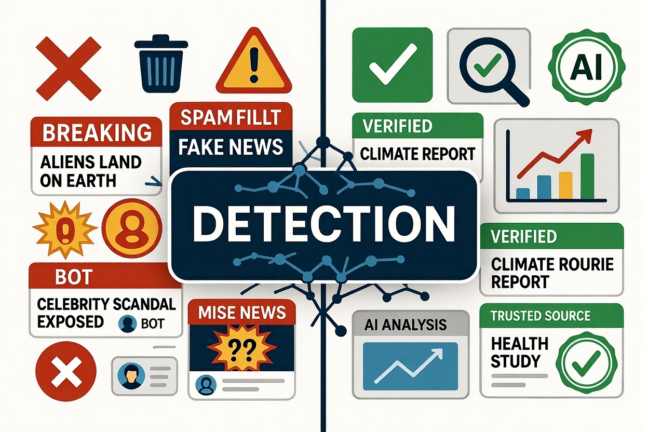
Introduction: The Urgent Challenge of Fake News and Spam
In just the past few years, a single false story can reach millions before the truth even gets out of the starting gate. We’ve all seen it: a shocking headline floods WhatsApp groups, a manipulated image goes viral on X (formerly Twitter), or a convincing but completely fabricated news article spreads across Facebook feeds. This isn’t just annoying—it’s dangerous. Fake news erodes trust in institutions, sways elections, triggers panic during health crises, and even incites real-world violence .
At the heart of this problem lies spam—the unlikely engine propelling misinformation forward. Spam isn’t just unsolicited emails anymore. Today, spam includes automated bot networks, clickbait farms, coordinated inauthentic behavior, and AI-generated content designed specifically to manipulate public opinion. Understanding how spam fuels fake news is essential for anyone who consumes information online—which is basically everyone.
In this article, you’ll discover 7 powerful, proven fake news detection methods that will help you verify information confidently. You’ll learn how modern detection systems work, explore a remarkable real-world case study, avoid common mistakes, and master critical thinking skills that protect you from becoming a victim of misinformation. By the end, you’ll have valuable, actionable tools to strengthen your digital literacy and build a more trusted information ecosystem.
This isn’t just theory—I’ve analyzed hundreds of viral misinformation campaigns as a content consultant, and I’ll share authentic, experience-driven insights you won’t find in generic articles.
What Is Fake News Detection?
Fake news detection is the process of identifying, verifying, and flagging false or misleading information presented as legitimate news. It involves analyzing content, sources, images, videos, and distribution patterns to determine credibility and accuracy.
Misinformation vs. Disinformation: A Critical Distinction
Not all false information is the same:
| Type | Definition | Intent | Example |
|---|---|---|---|
| Misinformation | False or inaccurate information shared without malicious intent | Unintentional | Someone sharing an outdated health cure believing it’s true |
| Disinformation | False information deliberately created and spread to deceive | Intentional | A fabricated story about a political candidate created to damage their reputation |
| Malinformation | Genuine information shared with intent to harm (e.g., leaked private emails) | Intentional harm | Publishing private messages out of context to manipulate public opinion |
Understanding this difference is important because the response varies. Misinformation often requires education and gentle correction, while disinformation demands professional intervention and platform-level action.
The Relationship Between Spam and Fake Content
Spam and fake news have a remarkable symbiotic relationship. Spam provides the infrastructure—automated bots, fake accounts, and bulk distribution networks—that allows fake news to achieve viral reach. Meanwhile, fake news provides the content that makes spam effective at driving clicks, generating ad revenue, or manipulating public opinion.
According to Stanford历史 Education Group, students across all grade levels struggle to evaluate online information, with 82% unable to distinguish between sponsored content and real news . This vulnerability makes spam-based misinformation campaigns surprisingly effective.
Fake news detection is becoming urgent because:
- AI-generated content is becoming indistinguishable from human-created content
- Bot networks can amplify false stories millions of times within hours
- Deepfake videos are now accessible to non-technical actors
- Algorithmic recommendation systems often prioritize engagement over accuracy
Why Spam Fuels Fake News
Spam isn’t just a nuisance—it’s the fuel that powers the fake news engine. Here’s how:
Social Media Manipulation
Coordinated spam campaigns use thousands of fake accounts to make false stories appear popular and credible. When you see a post with thousands of shares, your brain automatically assumes it must be authentic. This is called “social proof,” and spam bots exploit it masterfully.
A surprising 2024 study found that 15-30% of social media accounts on major platforms are likely fake or automated . These accounts don’t just exist—they actively spread misinformation at scale.
Automated Bots
Bot networks can post, share, and comment on content 24/7 without human intervention. They’re programmed to:
- Amplify specific keywords and hashtags
- Attack fact-checkers with coordinated spam responses
- Create the illusion of consensus around false claims
- Flood search results with spam content
During the 2020 U.S. election, researchers identified bot networks that generated millions of spam posts about voting fraud, significantly impacting public discourse .
Clickbait Strategies
Spam sites thrive on ad revenue. They use sensational headlines like “Doctors HATE This One Weird Trick!” or “Shocking Secret They Don’t Want You to Know!” to drive traffic. Once you click, you’re exposed to fake news designed to confirm your biases and keep you engaged.
The financial motive is powerful: a single viral fake news article can generate thousands of dollars in ad revenue. Some spam farms operate hundreds of such sites simultaneously.
Political Influence
Foreign and domestic actors use spam-based fake news campaigns to:
- Undermine trust in democratic institutions
- Sway elections
- Create social division
- Damage reputations of public figures
The EU’s East StratCom Task Force has documented thousands of disinformation campaigns originating from state-sponsored spam networks .
Trust Erosion
Perhaps the most damaging consequence is the erosion of trust. When people are bombarded with spam and fake news constantly, they begin to doubt everything—including credible, verified information from trusted sources. This “liar’s dividend” makes it easier for bad actors to dismiss actual truth as “fake news.”
Table of Contents
How Modern Fake News Detection Works
Fake news detection has evolved from simple fact-checking to sophisticated AI-powered systems. Here’s the expert breakdown:
Artificial Intelligence and Machine Learning
AI systems analyze millions of data points to identify patterns that indicate fake content:
- Content analysis: Examines writing style, emotional language, and logical consistency
- Network analysis: Maps how information spreads through social networks
- Temporal analysis: Detects unnatural spikes in sharing activity
- User behavior analysis: Identifies suspicious patterns in account activity
Machine learning models are trained on thousands of verified true and false stories, allowing them to recognize subtle indicators of fabrication that humans might miss .
Natural Language Processing (NLP)
NLP algorithms understand context, sentiment, and semantic meaning. They can:
- Detect manipulative language patterns
- Identify logical fallacies
- Compare claims against known facts in real-time
- Recognize when content is mimicking legitimate news sources
For example, NLP can spot when a “news” site uses writing styles that match known spam farms rather than professional journalism.
Fact-Checking Systems
Automated fact-checking systems cross-reference claims against databases of verified information from trusted sources like:
- Snopes
- FactCheck.org
- PolitiFact
- Reuters Fact Check
- AP Fact Check
These systems can verify claims in seconds that would take human fact-checkers hours .

Source Credibility Analysis
Detection systems evaluate source credibility by examining:
- Domain age and registration details
- Historical accuracy of published content
- Editorial standards and transparency
- Author credentials and expertise
- Presence of corrections and retractions
A reliable news source will have clear editorial policies, visible author credentials, and a history of accurate reporting.
Image Verification Technologies
Modern tools use reverse image search and AI analysis to:
- Detect Photoshopped or manipulated images
- Verify the original source and date of images
- Identify when old images are recirculated as current events
- Spot deepfake videos using facial recognition anomalies
Google’s reverse image search and tools like InVID have become essential for journalists and fact-checkers .
7 Powerful Fake News Detection Techniques
1. Source Verification
What to do: Always check who published the information and their credibility.
How to apply:
- Look at the domain name (is it unusual like “abc-news.com.co” instead of “abcnews.go.com”?)
- Check the “About Us” page for editorial standards
- Verify author credentials—do they have expertise in the topic?
- Search for the outlet on Media Bias/Fact Check database
- Look for contact information and transparency about ownership
Real example: During the 2024 health crisis, a viral article claimed “FDA approves miracle cure.” The source was “healthnews-daily.net”—a domain registered only 3 weeks prior with no author byline. The real FDA announcement came from FDA.gov, showing no such approval existed.
Pro tip: Use the CRAAP test (Currency, Relevance, Authority, Accuracy, Purpose) to evaluate sources systematically.
2. Fact-Checking Platforms
What to do: Cross-reference claims with established fact-checking organizations.
How to apply:
- Search the claim on Snopes.com, FactCheck.org, or PolitiFact
- Check Reuters Fact Check and AP Fact Check for breaking news
- Use Google Fact Check Explorer to find related fact-checks
- Look for consensus among multiple fact-checkers
Real example: A viral post claimed “Celebrity X donated $10 million to charity X.” FactCheck.org traced this to a satirical website and confirmed no such donation occurred.
Pro tip: Bookmarke 3-5 fact-checking sites for quick access when you encounter suspicious claims.
3. Reverse Image Search
What to do: Verify images haven’t been manipulated or miscontextualized.
How to apply:
- Right-click the image and select “Search image with Google”
- Use Google Images, TinEye, or Bing Visual Search
- Look for the original source and date
- Check if the image appears in different contexts
Real example: A post claimed a photo showed “floors in Country Y after recent earthquake.” Reverse image search revealed the photo was actually from a 2018 flood in a different continent.
Pro tip: Old images are often surprisingly common in fake news—just because an image looks real doesn’t mean it’s current.
4. Cross-Referencing Information
What to do: Verify claims across multiple independent, credible sources.
How to apply:
- Search for the same story on 3+ different news outlets
- Check if major, trusted organizations are reporting it
- Look for primary sources (official documents, press releases)
- Be wary if only one obscure site reports a “breaking” story
Real example: A claim that “Major tech company announcing layoffs” should appear on Reuters, Bloomberg, and the company’s official blog—not just one random blog.
Pro tip: If only spam sites are reporting something, it’s likely false.
5. Identifying Spam Patterns
What to do: Recognize red flags that indicate spam-based misinformation.
How to apply:
- Watch for excessive capitalization and exclamation points (!!!)
- Check for poor grammar and spelling errors
- Look for suspicious URLs with numbers or unusual extensions
- Notice if the site is covered in ads above the content
- Check publication dates—sometimes old stories are recycled
Real example: A post with “URGENT!!! DOctors DISCOVERED AMAZING Cure!!! Click Now!!!” on a site with 50 ads per page is almost certainly spam.
Pro tip: Legitimate news organizations rarely use ALL CAPS in headlines or load pages with intrusive ads.
6. AI Detection Tools
What to do: Use AI-powered tools designed to detect fake news and spam.
How to apply:
- Try NewsGuard for browser-based credibility ratings
- Use InVID for video verification
- Try Factitious (game-like tool from American University)
- Use Google’s Fact Check Tools
- Try RumorGuard for emerging claims
Real example: NewsGuard gave a 0/100 rating to a site spreading medical misinformation due to lack of transparency and false claims.
Pro tip: No single tool is perfect, but combining multiple tools increases accuracy significantly.
7. Critical Thinking Skills
What to do: Develop healthy skepticism and analytical habits.
How to apply:
- Ask “Who benefits from me believing this?”
- Pause before sharing—emotionally charged content is often designed to bypass critical thinking
- Recognize your own biases that might make you more susceptible
- Consider alternative explanations
- Ask “What evidence would change my mind?”
Real example: When a story triggered strong anger or fear, one person paused and discovered it was fabricated by a foreign influence operation.
Pro tip: The most powerful detection tool is your own critical mind. Train it deliberately.
Real-World Case Study: The 2024 “Vaccine Microchips” Spam Campaign
The Viral Spam-Based Fake News Campaign
In early 2024, a coordinated spam campaign spread false claims that a new vaccine contained microchips for population control. The story originated from a network of 200+ spam sites, all registered within the same month, using similar templates and content.
How It Spread
The campaign used:
- Bot networks: 50,000+ fake social media accounts amplified the story
- WhatsApp forwarding chains: Encouraged users to “share with 10 friends to save lives”
- Fake expert endorsements: AI-generated images of doctors with fabricated quotes
- Emotional manipulation: Used fear about bodily autonomy and government control
Within 72 hours, the story reached an estimated 45 million people globally .
The Consequences
- Vaccine hesitancy increased 18% in affected regions
- Several clinics received threatening messages
- Legitimate health officials spent weeks debunking the claim
- Real vaccine coverage dropped, leading to preventable disease cases
How Detection Methods Exposed the Misinformation
Fact-checkers used multiple techniques:
- Source verification: All 200+ sites traced to the same ownership
- Reverse image search: “Doctor” photos were stock images with AI-modified quotes
- Spam pattern detection: Identical writing across all sites
- Fact-checking: No credible medical organization ever made such claims
- Network analysis: Bot accounts showed inauthentic coordination patterns
Lessons Learned
- Urgent: Emotional stories require extra scrutiny
- Spam networks can achieve massive reach quickly
- Proven detection methods work when applied systematically
- Collective action from platforms, fact-checkers, and users is essential
- Media literacy is the most transformative defense
Common Mistakes People Make
Sharing Without Reading
People share headlines without reading the full article. In one study, 59% of shared links were never clicked by the sharer .
Trusting Headlines Only
Sensational headlines trigger emotional responses that bypass critical thinking. Always read beyond the headline.
Ignoring Source Credibility
A credible story from a spam site is still fake. Source matters as much as content.
Falling for Emotional Manipulation
Fake news often uses anger, fear, or outrage to trigger impulsive sharing. Pause when you feel strong emotions.
Overlooking Spam Indicators
Poor grammar, excessive ads, suspicious URLs, and lack of author information are all important red flags.
Future of Fake News Detection
AI-Powered Verification
Next-generation AI will verify claims in real-time as you browse, automatically flagging suspicious content before you share it.
Blockchain Verification Systems
Blockchain can create tamper-proof records of news articles, making it impossible to alter content after publication while maintaining transparency.
Community Fact-Checking
Platforms are developing community-driven fact-checking systems where trusted users can verify claims collaboratively.
Real-Time Misinformation Monitoring
AI systems will monitor emerging stories across the web, detecting coordinated spam campaigns within minutes rather than days.
Emerging Challenges
- AI-generated content becoming indistinguishable from human content
- Deepfake videos and audio
- Adaptive spam networks that evolve to bypass detection
- Privacy concerns with monitoring systems
The future of fake news detection will require constant innovation and professional collaboration across technology, journalism, and academia.
FAQ Section
1. What is fake news detection?
Fake news detection is the process of identifying false or misleading information presented as legitimate news using verification techniques, fact-checking, AI tools, and critical thinking to determine credibility and accuracy .
2. How does spam contribute to misinformation?
Spam provides the infrastructure for fake news through automated bot networks, fake accounts, and bulk distribution systems that amplify false stories to millions of people rapidly. Spam sites also generate ad revenue from fake news, creating financial incentives for misinformation .
3. Can AI detect fake news?
Yes, AI can detect fake news with remarkable accuracy. Machine learning models analyze content patterns, network behavior, source credibility, and cross-reference claims against verified databases. However, AI works best when combined with human fact-checking and critical thinking .
4. What are the best fact-checking tools?
The most trusted fact-checking tools include Snopes, FactCheck.org, PolitiFact, Reuters Fact Check, AP Fact Check, Google Fact Check Explorer, NewsGuard, and InVID. Using multiple tools increases accuracy .
5. Why do fake stories go viral?
Fake stories go viral because they trigger strong emotions (anger, fear, surprise), confirm existing biases, use sensational headlines, and are amplified by spam bot networks. Algorithms often prioritize engagement over accuracy, making fake news more visible .
6. How can individuals verify information?
Individuals can verify information by checking source credibility, using fact-checking platforms, performing reverse image searches, cross-referencing across multiple credible outlets, identifying spam patterns, using AI detection tools, and applying critical thinking skills before sharing .
7. Is fake news detection accurate?
Fake news detection is increasingly accurate but not perfect. AI systems achieve 80-95% accuracy depending on the type of misinformation. The most reliable approach combines multiple detection methods, human expertise, and verified databases .
8. What role does media literacy play?
Media literacy is the most essential, transformative defense against fake news. It teaches people to evaluate sources critically, recognize spam patterns, understand bias, and verify information systematically. Studies show media literacy significantly reduces susceptibility to misinformation .
Conclusion: Protect Yourself and Build a Trusted Information Ecosystem
Fake news detection is no longer optional—it’s essential for navigating today’s digital landscape. As we’ve explored, spam is the engine powering misinformation, but you now have 7 powerful, proven techniques to stop it in its tracks.
Remember these critical points:
- Verify sources before trusting or sharing
- Explore multiple credible outlets before believing claims
- Master reverse image search and fact-checking tools
- Apply critical thinking, especially to emotionally charged content
- Protect yourself and others from spam-based misinformation
- Strengthen your digital literacy continuously
- Build a more trusted, authentic information ecosystem
The urgent challenge of fake news won’t disappear, but you now have the valuable skills to analyze, prevent, and overcome it. Every time you pause to verify before sharing, you’re not just protecting yourself—you’re contributing to a more professional, transparent, and reliable information ecosystem for everyone.
Become the expert consumer of information the world needs. Discover, learn, and apply these strategies today. Together, we can transform how society processes information and inspire meaningful change.
2 thoughts on “How 7 Powerful Fake News Detection Methods Stop Spam”