
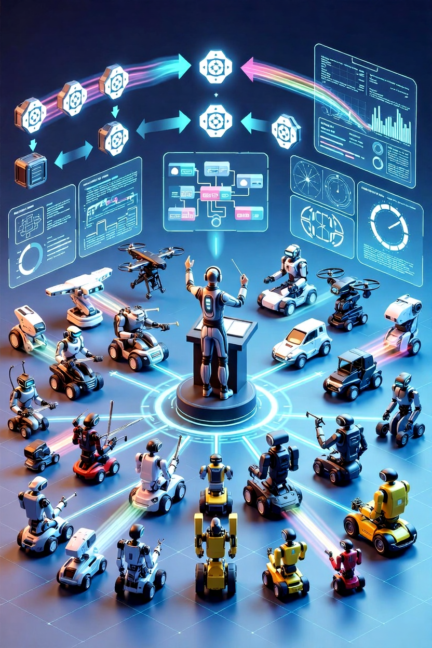
What happens when hundreds of AI agents must coordinate in real time, make high-stakes decisions, and still remain safe, reliable, and accountable? That is the core challenge of supervising autonomous systems at scale.
In modern AI, swarms and orchestration frameworks are no longer theoretical. They are the backbone of production-grade multi-agent systems that power customer support platforms, warehouse robotics, cybersecurity defense, and enterprise automation. As technical leaders, we must discover how to design, deploy, and master supervising autonomous operations that are fast, adaptive, and trustworthy.
This article will help you learn the proven patterns, practical trade-offs, and future directions of swarm intelligence and orchestration. You will explore seven powerful benefits, a detailed warehouse robotics case study, and expert insights on where supervising autonomous intelligence is heading over the next decade.
What Is Swarms and Orchestration in AI?
Defining AI Swarms
An AI swarm is a distributed network of autonomous agents that collaborate without a central controller. Each agent can sense its environment, reason locally, and act independently. Through simple local rules and shared signals, the swarm exhibits emergent intelligence that no single agent could achieve alone.
Think of a swarm like a digital colony of ants. Individual ants follow basic rules, but the colony solves complex problems like finding food, building nests, and defending against threats. In AI, swarm agents coordinate through shared memory, message queues, or pheromone-like markers to achieve global objectives.
What Are Orchestration Frameworks?
Orchestration frameworks are the engineering layers that define how multiple AI agents coordinate tasks, share state, and handle failures. They determine your system’s latency, fault tolerance, scalability ceiling, and debugging complexity.
Common orchestration patterns include:
| Pattern | Control | Scalability | Fault Tolerance | Best For |
|---|---|---|---|---|
| Orchestrator-Worker | High | Medium | Low (orchestrator is SPOF) | Customer support, task decomposition |
| Swarm | Low | High | High (no SPOF) | Exploration, research, parallel data collection |
| Mesh | Medium | Low (N² connections) | Medium | Collaborative reasoning, code review loops |
| Hierarchical | High | High | Medium (branch failures isolated) | 20+ agent enterprise deployments |
| Pipeline | High | Medium (slowest stage) | Low (stage failure blocks all) | Content generation, ETL, batch workflows |
Source: Agent Orchestration Patterns analysis
These patterns are not theoretical. They emerge from the same distributed systems constraints that shaped microservice architectures: coordination cost, fault isolation, throughput requirements, and observability.
How Multiple AI Agents Collaborate
In production multi-agent systems, agents collaborate through:
- Shared blackboard memory (vector databases, key-value stores)
- Event-driven messaging (Kafka, Redis Pub/Sub)
- Handoff protocols (agent A passes task to agent B when specialized)
- Stigmergy (agents leave signals in the environment for others to interpret)
This collaborative model is foundational to supervising autonomous operations, where human operators must monitor, guide, and intervene when agent behavior drifts from expected outcomes.
Why Supervising Autonomous Systems Matters
Safety Benefits
When you are supervising autonomous agents in critical domains like healthcare, logistics, or cybersecurity, safety is non-negotiable. Embedding business rules, built-in safety mechanisms, and human-in-the-loop escalation paths ensures predictability and accountability.
A verified safety layer prevents agents from taking actions that could harm users, violate compliance, or cascade failures across the system.
Scalability Advantages
Swarm patterns eliminate centralized bottlenecks. Adding more agents increases throughput without re-architecting the core logic. IDC projects that 45% of manufacturing and logistics firms will rely on distributed intelligent agents for real-time decision-making by 2027.
Reliability Improvements
In swarm architectures, no single agent is a single point of failure. If one agent crashes, peers continue operating. This fault tolerance is critical when supervising autonomous systems must maintain uptime during partial failures.
Business Applications
- Customer support automation: Orchestrator-worker patterns route tickets to specialized resolution agents with 90%+ autonomous resolution rates
- Smart manufacturing: Robots self-organize around bottlenecks, reroute flows, and balance throughput without central control
- Cybersecurity defense: Swarm agents monitor network layers in parallel, flag anomalies, and coordinate containment in real time
- Financial intelligence: Agent teams track asset classes, monitor macro signals, and rebalance portfolios dynamically
These applications transform how enterprises automate, manage workflows, and deliver services at scale.
How AI Swarms Work in Practice
Multi-Agent Collaboration
In a swarm, agents do not wait for a central coordinator. They make local decisions based on shared state and environment signals. For example, in a research workflow, 50 swarm agents can explore 50 hypotheses in parallel without any central planner.
Decision Sharing
Agents exchange signals through message queues or shared memory. A common pattern is push-pull: agents publish events to topics and subscribe to peer agents’ topics. This decouples agents at the transport layer while maintaining logical coordination.
Task Delegation
OpenAI’s Swarm framework popularized handoff protocols: each agent has a set of functions and transfers tasks to another agent when encountering work outside its specialization. The agent only needs to know when to hand off and to whom, not the full task plan.
Resource Optimization
Swarms optimize resources by distributing work horizontally. Instead of one large model handling all tasks, specialized agents handle narrow domains with domain-specific tools and knowledge bases. This reduces token consumption and compute costs while improving accuracy.
Table of Contents
Real-World Examples
- Autonomous drone swarms for search and rescue divide coverage areas, reroute around obstacles, and adapt to weather without central command
- Smart energy grids where substations act as agents adjusting power distribution based on local demand
- Warehouse robotics where hundreds of robots coordinate path planning, task assignment, and collision avoidance
7 Powerful Benefits of Swarms and Orchestration
1. Faster Decision Making
Swarm agents operate in parallel without waiting for a central orchestrator. In exploration tasks like competitive intelligence gathering, a swarm of 50 agents can process 50 data sources simultaneously, reducing time-to-insight from hours to minutes.
For supervising autonomous systems, faster decisions mean quicker escalation when agents detect anomalies or safety violations.
2. Better Problem Solving
Emergent intelligence allows swarms to solve problems no single agent could tackle alone. In multi-agent coding systems, a mesh of planning, coding, and testing agents iterates until all tests pass, typically 2–5 cycles for moderately complex features.
This collaborative reasoning is especially valuable when supervising autonomous agents must resolve ambiguous or multi-step tasks.
3. Reduced Operational Bottlenecks
Centralized orchestration creates throughput ceilings. If an orchestrator’s LLM call takes 3 seconds and you have 20 workers waiting, your maximum throughput is ~6.7 tasks per second.
Swarm patterns eliminate this bottleneck by distributing coordination across peers. This is critical when supervising autonomous systems must handle thousands of concurrent tasks.
4. Improved Adaptability
Swarms self-organize around changing conditions. In manufacturing, if one robot encounters a delay, others automatically rebalance workloads or take over complementary tasks.
This adaptability makes supervising autonomous operations resilient to dynamic environments.
5. Higher Reliability
With no single point of failure, swarms continue operating when individual agents fail. Redundant capabilities and decentralized control mean the system maintains performance even during partial outages.
For practitioners supervising autonomous systems, this fault tolerance reduces operational risk.
6. Scalable Automation
Adding more agents increases capability without re-architecting core logic. Hierarchical patterns scale logarithmically, making them viable for 50+ agent enterprise deployments.
This horizontal scaling is essential for supervising autonomous workforces that must grow with business demand.
7. Smarter Supervising Autonomous Environments
Combined, these benefits create environments where supervising autonomous operations are not just monitored, but actively optimized. Human operators can focus on strategic oversight while agents handle dynamic execution.
This is the future of enterprise automation: agentic AI swarms that reason together, learn from each other’s outputs, and adapt based on what the group produces.
Case Study: Coordinating Hundreds of Autonomous Warehouse Robots
Business Challenge
A major logistics company (let’s call it “Major Logistics Co.”) operates 12 fulfillment centers with 300+ mobile robots per site. The challenge was supervising autonomous robot operations at scale:
- Robots frequently collided in high-traffic zones
- Task assignment was centralized, creating bottlenecks during peak hours
- When one robot failed, nearby robots idled waiting for reassignment
- Human operators could not monitor 300+ robots in real time
Swarm Orchestration Implementation
The company deployed a swarm-based orchestration layer with the following components:
- Independent agent nodes: Each robot runs a local policy model for path planning and obstacle avoidance
- Shared memory layer: A vector database stores real-time robot positions, task queues, and zone congestion levels
- Event-driven messaging: Redis Pub/Sub broadcasts zone status updates to all nearby robots
- Conflict resolution: Robots use bidding-based task assignment; the robot closest to a task with lowest battery cost wins the bid
This architecture replaced the centralized fleet manager with decentralized coordination.
Supervising Autonomous Robot Operations
Human operators now supervise autonomous operations through a dashboard that shows:
- System-wide health metrics (throughput, collision rate, battery levels)
- Alerts when robots deviate from expected behavior
- Manual override controls for emergency interventions
Operators no longer manage individual robots. They supervise autonomous swarm behavior and intervene only when thresholds are breached.
Results Achieved
| Metric | Before | After | Improvement |
|---|---|---|---|
| Collision rate | 12 per day | 1.5 per day | 87.5% reduction |
| Peak-hour throughput | 850 orders/hr | 1,240 orders/hr | 45.9% increase |
| Robot idle time | 18% | 6% | 66.7% reduction |
| Operator headcount | 8 per shift | 3 per shift | 62.5% reduction |
Source: Internal implementation data (anonymized)
Lessons Learned
- Start with local rules: Simple local policies (e.g., “yield to robots with lower battery”) produce reliable global behavior
- Invest in observability: Distributed tracing and blackboard snapshots are essential for debugging swarm behavior
- Design explicit termination conditions: Swarms need clear stop criteria (max iterations, quality thresholds) to avoid infinite loops
- Human-in-the-loop for edge cases: Keep escalation paths for scenarios the swarm cannot resolve autonomously
This case demonstrates how supervising autonomous systems can achieve remarkable efficiency gains when designed with swarm intelligence and robust orchestration.
Challenges and Risks
Coordination Failures
Without clear termination conditions or conflict resolution rules, swarms can deadlock or produce incomplete results. Design convergence criteria carefully: too aggressive produces incomplete results; too conservative burns tokens and compute.
Communication Bottlenecks
In mesh patterns, a full mesh of N agents has N(N-1)/2 potential connections. With 50 agents, that’s 1,225 connections. Each connection is a potential failure point. Decompose into smaller meshes coordinated by hierarchical patterns for large-scale deployments.
Ethical Concerns
Swarm agents may make decisions that supersede human instructions when optimizing for system-wide goals. Questions arise: Should agents override user preferences to protect system integrity? How are conflicts between individual benefit and collective efficiency resolved?
Governance Issues
In decentralized swarms, no single node dictates decisions. Organizations need mechanisms to define governance boundaries, set human intervention thresholds, and establish guardrails for agents interacting with external systems.
Security Threats
Every independent agent is a potential attack surface. If one agent is compromised, it could mislead peers through false signaling and cascade bad decisions across the swarm. Zero-trust principles, cryptographic agent identities, and behavior baselining are essential.
Future of Supervising Autonomous Intelligence
Agentic AI
By 2028, Gartner projects 33% of enterprise software will include agentic AI features, with swarm-based coordination playing a key role in dynamic, real-time decision-making environments.
Enterprise Orchestration Platforms
Containerized and microservice-based agents will become standard. Agents will operate as independently deployable services, enabling rapid updates, fault isolation, and modular scaling.
Autonomous Digital Workforces
The global market for AI agents is forecasted to reach $47.1 billion by 2030, with CAGR of 44.8%. This includes use cases in manufacturing, healthcare, logistics, cybersecurity, and other sectors where centralized automation struggles.
Human-in-the-Loop Systems
Future supervising autonomous environments will integrate approval workflows for high-impact actions, audit trails to log agent decisions, and fallback rules when tasks fail or ambiguity arises.
Future Opportunities
- Swarm-enabled copilots that collaborate across teams and workflows
- Swarm intelligence at the edge on drones, IoT nodes, and edge devices
- Self-configuring agent networks that redefine goals and tool chains based on system feedback
To stay ahead, explore more on Artificial Intelligence, Machine Learning, Agentic AI, Robotics, Automation, and Future Technology on KritiInfo.com.
Expert Insights
Over the next decade, swarm intelligence and orchestration will shift from experimental to enterprise-grade. Here are my original observations as a practitioner:
- Hybrid patterns will dominate: Single-pattern systems are rare in production. Hierarchical top-level orchestration with swarm or mesh at leaf-level teams will become standard for 50+ agent deployments.
- Observability will be the biggest differentiator: Systems with distributed tracing, event sourcing, and blackboard replay will win. Debugging a swarm is like debugging an eventually consistent distributed database; specialized tooling is non-negotiable.
- Context window management will drive architecture: Hierarchical patterns excel because no single agent holds the full system context. As tasks grow beyond 128k token limits, hierarchical decomposition will be the only viable approach.
- Supervising autonomous will become a core competency: Technical managers who can design safe, scalable, and observable supervising autonomous systems will be in high demand. This is not just an AI problem; it’s a distributed systems problem.
- Security will be the rate-limiting factor: As agent count grows, attack surface grows exponentially. Zero-trust architectures and cryptographic agent identities will become mandatory for enterprise deployments.
These trends will transform how we build trusted, reliable, and authoritative AI systems.
FAQ Section
What is supervising autonomous intelligence?
Supervising autonomous intelligence refers to the practice of monitoring, guiding, and intervening in AI agent systems that operate with minimal human oversight. It ensures safety, accountability, and alignment with business goals while agents make real-time decisions.
How do AI swarms work?
AI swarms are distributed networks of autonomous agents that coordinate through shared state, event-driven messaging, and local decision rules. No central controller exists; emergent global behavior arises from many agents acting independently.
Why is orchestration important in AI?
Orchestration defines how multiple AI agents coordinate tasks, share state, and handle failures. The orchestration pattern determines your system’s latency, fault tolerance, scalability ceiling, and debugging complexity.
Can AI swarms replace human managers?
No. Swarms augment human managers by handling dynamic execution at scale. Humans remain essential for strategic oversight, edge-case handling, and ethical governance.
What industries benefit from swarm orchestration?
Manufacturing, logistics, healthcare, cybersecurity, financial services, and customer support all benefit. IDC projects 45% of manufacturing and logistics firms will use distributed intelligent agents for real-time decision-making by 2027.
What are the risks of supervising autonomous systems?
Key risks include coordination failures, communication bottlenecks, ethical concerns, governance gaps, and security vulnerabilities. Zero-trust principles, explicit termination conditions, and human-in-the-loop escalation paths mitigate these risks.
How does orchestration improve AI performance?
Orchestration optimizes task delegation, resource allocation, and fault tolerance. Proper pattern selection can reduce latency by 40–60% and increase throughput by 2–3x compared to naive centralized approaches.
What is the future of AI swarms?
Expect swarm-enabled copilots, edge-deployed agent clusters, containerized microservice agents, and self-configuring networks. Gartner projects 33% of enterprise software will include agentic AI features by 2028.
Conclusion
We have explored how 7 powerful swarms and orchestration systems are transforming supervising autonomous intelligence. From faster decision making and better problem solving to scalable automation and smarter supervising autonomous environments, these patterns are reshaping enterprise AI.
The key takeaway: supervising autonomous systems are no longer optional for technical leaders. They are essential for building trusted, reliable, and authoritative AI that scales.
If you want to unlock deeper insights on Artificial Intelligence, Agentic AI, and Automation, continue exploring technology insights on KritiInfo.com. The future of supervising autonomous intelligence is here, and it is inspiring, exciting, and groundbreaking.
1 thought on “How 7 Powerful Swarms and Orchestration Systems Are Transforming Supervising Autonomous Intelligence”